
40 Common Hypertrophy Questions, Answered | Every "Why?" and "Does This Actually Work?" in One Place
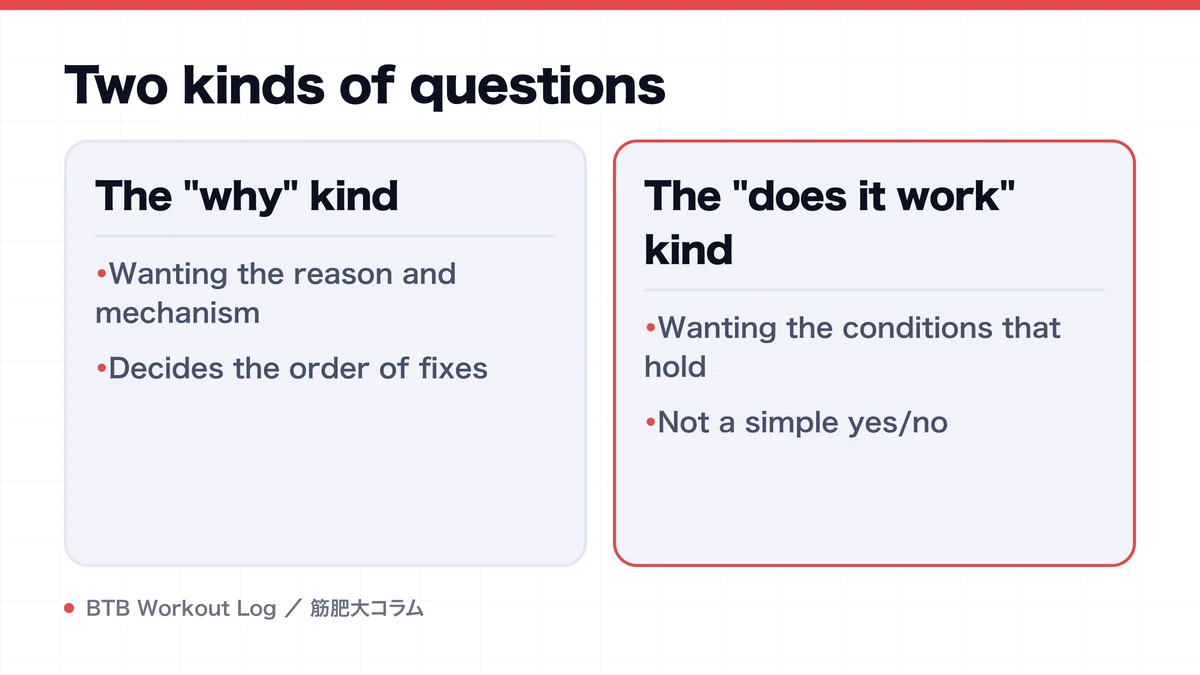
Hypertrophy questions broadly split into two kinds: questions wanting to know "why does this happen," and questions wanting to verify a hypothesis — "does this method actually work." The former deals with mechanisms; the latter deals with the conditions under which something holds.
Neither can be answered with a simple yes/no. Below is an index ordered by how commonly people get stuck on each.
"Why" around progress
The most common thing people ask about is putting in effort while the numbers don't move. The cause lies somewhere in stimulus, fatigue, recovery, or logging.
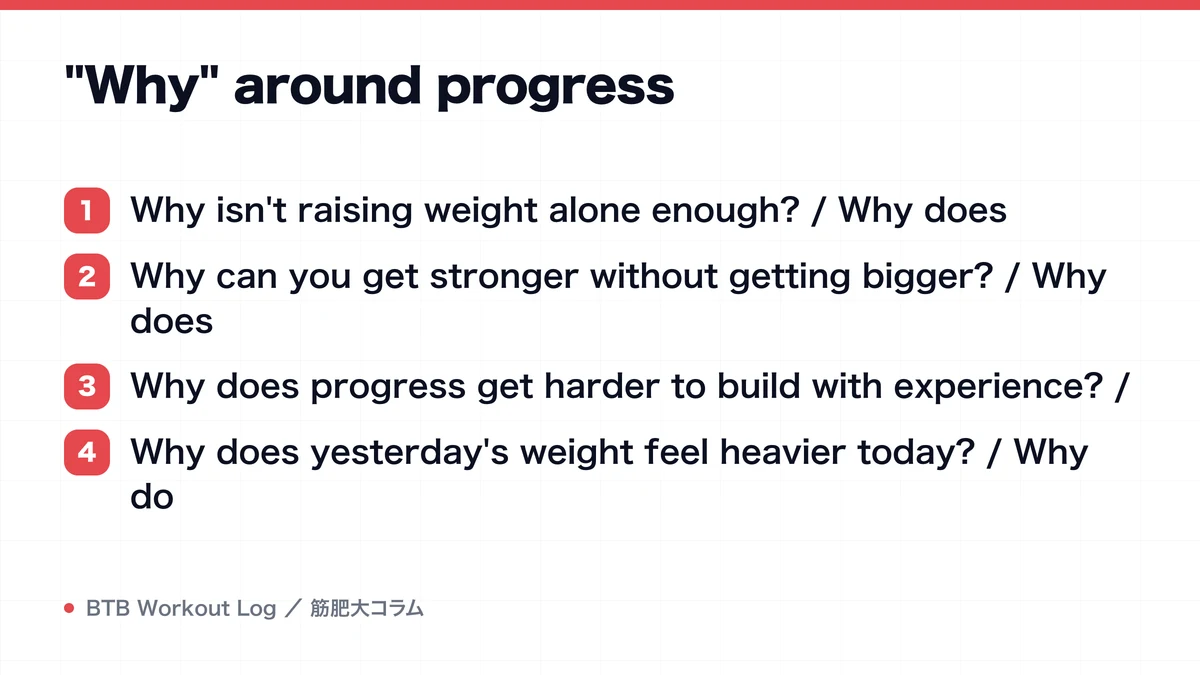
- Why isn't raising weight alone enough? / Why does progressive overload matter more than "feeling like you worked hard"?
- Why can you get stronger without getting bigger? / Why does "how many reps" matter just as much?
- Why does progress get harder to build with experience? / Why do months of accumulation beat one perfect session?
- Why does yesterday's weight feel heavier today? / Why do people who log notice a plateau sooner?
What this group has in common is a structure where the direction of effort, not the amount, is off. Feeling brutal every time despite not beating last time, strength rising while appearance doesn't change, the same weight feeling different day to day - in every case, the likely cause is using sensation as your progress metric. Checking first whether the numbers are actually moving clears up half these worries.
"Why" on stimulus, volume and frequency
Why the same written routine produces different results usually comes down to proximity to the limit and what's actually inside your volume.
- Why can you grow without going to failure every time? / Why does the same 10 reps produce different results?
- Why does too many sets backfire? / Why can the same 10 weekly sets differ in effect?
- Why doesn't more frequency always mean faster progress? / Why shouldn't rest be too short?
- Why can light weight still build muscle? / Why can hypertrophy occur without soreness?
Here, nearly every fork in the road comes down to how close you actually got to the limit. The same "10 reps" is insufficient stimulus if 4 reps of reserve remain, but becomes real stimulus even at light weight if only 1 rep of reserve remains. Before raising set count or frequency, checking where each set is actually being stopped makes the effect of any change easier to read.
Conversely, if you've raised proximity to the limit and still aren't progressing, first suspect that volume is excessive and recovery can't keep up. Stimulus and recovery are a trade-off, so adjusting from just one side sends you back and forth.
"Why" around exercise choice and form
Not feeling it in the target area, or not feeling it working at all, usually comes from a gap between the exercise's characteristics and your own subjective sense.
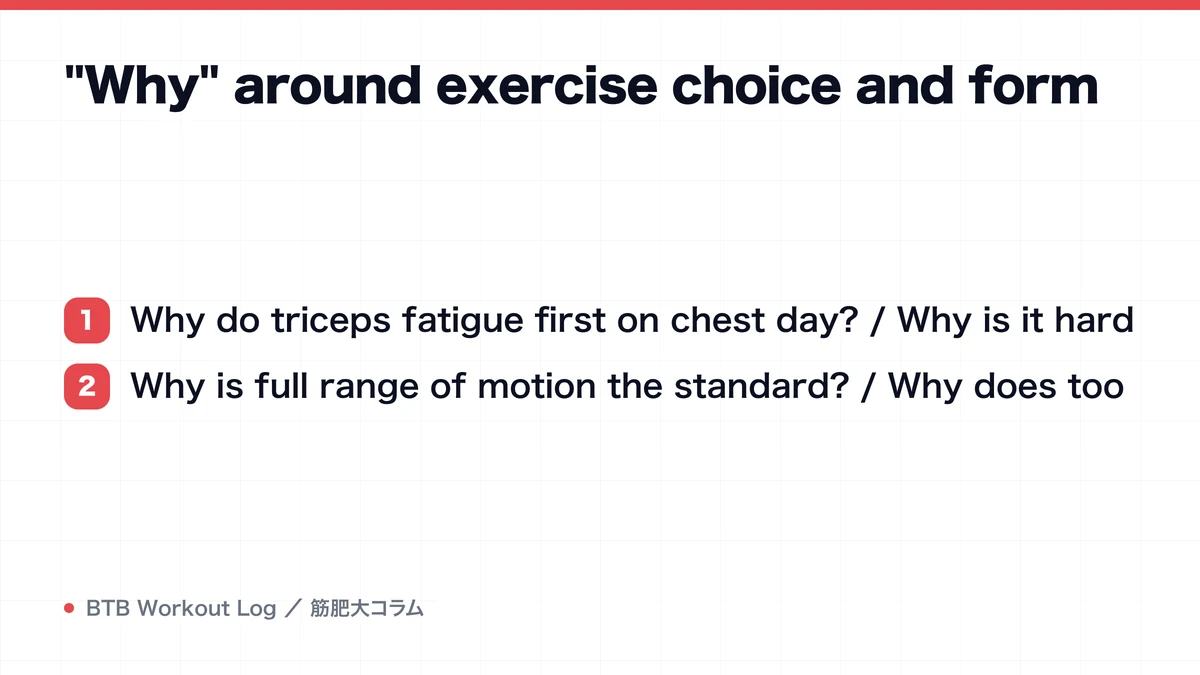
- Why do triceps fatigue first on chest day? / Why is it hard to feel your back working?
- Why is full range of motion the standard? / Why does too many exercises blur your progress?
Exercise-related worries resolve faster once volume and proximity to the limit are already handled. Even on an exercise where the sensation feels weak, stimulus is landing if load and reps are progressing. The less reliable the sensation for a given body part, the more checking via your log actually pays off.
Testing methods
From here, it's hypothesis testing. Most of these settle into the shape "it works if conditions are met, but the conditions are demanding."
| Hypothesis | Related |
|---|---|
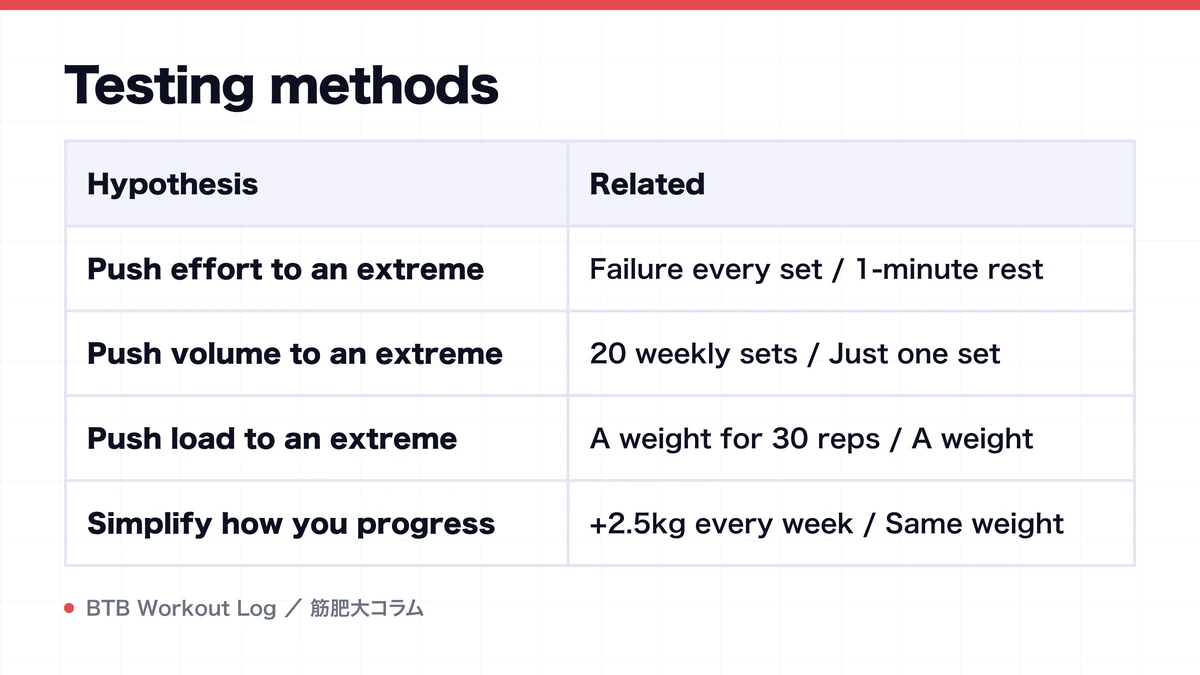
| Push effort to an extreme | Failure every set / 1-minute rest |
| Push volume to an extreme | 20 weekly sets / Just one set |
| Push load to an extreme | A weight for 30 reps / A weight for only 3 reps |
| Simplify how you progress | +2.5kg every week / Same weight for 6 months / One more rep than last time / A different exercise every session |
| Use sensation as your metric | No soreness / No pump |
The answer common to all these tests is "it works, but the conditions are demanding." Adding 2.5kg every week, for instance, genuinely runs during the first few months of the novice phase, but as the weight handled climbs, that same fixed increment becomes relatively larger, and it eventually breaks down. Extreme conditions fail not because the method is wrong — mostly it's because it kept being used past the range where it actually holds.
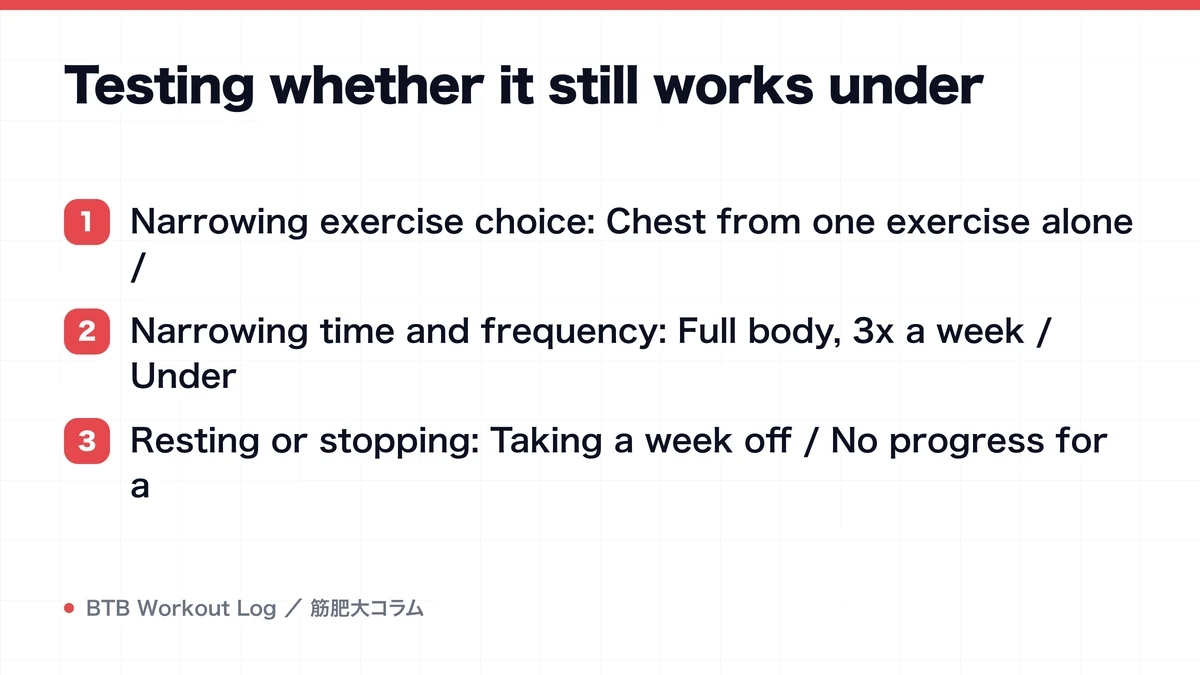
Testing whether it still works under real-world constraints
This is the question of how far things still work under constraints like time, exercise count, and rest days.
- Narrowing exercise choice: Chest from one exercise alone / Bench press alone / Squats alone / Pull-ups alone
- Narrowing time and frequency: Full body, 3x a week / Under 60 minutes
- Resting or stopping: Taking a week off / No progress for a month
Questions on the constrained side aren't about "giving up on the ideal." Even under 3x a week, 60 minutes, and a narrow exercise list, there's no particular reason growth should stall as long as weekly sets per body part and proximity to the limit are secured. What actually causes problems is a case where the constraint quietly lowers volume on just one specific body part without you noticing. The shorter your time, the more it pays to know exactly how many sets are landing on each body part.
Answering this type of question with generalities is pointless. Whether you're meeting the conditions can be judged from your own weekly set count and per-exercise trend (see the logging app).
FAQ
- There are too many questions — where should I start reading?
- If your numbers have stalled right now, start with the progress section; if you're rebuilding your routine, start with stimulus, volume and frequency. Exercise-related worries are easier to resolve once volume and proximity to the limit are already satisfied.
- Everything just says "it works if conditions are met" — I'm not getting a clear answer
- Many hypertrophy-research topics show small average differences, so stating something as absolute would actually be less honest. Practically, the fastest path is meeting the conditions, testing for a few weeks, and judging from your own record trend.
- How do I check whether something applies to my own case?
- Change only one thing at a time, and hold the same conditions for 2–3 weeks. Changing several things at once makes it impossible to identify which factor actually worked.
Key takeaways
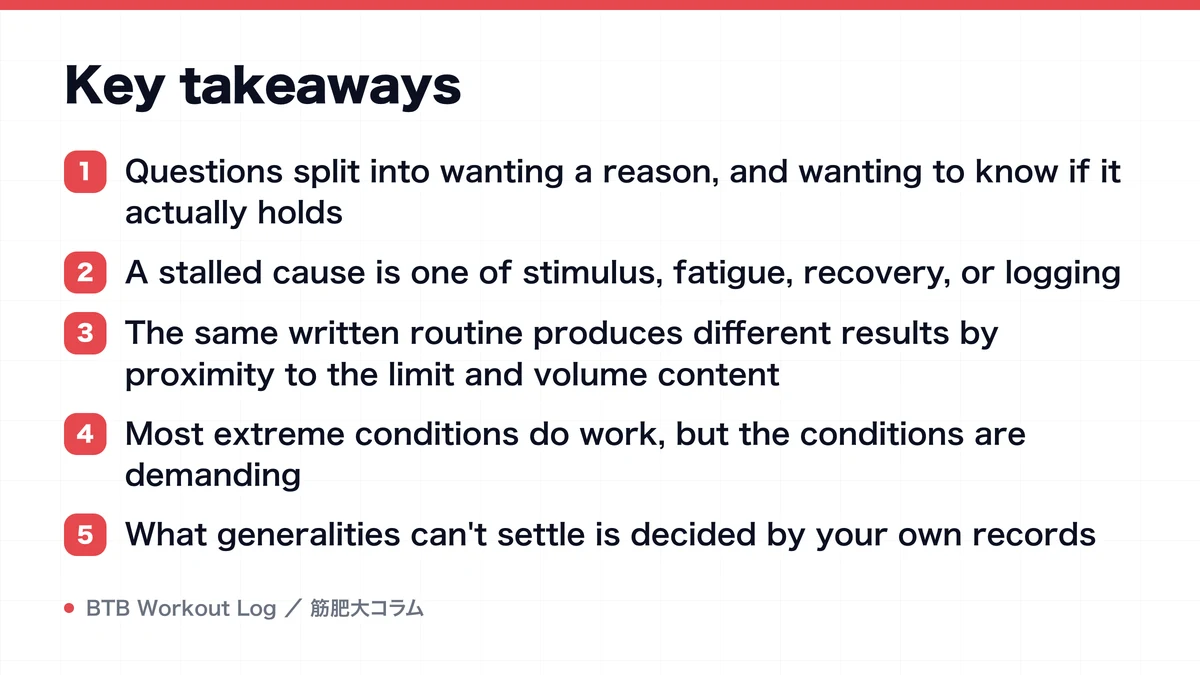
- Questions split into wanting a reason, and wanting to know if it actually holds
- A stalled cause is one of stimulus, fatigue, recovery, or logging
- The same written routine produces different results by proximity to the limit and volume content
- Most extreme conditions do work, but the conditions are demanding
- What generalities can't settle is decided by your own records
References
- Dose-response Relationship Between Weekly Resistance Training Volume and Muscle Mass
- The Resistance Training Dose Response: Meta-Regressions Exploring the Effects of Weekly Volume and Frequency on Muscle Hypertrophy and Strength Gains
- ACSM Position Stand: Progression Models in Resistance Training for Healthy Adults