
10 Sets a Week, Different Results: Why Set Quality Matters More Than Quantity
Ten weekly sets is a useful marker of volume, but it doesn't guarantee ten equal doses of stimulus. Change the target muscle's actual contribution, proximity to failure, movement quality or recovery between sets, and the same 10 sets deliver different stimulus and fatigue.
What separates good from bad isn't just "more or less than 10" — it's what you counted as a set, and whether that quality holds into next week.
Ten weekly sets isn't stimulus itself
Weekly set count is a convenient metric for comparing programmes and managing volume up or down. Research also shows an average dose-response trend — more weekly sets, more hypertrophy — which is exactly why weekly sets is a sensible starting point for designing a programme.
But a set count is just counting how many times you broke the work into pieces. It doesn't capture load used, reps, RIR, range of motion, which muscle actually took the work, or rest period. Two people both doing 10 weekly chest sets — one holding target range of motion and reaching near failure, the other leaving plenty in reserve with a shortened range — aren't receiving the same stimulus, even though the count matches.
The common assumption is that every hard set counts as one equal "vote". In reality a set isn't a coin — it's a trial run under conditions that vary. A total of 10 weekly sets describes the outer frame of a programme; it doesn't describe how dense the contents were. Volume load (load × reps × sets) is useful too, but it shares the same limitation — it can't fully represent stimulus to the target on its own.
Direct versus indirect sets change what "10" means
The first thing to fix is what counts as a set for a given muscle group. Curls are a direct set for biceps — the prime mover; biceps also assists during rows. Add five curl sets to five row sets and call it "10 arm sets", and that isn't the same biceps contribution as 10 curl sets, even though both total 10.
A 2026 meta-regression explored classifying sets as direct when the measured muscle was the prime mover and indirect when it played an assisting role, rather than counting every indirect set at full weight equal to a direct one. That isn't a fixed prescription — "indirect always counts as 0.5" — it's a research finding suggesting that distinguishing contribution by exercise captures training volume better than treating everything as one equal set.
In practice, tracking direct and indirect sets in separate columns is enough. Add a chest press's one set simultaneously to chest, triceps and front delt totals and you'll overstate the load on the assisting muscles. Credit the prime mover one set and log the contribution to assisting muscles separately as "indirect" — that lets you tell apparent 10 weekly sets from 10 weekly sets where the target genuinely did the work.
RIR and movement conditions decide what one set delivers
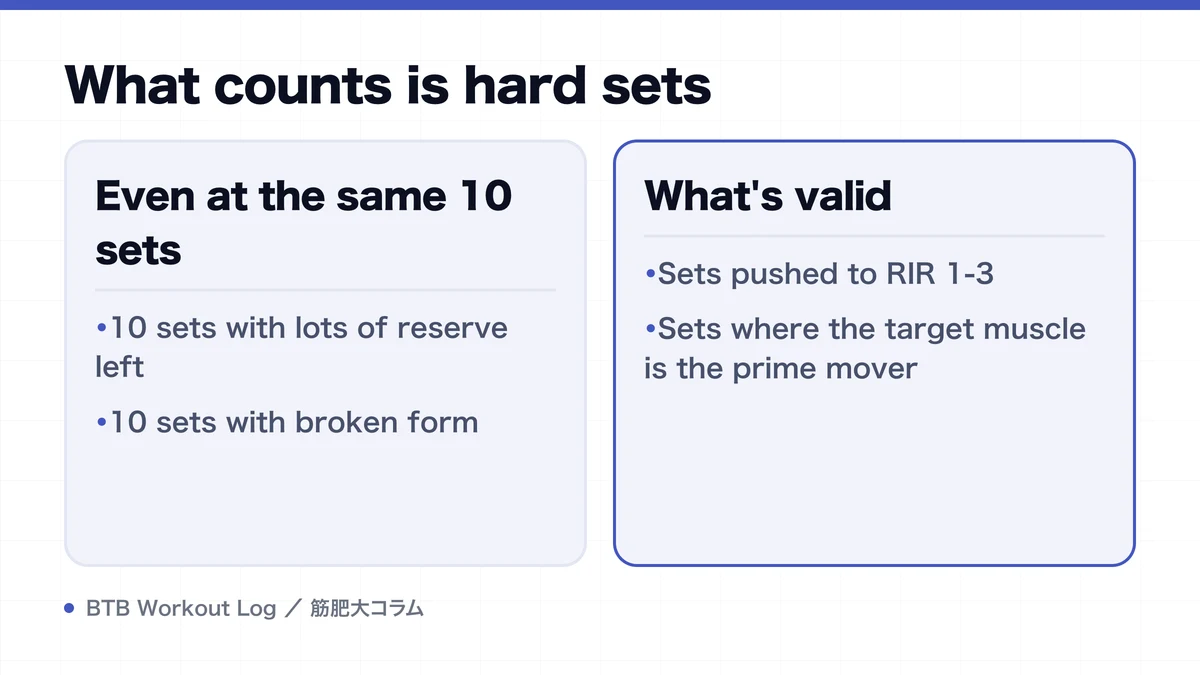
Next comes RIR (Repetitions in Reserve) — how many more reps you had left. Run the same exercise for the same reps and a set stopped at RIR 5 differs in proximity to failure from one stopped at RIR 1. Count 10 sets that all left a lot in reserve, and that isn't necessarily equivalent stimulus to 10 sets built mostly within a few reps of failure. See the RIR guide for how to use it.
Taking every set to RIR 0 — genuine failure — doesn't automatically raise quality either. A systematic review comparing training to failure with stopping short found that training to momentary muscular failure wasn't consistently superior for hypertrophy. Failure isn't a switch that converts a set into an "effective set" — it's an option that can raise both stimulus and fatigue.
Even matched RIR on paper can hide a broken comparison if range of motion shortens, momentum increases, or load shifts off the target onto another muscle. RIR is only useful once form and range of motion are held constant. The fact that reps alone don't settle what a set delivered connects to why the same 10 reps differ too.
How you place the 10 sets changes late-session output
The same 10 sets can differ depending on whether you concentrate them in one day or split them into five and five across two sessions a week. Concentrated in one day, local fatigue and breathlessness build through the back half, making load, reps and range of motion harder to hold. Split across sessions, each one tends to start at high output, at the cost of extra warm-ups and travel time. Frequency itself isn't a magic accelerant for hypertrophy — it's a distribution variable that determines whether planned sets get executed in good condition. See training frequency for the fuller picture.
Rest between sets is part of that distribution too. An eight-week study with 21 trained young men running seven full-body exercises three times a week compared one-minute and three-minute rest, and the three-minute group came out ahead on bench press and back squat 1RM and quad thickness. One study can't fix three minutes as universal for every exercise, but it's a concrete example of how short rest, by dropping reps on later sets, changes the quality of work you actually complete even at matched set counts. Set rest per interval guidance — long enough to recover the load, reps and movement you're targeting on the next set.
To judge how to split, compare set 1 against your final set. If reps crash only late, if you need to cut load heavily just to hold form, or if breathing or grip limits out before the target does, the benefit of cramming 10 sets together has shrunk. Extending rest, or moving some sets to another day, tends to reproduce the same 10 weekly sets more reliably than simply adding more.
Audit your own 10 weekly sets on five points
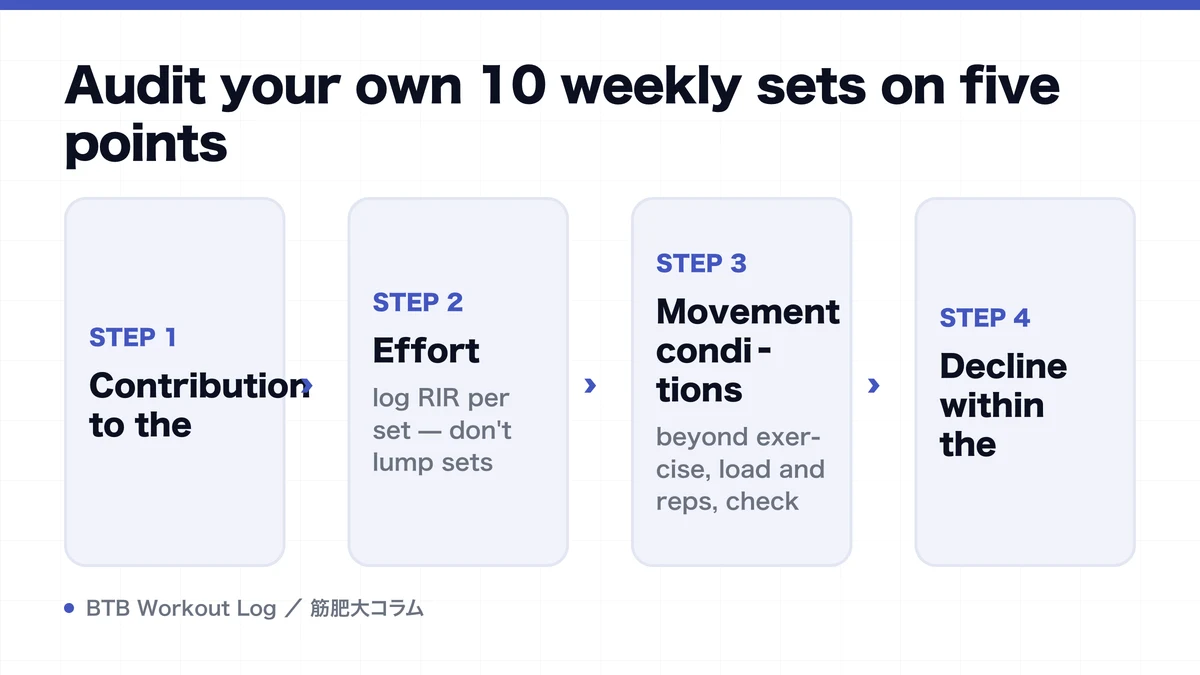
You can't directly measure hypertrophy in the moment. So check set execution and subsequent progress separately. If 10 weekly sets is your benchmark, match these five across several weeks.
- Contribution to the target: distinguish direct from indirect sets and fix what you're counting toward the 10.
- Effort: log RIR per set — don't lump sets with a lot in reserve together with sets near failure.
- Movement conditions: beyond exercise, load and reps, check range of motion and form haven't broken down.
- Decline within the session: check how far late-session load, reps and RIR drift from plan.
- Reproducibility next time: watch whether load or reps are climbing under matched conditions, or whether output keeps declining instead.
If load or reps are climbing at matched RIR and movement, there's a reason to keep the 10 as is. If the front half is fine but only the back half breaks down, adjust rest or frequency without changing the total. If every set leaves a lot in reserve, revisit load or rep targets first. If output keeps falling or recovery keeps lagging, consider cutting rather than adding — judge that separately from the problem of too many sets.
The point of logging isn't filling in a set count — it's judging whether the same-conditions stimulus is progressing and reproducible next week. What separates good from bad isn't the total of 10 — it's whether you can look back and say what those 10 sets actually were. BTB Workout Log keeps load and reps down to the set level.
FAQ
- If I'm doing 10 weekly sets, should every one push close to failure?
- Not necessarily. RIR 1–3 is a practical starting point, but taking every set to failure hasn't been shown to be consistently superior. Weigh exercise safety and fatigue carried into later sets, and match effort within a range where form holds.
- On a compound lift, does an assisting muscle also get counted as one set?
- Logging a direct set for the prime mover and a separate indirect set for the assisting muscle is the more manageable approach. Don't fix indirect stimulus permanently at zero or one full set — adjust it against the direct volume and recovery for that muscle group.
- If load and reps aren't rising at 10 weekly sets, should I add more?
- Not immediately. Check RIR, range of motion, rest, late-session decline and recovery state first. Only consider a small addition once set quality is holding, several weeks have passed with no progress, and recovery still has room.
Key takeaways
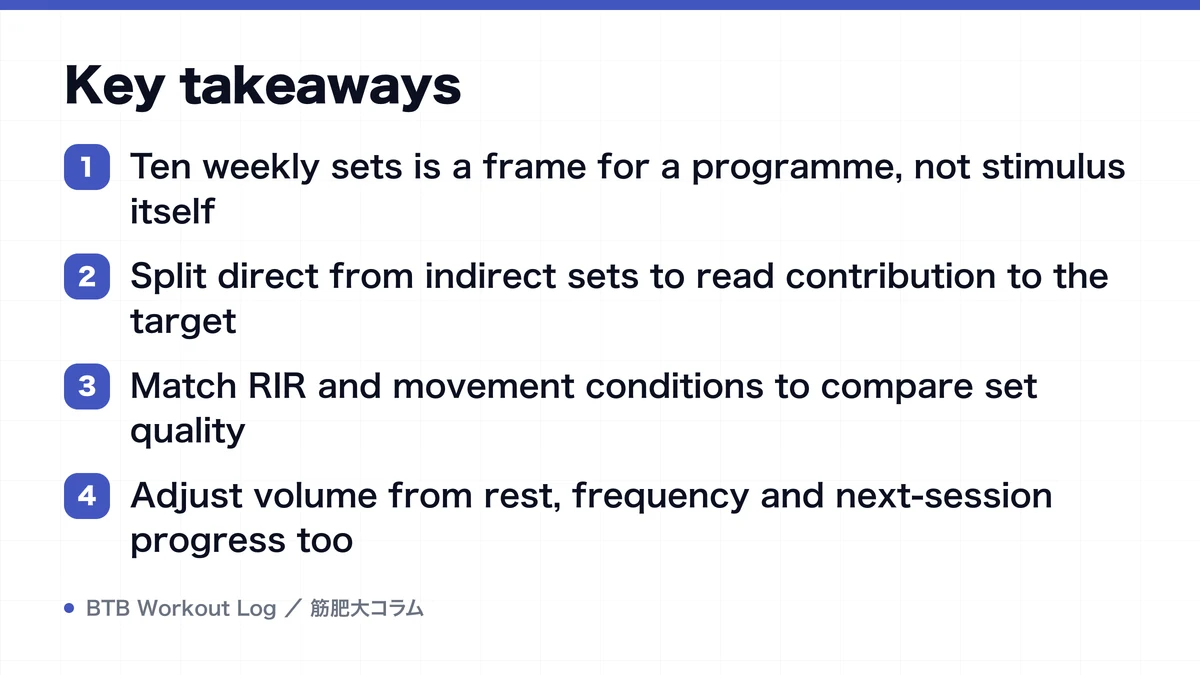
- Ten weekly sets is a frame for a programme, not stimulus itself
- Split direct from indirect sets to read contribution to the target
- Match RIR and movement conditions to compare set quality
- Adjust volume from rest, frequency and next-session progress too
References
- The Resistance Training Dose Response: Meta-Regressions Exploring the Effects of Weekly Volume and Frequency on Muscle Hypertrophy and Strength Gains
- Proximity-to-Failure and Muscle Hypertrophy: Systematic Review with Meta-analysis
- Longer Interset Rest Periods Enhance Strength and Hypertrophy in Trained Men