Should You Switch Programs After 1 Month Without Progress? | Check This Before You Jump Ship
Even if weight hasn't moved in a month, there's no need to rush and change the whole program. First check, across roughly 4–8 matched-condition trials, whether progress beyond weight has stalled too, and only change one item that matches the cause.
What to test isn't "has 30 days passed" — it's how many times you tried the same exercise, under how matched conditions, and which of weight, reps, RIR or movement changed in that window. A month is a cue to reassess, not an expiration date for a program.
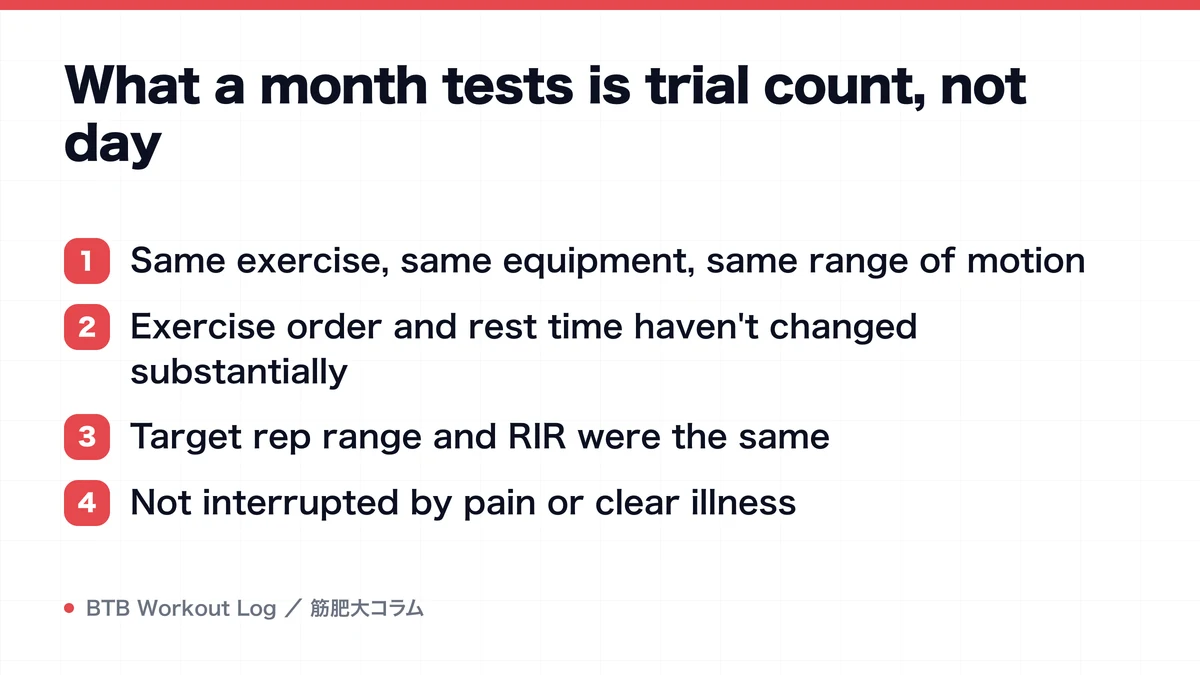
What a month tests is trial count, not day count
The same month gives you roughly 4 comparable data points for a once-a-week bench press, or roughly 8 for twice a week. Add travel, poor sleep, or equipment swaps from a crowded gym, and valid comparisons shrink further. Seeing no upward trend from just 4 once-a-week data points isn't the same "1-month stall" as 8 matched-condition twice-a-week points staying flat.
Past the intermediate level, some exercises don't progress fast enough to add a plate every week. On exercises using a small muscle group, or where the gym's smallest plate is large, the jump to the next weight can itself be too large relative to current capability. So using the calendar alone as your change criterion makes it easy to mistake normal slow progress for a stall.
First, count "comparable trials"
- Same exercise, same equipment, same range of motion
- Exercise order and rest time haven't changed substantially
- Target rep range and RIR were the same
- Not interrupted by pain or clear illness
Don't erase days that fall outside these conditions as failures — log them as a separate condition instead. If comparable trials are few, fixing your measurement conditions should come before changing the program.
Rule out cases where you're still progressing even at the same weight
Weight used is an easy metric, but it doesn't represent hypertrophy-training progress on its own. If 80kg hasn't changed in a month, but reps rose from 8 to 10 while form and range of motion held, and RIR (how many more reps were possible at the end of the set) stayed at 2, capability has risen. This is a state where progressive overload advanced through reps, not weight.
| Record change | Interpretation | Immediate response |
|---|---|---|
| Reps rose at the same weight | Clear progress | Continue to the rep ceiling |
| RIR rose at the same weight/reps | You have more reserve than before | Try raising reps next time |
| Form or range of motion improved | Work quality rose | Fix conditions and reassess |
| Weight, reps, RIR and movement all unchanged | Stall candidate | Diagnose fatigue and stimulus volume |
| Reps declining across several exercises too | Suspect fatigue or insufficient recovery | Check recovery before adding load |
RIR isn't a perfect measurement, and it carries reporting habits too. Even so, logging it against the same standard every time lets you track a change in reserve that reps alone can't show. See how to use RIR for occasionally calibrating your sense of it on a safe exercise.
Does research support a total overhaul after 1 month?
In resistance-training progression models, external weight isn't the only thing you can raise. You adjust reps, set count, frequency and more, to build a stimulus matched to your current stage of adaptation. In other words, weight stalling for a month is material for adjustment, but not, on its own, a reason to overhaul exercise selection and split down to the last detail.
Periodization research shows deliberately varying load over time can favor strength gains, but for hypertrophy, at matched total training volume, the advantage isn't consistently large. Shifting toward low reps and heavy weight to push a lift record forward changes motor familiarity and how strength shows up — but that isn't the same as saying hypertrophy had completely stopped on the original program.
On volume too, there's a tendency for higher weekly set count to favor average hypertrophy response, but "always add sets once stalled" isn't the answer. If you're already past your recoverable volume, adding more just lowers output further. Weekly set count needs to be judged by summing every exercise on the same muscle group and including recovery status and set quality.
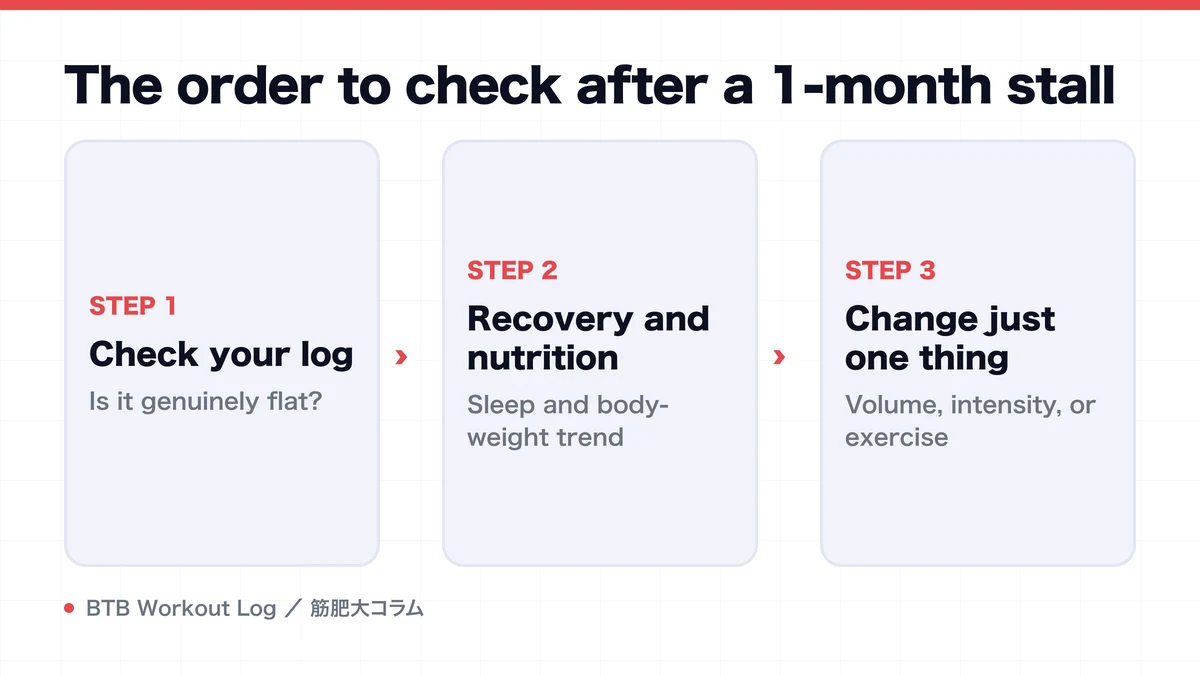
Split what to change by what actually stalled
How widely the stall spreads matters for the change decision. Whether just one exercise stalled, several exercises on the same muscle group stalled together, or main lifts across your whole body dropped, points to different suspected causes.
Only one exercise is flat
Suspect increment size, technique, range of motion, and exercise order first. Small changes are often enough — build reps to your rep ceiling before adding the smallest weight increment, use micro-plates, or fix exercise order. Consider switching exercises when there's pain, difficulty loading the target muscle group, or a structural inability to progress in small steps.
Several exercises on the same muscle group are flat
Check weekly set count, frequency, and overlap between exercises. If every set is already going close to the limit, reducing fatigue takes priority over adding volume. Conversely, if RIR is large and hard sets on the target muscle group are few, either match effort level on existing sets, or add a small amount while watching recovery.
Main lifts across the whole body have declined
Prioritize checking sleep, energy intake, body-weight change, life stress, and accumulated fatigue over insufficient program stimulus. If several exercises dropped together over the last 2–3 sessions and even the warm-up feels heavy, a deload is an easier hypothesis to test than adding sets or swapping exercises. If records return after recovery, the cause was more likely fatigue than the program's structure.
Conditions for changing your program, and the order to change it in
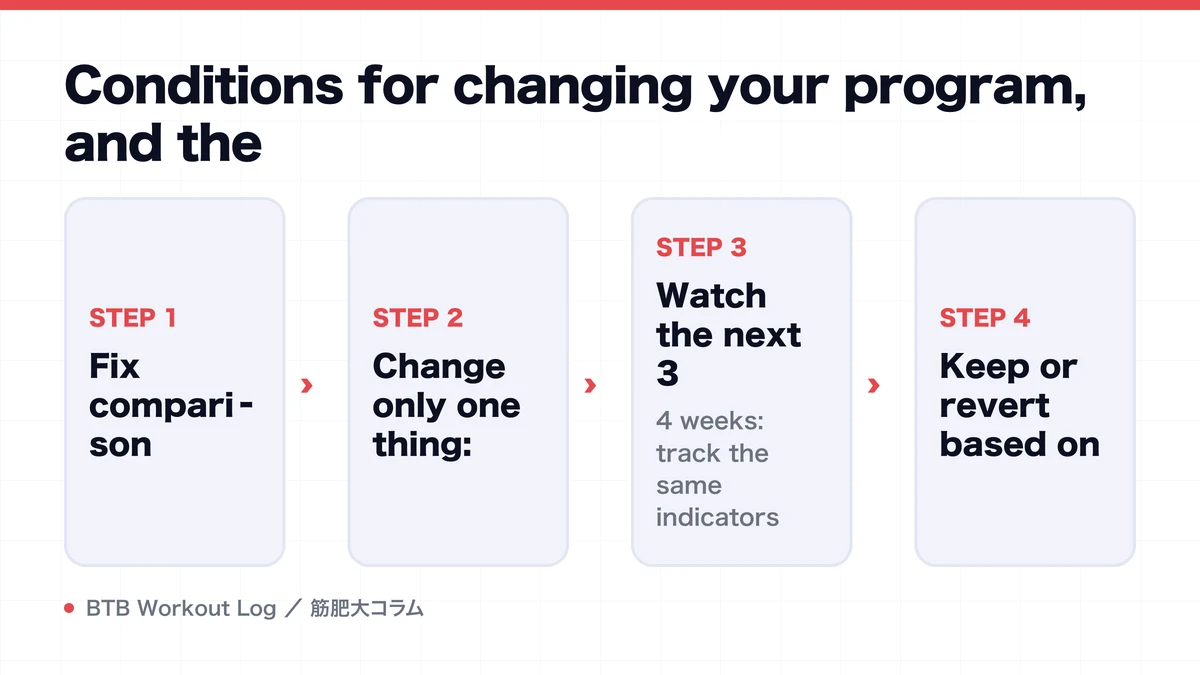
It's easier to consider a change when, across roughly 4-8 comparable trials, none of weight, reps, RIR, form or range of motion trend up, and no major disruption - sleep, nutrition, body weight, pain - explains it. That said, 4 trials on an exercise done just once a week carry limited information, so factor in the trend on other exercises or the muscle group as a whole. Conversely, if several indicators are worsening, prioritize addressing fatigue or pain rather than waiting for 4-8 trials.
- Fix comparison conditions: match exercise, order, rest, rep range and target RIR.
- Change only one thing: pick the single most suspect item among rep range, weight increment, set count, frequency, or exercise.
- Watch the next 3-4 weeks: track the same indicators under the new condition and compare against the pre-change trend.
- Keep or revert based on response: continue if output trends up and pain or excess fatigue don't increase.
Change every item at once and even if you improve, you won't know what actually worked. See sorting out a weight plateau for detailed cause candidates - here, the priority is testing one hypothesis with one change.
A trend is more useful for this judgment than a single personal best. Use it to find the range where things stalled, and to compare before and after a change under matched conditions. Whether you have genuinely been stalled for a month is easier to judge when you have records. BTB Workout Log lets you look back over that full month as is.
FAQ
- Is it a stall if weight hasn't risen at all in a month?
- It's a stall candidate, but day count alone doesn't decide it. If reps rose at the same weight, RIR gained room at the same reps, or range of motion or form improved, you're progressing. Check comparable trial count and multiple indicators.
- If I do change my program, what should I change first?
- Only the single item closest to the actual cause. If the weight increment is too large, try reps or micro-plates; if stimulus is low, add a small amount of volume; if output has dropped across your whole body, a deload is a candidate. Changing exercise, split and volume all at once makes the effect impossible to judge.
- Can hypertrophy still be happening even if weight used doesn't rise for a month?
- Yes. If reps, form or range of motion are progressing, training stimulus is still changing even at the same external weight. Hypertrophy and a specific exercise's weight record also don't always align perfectly. Consider a fix if progress beyond weight also stays unchanged for a long time.
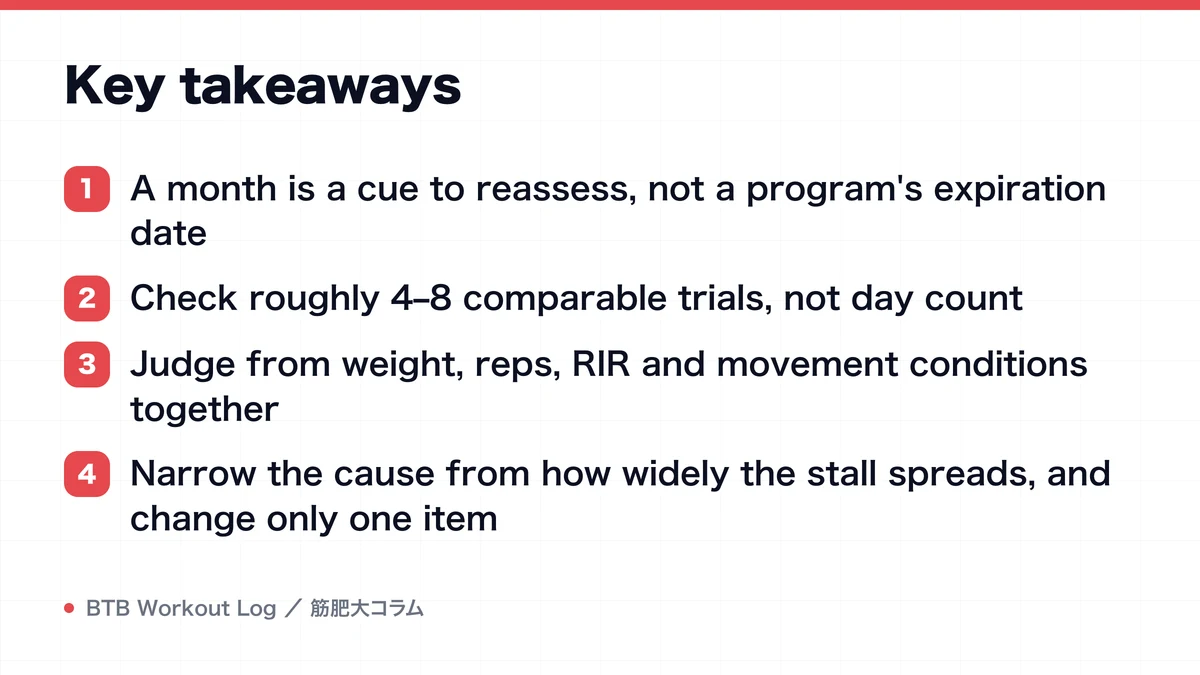
Key takeaways
- A month is a cue to reassess, not a program's expiration date
- Check roughly 4–8 comparable trials, not day count
- Judge from weight, reps, RIR and movement conditions together
- Narrow the cause from how widely the stall spreads, and change only one item
References
- ACSM Position Stand: Progression Models in Resistance Training for Healthy Adults
- Periodization, Strength and Muscle Hypertrophy: Systematic Review and Meta-analysis
- Linear vs Daily Undulating Periodized Training and Hypertrophy: Meta-analysis
- Dose-response Relationship Between Weekly Resistance Training Volume and Muscle Mass
- Resistance Training Volume Enhances Muscle Hypertrophy in Trained Men