Is Bench Press Alone Enough to Grow Your Chest? | Testing the Limits of a "Bench-Only" Approach
Bench press alone can still develop the pecs. But calling it "sufficient" requires that the chest is the set's limiting factor, you can sustain your needed stimulus volume and progress against last time, and there's no bias in the area you want developed.
What to test isn't exercise count — it's whether flat bench alone can simultaneously satisfy "valid stimulus to the pecs," "a recoverable volume," and "development in your intended shape."
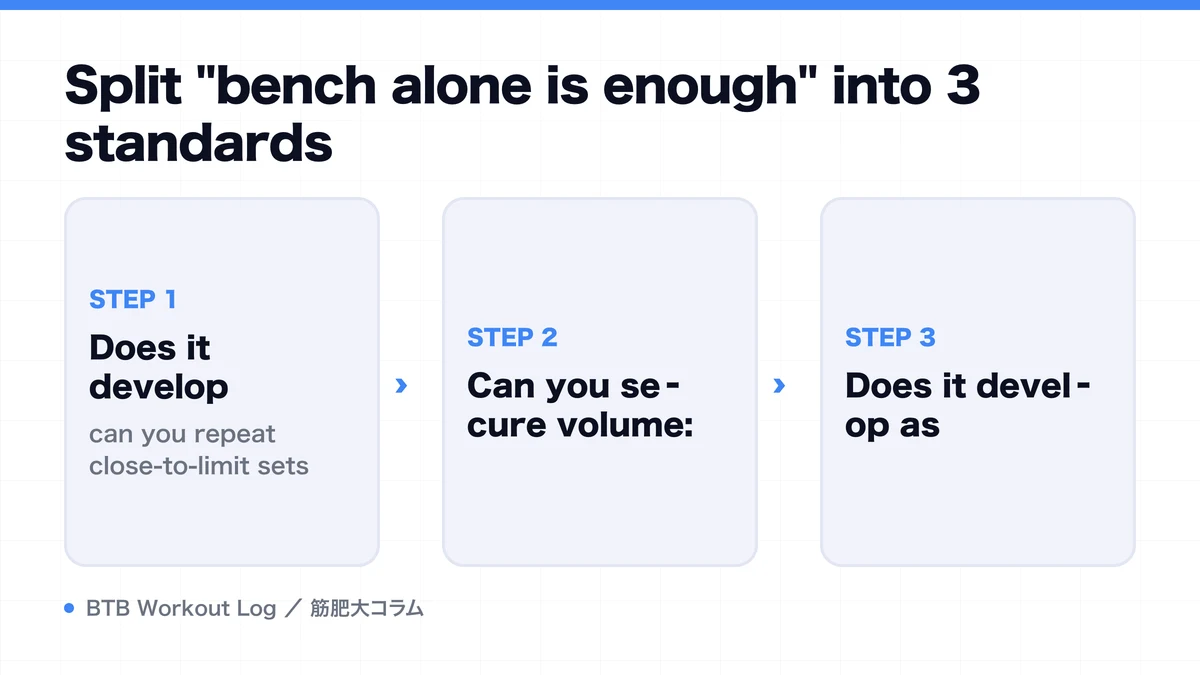
Split "bench alone is enough" into 3 standards
Weight rising on bench press and the pecs developing as intended aren't the same thing. Lifted weight rises not just from the pecs but from triceps, front delts, form mastery, and improved bridging or leg drive. So split "sufficient" into these three stages.
- Does it develop: can you repeat close-to-limit sets with form that keeps tension on the chest?
- Can you secure volume: can you hold chest stimulus through the back half of a set and bank a weekly volume you recover from by next time?
- Does it develop as intended: is there no issue with appearance, including upper chest, or left-right asymmetry?
Many people can meet the first standard from bench alone. But once you include "even development across the whole pecs" and "many sets with low joint stress," one exercise alone becomes inconvenient for more people. There's no inherent value in adding exercises — the value is in filling a role a single exercise can't cover alone.
Your pass line also shifts with goal. Someone prioritizing bench competition performance alongside chest growth benefits from concentrating skill on one exercise. Conversely, someone prioritizing overall contour including upper chest, or fixing left-right asymmetry, may need a different angle or path even with steady lift progress. Evaluating "did the chest grow from bench" separately from "did it get closer to my ideal chest" keeps the exercise-count debate from getting muddled.
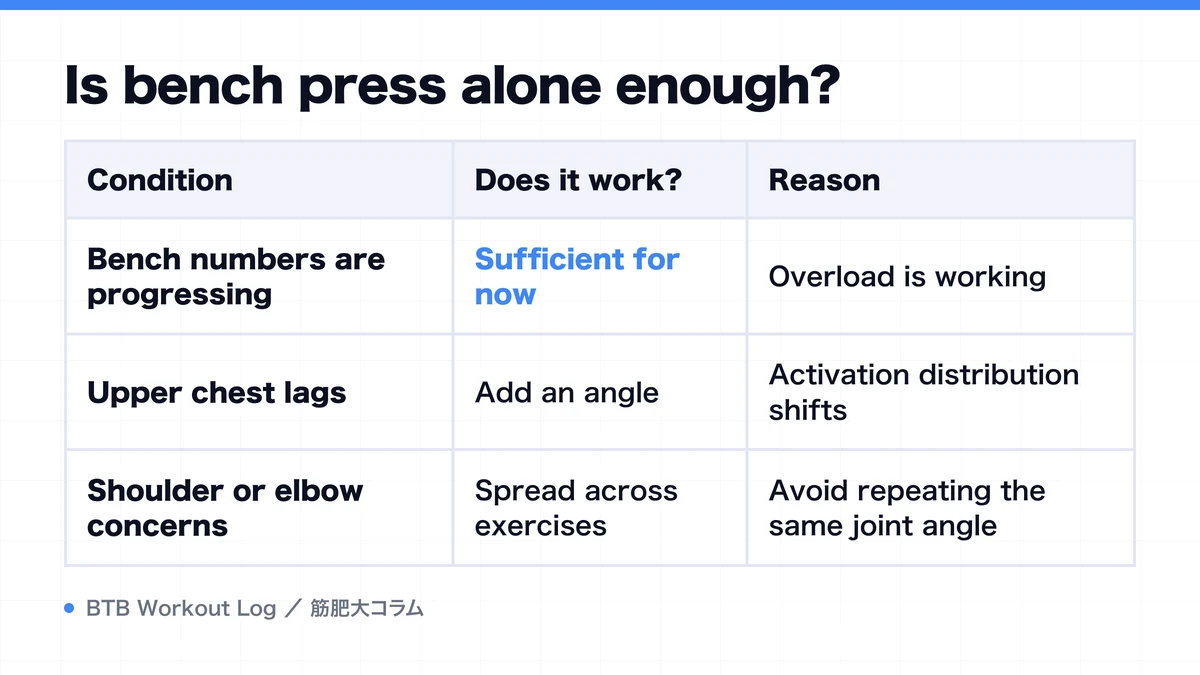
Flat bench is strong stimulus, but regional differences remain
Bench press moves the shoulder and elbow joints together, placing high tension on the pecs while making it easy to add load in fine increments. Since you can repeat stable form and easily track weight/rep progress, it's reasonable as a main lift supporting chest hypertrophy.
But the pecs don't work uniformly across their whole area like a flat plate. A study comparing flat and incline bench press reported that activation distribution within the pecs shifts with angle. This doesn't mean flat bench doesn't work the chest — it's material showing one angle doesn't necessarily deliver the same proportion of stimulus everywhere.
You can't directly translate a muscle-activity measurement into long-term hypertrophy amount, though. Acute activity is a clue for exercise selection — it isn't grounds to declare "adding incline always grows the upper chest more." In reality, some people develop their desired chest shape from flat bench alone, while others notice lagging upper-chest development. The average difference research shows and your own progress need to be treated separately. Angle-based roles are also covered in a chest hypertrophy routine.
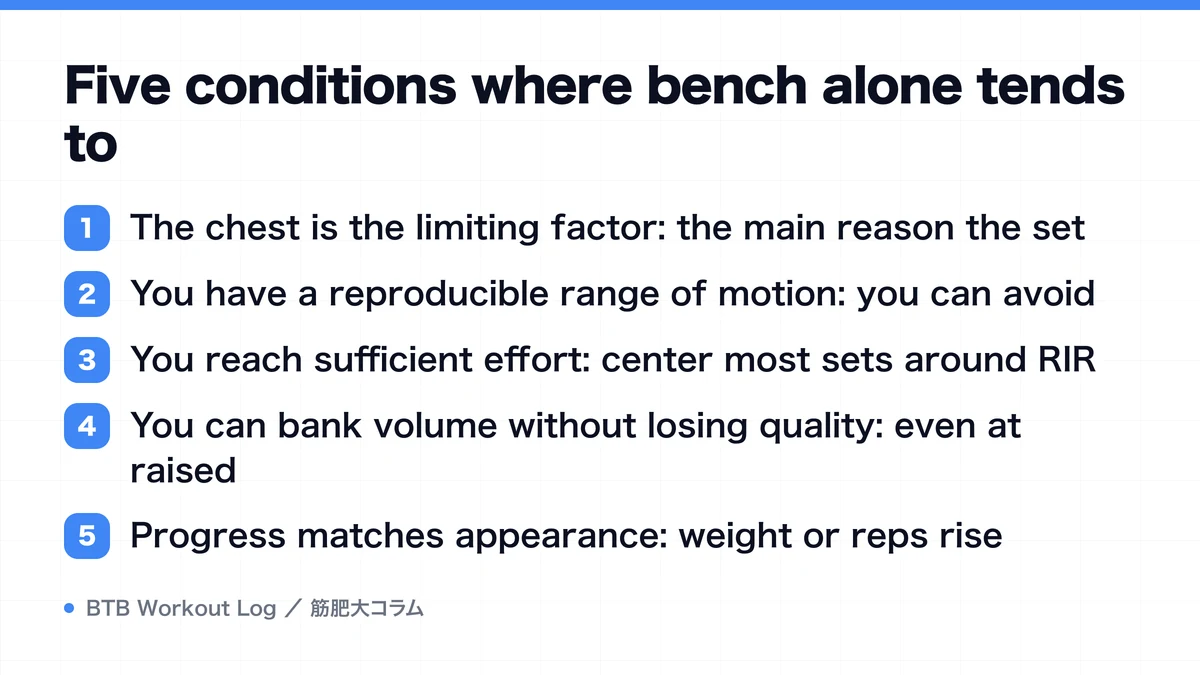
Five conditions where bench alone tends to work
To confirm "bench alone" works, check whether these conditions are met.
- The chest is the limiting factor: the main reason the set ends is declining pec output, not triceps or shoulders.
- You have a reproducible range of motion: you can avoid shoulder pain and lower to roughly the same position every time, holding tension on the chest.
- You reach sufficient effort: center most sets around RIR 1–3 (how many more reps were possible) rather than finishing only with too-light reps. See RIR guidelines for detail.
- You can bank volume without losing quality: even at raised weekly set count, form, reps and chest stimulus don't badly break down, and you recover by next time.
- Progress matches appearance: weight or reps rise medium-term at the same form, and matched-condition measurements or photos show the intended change too.
Weekly set count varies by individual, with no fixed correct answer. Start from whatever volume you're currently recovering from, and only raise it a little once chest growth and set quality stall. Volume thinking connects to weekly set count, and load progression to progressive overload. As long as bench alone meets these conditions, there's no need to add "just in case" accessory work.
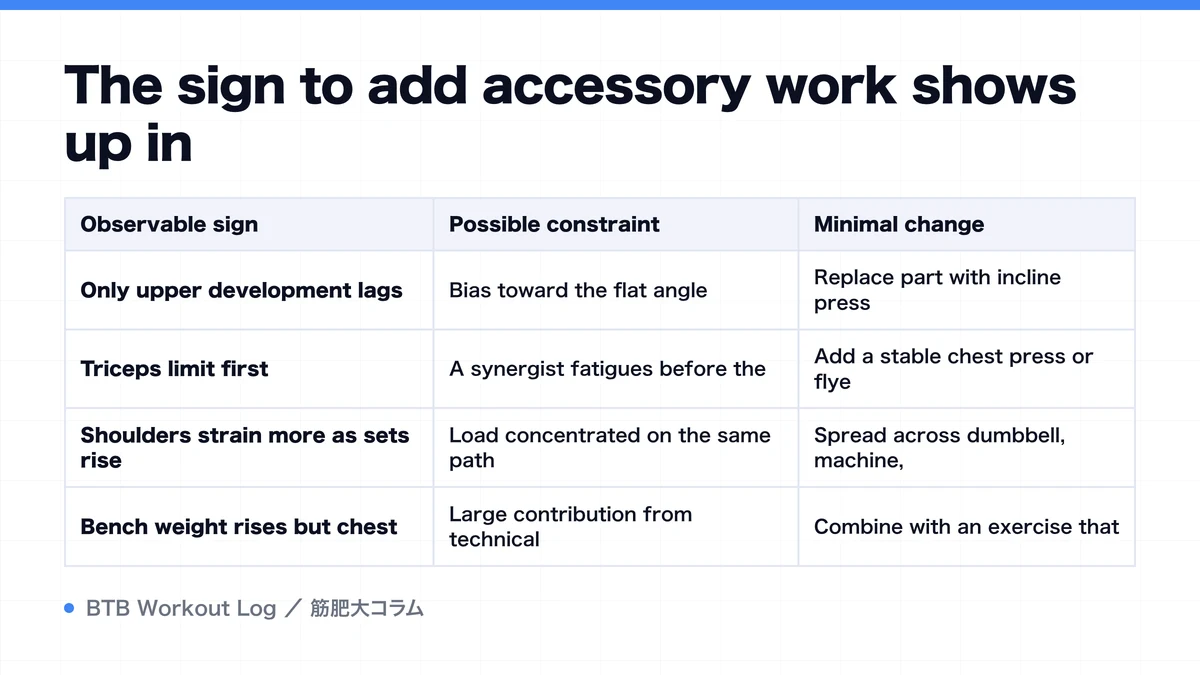
The sign to add accessory work shows up in results, not exercise count
Slow chest growth makes it tempting to immediately add exercises. But first check whether bench's form, effort level, total volume, or recovery has broken down. If the following signs persist even after fixing those, there's a reason to add a different exercise.
| Observable sign | Possible constraint | Minimal change |
|---|---|---|
| Only upper development lags | Bias toward the flat angle | Replace part with incline press |
| Triceps limit first | A synergist fatigues before the chest | Add a stable chest press or flye |
| Shoulders strain more as sets rise | Load concentrated on the same path | Spread across dumbbell, machine, cable |
| Bench weight rises but chest change is thin | Large contribution from technical adaptation | Combine with an exercise that makes the chest the limiter |
When adding, don't unconditionally stack sets on top of bench — first replace part of your existing sets. This avoids spiking total fatigue and lets you judge which change actually worked. If bench itself has stalled, that may be a separate problem from insufficient chest exercise variety — see isolating a bench press plateau.
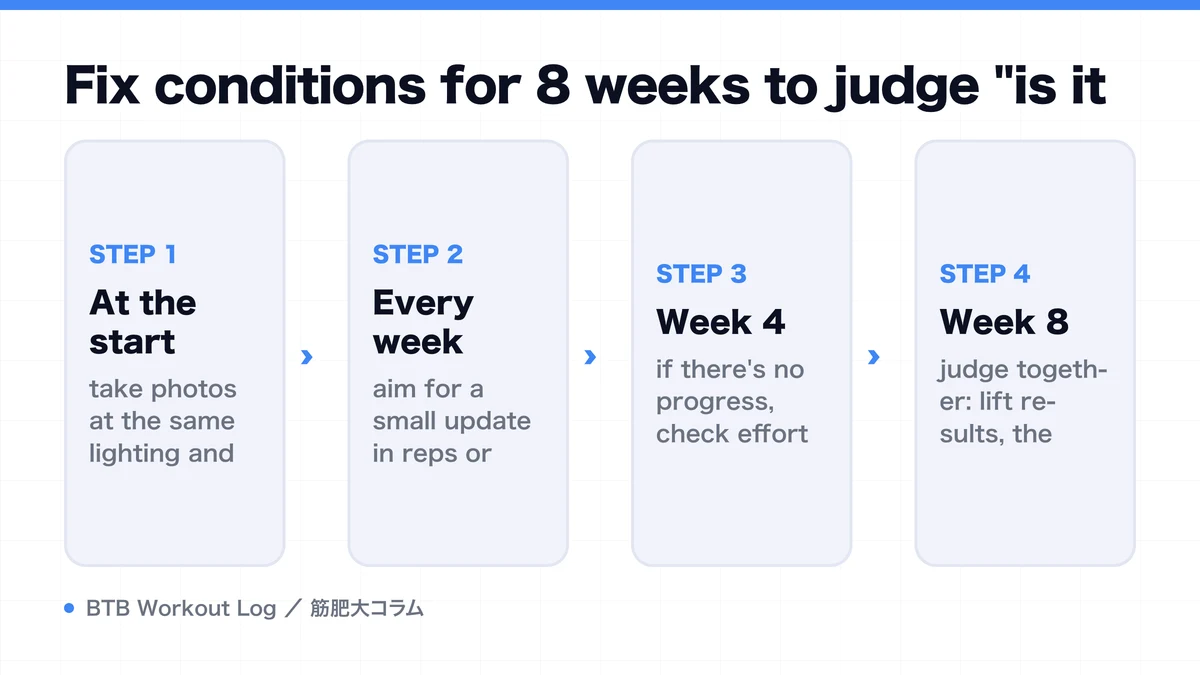
Fix conditions for 8 weeks to judge "is it enough for me"
A single pump or bout of soreness can't judge an exercise's sufficiency. First, for 8 weeks, don't substantially change bench's grip width, range of motion or tempo, and keep chest training frequency and weekly set count stable. Alongside each set's weight, reps and RIR, briefly note whether chest, triceps, or shoulders approached their limit first.
- At the start: take photos at the same lighting and posture, log chest measurement, and record bench's baseline weight, reps and RIR.
- Every week: aim for a small update in reps or weight while holding the same form. Log any pain or delayed recovery too.
- Week 4: if there's no progress, check effort level, rest, sleep and intake before adding an exercise.
- Week 8: judge together: lift results, the proportion of sessions where chest was the limiter, and visible regional differences.
If results are progressing, the chest is the main limiter, and you're moving toward your desired look, bench alone is sufficient. If only weight is rising while upper-chest lag persists, triceps or shoulders keep ending the set, or the same path causes pain, replace part of it with an exercise that fits your specific goal. Using numbers as your material lets you add only the role you're actually missing, rather than adding an exercise "because it's standard."
FAQ
- How many weekly sets do I need if it's bench press alone?
- There's no universal correct answer. Start from your current recoverable volume, and check whether weight/reps rise at the same form and the chest is the limiting factor. If progress stalls and sleep and nutrition aren't the issue, raise it a small amount at a time.
- Is incline bench mandatory for upper-chest development?
- Not mandatory. Angle shifts activation distribution within the pecs, but long-term development has individual variation. If you don't notice upper-chest lag from flat alone, continue; if lag persists, replace part of your volume with incline.
- If bench weight is rising, is the chest developing too?
- A strong progress indicator, but not conclusive alone. Weight can also rise from triceps, shoulders, or form mastery. Watch results at the same range of motion and form together with whether the chest approaches its limit first, plus matched-condition photos or measurements.
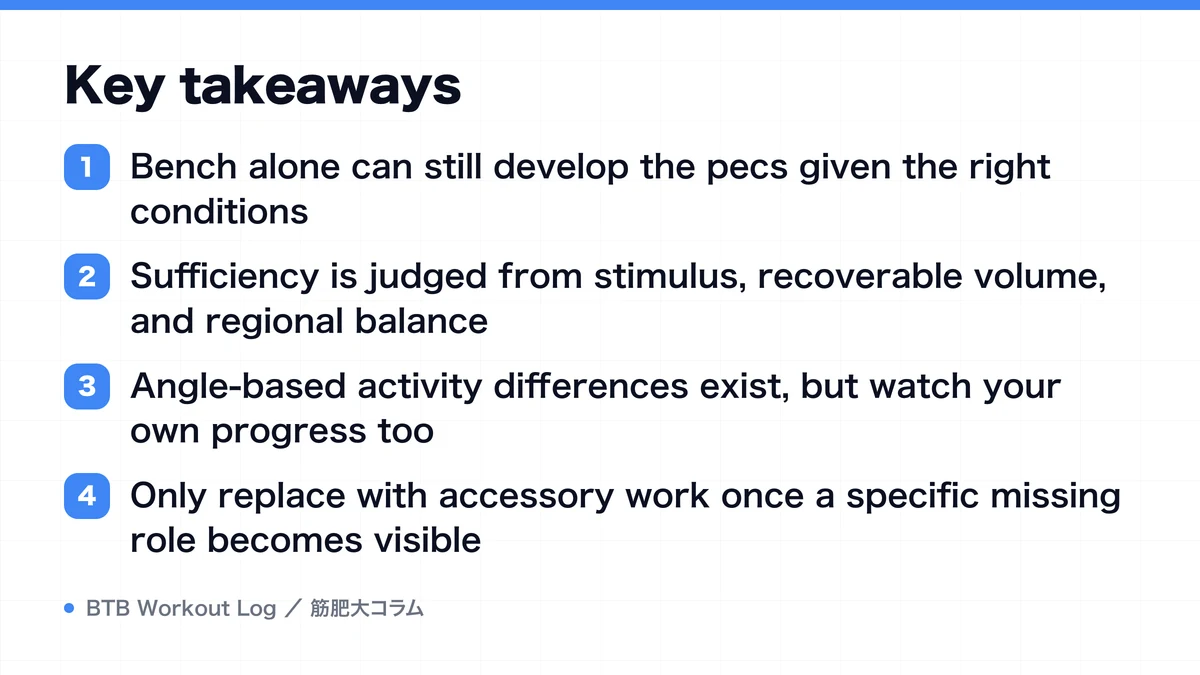
Key takeaways
- Bench alone can still develop the pecs given the right conditions
- Sufficiency is judged from stimulus, recoverable volume, and regional balance
- Angle-based activity differences exist, but watch your own progress too
- Only replace with accessory work once a specific missing role becomes visible
References
- Non-uniform Excitation of the Pectoralis Major During Flat and Inclined Bench Press
- The Effects of Bench Press Variations in Competitive Athletes on Muscle Activity and Performance
- Dose-response Relationship Between Weekly Resistance Training Volume and Muscle Mass
- ACSM Position Stand: Progression Models in Resistance Training for Healthy Adults