Progressive Overload for Hypertrophy | Why Feeling Worked Isn't Enough
"How hard it felt" is one day's experience. Progressive overload is the principle that confirms whether the demand on your body is actually advancing over time. For hypertrophy, repeating a state where you can nudge load or reps up under matched conditions matters more than maximising how brutal a session felt.
That doesn't mean coasting is fine. Building a sufficiently effortful set and advancing that stimulus within what you can recover from are two things to manage separately.
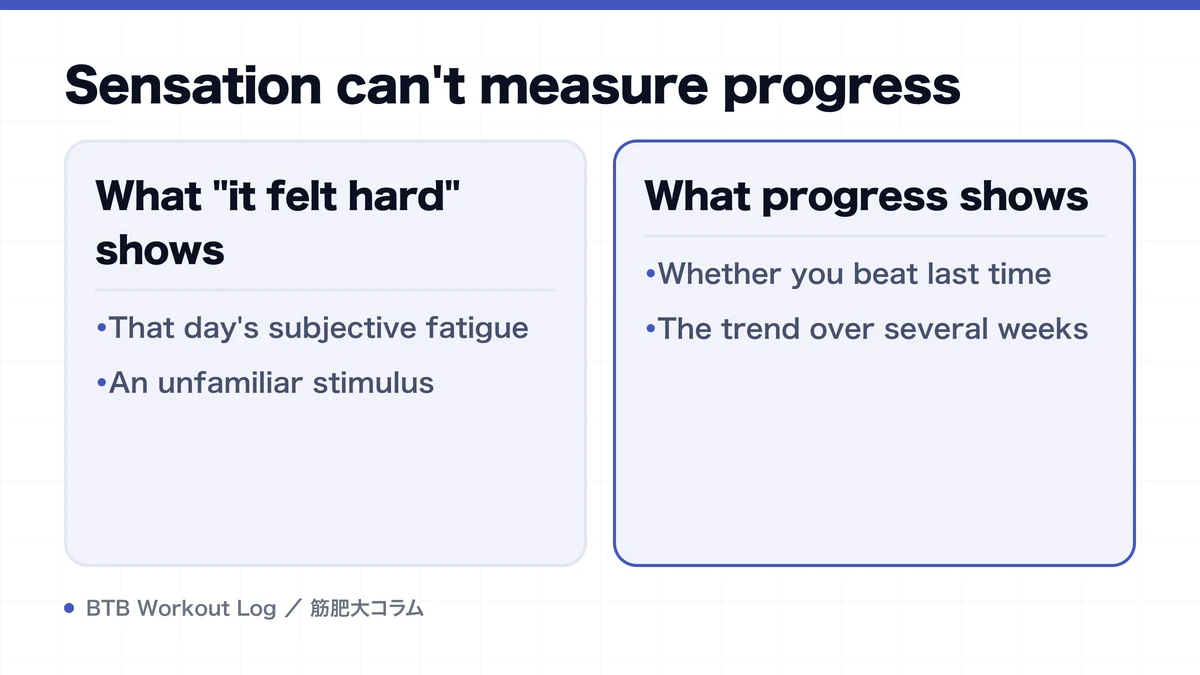
Why "that was rough" looks like results
Right after training you're left with breathlessness, burning muscles, pump, sweat and general depletion. Wake up sore the next day and it feels even more like "that worked". All of this is easy to notice yourself and arrives the moment the session ends, which makes it hit harder than hypertrophy that only shows up over weeks.
But these are acute reactions to what happened today — not proof you delivered a more effective stimulus than last time. You can boost the feeling of effort with short rest that leaves you gasping, soreness from an unfamiliar exercise, or a chain of drop sets that pumps you up. None of that guarantees load on the target muscle actually advanced if load, reps and form stayed the same.
Conversely, one more rep than last time at the same load, or the same reps held through a steadier range of motion, look unremarkable. Past the beginner stage, these small, reproducible improvements are the more useful evidence. Feeling like you worked hard keeps you motivated to keep training — it isn't a good scorecard for growth.
The body adapts to "a higher demand than before"
Progressive overload means gradually increasing training demands as your capacity improves. For hypertrophy, that means repeatedly performing sets that expose the target muscles to sufficient mechanical tension, then increasing the stimulus as you adapt. The ACSM progression model for healthy adults also treats adjusting load, reps, and other variables as your capacity changes as a fundamental part of resistance training.
Here, "load" means more than the weight on the bar. The main options are to increase weight or reps while keeping execution consistent and reps in reserve similar, or to adjust the number of sets when needed. Improving your range of motion or technique also counts as meaningful progress if you can match your previous numbers under more demanding conditions. See how to apply progressive overload for a detailed breakdown of your options.
But if adding weight means shortening your range of motion, using more momentum, or finishing with more reps in reserve, the conditions have changed. Higher numbers alone do not show that you have increased the demands on the target muscles. This is the same problem with chasing weight alone: progressive overload is more than setting a new record. It means increasing demands under consistent conditions.
Recent reviews of the mechanisms behind resistance-training-induced hypertrophy identify mechanical tension as a primary driver, while support for explanations in which metabolic stress and similar factors independently cause hypertrophy remains limited. Applying tension to the target muscles and tracking how their capacity changes over time gives you a more useful basis for training decisions than chasing a burn or a pump. For the full sequence from training stimulus to growth, see how hypertrophy happens.
That doesn't mean effort is unnecessary
Prioritising progressive overload doesn't mean mechanically repeating sets with a lot left in reserve. Add reps at too-light a load and if the target muscle never gets sufficient stimulus, all you've progressed is a number. RIR (Repetitions in Reserve) — your estimate of how many more reps you had — is what lets you check that.
Set a target around RIR 2, say, and one more rep than last time at the same exercise, range of motion and rest period suggests capability genuinely improved without effort changing much. But if last time was RIR 2 and this time you pushed to genuine failure for that same extra rep, the gain is explained partly by effort, not just progress. See using RIR for the fuller framing.
Across resistance-training research in healthy adults, the relationship between proximity to failure and hypertrophy isn't uniform, and taking every set to failure isn't established as necessary. Failure does intensify the feeling of effort, but it can also cost reps on later sets and recovery into the next session. Using failure is something to choose by exercise safety and where the set sits in the session.
Effort manages "was this set high enough quality to count as stimulus"; progressive overload manages "is that quality holding while demand rises over several weeks". They're different jobs, not alternatives. The order matters: set the effort you need, then track progress on top of it — don't chase the feeling of effort itself.
What tells you overload actually happened
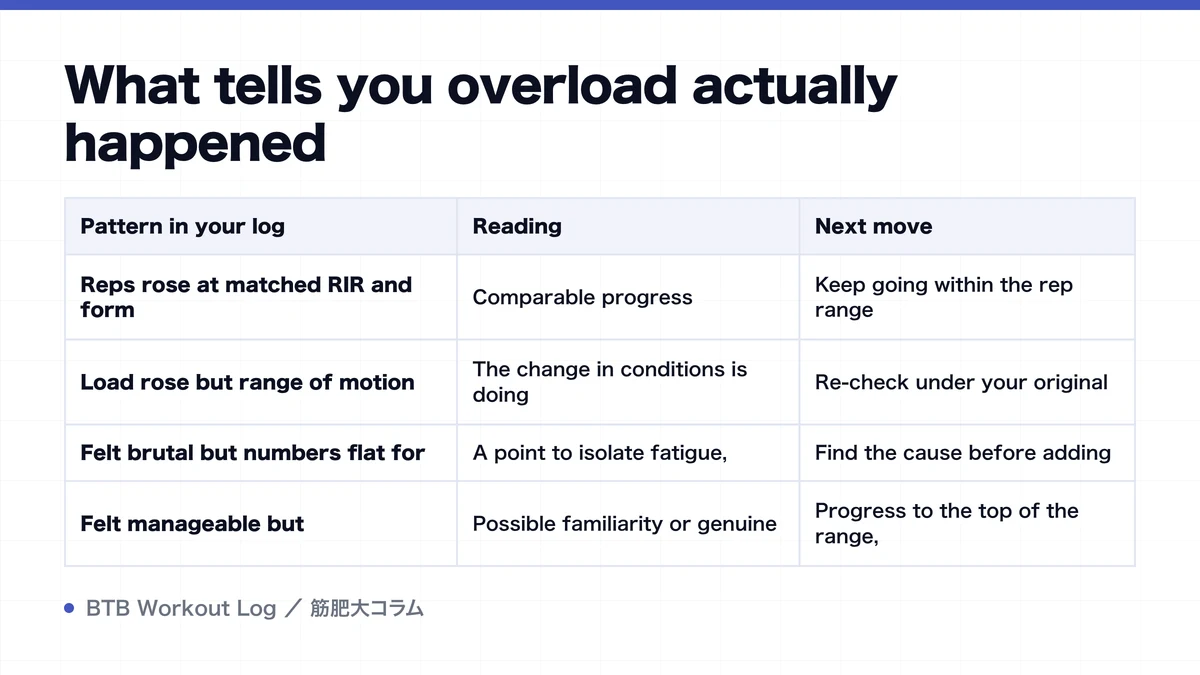
For the comparison, match not just the exercise name but form, range of motion, exercise order, rest period and RIR as far as you can. Day-to-day noise from sleep, food and equipment is unavoidable, so don't call success or a plateau from one session up or down. Watch whether the same trend holds across several sessions.
| Pattern in your log | Reading | Next move |
|---|---|---|
| Reps rose at matched RIR and form | Comparable progress | Keep going within the rep range |
| Load rose but range of motion shrank | The change in conditions is doing a lot of work | Re-check under your original standard |
| Felt brutal but numbers flat for several sessions | A point to isolate fatigue, recovery and load selection | Find the cause before adding volume |
| Felt manageable but matched-condition reps rose | Possible familiarity or genuine capability gain | Progress to the top of the range, then add load |
Even if load hasn't moved, more reps at the same load and RIR can count as progress — that connects to why reps matter too. But change exercise or order every time and the reference point for comparison disappears. Outside phases where you're deliberately varying stimulus, holding your main lifts fixed for a stretch makes the trend easier to read.
Set count works the same way. Add a set every time numbers stall and the feeling of effort rises while fatigue can drag down every set's quality. Check first how load, reps and RIR are moving on your existing sets, and only nudge weekly hard sets up in small amounts once you're recovering fine but stimulus genuinely looks short. Overload isn't raising every variable at once.
Turn how a session felt into the next decision
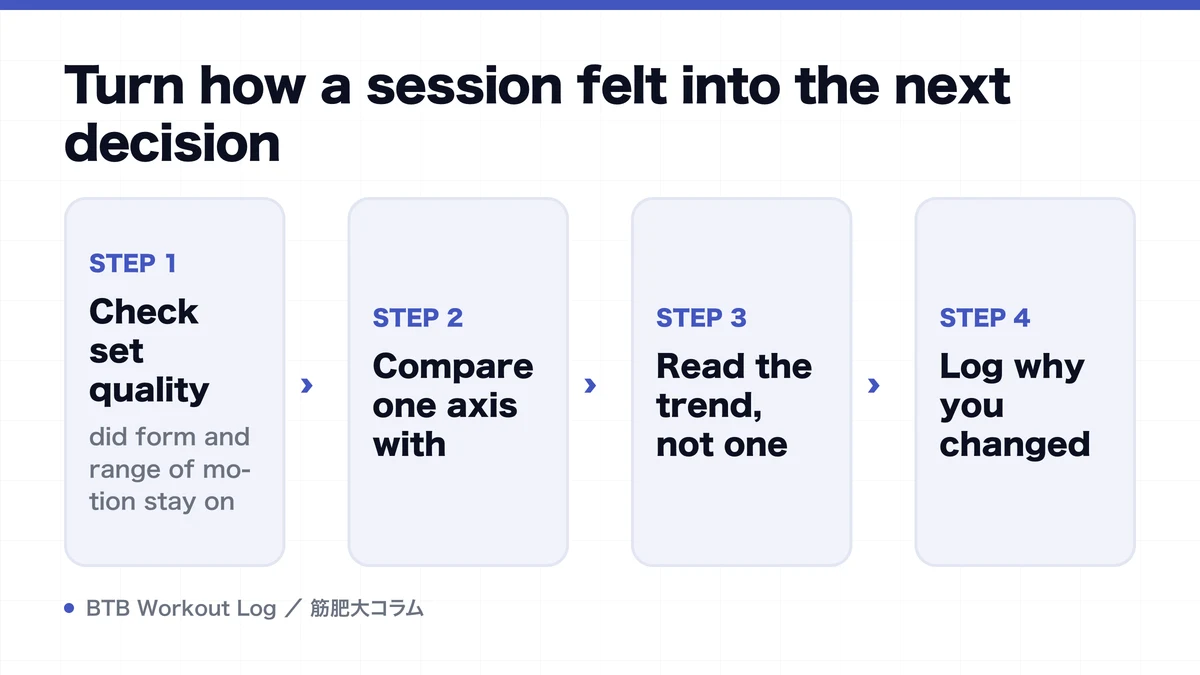
After training, don't stop at "that worked today" — read your log in this order.
- Check set quality: did form and range of motion stay on target, and did you reach roughly your intended RIR?
- Compare one axis with last time: add reps at the same load first, then add a small load increment once you hit the top of the range. Don't move load and reps a lot at once.
- Read the trend, not one instance: retry the same setup after one off day. If decline persists across several sessions and sleep or nutrition also look off, prioritise recovery over more stimulus.
- Log why you changed anything: note what you changed — load, reps, sets, exercise — and why. That stops you repeating the same mistake at the next plateau.
The goal isn't leaving every session wrecked — it's stacking matched-quality sets and, weeks later, being able to handle a higher demand than before. If you're progressing on schedule, weak pump or soreness isn't a reason to change your programme just to intensify the feeling. Conversely, if every session delivers a strong sense of accomplishment while your comparable numbers stall, revisit the programme and recovery before adding more effort.
This connects directly to your log. An app doesn't produce hypertrophy — its job is leaving you evidence for the next session's load instead of ending at "that was rough". What replaces "how hard it felt" is last time's numbers, and BTB Workout Log lets you set today's target with those in view.
FAQ
- Should I ignore pump and soreness entirely?
- No need to ignore them. They're useful supporting information for whether you engaged the target and whether an unfamiliar stimulus or recovery burden is at play. Just don't treat their intensity as the result — judge alongside the load, rep and RIR trend under matched conditions.
- Do I need to set a new load or rep PR every session to grow?
- No. Past the beginner stage, progress often moves over multi-week blocks with day-to-day ups and downs. If decline persists across several matched attempts, isolate recovery, load selection and set count rather than assuming failure.
- What should I log to balance effort feel with progressive overload?
- Load, reps per set and RIR, plus short notes on range of motion or form changes that would affect the comparison. Keep exercise order and rest period reasonably fixed too, and reading last-time comparisons — and whether you're progressing at the effort level you intended — gets much easier.
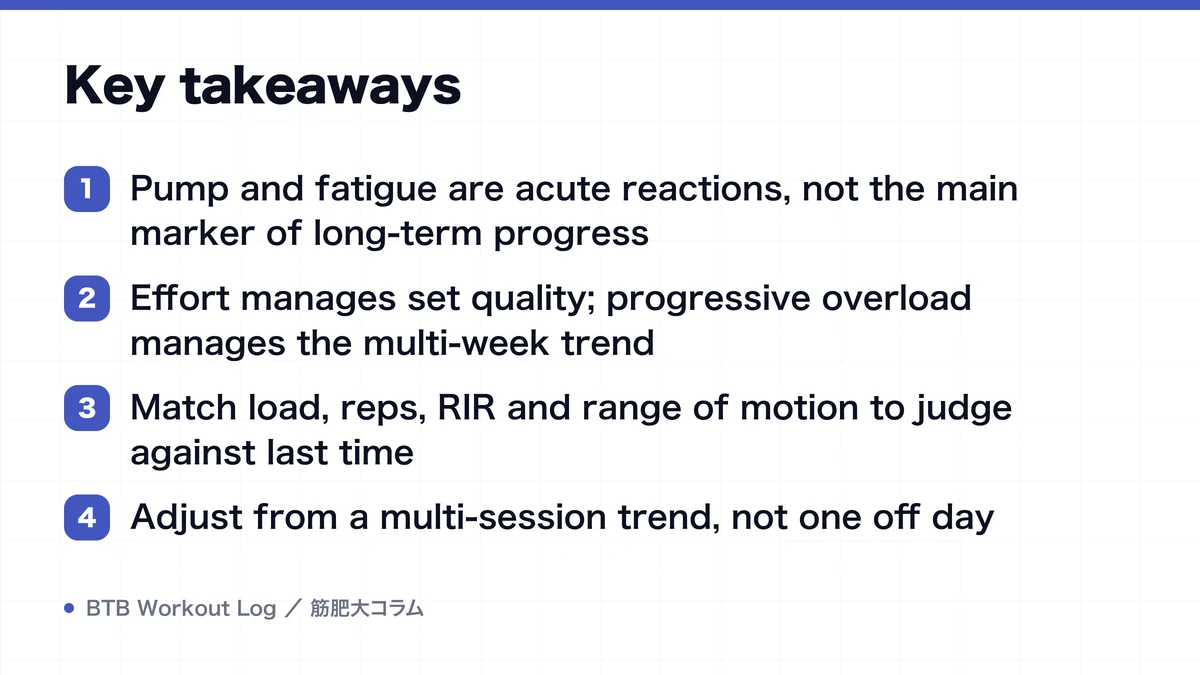
Key takeaways
- Pump and fatigue are acute reactions, not the main marker of long-term progress
- Effort manages set quality; progressive overload manages the multi-week trend
- Match load, reps, RIR and range of motion to judge against last time
- Adjust from a multi-session trend, not one off day
References
- ACSM Position Stand: Progression Models in Resistance Training for Healthy Adults
- Proximity-to-Failure and Muscle Hypertrophy: Systematic Review with Meta-analysis
- Training to Repetition Failure or Non-failure: Systematic Review and Meta-analysis
- Mechanisms of Muscle Hypertrophy: Current Understanding and Future Directions