
Can "1 More Rep Than Last Time" Alone Build Hypertrophy? | Testing the Simplest Way to Progress
Stacking "one more rep than last time" while matching load, form, range of motion and RIR is a valid way to drive hypertrophy. But the fact of gaining one rep alone doesn't guarantee hypertrophy.
Rep count isn't stimulus to the muscle itself — it's a metric for whether you handled the same challenge at a higher standard than before. Only once you decide what counts as matched conditions and when to move to weight does it become a reproducible method.
What's being tested is the claim "one more rep means more muscle"
Building the same weight from 8 to 9 reps means at least your capability on that exercise has risen. This is easy progress to structure into progressive overload — it gives you a goal even in fine increments where you can't add a plate, and pass/fail is clear each time.
But rep count isn't a direct measurement of hypertrophy. A one-rep gap can move with sleep, food, exercise order, rest time, or that day's motivation. Reps can rise purely because you got more efficient with a familiar movement. Conversely, muscle could be up slightly while reps drop below last time on a high-fatigue day. So a single "+1" isn't proof of growth — it's an observation to track as a trend over several weeks.
What we want to check isn't whether you can mechanically add a rep every time — it's whether the approach of building reps under matched conditions and raising load once you hit your set ceiling works as hypertrophy-relevant progression. In that sense, the answer is yes.
Five conditions for making "one more rep at the same weight" comparable
To use week-over-week comparison as material, match the premises behind the numbers as closely as possible. Going from 10 to 11 reps means little if you also squatted shallower, added more momentum, or rested longer — you can't call that the muscle beating the same challenge.
| Item to match | What to check | If it drifts |
|---|---|---|
| Load and equipment | Weight, machine, setting position | Log as a separate condition |
| Form and range of motion | Momentum, depth, stopping position | Don't count it as a rep update |
| End-of-set RIR | How many more reps were possible | Note the effort-level gap |
| Rest and exercise order | Rest time, position within the session | Read it accounting for the condition gap |
| Aggregation unit | Per-set or total reps | Don't switch the standard mid-stream |
Especially important is RIR (Reps In Reserve) — how many more reps were possible at the end. If last time was 10 reps at RIR 3, and this time 11 reps at RIR 0, that might be a difference from pushing to the limit this time rather than a genuine one-rep capability gain. If both are RIR 2, the comparison carries more weight. See the RIR guide for the basics.
For multiple sets, you don't need every set to gain a rep each time. For instance, if 10, 9, 8 reps (total 27) becomes 10, 9, 9 (total 28) next time, that's a +1 in total reps. Keeping the per-set decline too lets you check whether you only forced set one and let the back half suffer.
Research supports load progression itself more than any fixed "+1 rule"
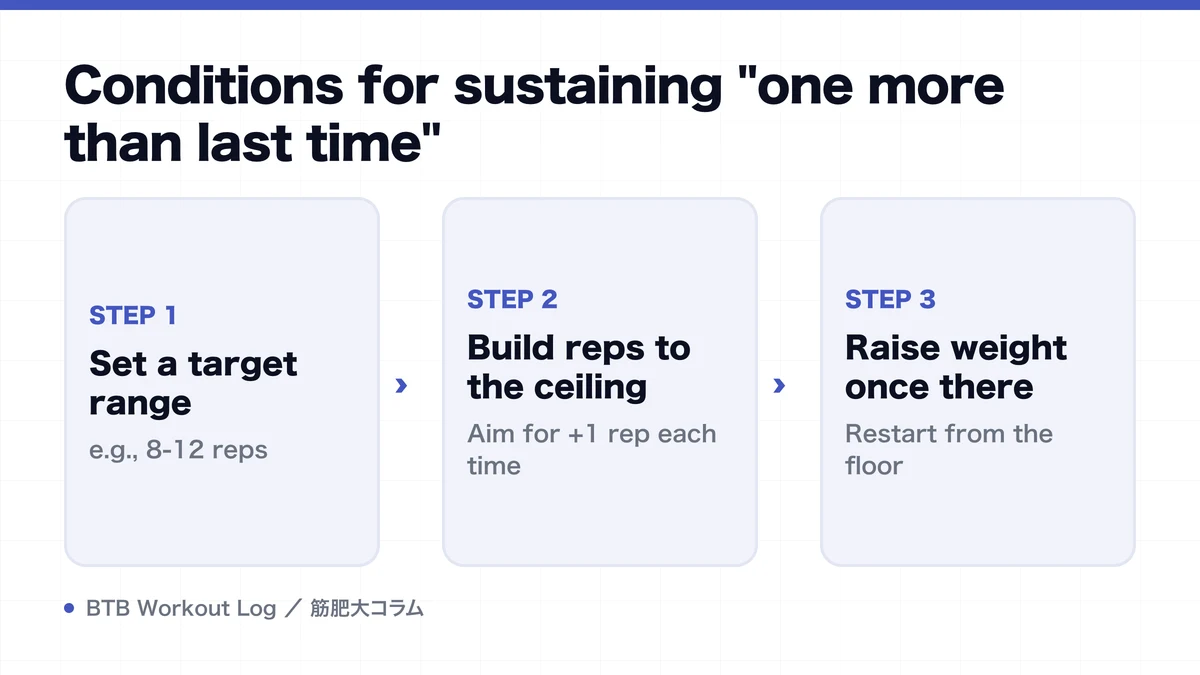
For hypertrophy, what matters is repeating at appropriate effort and gradually raising the work handled over time. Doing one more rep at the same weight and RIR means you completed more reps than before while still holding proximity to the limit. That's usable as grounds for advancing to the next stimulus.
ACSM's resistance-training progression model also lays out raising load once you can stably exceed your target rep count. It doesn't demand a fixed pace of exactly one rep each session, but it aligns with a design that builds reps first, then raises weight afterward.
Load-related meta-analyses conclude hypertrophy isn't confined to heavy load alone — it can occur across a wide load range given sufficient effort. So there's a real opportunity for hypertrophy during a stretch where you're building reps within a set rep range too. That said, you can't assume a small rep increase at light load with large reserve left is automatically sufficient stimulus — you need to watch proximity to the limit alongside it.
Strength or rep-capacity gains also include factors beyond muscle mass — exercise technique, familiarity with the movement, and that day's condition all shift. That's exactly why you shouldn't judge from a single session's win or loss — watch how comparable-condition records move over 4–8 weeks. If reps fluctuate but the baseline trends up, progression is working.
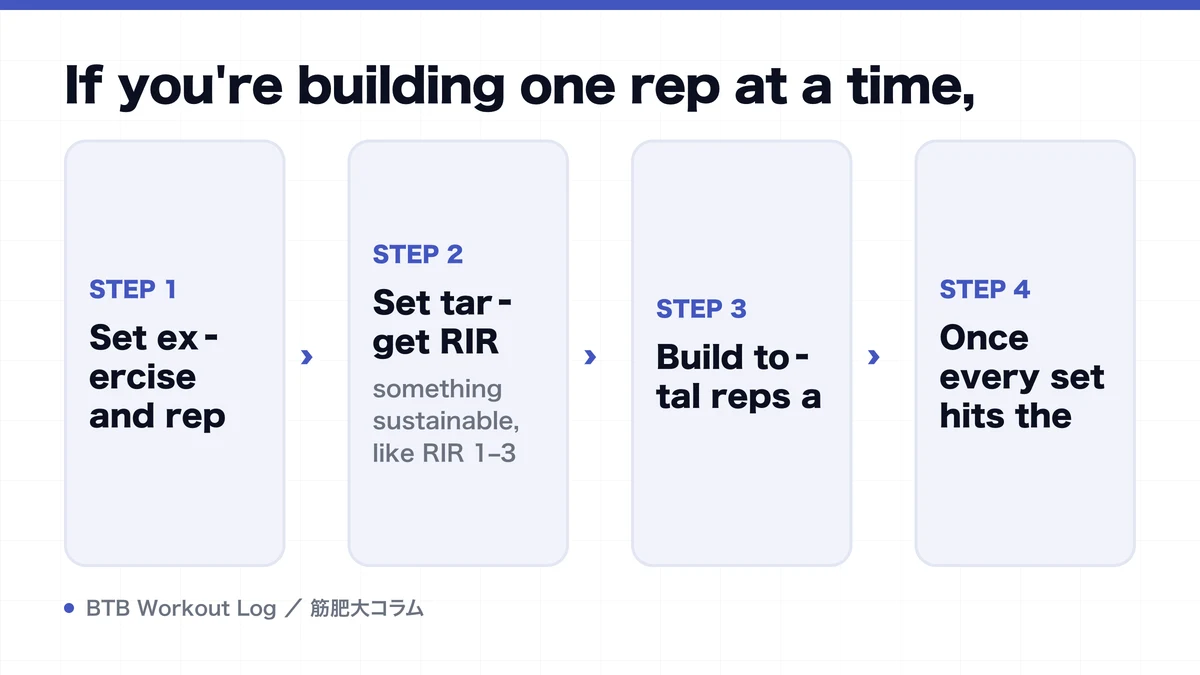
If you're building one rep at a time, structure it as double progression
In practice, it's easier to manage by combining a rep range with load updates, rather than extending reps without limit. This method is called double progression.
- Set exercise and rep range: say, bench press at 6–10 reps, 3 sets.
- Set target RIR: something sustainable, like RIR 1–3 per set.
- Build total reps a little at a time: if you got 8, 8, 7, aim for a total of 24 next time — it doesn't matter which set the gain comes from.
- Once every set hits the ceiling, raise weight: once you hit 10, 10, 10 under the same conditions, add the smallest available increment.
- Accept reps returning toward the floor: if the update leaves you at 7, 7, 6, that isn't failure — it's the starting point of the new range.
This method lets you alternate between building reps and building weight. Even if reps drop right after a weight increase, the long-term goal is returning to the same rep range at heavier load. If you're unsure which to move first — weight or reps — comparing weight-first vs. rep-first progression, also part of this 100-article set, is a useful decision axis.
"+1" is a target, not a quota. Squeezing out that last rep by breaking form, shortening range of motion, or getting a hand from a spotter has become a different challenge. On a day you can't beat your record, simply reproducing the same reps at the same RIR is still a high-quality record you can use for next time's comparison.
If reps stop rising, don't rush to add sets
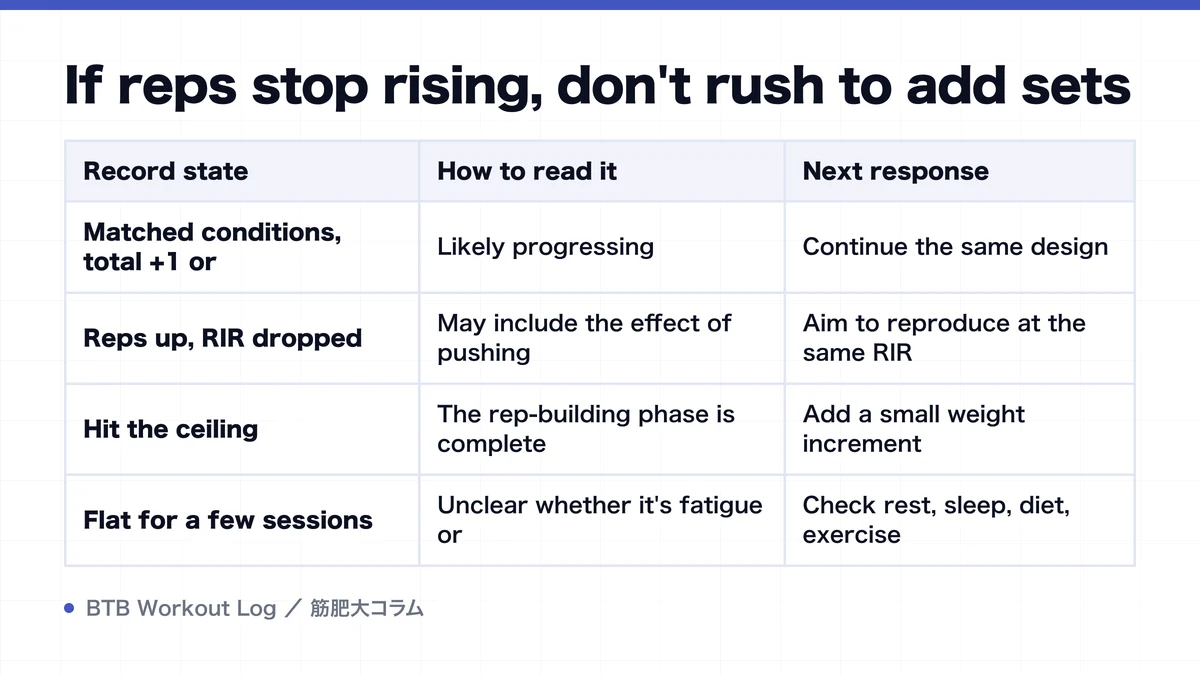
Past the intermediate level, the same exercise doesn't necessarily progress every session. A session where you can't gain a rep doesn't immediately mean hypertrophy has stalled. To separate day-to-day variance from a genuine stall, first line up 2–4 sessions' records on the same exercise.
| Record state | How to read it | Next response |
|---|---|---|
| Matched conditions, total +1 or more | Likely progressing | Continue the same design |
| Reps up, RIR dropped | May include the effect of pushing harder | Aim to reproduce at the same RIR |
| Hit the ceiling | The rep-building phase is complete | Add a small weight increment |
| Flat for a few sessions | Unclear whether it's fatigue or an adaptation plateau | Check rest, sleep, diet, exercise order |
| Declining long-term | Suspect insufficient recovery or a mismatched setup | Review load, frequency, weekly set count |
Raising weekly set count the instant you see a flat trend can backfire if fatigue was the actual cause. First check whether you're getting the same rest, whether body weight or sleep have dropped substantially, and whether other exercises' results have also declined. If recovery isn't the issue and only the target exercise stalls for several sessions, consider a smaller weight increment, a different rep range, or reviewing set placement.
On exercises where raising weight breaks your form, rather than extending reps without limit even after the ceiling, set a separate range with fixed tempo and range of motion. Changing one thing at a time lets you read the effect of that change from your next records. This overlaps with the general approach in the plateau-checking procedure.
Judge whether hypertrophy is happening from a body of records, not one rep
Judge whether this progression is working over 4–8-week blocks. At minimum, log weight, reps per set, RIR, and a brief note on any form or range-of-motion change, and watch the trend on the same exercise. If you use body weight, measurements, or photos, keep measurement conditions matched and use them as supporting metrics.
What to check isn't "a clean +1 every time" — it's whether total reps rise at comparable RIR and movement quality, and whether you can eventually return to the same rep range even after raising weight. If this cycle continues and you're delivering intended stimulus to the target muscle, "one more rep than last time" is a sufficiently practical progression rule for hypertrophy.
An app doesn't produce hypertrophy — it's appropriate to use it for making matched-condition comparison and your next load adjustment easier. Chasing "one more than last time" requires knowing, on the spot, what last time's number was. BTB Workout Log can surface that last value per exercise.
FAQ
- Do I need to add a rep to every single set compared to last time?
- No. For 3 sets, even a total-rep increase of just 1 counts as progress. Trying to add a rep to every set simultaneously tends to push the early sets too hard and wreck the back half — prioritize matching RIR and form instead.
- How many reps should I build to before raising weight?
- Set a rep range for each exercise ahead of time, and the guide is once every working set reaches the ceiling at comparable RIR. Raise weight by the smallest available increment, and treat reps returning near the floor of the range as normal progression.
- If a stretch continues without gaining a rep, does that mean hypertrophy has stopped?
- You can't judge from a few flat sessions on one exercise alone. Check sleep, diet, rest, exercise order, and results on other exercises, and line up several matched-condition records. Only if the overall picture declines long-term should you consider adjusting recovery, load, or weekly set count.
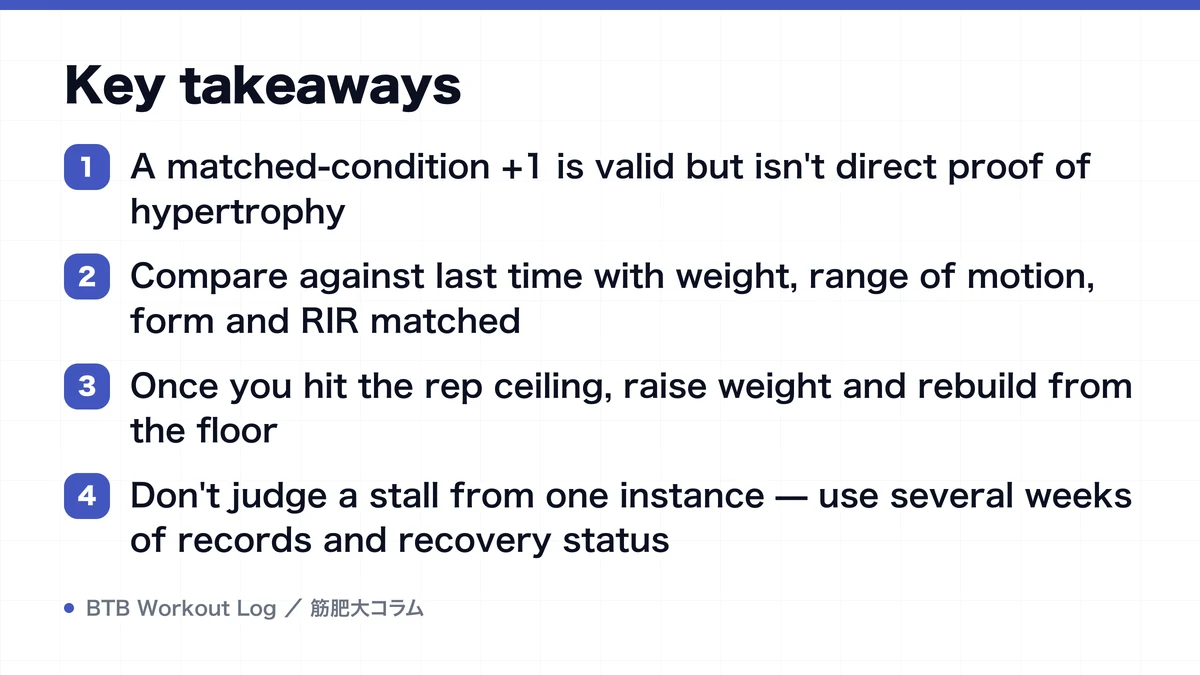
Key takeaways
- A matched-condition +1 is valid but isn't direct proof of hypertrophy
- Compare against last time with weight, range of motion, form and RIR matched
- Once you hit the rep ceiling, raise weight and rebuild from the floor
- Don't judge a stall from one instance — use several weeks of records and recovery status
References
- ACSM Position Stand: Progression Models in Resistance Training for Healthy Adults
- Low- vs High-load Resistance Training for Strength and Hypertrophy: Meta-analysis
- Resistance Exercise Load Does Not Determine Training-mediated Hypertrophic Gains in Young Men
- Proximity-to-Failure and Muscle Hypertrophy: Systematic Review with Meta-analysis
- Repetitions in Reserve Is a Reliable Tool for Prescribing Resistance Training Load