Can 1 Exercise Alone Grow Your Chest? | Chest Training for Lifters Short on Time, Put to the Test
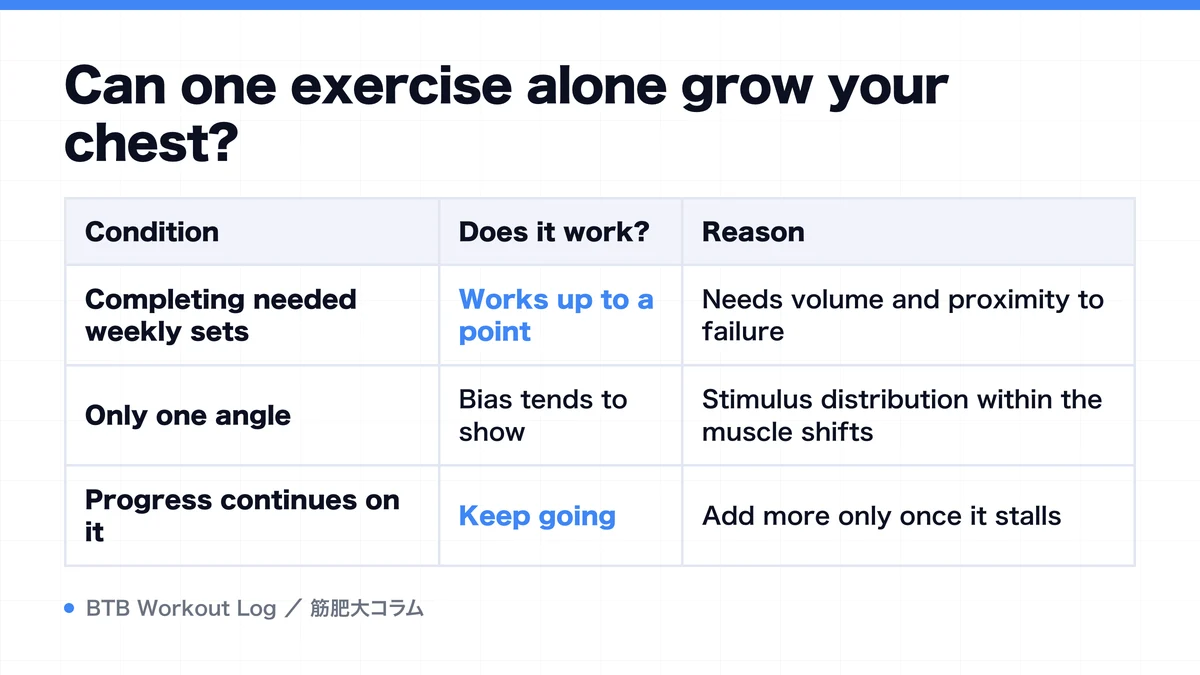
A single exercise can still grow your chest. But the condition is that this one exercise sufficiently works the pecs, and you can sustain quality weekly sets plus progressive overload on it.
Two questions need testing: "does it grow" and "can it maximally develop the whole chest." The former can hold, but the latter's answer shifts with stimulus bias by angle, and whether shoulders or triceps become the limiter first.
What decides whether "one exercise is enough"
"One exercise" here means a single movement with equipment, bench angle, grip, and range of motion held roughly fixed. If you alternate flat press and incline press by day, that isn't "one exercise" — even on the same equipment, the stimulus condition differs.
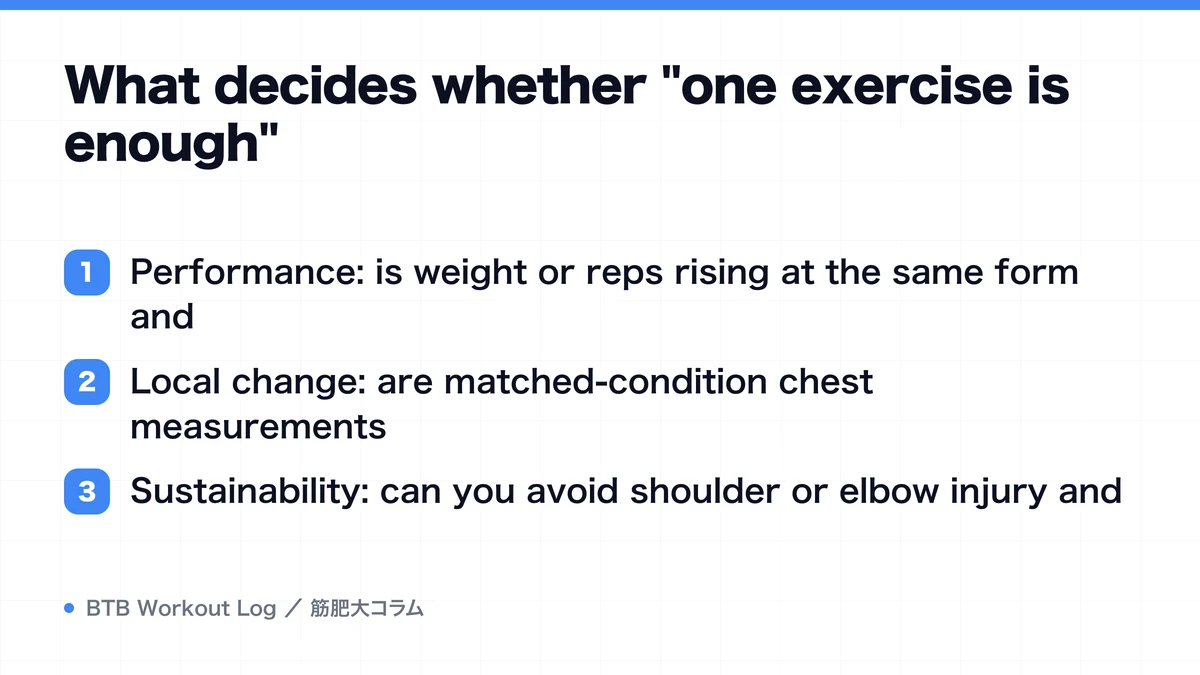
A strong pump or soreness alone also can't confirm "the chest grew." Track the following three under matched conditions for at least 8–12 weeks.
- Performance: is weight or reps rising at the same form and range of motion?
- Local change: are matched-condition chest measurements trending up, accounting for body-weight change too?
- Sustainability: can you avoid shoulder or elbow injury and repeat high-quality sets after recovering by next time?
Don't conclude from just one moving. Chest measurement during a bulk, for instance, includes fat and back changes too. Watching whether several indicators move in the same direction raises confidence in "it's still growing even with one exercise."
What decides hypertrophy is set content, not exercise count
Hypertrophy stimulus arises not from how many exercise types you did, but from banking sets that deliver sufficient tension to the target muscle and repeating them while recovering. There's an average dose-response relationship between weekly resistance-training volume and hypertrophy, but that doesn't mean more exercise variety is always favorable. If you can secure the same chest weekly set count from one exercise, there's no basis for calling it a failure purely because "there's only one." See weekly hard sets for that thinking.
That said, the research cited here doesn't include a direct, long-term head-to-head comparison of "one chest exercise" versus "multiple chest exercises" with total sets and effort matched. It's reasonable to combine surrounding research — weekly set count, proximity to failure, and angle-based muscle activity — and confirm the actual working conditions through your own trend.
That said, it's inappropriate to pad the count with warm-ups or sets left with a lot of reserve. RIR is an estimate of how many more reps were possible — in practice, keeping most sets around RIR 1–3 lets you direct sufficient effort at the chest while still being able to repeat. You don't need to take every set to complete failure, and there's no clear evidence that failure training beats non-failure for hypertrophy. See how to use RIR for matching effort level.
The other condition is progress. Repeat the same weight, reps and range of motion for a long time with unchanged stimulus, and you'll stall whether it's one exercise or five. You need to build reps within your set rep range and raise weight by a small amount once you hit the ceiling — creating progressive overload in a comparable form.
For chest, check "stimulus bias" and "what fatigues first"
The pecs may look like one muscle, but fiber direction differs between the clavicular and sternal heads. A study comparing flat and 45-degree incline bench press found the region of strongest activation within the pecs shifted with angle. But this is a single-bout muscle-activity study — it doesn't directly show that adding angles produces greater long-term hypertrophy. Even so, it's grounds not to assume one angle stimulates the entire chest identically.
An exercise works well as a single-exercise routine if it lets you use a large, pain-free range of motion, press from a position where the chest is strongly stretched, and end the set from declining chest output. Conversely, if triceps, front delts, posture holding, or grip consistently limit you first, it's hard to count every one of those sets as valid chest volume. What matters isn't exercise name — it's what's actually the limiting factor on your body.
Narrowing to one exercise has benefits too — stable technique, easy comparison against last time, and less time spent on warm-up and equipment moves. But load concentrates on the same joint angle, and there's no other movement to shift to if back-half set quality drops. Rather than making "don't add exercises" the goal, think in terms of each set's role, as in the relationship between exercise count and growth.
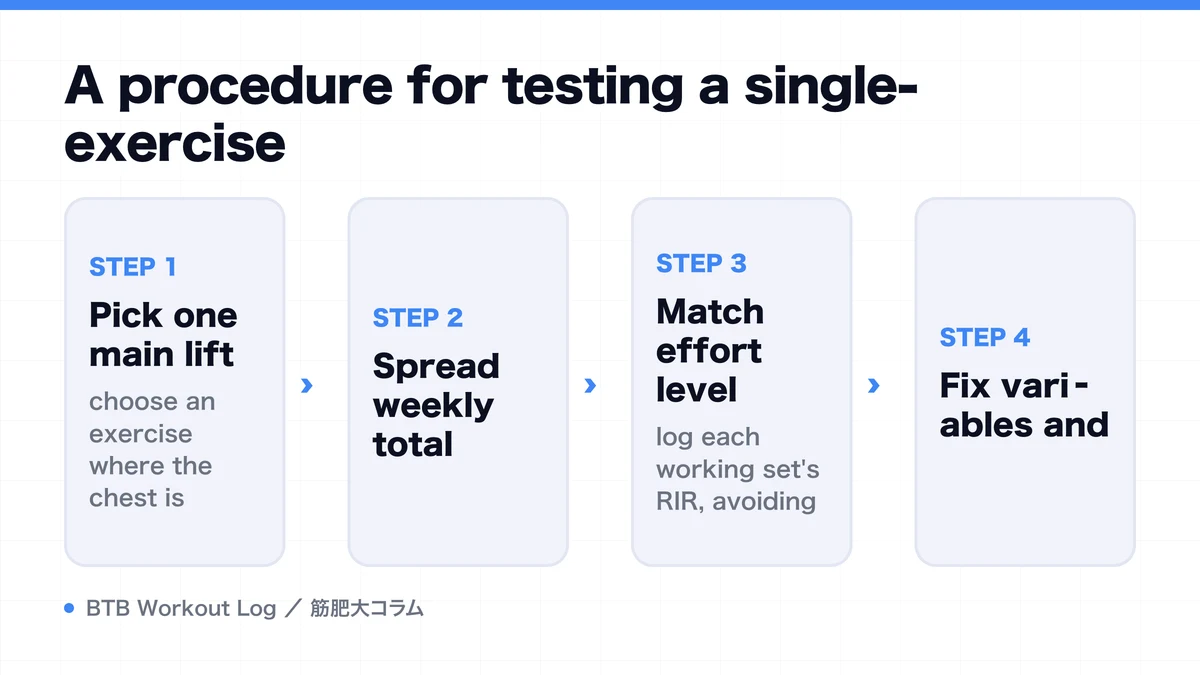
A procedure for testing a single-exercise routine over 8–12 weeks
- Pick one main lift: choose an exercise where the chest is the limiting factor, you can reproduce pain-free range of motion every time, and load is easy to adjust. Free weight isn't mandatory.
- Spread weekly total volume out: use your currently recoverable chest weekly set count as the baseline, splitting it across roughly twice a week rather than cramming it into one session. If reps or range of motion drop badly in the back half, first reduce per-session set count.
- Match effort level: log each working set's RIR, avoiding sets that are too light and avoiding complete failure every time. Taking just the final set close to failure, for example, keeps fatigue manageable.
- Fix variables and progress: don't frequently change bench angle, grip, tempo or range of motion — build weight or reps under matched conditions. Don't count a rep increase from shortened form as progress.
- Judge after 8–12 weeks: check performance, chest change, and joint status together. If there's pain, or the chest never becomes the limiting factor, fix it without waiting out the full period.
Twice a week, 3–5 working sets each session, is an example starting point for the test, but the amount needed shifts with training history, effort level, and recovery capacity. Rather than fixing a number as prescription, start from a range where you can hold set quality even in the back half.
A single-exercise routine has fewer comparison variables, so it pairs well with logging.
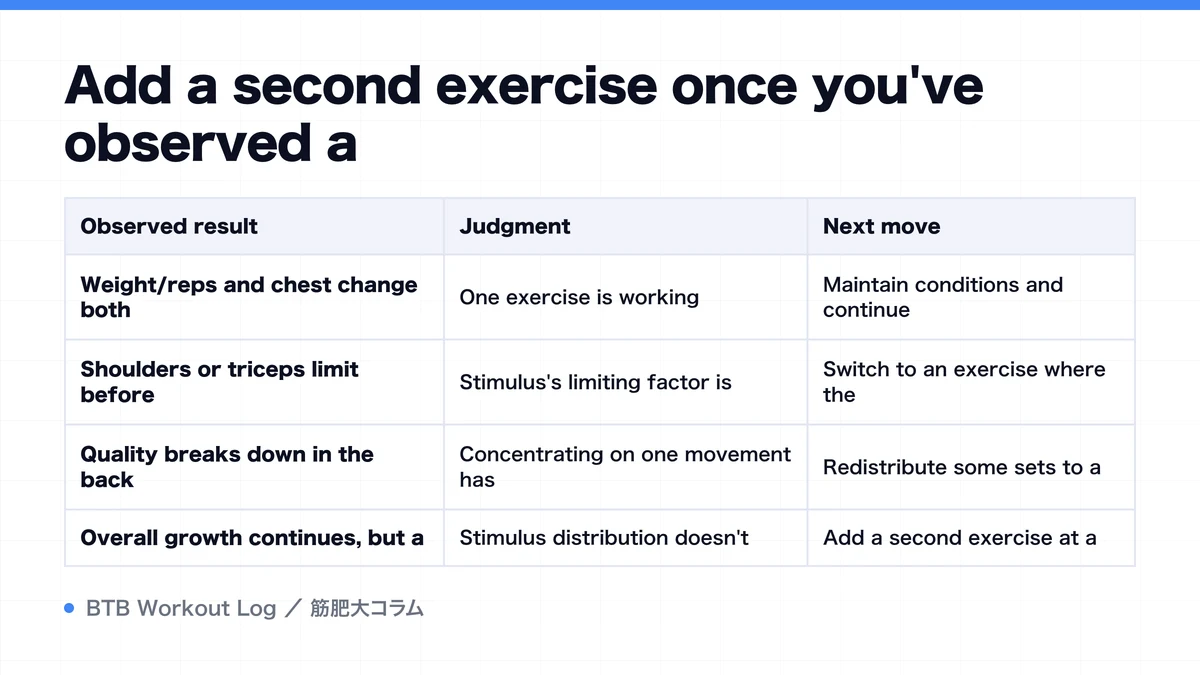
Add a second exercise once you've observed a shortfall
| Observed result | Judgment | Next move |
|---|---|---|
| Weight/reps and chest change both trending up, no pain | One exercise is working | Maintain conditions and continue |
| Shoulders or triceps limit before the chest | Stimulus's limiting factor is mismatched | Switch to an exercise where the chest is the limiter |
| Quality breaks down in the back half of needed weekly sets | Concentrating on one movement has hit its ceiling | Redistribute some sets to a different exercise |
| Overall growth continues, but a priority area like upper chest isn't changing | Stimulus distribution doesn't match your goal | Add a second exercise at a different angle |
| Shoulder/elbow discomfort recurs | Insufficient sustainability | Replace with an exercise using different equipment or path |
When adding a second exercise, don't simply stack sets on top — first move part of your existing sets over. This lets you keep total volume roughly matched while isolating how the angle or stability difference affected results. Keeping your main lift as the comparison axis and only adding the second to fill a gap is the clearer way to organize it.
For the full chest exercise structure, see a chest hypertrophy routine; for whether to narrow specifically to bench press alone, the next question is testing chest training from bench press alone. While you're still growing on one exercise, there's no reason to add more — but a second exercise addressing an observed shortfall has clear value.
FAQ
- If training chest with just one exercise, what should I choose?
- One where the chest is the main limiting factor, you can reproduce a large pain-free range of motion, and you can fine-tune weight. Don't limit yourself to barbell — dumbbells and machines count too — choose whichever lets you track progress under matched conditions for 8–12 weeks.
- Can upper chest still grow from a flat exercise alone?
- Some stimulus reaches it, but research shows the distribution of activation within the pecs shifts with bench angle. If overall growth is happening but upper chest remains a priority gap, either make incline your main lift or redistribute part of your sets to a different angle.
- How many weeks of no progress before adding a second exercise?
- First use roughly 8–12 weeks as a guide, tracking weight/reps and chest change at the same form, range of motion and RIR. Consider adding once several indicators stall even after tightening recovery and load setup, and change sooner if there's pain or a non-chest muscle consistently fatiguing first.
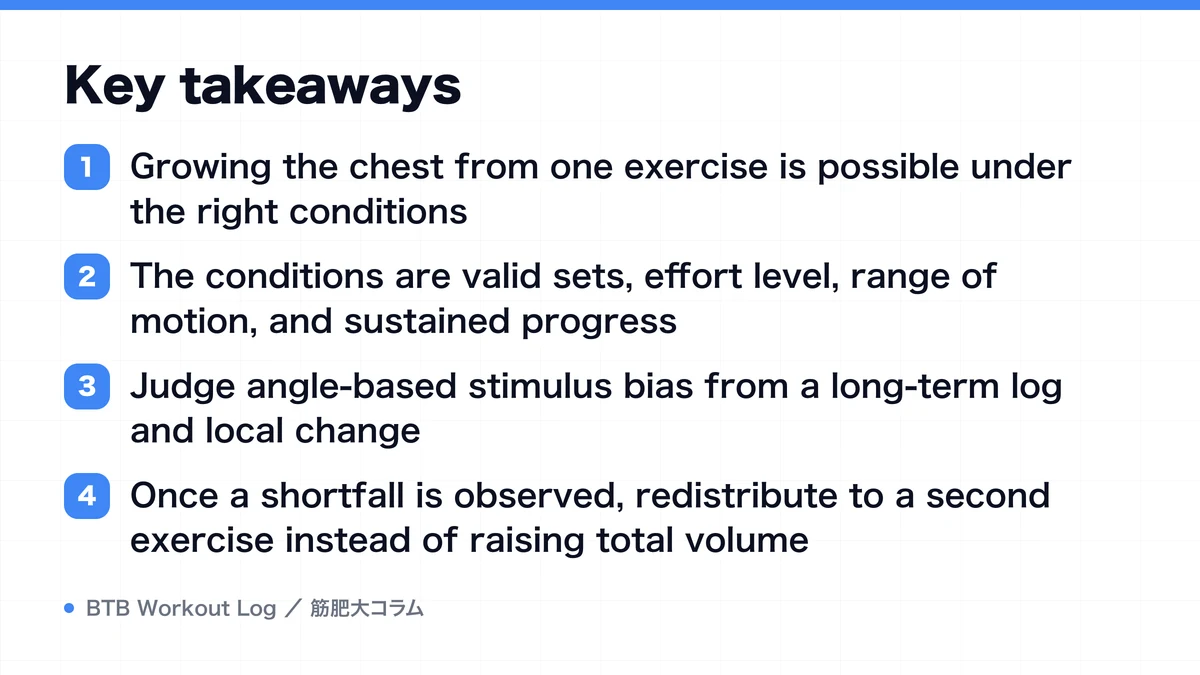
Key takeaways
- Growing the chest from one exercise is possible under the right conditions
- The conditions are valid sets, effort level, range of motion, and sustained progress
- Judge angle-based stimulus bias from a long-term log and local change
- Once a shortfall is observed, redistribute to a second exercise instead of raising total volume