Training Frequency and Hypertrophy: Why More Isn't Always Better
Adding a day doesn't automatically add useful weekly work or improve the quality of any individual set. At a fixed weekly set count, frequency mostly changes how those sets are spread across the week.
Growth doesn't accelerate the moment you add a training day. Some people do get better sets out of spreading the work; others end up under-recovered or with a schedule they can't repeat, and progress gets harder to reproduce.
Why "more sessions, more chances to grow" doesn't hold up
Going from chest once a week to three times looks like tripling the number of growth signals. But training frequency here means how often a muscle group is trained per week, not how many days you're in the gym. And when you're reasoning about hypertrophy, you have to hold frequency and weekly set count apart.
Take someone doing 12 chest sets on Monday. Split into 4 sets on Monday, Wednesday and Friday, frequency tripled but weekly sets didn't move. Do 12 sets on each of those days and you've changed both — frequency and weekly volume, from 12 sets to 36. If results improve in the second case, none of it can be attributed to frequency alone.
The other thing that gets missed: number of sessions isn't the same as number of effective stimuli. If fatigue from the last session is still there and load, reps and range of motion are down, adding days hasn't added high-quality sets. What matters isn't how many entries are on the calendar — it's how many opportunities you get to push a lift while recovered.
Equate weekly volume and frequency's own contribution gets small
Frequency research splits people because two different study designs get quoted together: those that changed frequency and volume at once, and those that held weekly volume constant. The 2016 meta-analysis suggested twice a week may beat once a week, but couldn't really settle whether three or more beats two.
A 2019 meta-analysis with a larger pool concluded that with weekly volume equated, the hypertrophy difference between higher and lower frequency was neither statistically nor practically meaningful. The 2026 meta-regression is consistent with the same picture: frequency's independent effect on hypertrophy is small. Populations, measurement sites and training history all vary, so this isn't proof that nobody responds differently. It does make "train it more often and it grows proportionally faster" hard to defend.
None of which makes frequency pointless. What the research is trying to isolate is the independent effect of splitting the same workload into more pieces. In practice, raising frequency lets you spread out sets that used to be crammed into one session, and the payoff shows up as better late-session quality and a schedule that actually fits. Frequency's value isn't doubling the growth signal — it's making the work you already need to do easier to repeat in good condition.
It changes distribution and quality more than total stimulus
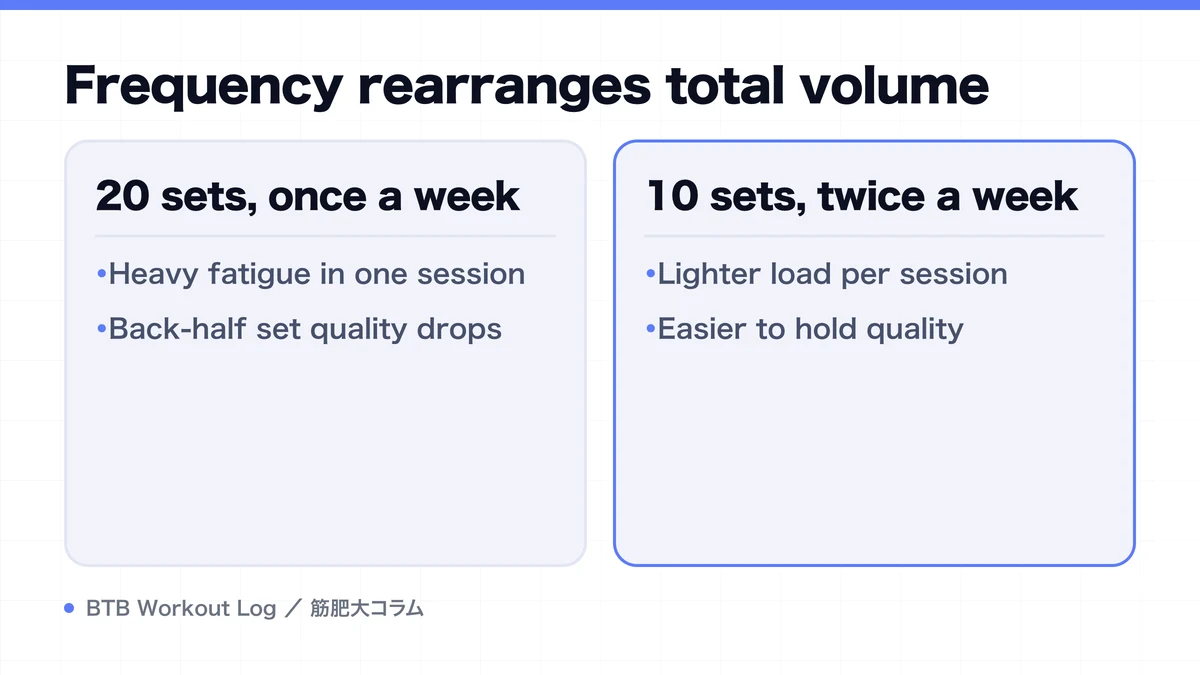
Twelve chest sets in one session means local fatigue stacks up through the back half. Split into six and six across two days and most people hold load, reps and range of motion much further into each session. That isn't higher frequency being better — it's the same weekly sets being executed at higher quality because they were spread out.
Spreading doesn't always improve quality, though. You can end up training chest while triceps and front delts are still fatigued from yesterday's pressing, or splitting lower body so finely that your lower back takes load on consecutive days. If RIR (how many reps you had left in reserve) comes in lower than planned and reps drop at the same load, recovery hasn't kept up — however short the session looked.
There's also the trap of adding sets every time you add a day, which pushes weekly hard sets up too. Weekly volume and hypertrophy do show a dose-response trend, but the return on each added set isn't constant — the useful range moves with your recovery capacity and exercise selection. Change weekly volume while you're trying to evaluate frequency and you lose the ability to explain either the improvement or the regression.
Who benefits from more frequency, and who should leave it alone
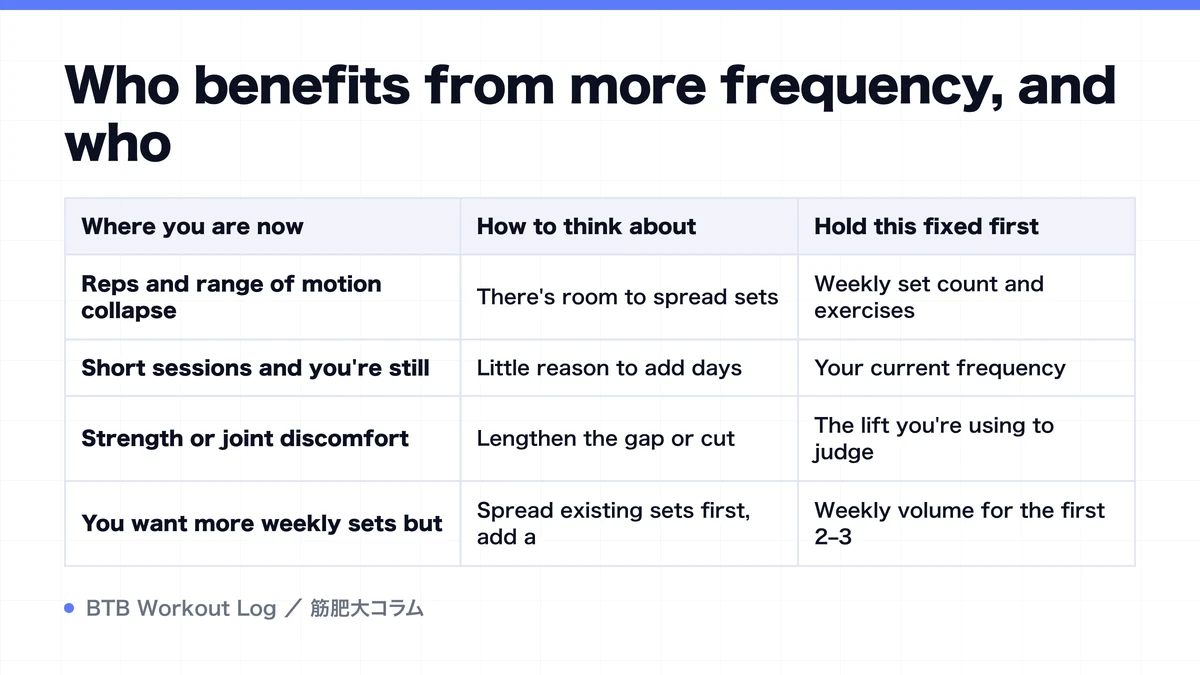
The question isn't "how many days is optimal" — it's whether you can execute your current weekly sets at high quality in your current layout. Framing it this way makes the purpose of any change explicit.
| Where you are now | How to think about frequency | Hold this fixed first |
|---|---|---|
| Reps and range of motion collapse late in the session | There's room to spread sets across more days | Weekly set count and exercises |
| Short sessions and you're still beating last time | Little reason to add days | Your current frequency |
| Strength or joint discomfort lingers into the next session | Lengthen the gap or cut overlapping exercises | The lift you're using to judge |
| You want more weekly sets but sessions are already too long | Spread existing sets first, add a little afterwards | Weekly volume for the first 2–3 weeks |
The same applies to changing your split. Going from three full-body days to a five-day split doesn't necessarily raise any muscle group's frequency. Count gym days, per-muscle frequency, and direct versus indirect sets separately. Presses, rows and squat patterns load several muscle groups at once, so don't decide "this still isn't often enough" by looking only at direct work.
If you're progressing on once a week, holding set quality, and it fits your life, low frequency alone isn't a reason to change. If you're stuffing so much into one day that the back half is a formality, splitting it — without adding a single set — may be all you need.
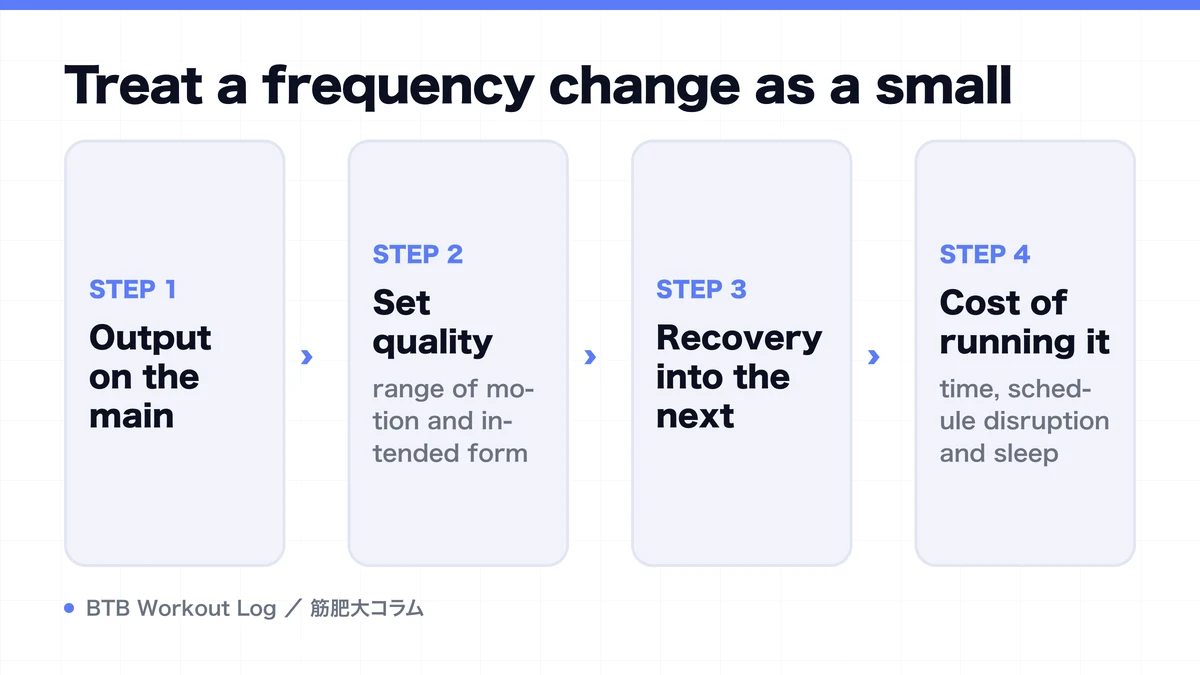
Treat a frequency change as a small experiment at fixed volume
If you're raising frequency, keep weekly set count, main exercises, target rep range and RIR as close to unchanged as you can for the first two to four weeks, and change only the distribution. Moving 12 chest sets from one day to two means six and six — nothing more. Adding sets in the excitement of a new training day destroys the comparison.
Four things to read before and after
- Output on the main lift: reps at the same load, or load at the same reps, trending up.
- Set quality: range of motion and intended form holding into the back half, landing on the RIR you planned.
- Recovery into the next session: no obvious drop in output from warm-up onward when you hit that muscle group again.
- Cost of running it: time, schedule disruption and sleep included — can you actually repeat this layout?
If the late-session drop-off shrinks and load or reps climb week over week, the new distribution is working. If output falls on every day and the next stimulus arrives before you've recovered, reverse the change, widen the gaps, or cut indirect sets — in that order. Don't decide on soreness alone; read the trend across several logged sessions.
No app decides your optimal frequency. What it's for is telling you whether the redistribution actually improved set quality and progress. Judging a frequency change requires confirming weekly volume was the same before and after — and BTB Workout Log holds per-muscle weekly sets in exactly that form.
What happens to weekly sets when you raise frequency
When you say "raise frequency", two changes of quite different character can actually be happening. One is spreading the work out while holding total weekly sets fixed, the other is keeping the per-session volume so that the total rises too. If you mix the two, you will never be able to evaluate the effect of frequency.
If a muscle that was getting 12 weekly sets in one session moves to 6 sets twice a week, the total does not change. What changes is how fatigue builds up within a session, which makes it easier to hold output on the later sets. If instead you add a third day to a muscle already doing 6 sets twice a week and end up at 18 sets, that is not a frequency experiment but a volume increase.
In order, you first hold weekly total volume fixed and spread it out, then see whether load and reps improve late in the session. If they improve and recovery is keeping up, only then do you consider whether there is room to add total volume. If you move both at once, you cannot identify the cause whether you progress or stall.
FAQ
- Will I still grow training each muscle only once a week?
- Yes, if you can execute the weekly sets you need at high quality and load or reps are climbing. If quality falls apart in the back half of the session, or you can't fit the volume into the time you have, splitting into two days — without adding volume — is worth doing.
- What frequency should I start from for hypertrophy?
- For most people, roughly twice a week per muscle group makes it easier to hit your weekly sets while still recovering. It isn't a fixed answer, though — some progress fine on once a week, others find small doses three times a week easier to manage. Let set quality decide.
- Can I raise frequency and set count at the same time?
- You can, but you won't be able to explain the result. Hold weekly sets fixed, change only the distribution for two to four weeks, and check output and recovery. If you still have room and progress continues, add a small amount of volume afterwards as a separate change.
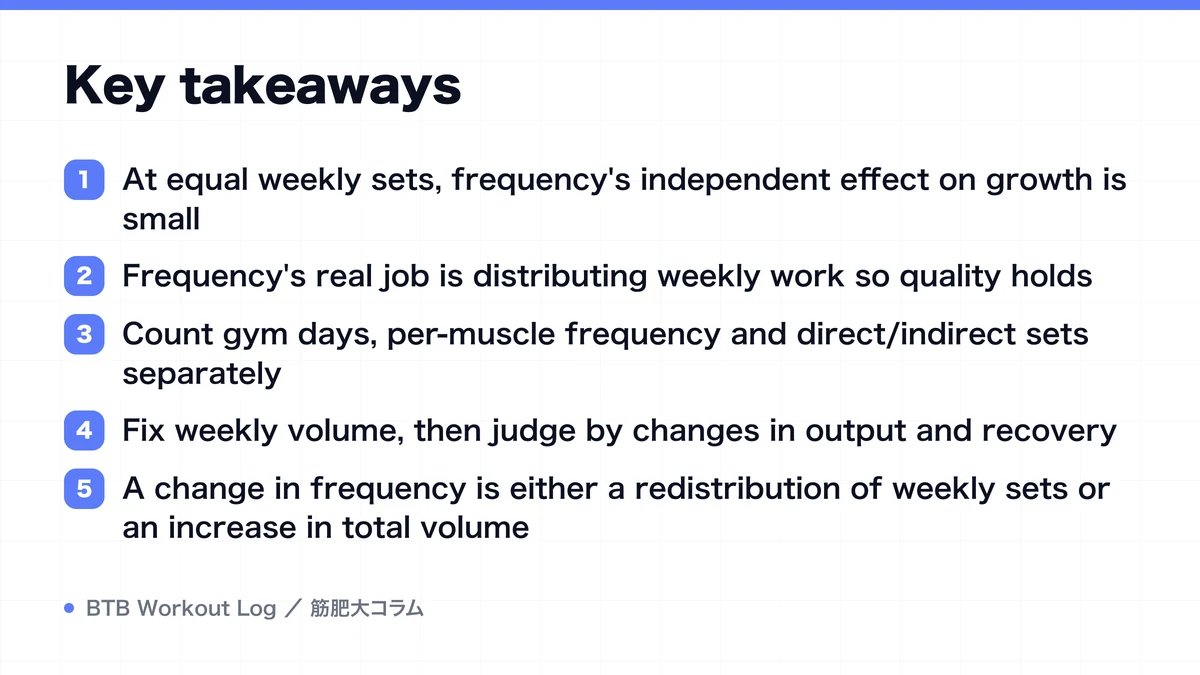
Key takeaways
- At equal weekly sets, frequency's independent effect on growth is small
- Frequency's real job is distributing weekly work so quality holds
- Count gym days, per-muscle frequency and direct/indirect sets separately
- Fix weekly volume, then judge by changes in output and recovery
- A change in frequency is either a redistribution of weekly sets or an increase in total volume
References
- Resistance Training Frequency and Muscle Hypertrophy: Systematic Review and Meta-analysis
- The Resistance Training Dose Response: Meta-Regressions Exploring the Effects of Weekly Volume and Frequency on Muscle Hypertrophy and Strength Gains
- Effects of Resistance Training Frequency on Muscle Hypertrophy: Systematic Review and Meta-analysis
- Dose-response Relationship Between Weekly Resistance Training Volume and Muscle Mass