
Hypertrophy: Does Pushing to Failure Mean More Growth? Going Too Far Can Stall Gains
Getting close to failure matters, but adding more failure sets doesn't scale hypertrophy up in a straight line. Failure is one endpoint stimulus can reach — it isn't a special switch that keeps adding hypertrophy the more you use it.
Bringing a set with too much reserve genuinely close to the limit and forcing every set that's already near the limit into actual failure are two separate decisions.
Two different claims get blended into "push harder, grow more"
This belief has something right sitting next to something that overreaches. Bring a set with RIR (Reps In Reserve — how many you had left at the end) of 5 or more down to around RIR 2, and you make it much easier to deliver sufficient stimulus to the target. But push RIR 2 to RIR 0, and every set of a multi-set exercise to RIR 0, and hypertrophy doesn't scale up proportionally to match.
Failure here means the point where you can't complete the next rep while holding your intended form and range of motion. Mix that with a "technical limit" where form breaks down but the rep could continue, or a stop from pain or breathlessness, and effort levels stop being comparable. Match a shared RIR definition first, and keep "close to the limit" separate from "genuinely failed".
Counting failures is easy; the stimulus the muscle received isn't decided by pass or fail alone. Load, reps, range of motion, how load distributed to the target, rest and set placement all shift what's inside a given RIR 0. Treating "more failure sets" as a single lever crams all of that into one number.
How far it holds: shrink reserve that's far too big
If a hypertrophy-focused working set always leaves you able to hold a conversation and bar speed barely drops, there's room to push harder. Light loads especially allow many reps, so stopping early can mean you never reach sufficient effort. "Push harder" makes sense as an improvement for someone who was leaving far too much in reserve and moved closer to the limit.
What's actually helping, though, isn't the instant of failure — it's the set reaching sufficiently high effort. A set finished at RIR 1–3, where the last reps slow down and the target muscle is still doing the work, shares most of that process with a failed set. Treating everything short of failure as "ineffective" and only failed sets as "effective" is too coarse a binary.
Conversely, if your self-reported RIR consistently understates how many reps you actually had, the number isn't doing its job. Occasionally taking a safe machine or single-joint exercise to genuine failure to check your prediction is useful — as a calibration for your RIR sense, not a routine prescription.
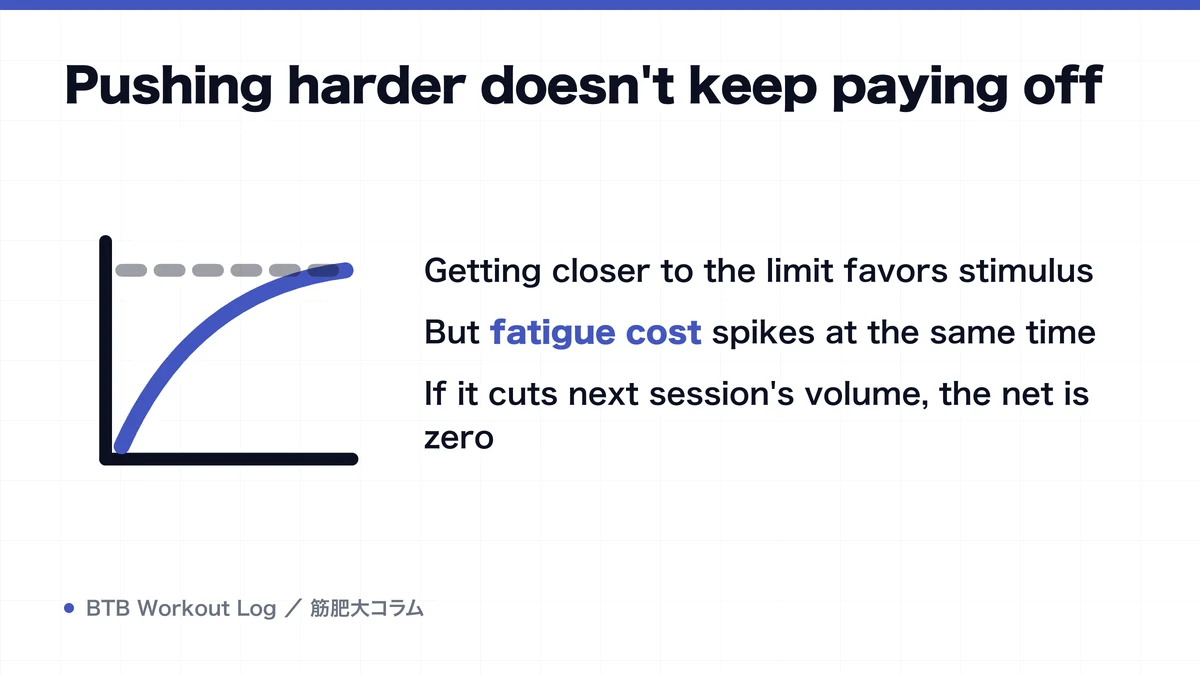
Where it becomes a myth: adding RIR 0 doesn't scale the benefit
The first mistake is counting RIR 0 as a unit of stimulus. Take all four sets of an exercise to failure and the last set doesn't necessarily hold the same quality of reps as the first. If rep decline between sets, a shrinking range of motion or compensation from muscles other than the target grows large, then reaching failure each time doesn't mean the work actually completed stayed the same. It's the same problem as crediting too-short rest for "working" purely because it feels brutal.
The second is looking only within one exercise and forgetting the rest of the week. If taking every set of an early exercise to RIR 0 costs reps on later exercises, or leaves output depressed into the next session for the same muscle group, the added failure sets carry an opportunity cost. What a hypertrophy programme needs to protect isn't how wrecked one session felt — it's a continued, recoverable accumulation of weekly hard sets.
The third is treating reaching failure itself as progress. Failing at the same load and reps week after week doesn't establish that overload advanced. Check whether reps or load are rising at the same form, range of motion, rest and RIR, and judge progressive overload separately from how hard you pushed.
Research supports getting close, not a ticket that rewards more failure
Systematic reviews and meta-analyses comparing failure and non-failure training find no clear average hypertrophy difference, and conclude failure isn't necessary for muscle gain. A separate meta-analysis on proximity to failure found no evidence that training to momentary muscular failure beats non-failure conditions, suggesting proximity to failure and hypertrophy may not simply track together in a straight line.
That doesn't mean any amount of reserve is equivalent. Studies vary in how they define failure, how much RIR the non-failure group genuinely left, load, volume and participants. You can't take the average and declare RIR 4 and RIR 1 equivalent, or fix one universal stopping point across every exercise. Results skew toward younger participants too, so applying them unchanged to advanced lifters or other age groups needs caution.
The practical range that survives: you can't say hypertrophy fails without reaching failure, and you can't say more failure is always better. The research isn't banning RIR 0 — it's removing failure from the list of necessary conditions. Starting from the average trend and adjusting by exercise and your own response is the sensible approach.
Why "to failure" looks like proof of growth
Failure is a legible event. The bar stops, a strong burn lingers, and you get a real-time sense of having worked hard. Hypertrophy, meanwhile, is a change over weeks to months that no single session can confirm. That gap in timing makes it tempting to use the visible "rep that didn't move" as a stand-in for growth.
Add a failure set during an under-trained phase and see progress, and it's easy to extend that success story without limit — treating the effect of going from RIR 5 to RIR 1 as the same slope as going from RIR 1 to RIR 0. What's actually worth checking isn't how many sets failed — it's whether load or reps keep progressing after the change.
"Push harder" is also the easy answer to reach for during a plateau. But if the real cause is short rest, too many weekly sets, poor sleep or exercise placement, adding failure sets muddies the diagnosis further. Before raising effort, isolate which number stalled, where reps started breaking down, and what hasn't returned by next time.
Decide by "can I still progress next time", not failure count
Set your standard per exercise. Free-weight compounds carry a bigger cost when form breaks down, and the effect spreads to later sets, so stabilise around RIR 1-3 first. Machine and single-joint work is easier to control at failure, which makes taking a final set to RIR 0-1 more reasonable. Light, high-rep sets make reserve easy to misjudge, so push closer to the limit there as needed.
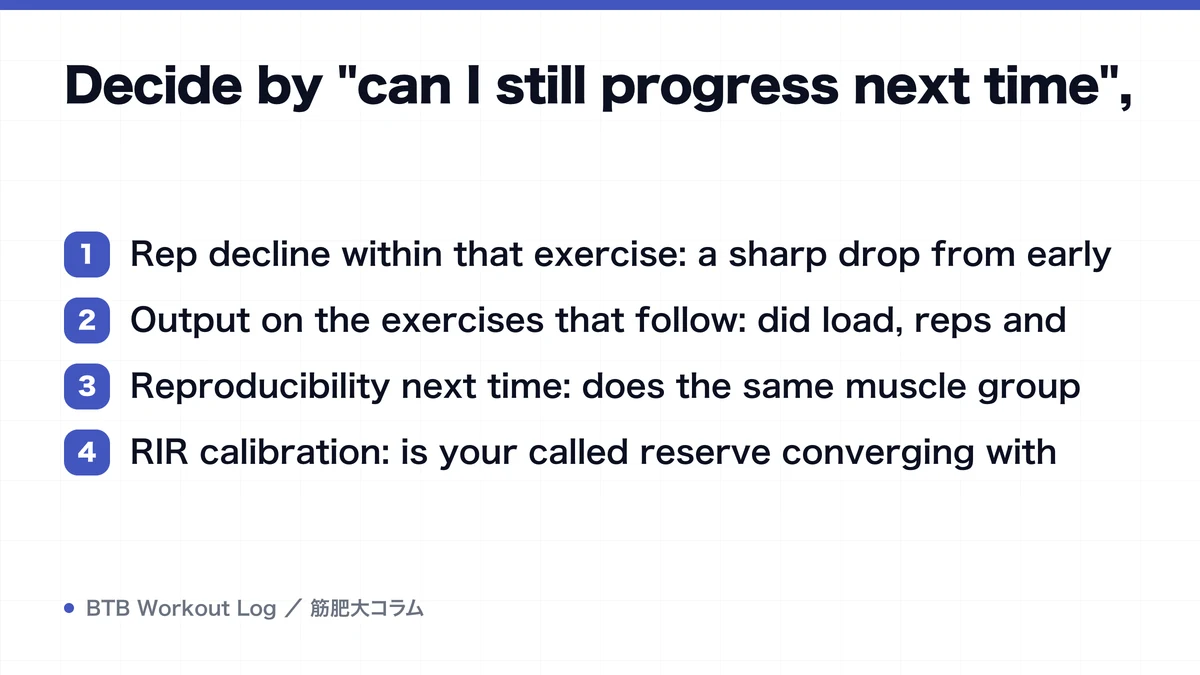
Change one thing at a time. Move just one exercise's final set from RIR 1 to RIR 0, say, and compare these four points over two to four weeks.
- Rep decline within that exercise: a sharp drop from early sets to late?
- Output on the exercises that follow: did load, reps and range of motion hold?
- Reproducibility next time: does the same muscle group return with equal or better reps and load?
- RIR calibration: is your called reserve converging with where you actually fail?
If results hold and progress on the target continues, keep the failure set. If output on the rest of the session and next time keeps falling, pull RIR back by 1-2 or reduce how many sets go to failure. The costs and benefits of pushing to the limit covers more detail on how to place these sets.
A training log's job isn't praising how hard you pushed — it's leaving you the evidence to check afterward whether that effort actually supported progress.
What happens when you take every set to the limit also stays in the log. Set count on the day drops and output on the following days tends to fall as well, so weekly total volume can go down. If you have raised how hard you push, check the following week whether you are holding the previous load and reps. If you aren't, the increase is being offset by the volume it cuts away.
FAQ
- Is it fine to take every set to RIR 0 if I can still recover?
- It's an option if reps, range of motion and output on later exercises hold and you're still progressing next time. Just don't make adding failure sets the goal itself — compare it over several weeks against pulling RIR back to 1–2.
- Which exercises suit taking to failure?
- Machines and single-joint exercises where you can hold position at failure and finish safely are the easier category. Free-weight compounds warrant leaving more reserve, given how form breakdown and the effect on later sets both carry more cost.
- If my RIR estimate is unreliable, do I have to go to failure every time?
- No — occasionally checking true failure on a safe exercise and comparing it against your everyday RIR estimate is enough to calibrate it. Log load, reps and form conditions too, and watch whether the gap between prediction and reality is shrinking.
Key takeaways
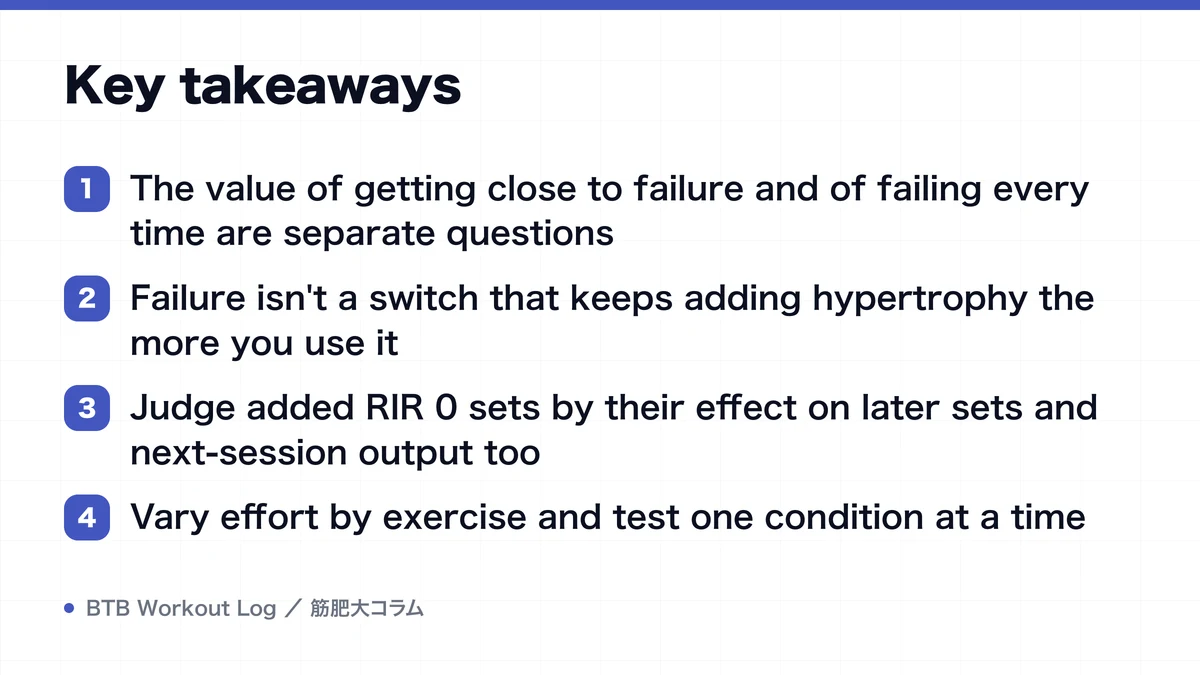
- The value of getting close to failure and of failing every time are separate questions
- Failure isn't a switch that keeps adding hypertrophy the more you use it
- Judge added RIR 0 sets by their effect on later sets and next-session output too
- Vary effort by exercise and test one condition at a time