Getting Stronger but Not Bigger? Why Your Lifts Improve but Your Muscles Don't Grow
Strength and hypertrophy overlap a lot, but they aren't the same adaptation. Lifting performance can rise from nervous-system efficiency, form and exercise familiarity too, so a strength gain doesn't automatically translate one-to-one into muscle size.
A strength gain is still a genuinely useful result. But if hypertrophy is the goal, you need to separate "how many more kilos" from what actually drove that number up.
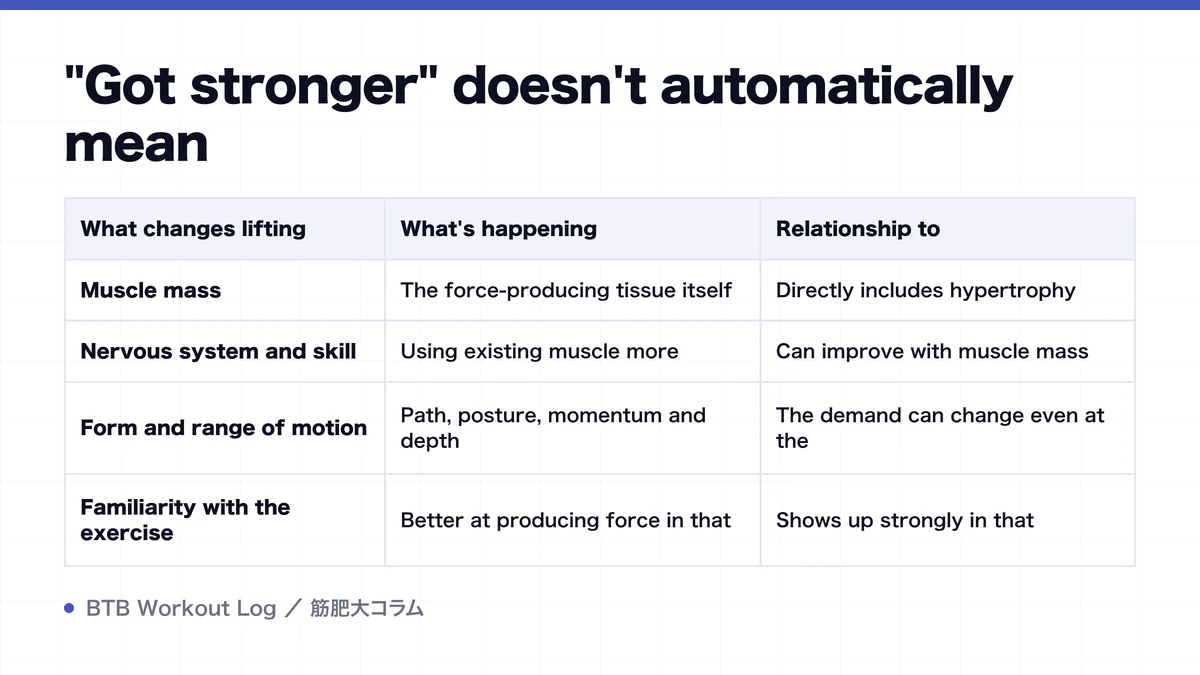
"Got stronger" doesn't automatically mean "got bigger"
Bigger muscle does raise the ceiling on force you can produce, so over the long run size and strength aren't unrelated. But the number on a barbell isn't a pure measurement of muscle mass — it's the outcome of several things combined.
| What changes lifting performance | What's happening | Relationship to hypertrophy |
|---|---|---|
| Muscle mass | The force-producing tissue itself increases | Directly includes hypertrophy |
| Nervous system and skill | Using existing muscle more efficiently in the movement | Can improve with muscle mass unchanged |
| Form and range of motion | Path, posture, momentum and depth shift | The demand can change even at the same load |
| Familiarity with the exercise | Better at producing force in that specific movement or rep range | Shows up strongly in that exercise's numbers |
So strength is a "performance" figure that includes mass — it isn't mass itself. Comparing heavy and light loads shows this gap too: hypertrophy outcomes end up similar, but maximal strength tends to favour the heavier side. Treat the two as identical and you'll grade a day you added a plate as hypertrophy and a day you couldn't as failure — both too extreme.
How lifting performance rises without adding muscle
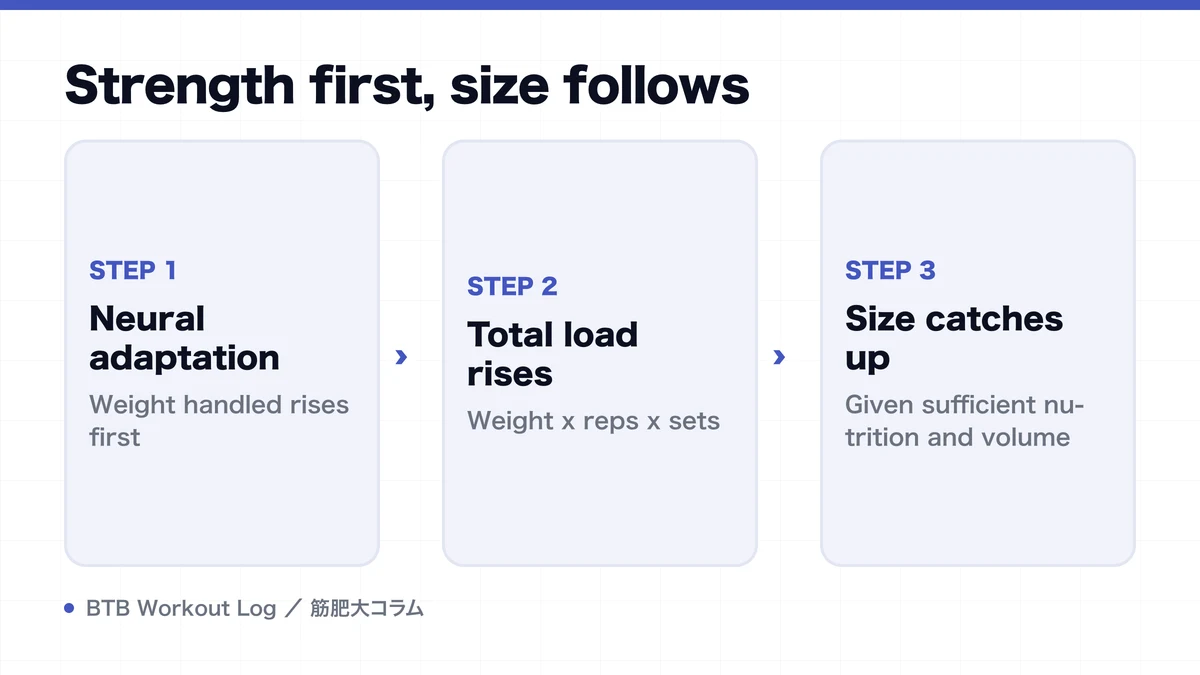
Repeat the same exercise and the timing of recruiting the right muscles, how you brace, and the path that transmits force most efficiently all get refined. On squat that means foot pressure and the turnaround; on bench press, bracing and bar path stabilise, letting you extract more performance from the muscle you already have. That isn't cheating — it's genuine skill improvement specific to that movement.
This especially shows up during a phase using low reps and heavy load often — you accumulate more practice producing force against heavy weight. So it's unsurprising if your 1RM or 3-rep numbers rise first. Meanwhile, if the volume of hard sets that push the target muscle near failure is low, hypertrophy stimulus may not be accumulating at the same rate as lifting skill.
A PR under changed conditions isn't a comparison of the same capability
If load rose on a shallower squat, a bench press with more bounce off the chest, or a curl with more momentum, the number is a PR without necessarily beating the same challenge. The more range of motion, tempo, equipment, exercise order and rest period shift, the more non-strength differences get mixed into the record. The risk of treating load alone as progress connects to why adding load isn't enough on its own.
Load studies show hypertrophy and strength moving separately
Schoenfeld et al.'s 2017 meta-analysis, pooling studies where every set was taken to momentary failure, found a small hypertrophy difference between low and high load while 1RM strength gains favoured the higher-load side. Muscle-building stimulus can form across a wide load range, but the ability to lift heavy weight is more sensitive to practice handling heavy weight specifically.
This is explained by specificity — the tendency for capability to improve most in whatever movement, load and rep range you actually practised. Train heavy bench press and you simultaneously sharpen the skill a 1RM test on bench press needs. That doesn't require zero change in cross-sectional area — it means non-mass improvements are also stacking onto the test result.
Conversely, mass can be increasing on sets built around 8–15 reps while it doesn't immediately show up in maximal strength if you aren't practising 1RM attempts. So progressive overload matters, but you have to be clear which metric you're overloading. It's reasonable to treat strength gains as a useful foundation for hypertrophy, not standalone proof it occurred.
Read what improved from your log
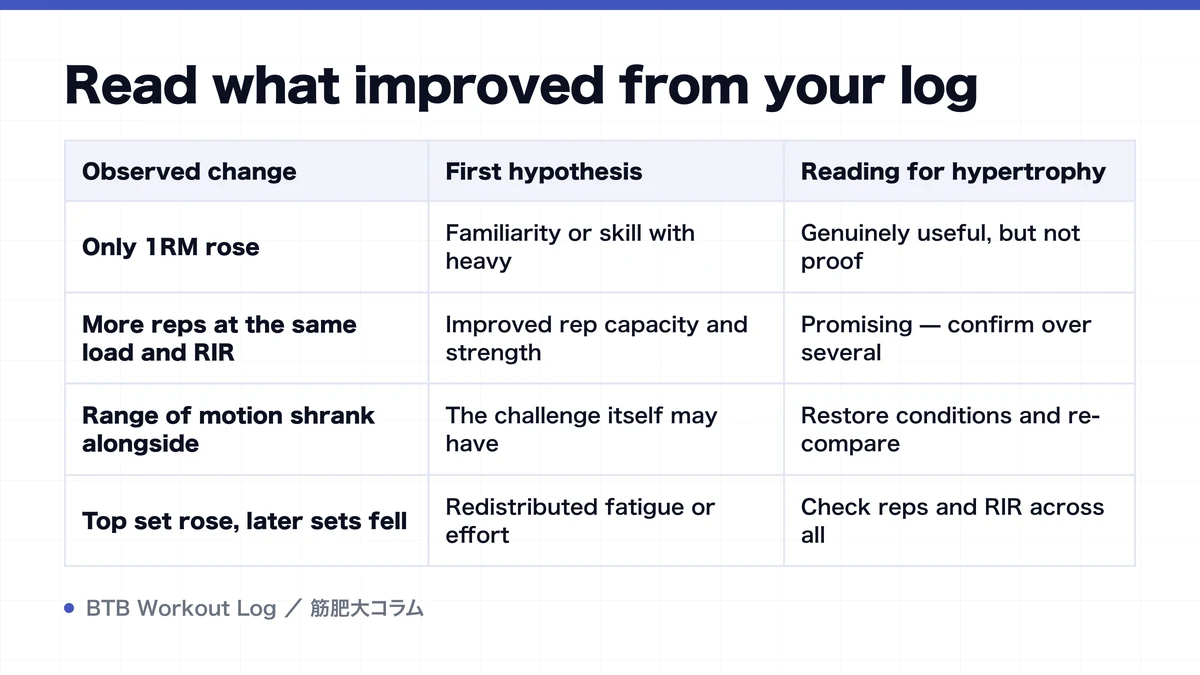
For hypertrophy, a matched-conditions comparison is what carries value. Same exercise, same range of motion and form, similar rest period, similar RIR (reps in reserve) — watch whether load or reps are climbing. That's what lets you judge whether the target muscle's workload genuinely increased without the challenge itself changing much.
| Observed change | First hypothesis | Reading for hypertrophy |
|---|---|---|
| Only 1RM rose | Familiarity or skill with heavy load | Genuinely useful, but not proof of added mass |
| More reps at the same load and RIR | Improved rep capacity and strength | Promising — confirm over several weeks |
| Range of motion shrank alongside load | The challenge itself may have gotten easier | Restore conditions and re-compare |
| Top set rose, later sets fell | Redistributed fatigue or effort | Check reps and RIR across all sets too |
A multi-week trend under matched conditions is more useful evidence than any single day's PR. Appearance and circumference also move with lighting, measurement position, pump and hydration, so keep conditions as matched as you can each time. When tracking overall session workload, don't rely on load × reps alone — logging weekly hard sets alongside RIR makes it far easier to interpret.
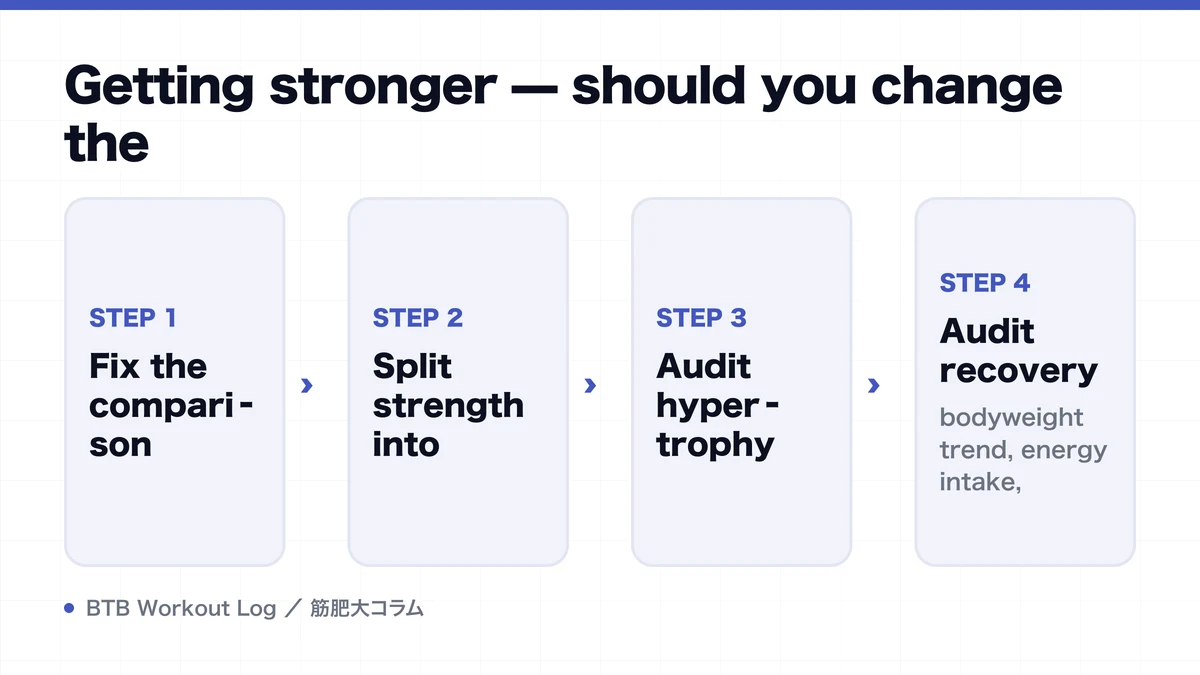
Getting stronger — should you change the programme?
If size looks unchanged, you don't need to add sets right away. Check in this order first.
- Fix the comparison conditions: exercise, equipment, range of motion, form, rest and exercise order matched.
- Split strength into two: track your 1RM or low-rep top set separately from your moderate-rep later sets.
- Audit hypertrophy inputs: weekly hard sets for the target, RIR, frequency and overlapping stimulus across exercises.
- Audit recovery: bodyweight trend, energy intake, protein and sleep for any obvious shortfall.
If matched-condition reps and later sets are also climbing, and you've only watched bodyweight and circumference for a short period, there's room to keep the current programme and gather more trend. If only the 1RM is rising while hard sets and moderate-rep work for the target have stalled, consider that you may be skewed toward heavy-load skill. Only once recovery has room and standardised records have stalled for several weeks is it worth considering added sets or adjusting exercise selection.
The relationship isn't one-directional either — the opposite trap, assuming stalled load means no hypertrophy, is unpacked in testing "no strength gain means no hypertrophy".
Short notes on form and range of motion give you the evidence to separate a bare load PR from progress accumulated under matched conditions. If you're suspecting strength and mass have diverged, you need to look at load trend and weekly total volume separately — BTB Workout Log lets you check both apart.
FAQ
- If strength is rising, can I assume the current hypertrophy programme is working?
- It's a good sign, but not conclusive on its own. Also check whether moderate-rep sets are progressing at the same range of motion, form and RIR, and whether weekly hard sets for the target and recovery are holding. If only the 1RM rose, skill adaptation may be doing most of the work.
- Over what timeframe should I judge whether muscle actually got bigger?
- A few sessions or day-to-day appearance can't separate pump and hydration swings from real change, so judge over weeks to months. Match photos and measurements to the same time of day, posture and position, and read them alongside bodyweight and standardised training records.
- If I'm getting stronger but size isn't changing, should I add sets?
- Not immediately. First check whether range of motion or RIR has drifted, whether the target is getting the sets it needs, and whether nutrition and sleep are adequate. Only consider a small set addition once those are matched, progress has stalled for several weeks, and recovery still has room.
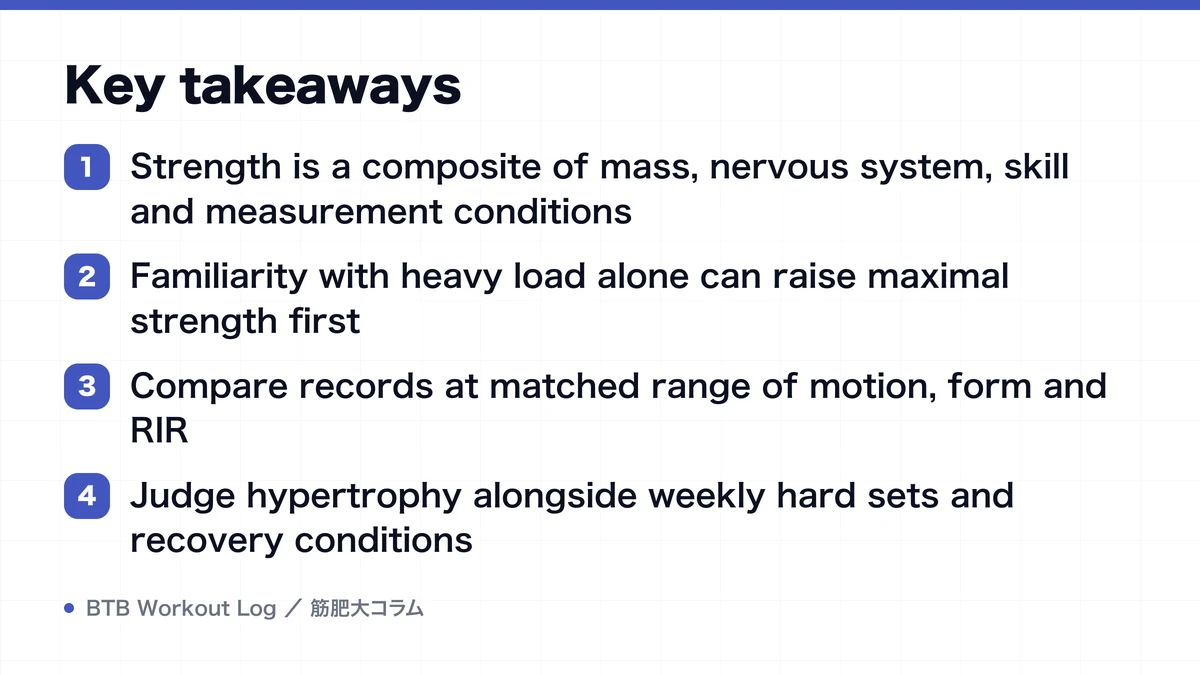
Key takeaways
- Strength is a composite of mass, nervous system, skill and measurement conditions
- Familiarity with heavy load alone can raise maximal strength first
- Compare records at matched range of motion, form and RIR
- Judge hypertrophy alongside weekly hard sets and recovery conditions