10 vs 20 Sets per Week for Hypertrophy: Is Twice the Work Worth It?
Under matched conditions, 20 weekly sets can add to hypertrophy, but it doesn't mean growing twice as much as 10 sets. If you're progressing on 10 sets, maintain it; if progress has stalled and you have recovery capacity to spare, stepping gradually toward 20 is reasonable.
What to compare isn't set count alone — it's the small benefit an added set produces against its cost in fatigue, time, and back-half quality. Don't treat either number as a fixed prescription; judge it for the same muscle group over the same period.
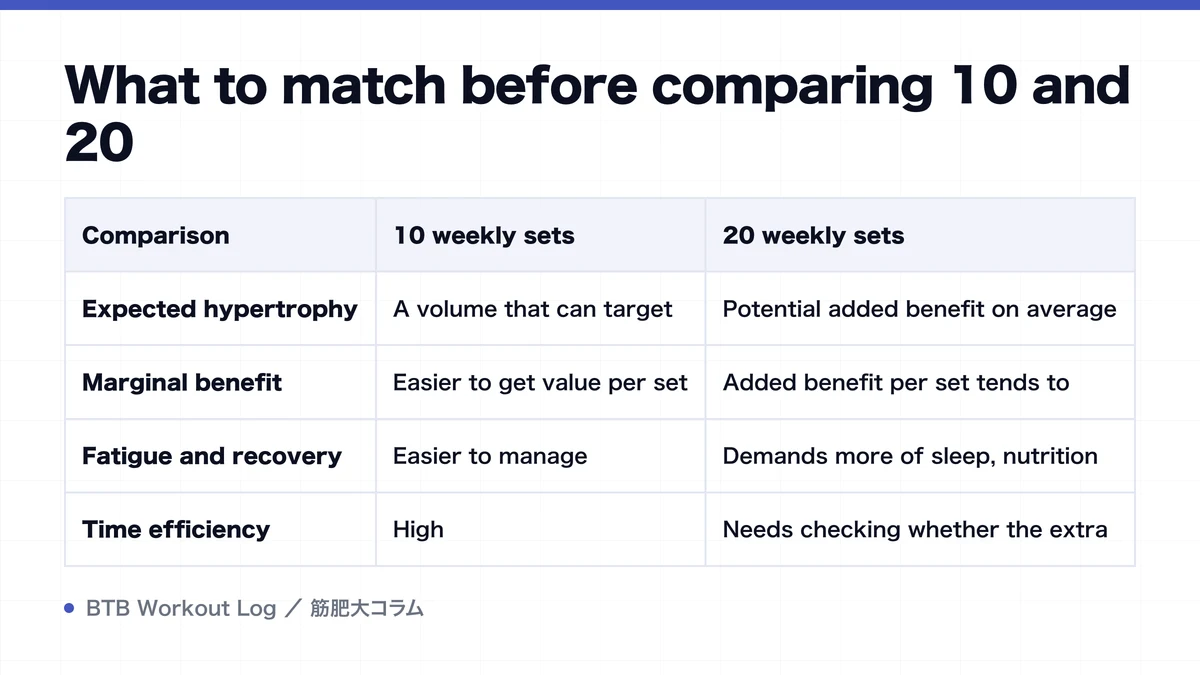
What to match before comparing 10 and 20 weekly sets
The set count here means weekly hard sets per muscle group. A hard set moves the target muscle through sufficient range of motion and reaches roughly RIR 1–3 — 1 to 3 reps left in reserve before the limit. It doesn't include warm-ups or sets left with a lot of reserve for movement practice. The basic counting method is covered in how to think about weekly sets.
You also need to distinguish direct from indirect stimulus. A chest press, for instance, is a direct set for the pecs, but it also loads the triceps. Whether you count every indirect set as a full set or as roughly 0.5 sets changes the total. Either convention is fine, but you must not change it mid-comparison. Pelland et al.'s 2026 meta-regression, for instance, also distinguishes direct from indirect sets in its tallies.
| Comparison | 10 weekly sets | 20 weekly sets |
|---|---|---|
| Expected hypertrophy | A volume that can target sufficient growth | Potential added benefit on average |
| Marginal benefit | Easier to get value per set | Added benefit per set tends to shrink further in |
| Fatigue and recovery | Easier to manage | Demands more of sleep, nutrition and frequency design |
| Time efficiency | High | Needs checking whether the extra time is worth it |
| Fits best when | Progressing, time-constrained | Stalled, with recovery capacity to spare |
In other words, "10 vs. 20" only becomes a meaningful comparison once exercise, form, RIR, rest and frequency are roughly matched. Comparing a high-quality 10 sets against a 20 where form and output broke down in the back half doesn't tell you the numeric gap reflects a stimulus gap. You need to keep in mind first that the same 10 sets can differ in content.
20 sets may favor the hypertrophy average, but the benefit diminishes
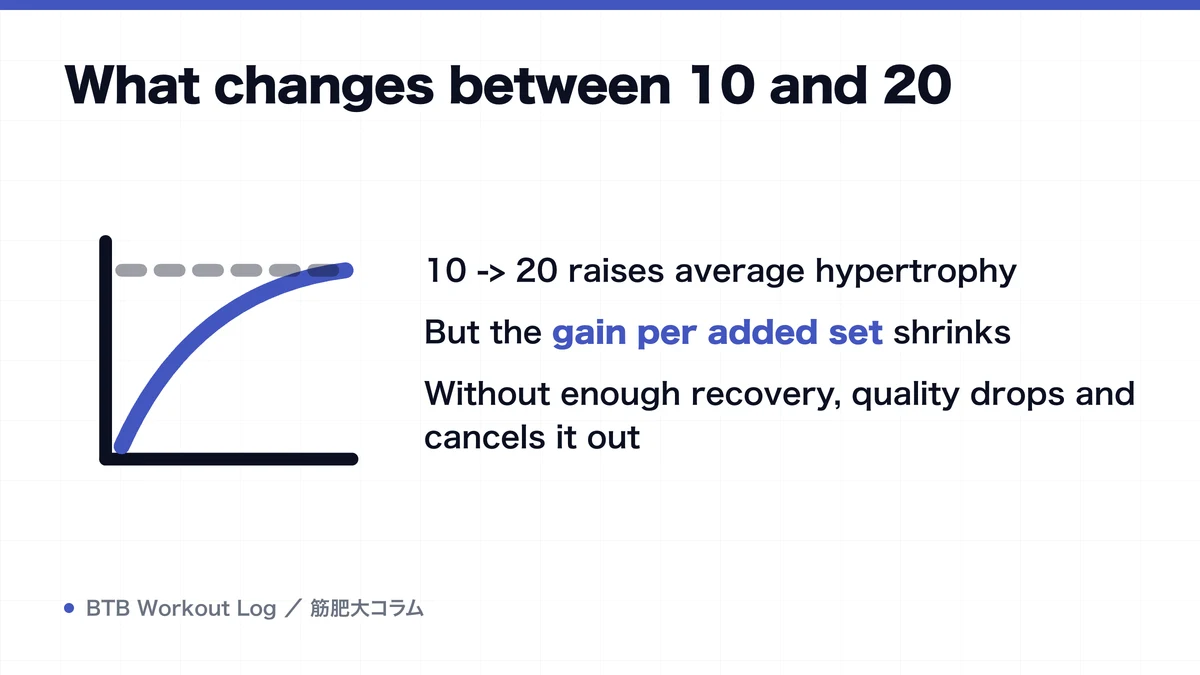
A dose-response relationship has been shown between weekly volume and hypertrophy, where average hypertrophy tends to rise as volume increases. Schoenfeld et al.'s 2017 meta-analysis reported a trend of larger muscle gains at higher weekly set counts compared to lower ones. A 2019 study comparing multiple volume conditions in resistance-trained participants likewise found the higher-volume condition favored on some measurement sites.
But reading this as "20 sets grows you twice as much as 10" is a mistake. The 2026 meta-regression shows a shape where the estimated hypertrophy value keeps rising with more weekly sets, while the benefit from each additional set gets progressively smaller. In other words, the 11th set added onto 10 and the 20th set added onto 19 can't be treated as equally valuable.
A research average doesn't directly specify anyone's individual optimum either. Participant training history, exercise selection, how sets were counted, intervention duration, and which measurement site (like muscle thickness) all differ, so response doesn't align even at the same high volume. 20 weekly sets is neither a "ceiling" nor a "required minimum" — it's an option that targets an average gain while also raising cost.
10 extra sets add fatigue and time, not just stimulus
The problem with the 20-set side isn't simply more soreness. If reps at the same weight drop in the back half of a session, assisting muscles fatigue before the target does, or local tightness doesn't clear by next time, the quality of the added volume falls. Simply completing the sets under those conditions can end up interfering with next week's progressive overload.
Time cost isn't negligible either. Going from 10 to 20 weekly sets literally doubles your main set count. Total session time won't fully double since warm-up can be shared, but rest, moving between equipment, and logging all add extra time on top. Within a limited 3-day-a-week structure, adding 10 sets to chest might force you to cut priority exercises for back or legs. Maximizing one muscle group and completing a well-rounded full-body program are separate axes to evaluate.
If you go with 20 sets, spreading them across 2–4 sessions a week instead of cramming them into one makes it easier to hold output on each set. Raising frequency itself isn't magic for hypertrophy though — it's a tool for distributing needed volume without losing quality. See comparing once vs. twice weekly for more on weekly distribution.
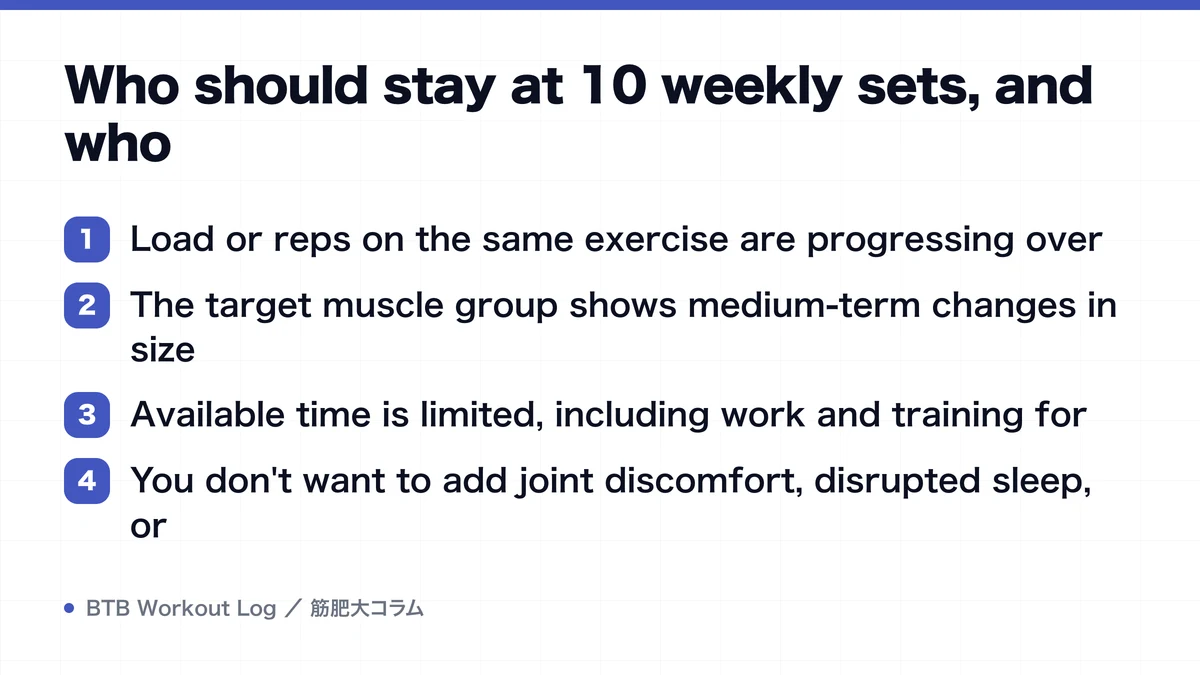
Who should stay at 10 weekly sets, and who can consider 20
Conditions for maintaining 10 weekly sets
- Load or reps on the same exercise are progressing over several weeks
- The target muscle group shows medium-term changes in size or girth
- Available time is limited, including work and training for other body parts
- You don't want to add joint discomfort, disrupted sleep, or next-session output decline
In this state, not raising volume isn't a passive choice. If you're progressing on 10 sets, that volume is working for you right now. It's more time-efficient to first tighten each set's RIR, exercise stability and rest, and squeeze out what the current volume can give you.
Conditions for leaning toward 20 weekly sets
- Load, reps or measurements on the target muscle have stalled even at around 10 sets sustained
- Sleep, energy intake and protein are stable, and you're recovering by next time
- Splitting the added volume across multiple days doesn't crowd out priority exercises for other body parts
- You can keep logging RIR and form consistently even after adding sets
Even meeting these conditions, you don't need to double from 10 to 20 at once. Start with a small change — say, adding 2 sets to one exercise — and hold everything else steady for several weeks while you observe. Keep it if the response is good; revert if fatigue rises with no progress. 20 isn't a target to hit — it's a comparison point to approach as needed.
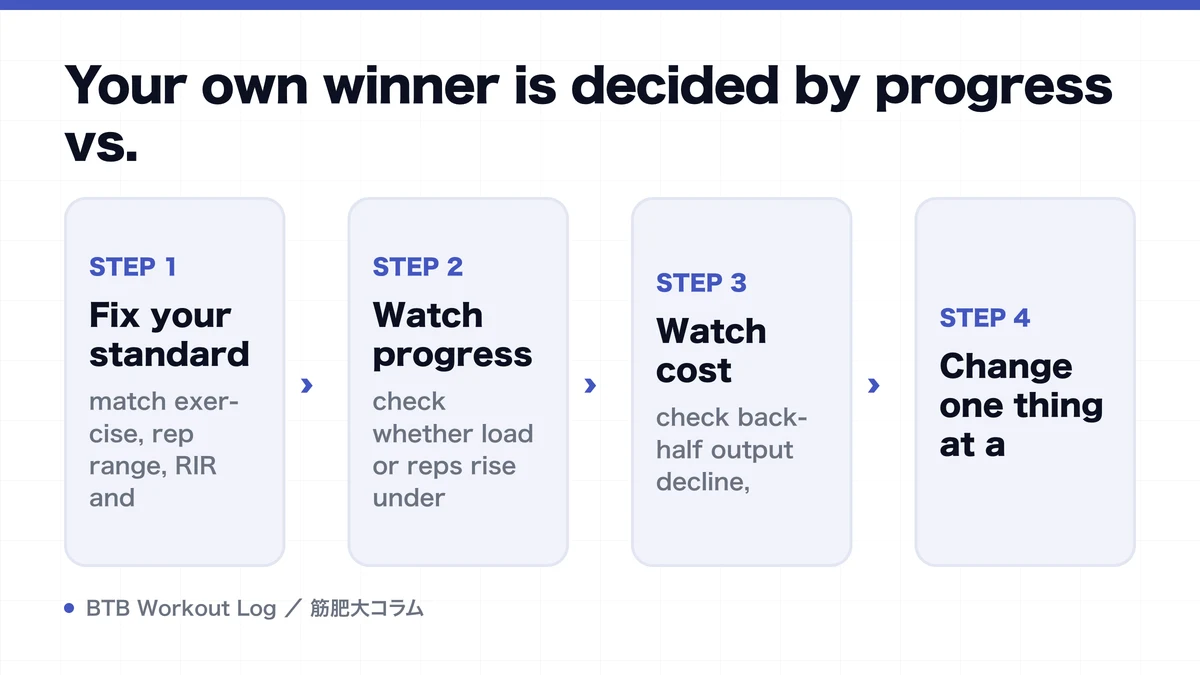
Your own winner is decided by progress vs. cost, not set count
Track, over the same period, not just set count by muscle group but each exercise's load, reps and RIR, within-session rep decline, and recovery by next time. Hypertrophy changes are hard to read over the short term, so don't switch based on one good or bad session — run one program for several weeks and watch the trend. Separating the roles of daily volume load and weekly set count, as in managing volume, helps organize this.
- Fix your standard: match exercise, rep range, RIR and how you count sets.
- Watch progress: check whether load or reps rise under the same form.
- Watch cost: check back-half output decline, delayed recovery, joint discomfort, and time required.
- Change one thing at a time: only add a small amount of volume to the target muscle once progress has stalled and cost still has room.
A training log isn't there to justify 20 sets — use it as material for deciding whether to stay at 10 or try adding more. Your right amount is only decided by looking at several weeks after the change. BTB Workout Log lets you track weekly hard sets by muscle group at that level.
The premise for adding volume is not to double it at once. Move from 10 weekly sets to 20 in one jump and you can't tell whether the result changed through the effect or through the fatigue. Adding 2-4 sets every two weeks, staying there while load and reps keep beating last time, and treating the point just before they stop beating it as your ceiling for that period, is more reproducible.
FAQ
- Will beginners grow faster by doing 20 weekly sets?
- Beginners tend to progress even on lower volume, and their exercise technique and recovery management aren't yet established. It's easier to judge the effect of extra volume if you first confirm load and rep progress around 10 weekly sets, and only add small increments once progress stalls and recovery capacity allows.
- Can I do 20 weekly sets all in one session?
- It's not impossible if you can hold output and form on the target muscle through the back half, but splitting 20 sets across multiple days makes it easier to maintain quality. If cramming them into one session badly degrades reps or RIR, consider spreading it across 2–4 sessions a week.
- How many weeks should I judge before adding to 10 sets?
- Don't change from one or two off sessions — watch the trend over several weeks at the same exercise, RIR and counting method. Maintain if load or reps are progressing and recovery is good. It's a candidate to try adding volume once progress has stalled, sleep and nutrition aren't the issue, and you have time and recovery to spare.
Key takeaways
- 20 weekly sets can add to average hypertrophy, but the benefit diminishes
- If you're progressing, it's fine to maintain the more time-efficient 10 weekly sets
- The case for leaning toward 20 sets is a stall plus sufficient recovery capacity
- Decide changes by matching load, reps, RIR and fatigue
References
- The Resistance Training Dose Response: Meta-Regressions Exploring the Effects of Weekly Volume and Frequency on Muscle Hypertrophy and Strength Gains
- Dose-response Relationship Between Weekly Resistance Training Volume and Muscle Mass
- Resistance Training Volume Enhances Muscle Hypertrophy in Trained Men