Progressive Overload: Can You Build Muscle If You Change Exercises Every Workout?
Yes, you can. But picking a completely different exercise at random every time makes it hard to tell whether you actually raised the stimulus from last time. You need either exercises that recur on a schedule, or at least one you keep as a reference point.
What matters to the muscle isn't a fixed exercise name — it's effective stimulus to the target advancing over time. Confirming that advance, though, needs an observation point you can compare under matched conditions: load, reps, RIR, range of motion.
Progressive overload isn't "a personal best every time"
The core of progressive overload is raising the training stimulus over time in step with adaptation. It doesn't mean adding a plate every session or beating last time by one rep, specifically. More reps at similar RIR (reps left in reserve) with the same load, the same reps through a wider range of motion, or completing the same weekly sets with steadier form — all count as progress.
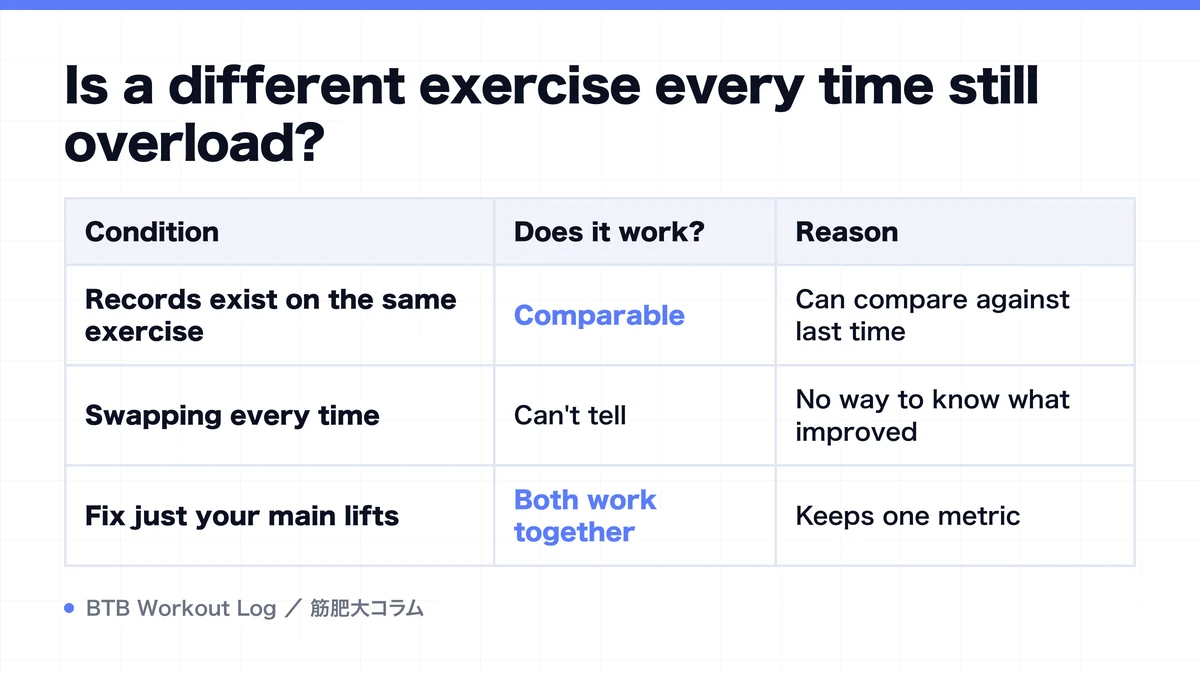
Separate the stimulus might have advanced from you can confirm it advanced. Barbell bench Monday, dumbbell flyes next week, dips the week after — each sufficiently effortful set can still stimulate the chest even as the comparison point changes every time. But equipment, path, stability, range of motion and what else is limiting the set all move at once, so you can't line up the loads or reps side by side. Exercise variety and stimulus can coexist; randomness is what makes verifying overload hard.
So the real question isn't "does it still work if you change exercises every time" — it's does your plan, varied as it is, contain a series you can measure repeatedly under matched conditions. With that series, you can track progressive overload while still rotating. Without it, the effort is real but whether you advanced stays a guess.
Research supports planned progression, not novelty
Resistance-training progression models adjust load, reps, sets and frequency against training history and adaptation. That doesn't mean the same exercise forever, and it doesn't mean replacing everything each session to "shock" the body either. It means planning variables toward the adaptation you want, and setting the next stimulus from how you responded.
Hypertrophy also depends on several variables together — intensity, volume, frequency, mode. Changing exercise is one way to change mode and how load is applied, but the change alone doesn't establish a bigger stimulus than before. A new exercise can also produce a quick jump in reps or load purely from motor learning, so treat that early rise cautiously rather than reading it straight as hypertrophy.
The choice between a fixed programme and exercise rotation affects measurability as much as stimulus type. Fixed exercises keep conditions matched; rotation is useful for joint discomfort, equipment availability, monotony and reaching specific muscle lengths or paths. Both have a role — the question isn't whether to change, but whether the design still lets you track progression after you do.
Three layouts that keep overload trackable through rotation
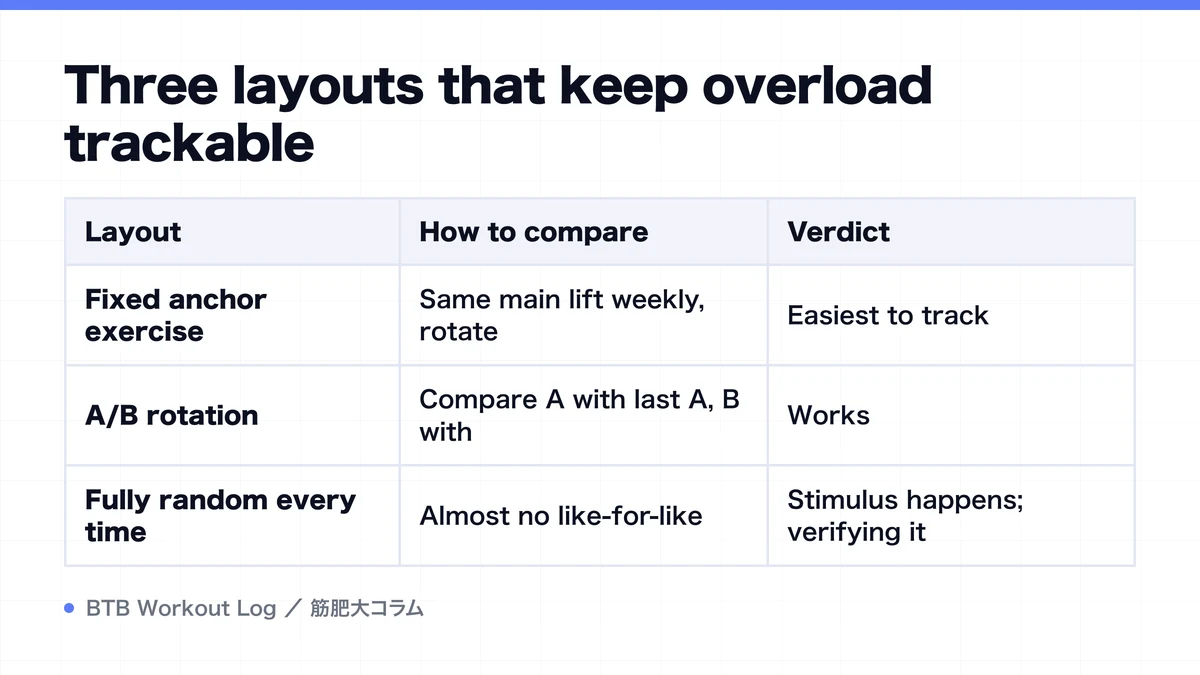
| Layout | How to compare | Verdict |
|---|---|---|
| Fixed anchor exercise | Same main lift weekly, rotate accessories only | Easiest to track |
| A/B rotation | Compare A with last A, B with last B | Works |
| Fully random every time | Almost no like-for-like remeasurement | Stimulus happens; verifying it doesn't |
Keep an anchor exercise
Keep one pressing movement as your reference for chest, one pulling movement for back. Rotate accessories freely and the performance series stays intact as long as the anchor keeps the same equipment, settings, range of motion and rep range. This is the easiest way to keep exercise freedom and measurability together.
Treat A and B as separate series
Bench press 80 kg for 8 in week 1, chest press 60 kg for 10 in week 2, bench 80 kg for 9 in week 3, chest press 60 kg for 11 in week 4 — compare with the same exercise two weeks back, not one. Each exercise appears less often, but if both A and B carry their own independent progression, you can still track overload across the whole rotation.
Give a substitute the same job
When equipment forces a swap, match target muscle, movement pattern, rep range and set effort as closely as you can. Don't add or ratio-convert numbers between an 80 kg barbell and a 60 kg machine — the mechanics and leverage differ. On a substitution day, manage weekly hard sets and RIR, and judge load and rep progress within each exercise separately.
Don't measure different exercises on the same ruler
Log load, reps per set, RIR, range of motion and equipment settings per exercise. Seat position or grip changing turns the same exercise name into different conditions, so note anything that affects comparability. Conversely, changing tempo or rest period in small ways every time leaves you unable to say what actually improved. Hold the main conditions steady, at least for the window you're using to judge progress.
The method doesn't need to be complicated. Pick an 8–12 rep range, add reps at similar RIR and form, and bump load slightly once you hit the top. On an A/B rotation, apply that rule separately to A and B. If you're unsure whether to add load or reps, deciding the rule in advance — as in load versus reps progression — keeps the day's mood from changing your criteria.
Watch total volume load too. Within the same exercise and range of motion, load × reps × sets is a useful secondary indicator. Across different exercises it isn't the same stimulus at all — 100 kg on a squat and 50 kg on a leg extension involve different muscles and mean something different as external load. Don't sum unrelated exercises into "10% more overload than last week"; keep within-exercise trends and weekly hard sets per muscle group separate.
Practical rules that keep freedom and verifiability both
If enjoying a different exercise each time is what keeps you consistent, you don't have to give that up. Just don't make everything a free slot — place one anchor per muscle group, or fix a two- or three-exercise rotation in advance. In a week where changes happened outside the plan, call it "volume completed" rather than claiming progress, so you don't over-read the record.
Legitimate reasons to swap: pain or discomfort, equipment constraints, a long-standing plateau, poor fit with the target, or falling adherence. If you're swapping every time purely because "beating last time's number is intimidating" or "I felt like changing it up", you may be avoiding the comparison rather than varying the stimulus. As with why more exercises blur progress, more choices spread your observations thinner.
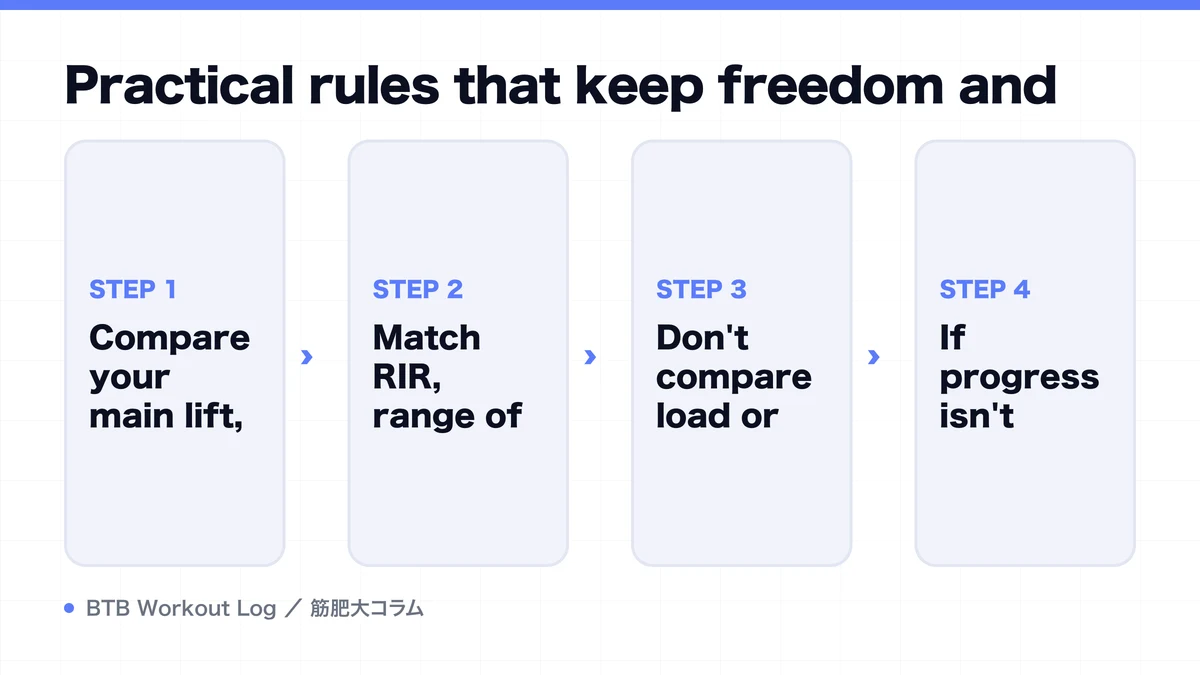
- Compare your main lift, or each A/B exercise, against the same exercise last time.
- Match RIR, range of motion and equipment settings — not just load and reps.
- Don't compare load or total volume directly across different exercises.
- If progress isn't visible after several reappearances, check recovery, volume and exercise fit one at a time.
No app produces overload by itself, but it can keep the comparable series from getting lost inside a rotation. Whether you change exercises every time or not, you can compare as long as records exist from the last time that exercise reappeared — and BTB Workout Log keeps that history organised per exercise.
FAQ
- Does hypertrophy still happen if I change exercises every session?
- It can, as long as each set delivers sufficient stimulus to the target and weekly volume and recovery are adequate. Because full randomness makes it hard to confirm the stimulus advanced over time, keeping an anchor exercise or a regular rotation is the practical fix.
- In an A/B rotation, what should I compare against what?
- Compare exercise A with the last time you did A, and B with the last B — not with the different exercise from one week ago. Match equipment settings, range of motion, rep range and RIR, and check whether load or reps are trending up within each series over time.
- Can I judge overload by summing total volume across different exercises?
- Not directly. Different exercises change range of motion, leverage, stability and which muscles are involved, so the same kilogram means something different each time. Keep total volume as a within-exercise indicator, and check the week as a whole through weekly hard sets per muscle group plus each exercise's own trend.
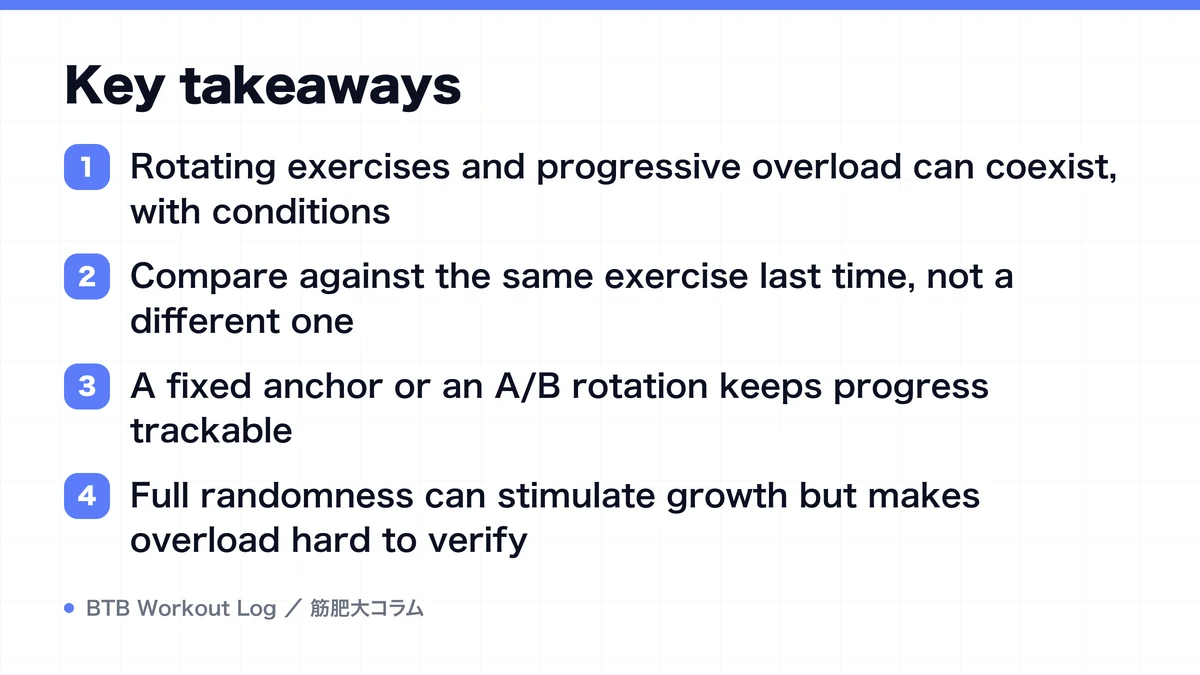
Key takeaways
- Rotating exercises and progressive overload can coexist, with conditions
- Compare against the same exercise last time, not a different one
- A fixed anchor or an A/B rotation keeps progress trackable
- Full randomness can stimulate growth but makes overload hard to verify