How Much Muscle Do You Lose After 1 Week Off? | The Answer for Lifters Afraid to Take a Break
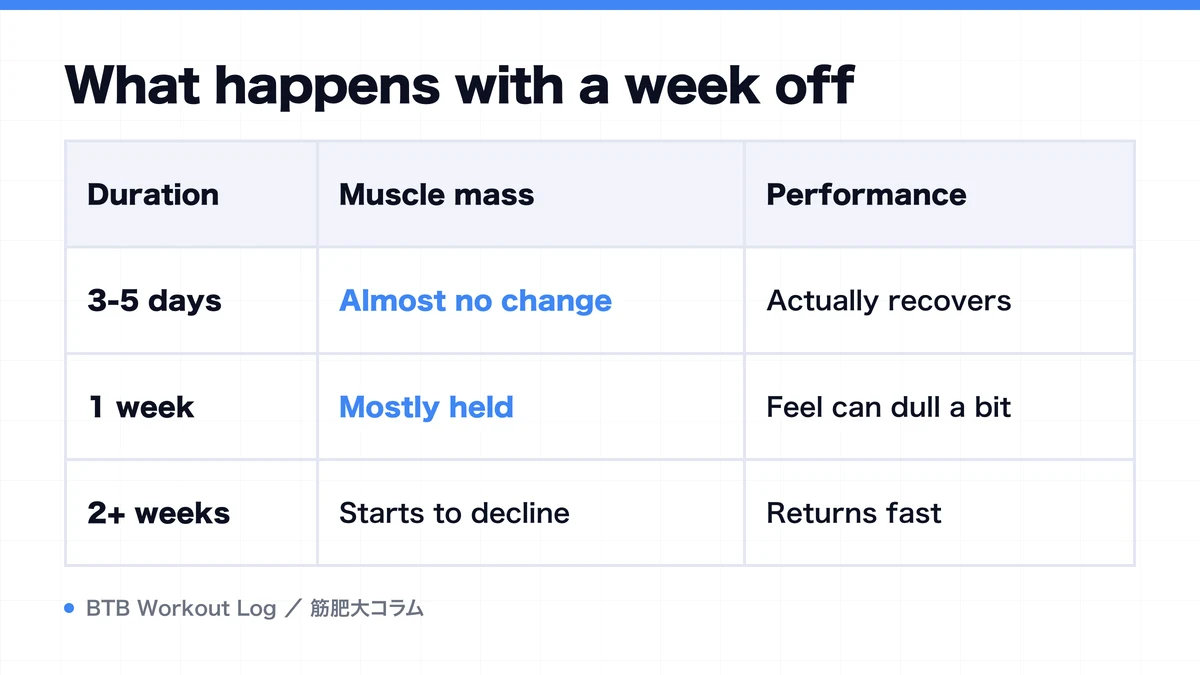
If you're healthy, still moving through a normal day and still eating roughly as usual, a week off costs you close to nothing in practical terms. What nobody can give you is a single percentage that applies to everyone.
Fullness, scale weight and your reps on the first session back really do change in a week — but none of those numbers is a readout of muscle tissue. Let's separate what you're actually measuring from what would have to be true for the answer to change.
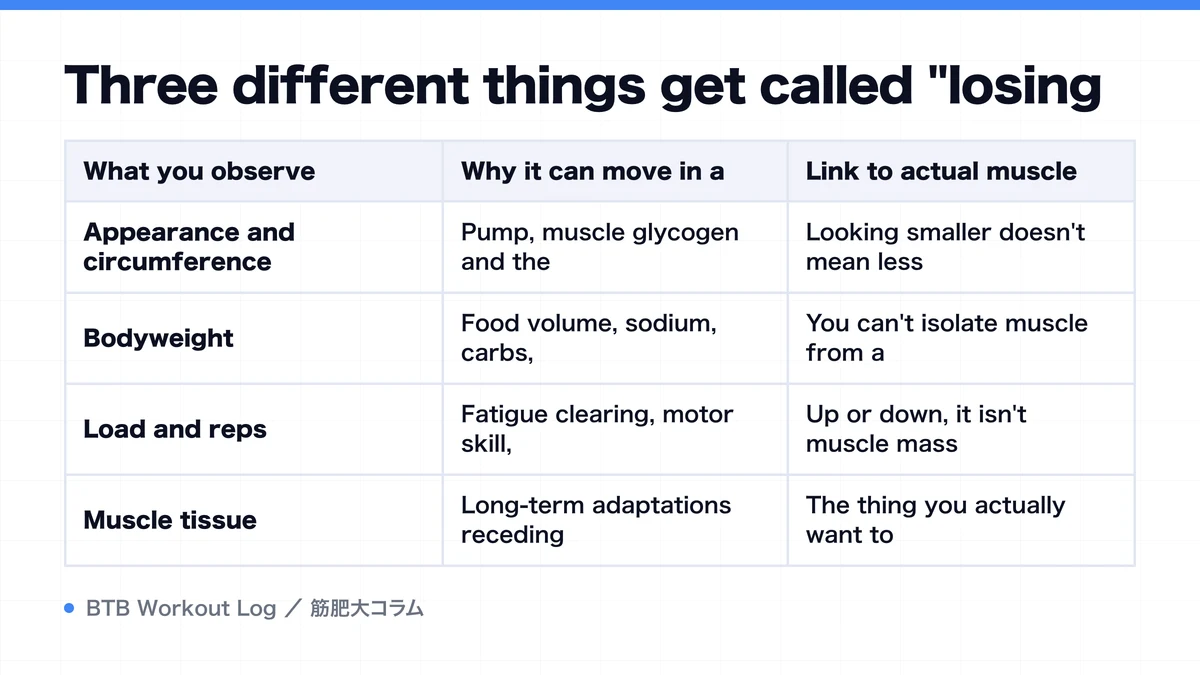
Three different things get called "losing muscle"
"I lost muscle" usually blends at least three separate observations. Looking flatter in the mirror after a week off, or finding the first set heavy, does not mean muscle fibres shrank by the same amount.
| What you observe | Why it can move in a week | Link to actual muscle loss |
|---|---|---|
| Appearance and circumference | Pump, muscle glycogen and the water stored with it | Looking smaller doesn't mean less tissue |
| Bodyweight | Food volume, sodium, carbs, hydration, gut contents | You can't isolate muscle from a short-term swing |
| Load and reps | Fatigue clearing, motor skill, sleep, warm-up quality | Up or down, it isn't muscle mass alone |
| Muscle tissue | Long-term adaptations receding once the stimulus is gone for a while | The thing you actually want to know about |
So comparing one before-and-after photo or one weigh-in can't tell you "I lost a kilo of muscle." How the picture changes from days to months is covered in how detraining unfolds; here we stay inside that one-week window.
Losing the stimulus isn't the same as losing the tissue
Hypertrophy isn't finished in a single session. It's what's left after repeatedly loading muscle fibres and letting protein remodelling and recovery accumulate over months. The reverse doesn't run at the same speed either: skipping one session's worth of stimulus doesn't start unwinding that work at the rate it was built.
The rise in muscle protein synthesis after a resistance session is temporary. But that response settling back to baseline is not the moment visible atrophy begins. Muscle protein is synthesised and broken down continuously, training or not, and daily activity and food both feed into it. The mistake is running short-term physiology and long-term mass off the same clock.
There's also the opposite case. Coming off a demanding block, a week can clear fatigue faster than it erodes adaptation — which is why the same load can feel lighter when you come back. That's less "I gained muscle in a week" and more "the output fatigue was hiding is now visible." The same reasoning appears in how a deload restores performance.
When "basically nothing" holds — and when it doesn't
Treating every week off as the same thing is where the answer goes wrong. A healthy lifter away for work or travel and someone whose physical activity is genuinely restricted by illness or injury are not putting their muscle through the same conditions.
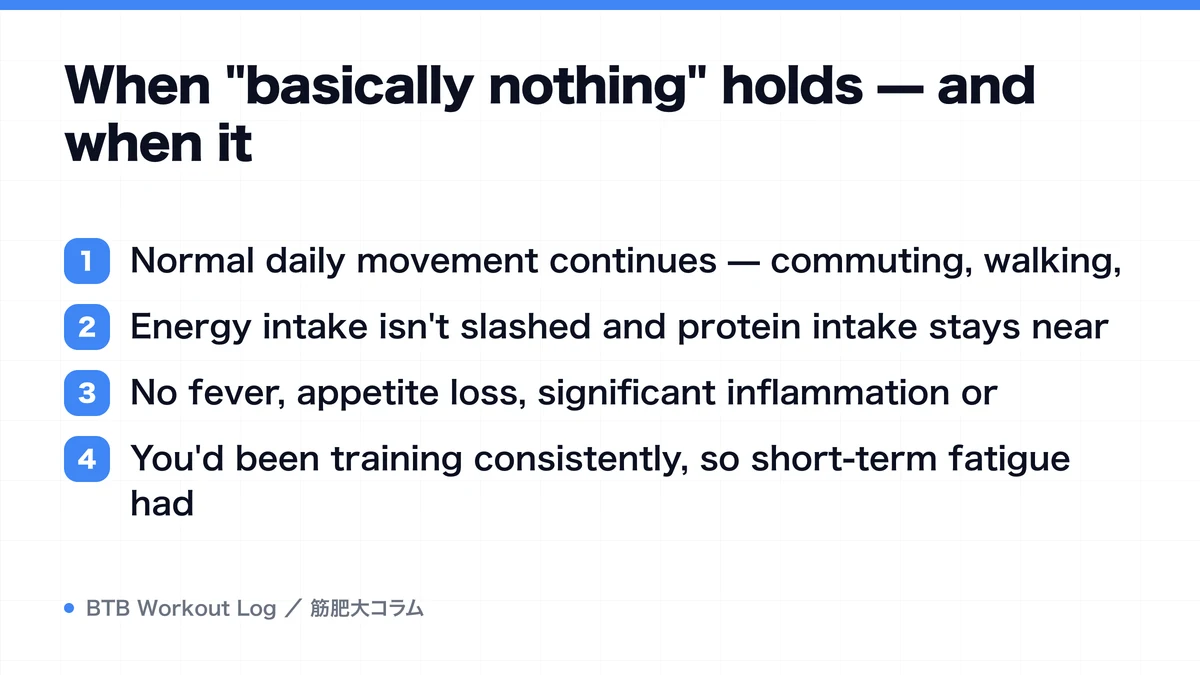
Situations where losses are effectively negligible
- Normal daily movement continues — commuting, walking, housework
- Energy intake isn't slashed and protein intake stays near usual
- No fever, appetite loss, significant inflammation or immobilised limb
- You'd been training consistently, so short-term fatigue had accumulated
Same "one week", but treat it separately
- Hospitalisation, bed rest or a cast, so the muscle is barely used
- Illness cutting food intake and activity at the same time
- An aggressive cut with a large energy deficit and rapid weight loss
- Older age, ongoing treatment, or a week that's the tail end of a much longer layoff
That second group isn't testing "what a week away from the gym does" — it's testing something else. With illness or immobilisation, recovery and medical advice come first. Deliberately reducing load to manage fatigue is a different goal again, so handle it as a deload rather than a full week off.
Why nobody can hand you a percentage
The most accurate answer to the question is this: for a healthy lifter living normally, meaningful muscle loss is unlikely — and there's no shared figure, not even 0.0%, that applies to everyone. Starting muscle mass, training history, age, activity level, food intake and which site you measure all change how it plays out.
Over a window this short, measurement noise moves in the same direction as the thing you're trying to detect. Morning versus evening, food, hydration and whether you trained recently all shift bodyweight, circumference and appearance. Even when a device gives you a number, the difference isn't necessarily contractile tissue. A precise-looking percentage is not usable for decisions if the conditions behind it weren't controlled.
If you do want to check your own case, use three sessions before the break and three after as the comparison unit. Hold measurement time, food, hydration, exercise order and rest periods as steady as you can, and don't judge on a single day's best. If circumference comes back and load and reps at the same RIR return within a few sessions, there's little left to explain with lost tissue. If output stays down, look at health, pain, sleep and the reason for the break before blaming muscle mass.
What the research actually supports is that hypertrophy is a long-term adaptation to some combination of frequency, intensity, volume and mode — not something a single acute protein-synthesis response explains. You can't derive "everyone loses X% in a week off" from that. Which means the useful question isn't the decimal place; it's why you're taking the week and what your activity and nutrition look like during it.
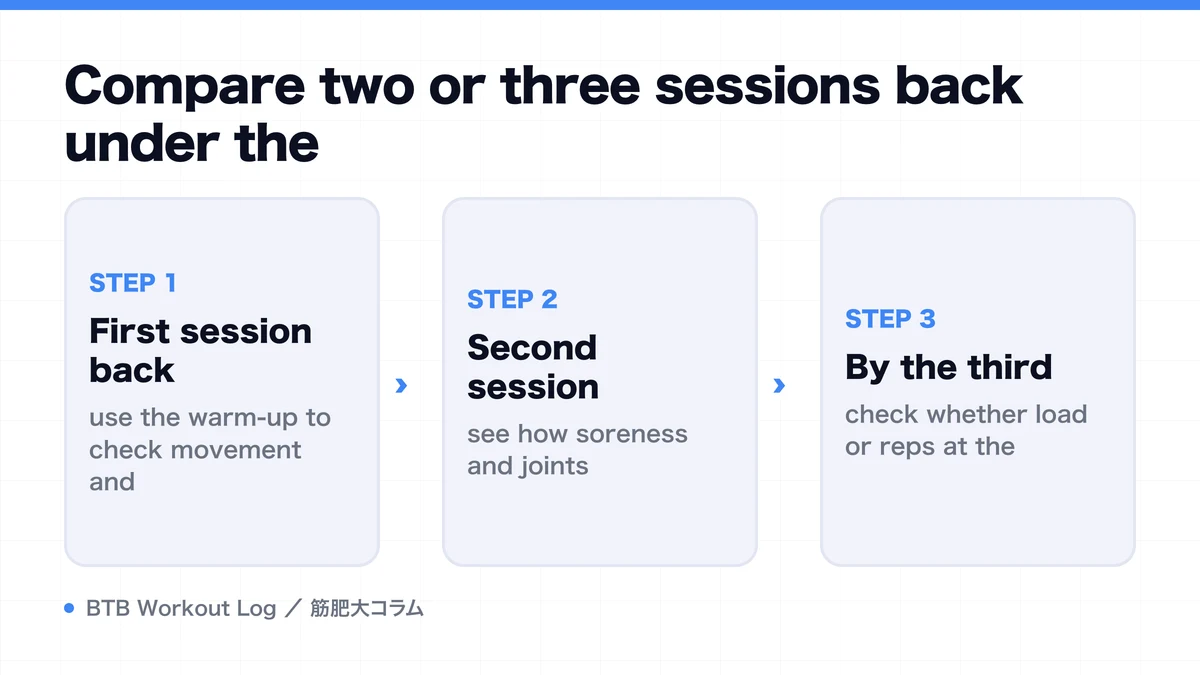
Compare two or three sessions back under the same conditions
If you need a full week off, you don't have to cram in make-up hard sets to protect muscle. Keep the last normal session before the break, and compare it against the same exercises, range of motion and rest periods when you return. What you're reading isn't a one-off personal best — it's the combination of load, reps and RIR (how many reps you had left).
- First session back: use the warm-up to check movement and how you feel. Trying your pre-break load is fine, but don't make hitting it mandatory — leave more RIR than usual.
- Second session: see how soreness and joints responded, then bring accessory work and set counts back toward normal.
- By the third: check whether load or reps at the same RIR are back in your pre-break range. If they are, that first-day drop was likely skill and daily state.
Adding the missed week's sets on top breaks the comparison and cancels a recovery break with fresh fatigue. Restart progressive overload from your current output, using the pre-break record as the reference point.
Don't write the first session off as a failure. Lining up how two or three sessions recover separates the feeling of having lost muscle from what performance actually did. What a week off did to you is answerable by putting the same exercises side by side before and after — and BTB Workout Log is built for exactly that comparison.
FAQ
- Should I still do light bodyweight work during the week off?
- If the point of the break is clearing fatigue, you don't need to add training out of fear of losing size. Moving a little while travelling is fine if you feel good — just stay well away from failure and keep it light enough that it doesn't undo the reason you took the week.
- My weight and arm measurement dropped in a week. Isn't that lost muscle?
- It isn't evidence either way. Carbs, sodium, hydration, gut contents and pump all move weight and circumference over short windows. Get food and training back to normal, then measure a few times at the same time of day under the same conditions before drawing a conclusion.
- Can I use my pre-break load on the first session back?
- You can try it after a proper warm-up if you feel good, but don't treat your pre-break reps as a target you owe. If it feels heavy, drop the load or the set count, keep RIR in hand, and let two or three sessions bring form and output back.
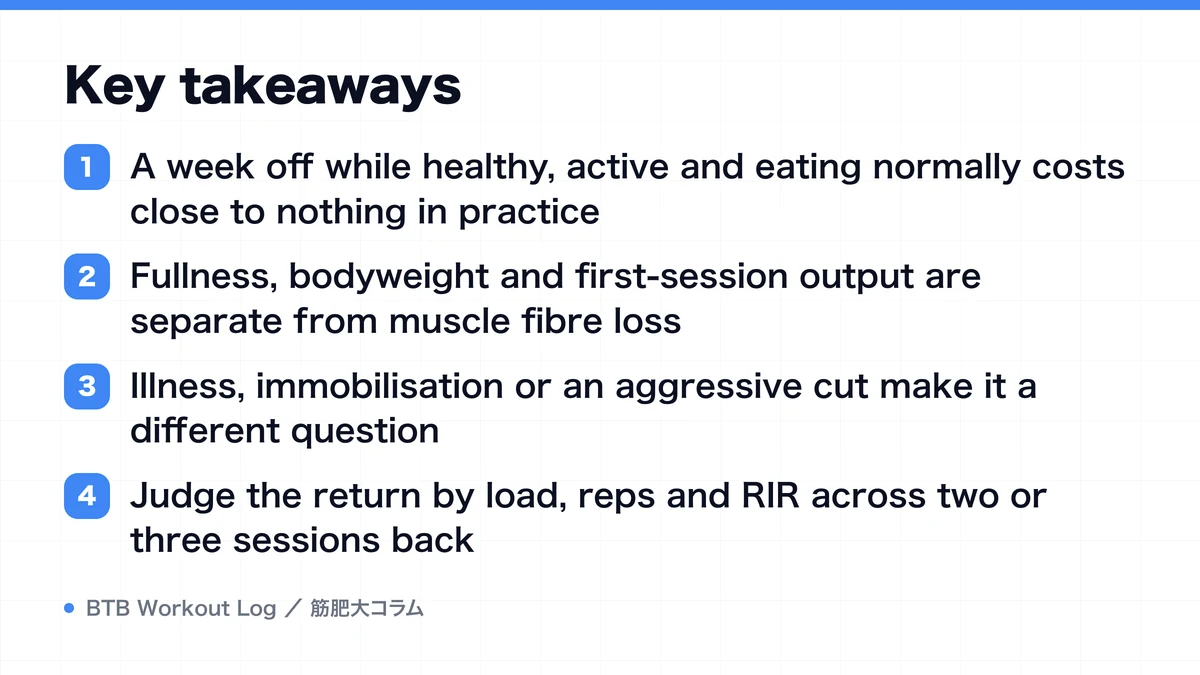
Key takeaways
- A week off while healthy, active and eating normally costs close to nothing in practice
- Fullness, bodyweight and first-session output are separate from muscle fibre loss
- Illness, immobilisation or an aggressive cut make it a different question
- Judge the return by load, reps and RIR across two or three sessions back