Does Pull-Up Alone Build a Big Back? | The Limits Bodyweight Lifters Should Know
Pull-ups alone can still build a bigger back, centered on the lats. But once you demand "even development across the whole back," people split between those for whom one exercise suffices and those for whom it falls short.
What to test isn't exercise count — it's whether sufficient stimulus reaches your intended area and whether you can keep progressing against a consistent standard.
"The back grows" and "the whole back is sufficiently covered" are different questions
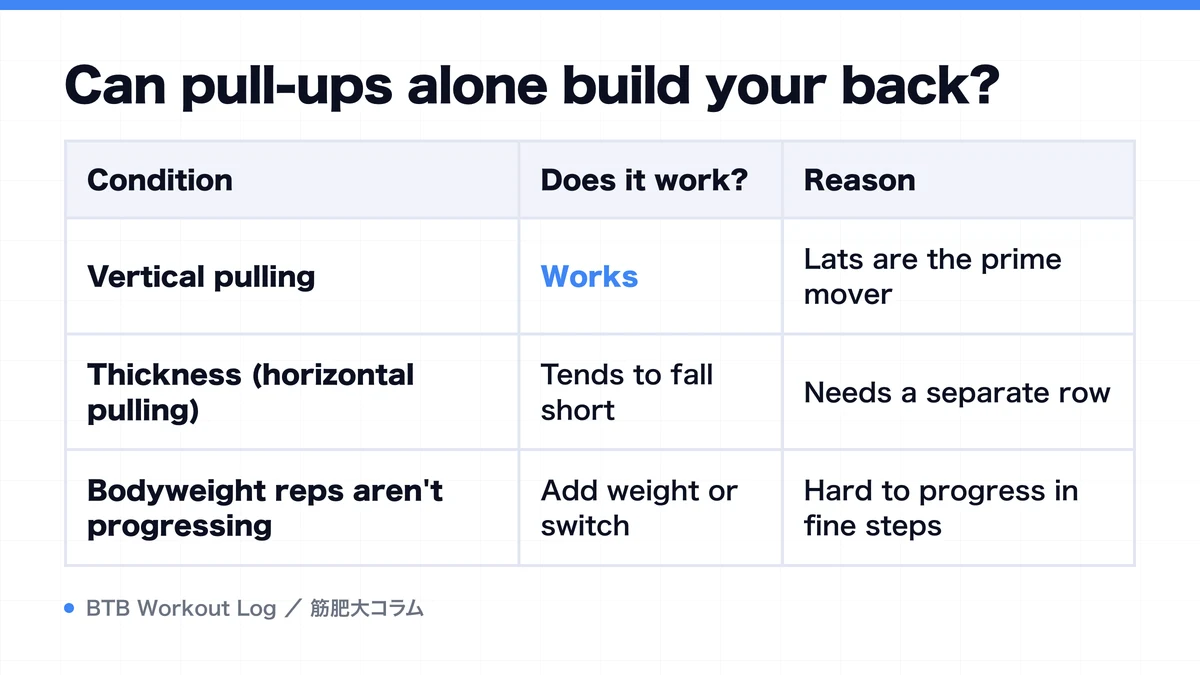
The back isn't just the lats. Lats, teres major, traps, rhomboids, rear delts, and spinal erectors overlap to create visible width, upper-back thickness, and dimension around the shoulder blades. Pull-up excels as a vertical pull centered on the lats, but it isn't an exercise that trains every tissue included in "the back" at the same proportion.
So the judgment standard shifts with your goal. If you want to widen the lats, minimize equipment, or build up pull-up reps and added weight, a pull-up-only design is a strong candidate. But if you also prioritize upper-back thickness from mid-traps and rhomboids, not using a horizontal-pulling row can become a real constraint. Think of the whole-back exercise structure with the same standard as a back hypertrophy routine.
Note there's no direct research available comparing, long-term, a pull-up-only group against a group doing multiple back exercises, measuring hypertrophy per back region. Avoid both "pull-ups alone are enough" as a blanket claim and "you can't develop without rows" as a blanket claim — it's more reasonable to combine general resistance-training research, muscle-activity studies on back exercises, and your own progress.
Where pull-ups strongly train, and where gaps tend to remain
On pull-ups, you pull the shoulder joint from overhead toward the torso while bending the elbow and lifting your body. It's easy to load the lats and teres major, and elbow flexors like the biceps, grip, and scapula-controlling muscles all work too. Since it's a multi-joint bodyweight exercise, at appropriate difficulty, one exercise can deliver substantial tension across several muscle groups.
But participating and receiving sufficient hypertrophy stimulus aren't the same thing. Even though the scapula moves on a pull-up, it isn't loaded with external resistance for scapular retraction the way a horizontal row is. EMG studies on lat-targeting exercises also confirm that muscle-activity patterns shift with grip and path differences. This isn't research directly showing pull-up-only long-term hypertrophy, and EMG level alone can't determine future hypertrophy either. Still, it's a caution that fixing your pulling direction tends to fix your stimulus distribution too.
There's also no need to disqualify pull-ups purely for a weak back-feel sensation. Sensation is reference information — prioritize whether reps or added load are progressing at reproduced form, and what actually becomes the limiter on the final reps. This is also covered in feeling the back working.
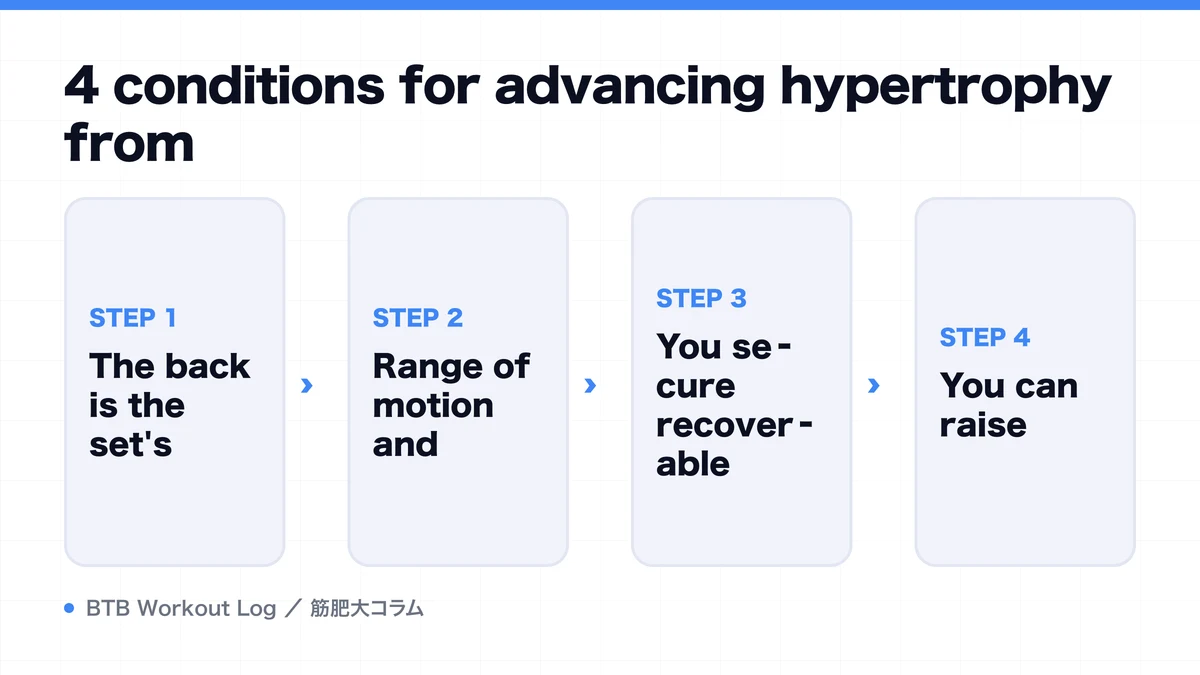
4 conditions for advancing hypertrophy from pull-ups alone
- The back is the set's limiting factor: if grip or biceps consistently give out first every set, the set ends before delivering needed stimulus to the back. Rather than adding momentum, adjust assistance amount, grip, or strap use so the target back can reach high effort.
- Range of motion and form are reproducible: decide in advance where the shoulder starts moving at the bottom, what counts as a completed rep at the top, and how much leg momentum you'll tolerate. You don't need to force an uncomfortable dead hang that doesn't fit your shoulder, but you also shouldn't shorten the standard week to week just to add reps.
- You secure recoverable hard sets: RIR is an estimate of how many more reps were possible. Run most sets at high effort, roughly RIR 1–3, and spread weekly volume out. Rather than applying a fixed correct set count, start from your current volume and adjust while watching performance and joint status. See weekly set count for that thinking.
- You can raise difficulty in steps: for assisted pull-ups, reduce assistance; for bodyweight, build reps at the same form; once you hit a ceiling, add a small amount of weight — create a continuous progression. Rather than simply making it harder each time, you need progressive overload that raises capability under comparable conditions.
During a period your body weight is changing, don't watch added weight alone. If you can do the same reps at 5kg heavier body weight, the challenge got harder even at the same externally hung weight. Conversely, during a cut, holding the same reps might mean total load actually dropped. Log body weight, added weight or assistance amount, and reps together.
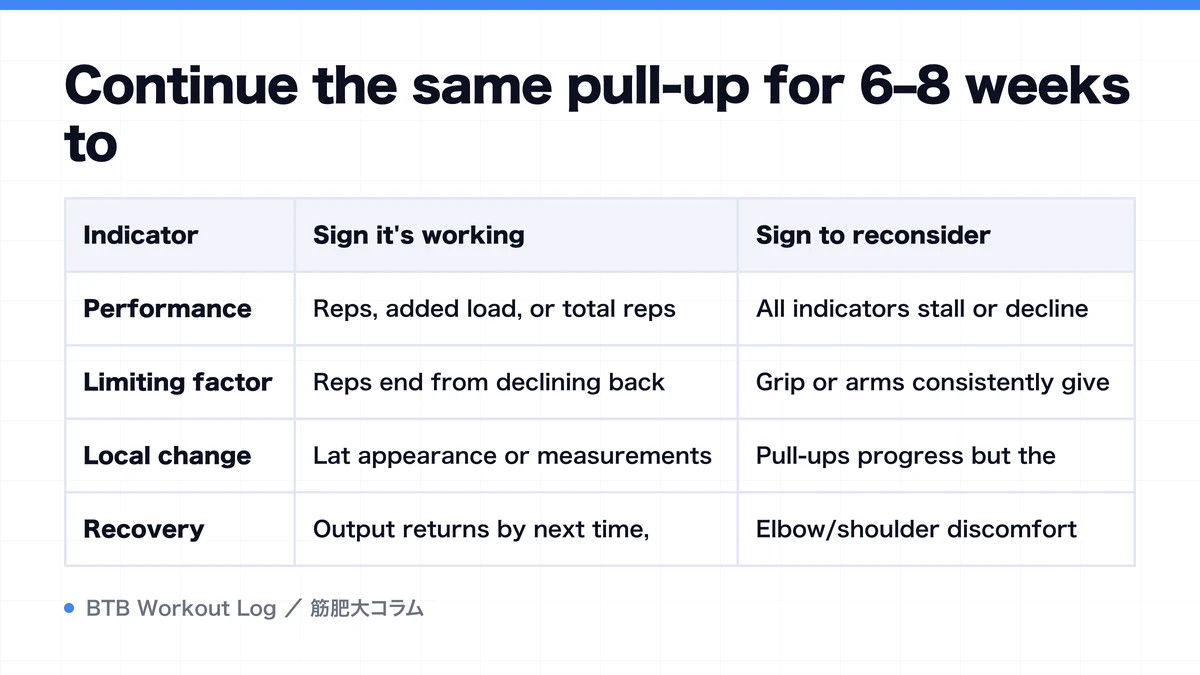
Continue the same pull-up for 6–8 weeks to judge sufficiency
One pump or bout of soreness can't tell you whether pull-ups alone suffice. Fix grip width and orientation, range of motion, and your momentum standard, and make the same pull-up your main lift for 6–8 weeks. You can split frequency, but don't change exercise week to week — line up the following indicators.
| Indicator | Sign it's working | Sign to reconsider |
|---|---|---|
| Performance | Reps, added load, or total reps rise at the same form | All indicators stall or decline across several sessions |
| Limiting factor | Reps end from declining back output | Grip or arms consistently give out first |
| Local change | Lat appearance or measurements move long-term | Pull-ups progress but the targeted upper back doesn't change |
| Recovery | Output returns by next time, joint symptoms don't increase | Elbow/shoulder discomfort accumulates, set quality drops |
The key is not deciding instantly from one indicator alone. If reps stall for one week but body weight rose and form tightened, that's not necessarily a setback. Conversely, rising reps from a shortened range of motion isn't evidence of overload either. If a stall persists, check sleep, diet and overall weekly fatigue before suspecting exercise insufficiency.
As a method for using your log as material, you can compare 6–8 weeks before and after a change.
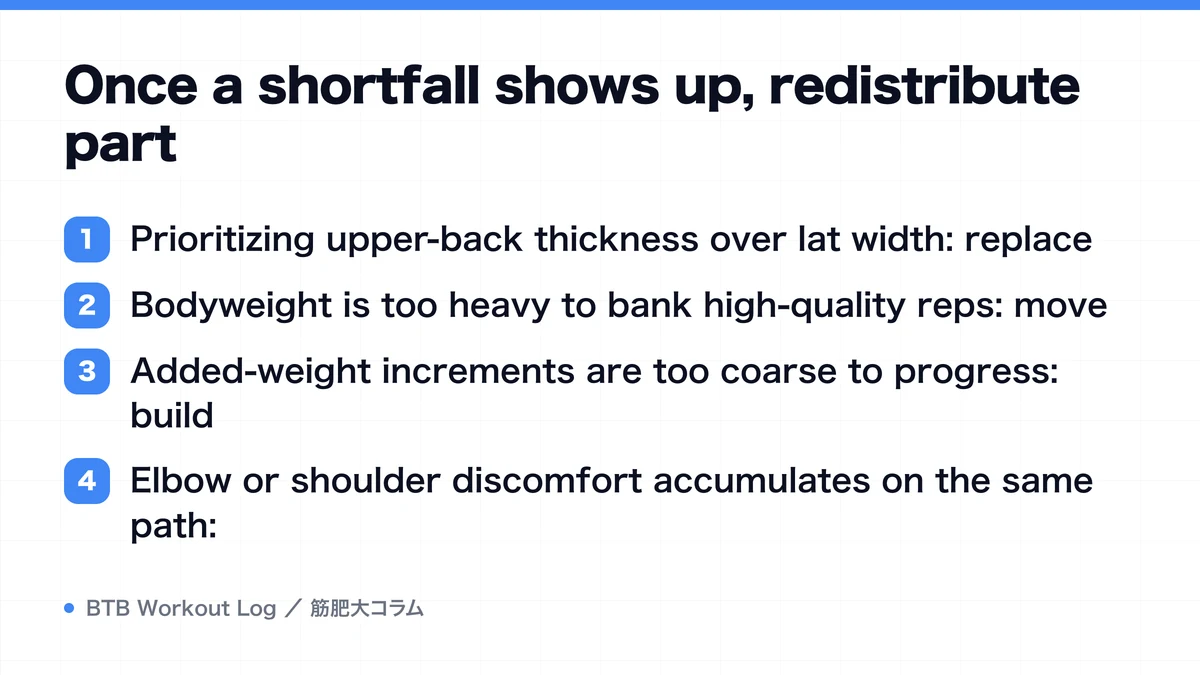
Once a shortfall shows up, redistribute part of your pull-up volume to a different role
While you're progressing on pull-ups alone, there's no obligation to add more exercises. Fewer exercises means easier technique repetition and easier tracking of what's progressing. Consider adding once a gap between your target area and actual adaptation is observed.
- Prioritizing upper-back thickness over lat width: replace part of your weekly pull-up sets with a horizontal pull like seated row or chest-supported row. Simply stacking sets on top mixes the effect of exercise choice with the effect of raised total volume.
- Bodyweight is too heavy to bank high-quality reps: move part of it to assisted pull-ups or lat pulldown to build your intended range of motion and RIR. See comparing lat pulldown and pull-up for that split.
- Added-weight increments are too coarse to progress: build reps first, and use small plates. If that's still hard to manage, move part of it to a cable exercise where load adjusts finely.
- Elbow or shoulder discomfort accumulates on the same path: don't push through pain and add more volume — look for a tolerable path via neutral grip or a different exercise. If symptoms persist, don't rely on training decisions alone — consult a medical professional.
If adding a row, you don't need to limit yourself to barbell. The choice shifts with whether you want to concentrate sets on the upper back, or also want whole-body load including posture holding. See comparing barbell row and seated row for candidates.
The answer to whether pull-ups alone can build a bigger back: "it can work if lat-centered is your focus. For the whole back, verify a shortfall against your goal and your records." Rather than making "stick to a minimal structure" the goal itself, continue as long as you're progressing, and only fill whatever role turns out missing — that keeps the decision from wavering.
FAQ
- If it's pull-ups alone, how many weekly sets should I start with?
- It depends on your current back training volume and recovery capacity. As a guide, start with roughly 6–8 hard sets a week split across about 2 sessions, and maintain or add a small amount if reps or added load at the same form are progressing and elbow/shoulder status is fine.
- Does a wider grip on pull-ups work the back more?
- Extremely wide isn't necessarily better — it can shorten range of motion or cause shoulder discomfort, lowering set quality. Try starting around shoulder width, and fix whatever width and hand orientation you can reproduce pain-free with the back as the limiting factor.
- Can I build a pull-up-only routine if I can't do a single pull-up?
- Yes, if you log assistance amount from a machine or band and can do several reps at your intended range of motion. But if the assistance increments or stability don't suit you, lat pulldown may make load easier to adjust while still practicing the same vertical pull.
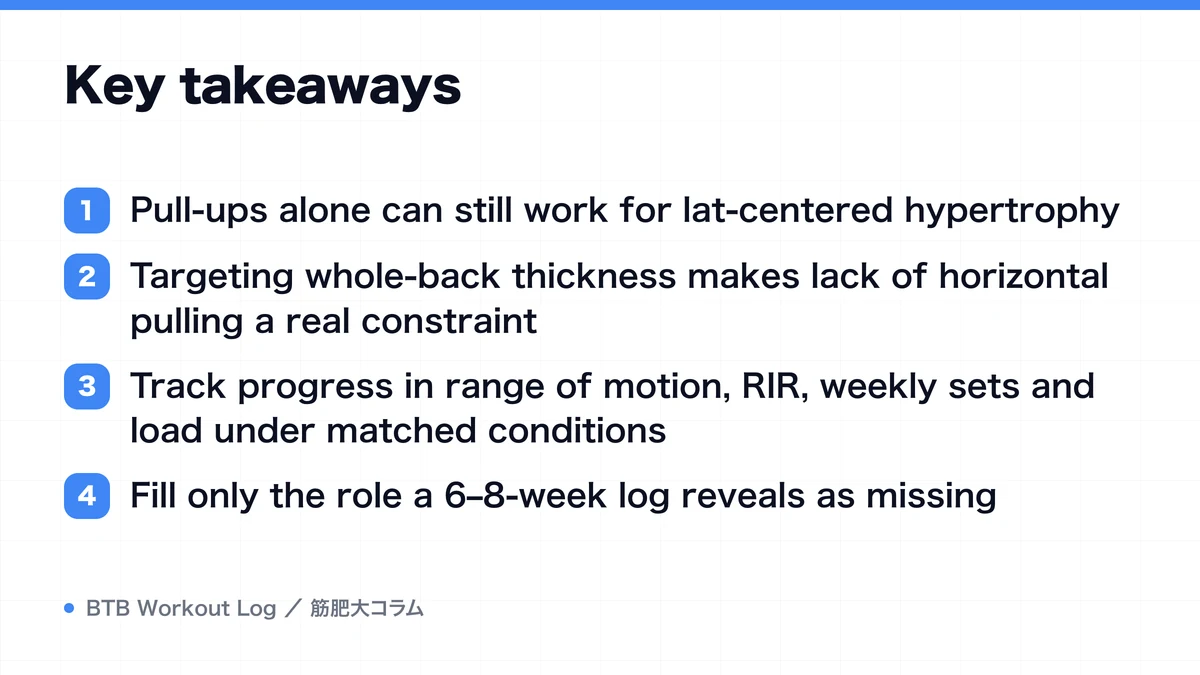
Key takeaways
- Pull-ups alone can still work for lat-centered hypertrophy
- Targeting whole-back thickness makes lack of horizontal pulling a real constraint
- Track progress in range of motion, RIR, weekly sets and load under matched conditions
- Fill only the role a 6–8-week log reveals as missing