
Hypertrophy: Why Too Many Sets Can Hold Back Your Gains
Push set count too far and the added fatigue can outweigh the added stimulus, dragging down quality on later sets and in your next session — which can actually slow hypertrophy.
The issue isn't that more sets shrink muscle. It's that volume beyond what you can recover from wrecks the reproducibility of load, reps and movement, cutting the effective stimulus you actually bank across the week.
The catch in "if it worked, add more of it"
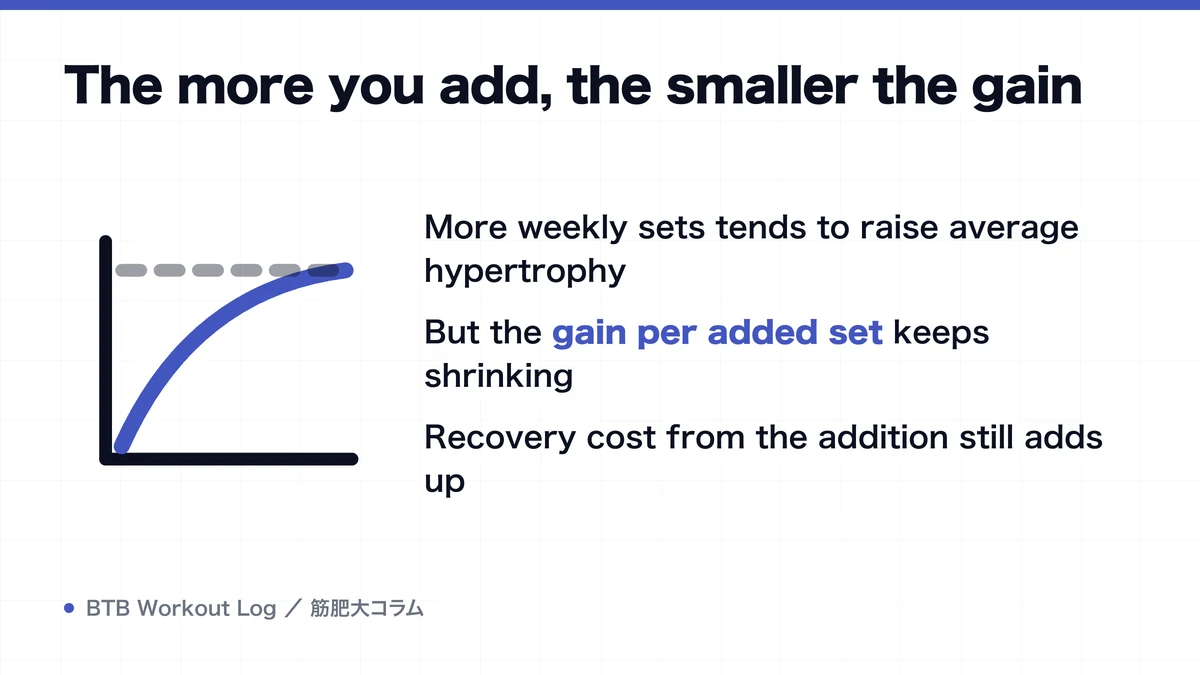
Hypertrophy and weekly sets show an average dose-response relationship. Add sets from too few and growth opportunities tend to rise — that much holds up as far as weekly sets go.
But you can't count set 1 and set 10, taken after heavy fatigue has already built up, as the same "one". What contributes most to hypertrophy is a set that moves the target through sufficient range of motion at appropriate load and proximity to failure. A set that just gets the rep count done, with load sliding off the target and range of motion shrinking, doesn't carry the same value even though it adds one more line to the tally.
It's more accurate to think of the benefit as large at first and shrinking with each further set, rather than accumulating at a constant rate — while fatigue and time cost keep rising with every addition. Past the point where the rate of fatigue overtakes the rate of benefit, "do more" starts working against you.
Within a session, later sets hold output worse
Stack up hard sets and local fatigue compounds with laboured breathing, weaker grip and posture, and mental drain. The result: fewer reps at the same load, form shifting to hit the same rep count, or an assisting muscle taking over from the prime mover.
RIR alone — reps in reserve — isn't enough here either. "Close to failure" doesn't automatically mean "effective": in a fatigued state, RIR 1 might reflect general breathlessness or an assisting muscle's limit rather than tension on the target. RIR is meaningful when load, reps, range of motion and form haven't broken down badly.
Cramming sets together with too-short rest accelerates this decline further. Rather than just finishing the planned set count, what matters more is resting enough on main lifts to hold output and checking whether late-session rep loss stays within a tolerable range. If an added set forces a big load drop, if the wrong muscle limits out first, or if you can only finish by cutting range of motion, that set is likely adding more fatigue than stimulus.
The real cost is a worse next session
A bit less output in one session doesn't automatically mean the programme failed. What matters more is whether you recover from the added volume by next time and can reproduce load, reps and movement on the same exercise.
Add chest sets, for instance, and if chest, shoulders and triceps are still fatigued days later so your first hard press falls short of last time, that addition traded away next session's quality. Complete a planned 20 weekly sets with poor late-session quality and depressed next-session output, and that isn't automatically better than a recoverable 14.
This shows up with overlapping compounds too. Counting bench press as chest-only and shoulder press as shoulder-only misses the indirect load on triceps and front delts. Track weekly totals per muscle group while distinguishing direct sets from indirect stimulus. If concentrating everything in one day is costing quality, distributing across more sessions is an option before adding more total volume.
Conversely, soreness alone, or just feeling tired after a session, isn't reason enough to cut. What matters is performance decline that persists into the next session, a plateau across several weeks, joint or tendon discomfort, or these compounding with worse sleep or motivation. If accumulated fatigue is clear, cut sets or use a deload to recover.
"More tends to help" and "no ceiling" aren't the same claim
Meta-analyses of weekly sets report that more volume tends to produce more hypertrophy than less. An eight-week study comparing volumes in 34 trained men found the higher-volume condition favoured some measures of muscle thickness. So cutting needed sets purely out of fear of fatigue isn't well justified either.
But a meta-regression pooling a wider set of studies found that while hypertrophy rises with added volume, the benefit from each additional set shrinks progressively. That isn't the same as discovering one shared "maximum set count" for everyone. Studies differ in participants, exercises, how sets were counted, proximity to failure and intervention length, and individual recovery capacity hides inside any average.
What the research supports isn't a fixed "high volume wins" prescription — it's a direction: raising volume from too little is worth it, but returns don't keep scaling in proportion to the increase. Your own ceiling isn't set by volume alone — it's set by whether that volume lets you progress and recover over several weeks at the same time.
Judge hold, add or cut from your log, not from a bad day
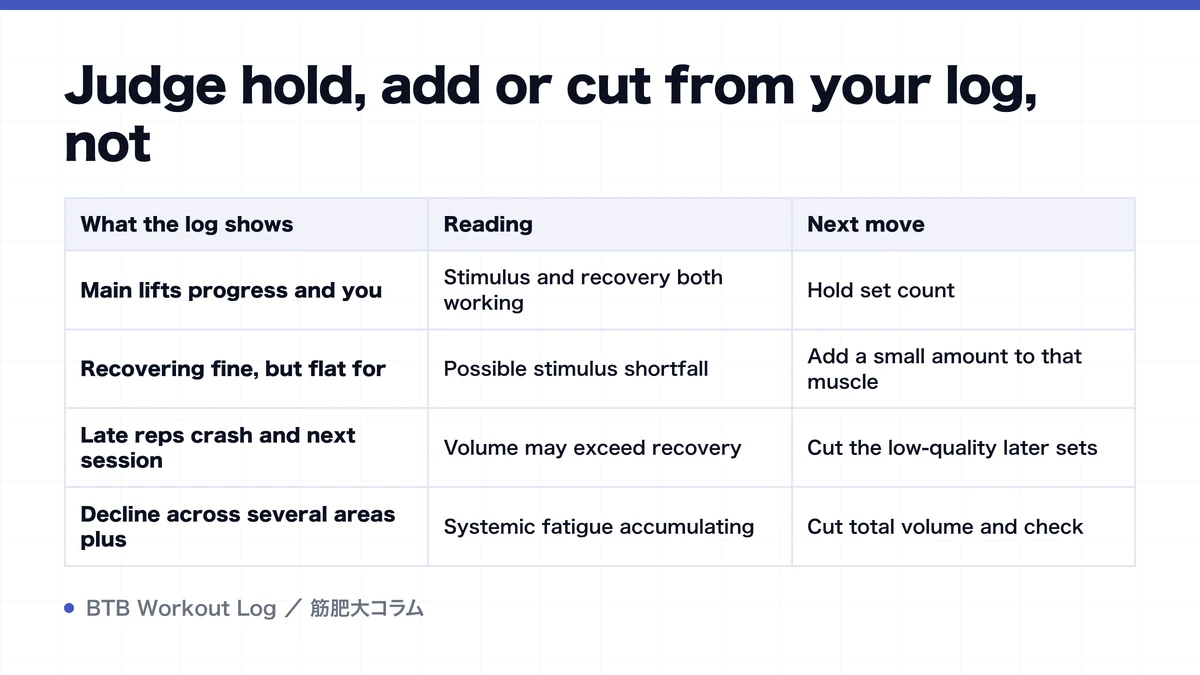
Adjust set count from a multi-week trend under matched conditions, not a reflex response to one stalled session. Check first whether load or reps are rising on the target muscle's first main exercise. If they are, current volume is likely sufficient stimulus and the case for adding is weak.
| What the log shows | Reading | Next move |
|---|---|---|
| Main lifts progress and you recover by next time | Stimulus and recovery both working | Hold set count |
| Recovering fine, but flat for several weeks | Possible stimulus shortfall | Add a small amount to that muscle only |
| Late reps crash and next session is down too | Volume may exceed recovery capacity | Cut the low-quality later sets |
| Decline across several areas plus ongoing fatigue signs | Systemic fatigue accumulating | Cut total volume and check recovery |
When you do add, move only weekly sets for the target muscle by a small amount — don't change exercise count, set count and RIR all at once. Then compare load and reps on the main sets, late-session drop-off and next-session recovery under matched conditions. Not every set needs to go to failure, and pushing closer to failure more often changes recovery cost too — changing that alongside set count makes it harder to isolate the cause.
This judgement needs the load, reps and sets you actually did, not what you planned. The right set count isn't the maximum you can survive — it's the amount that lets you bank quality stimulus and keep repeating progress.
How far is "more sets is always better" actually right?
The idea that "more sets is always better" is right within a certain range. For a body part where you only do a few sets a week, you can expect more hypertrophy as you add sets. The relationship shown by dose-response research also slopes upward on the low-volume side.
What breaks down is what comes after volume has risen. The extra return per added set gets smaller as volume grows, while the fatigue cost does not. In other words, "more is better" and "there is no ceiling" are different claims, and research supports only part of the first one. On top of that, the optimal ranges that get reported are group averages, and they do not take in your individual recovery capacity, your exercises, or the load of your life.
Set count is easy to overrate partly because it is easy to count. Weekly sets can be written into a log, while the quality of those sets and your recovery state do not turn into numbers. When you judge, look not only at how many sets you did, but at whether those sets pushed the muscle you were targeting and whether you are holding the weight and reps on your main exercises next session.
FAQ
- At what set count does it become "too many"?
- There's no shared threshold. Recoverable volume shifts with exercise selection, RIR, frequency, indirect stimulus and training history. If late-session quality and your next session's main sets fall across several sessions in a row, suspect your current volume is too high.
- If soreness lingers, should I cut set count?
- Don't decide on soreness alone. Prioritise whether you can still hit your intended range of motion and form, and whether you can hold last time's load and reps. Cut or take a rest if there's real pain, joint discomfort, or performance keeps declining.
- When I plateau, should I add sets first?
- Check RIR, range of motion, rest, frequency, nutrition and sleep first. Only once those are stable and you're recovering from current volume but still flat for several weeks is it safe to add a small amount to the target muscle's sets and compare the change.
Key takeaways
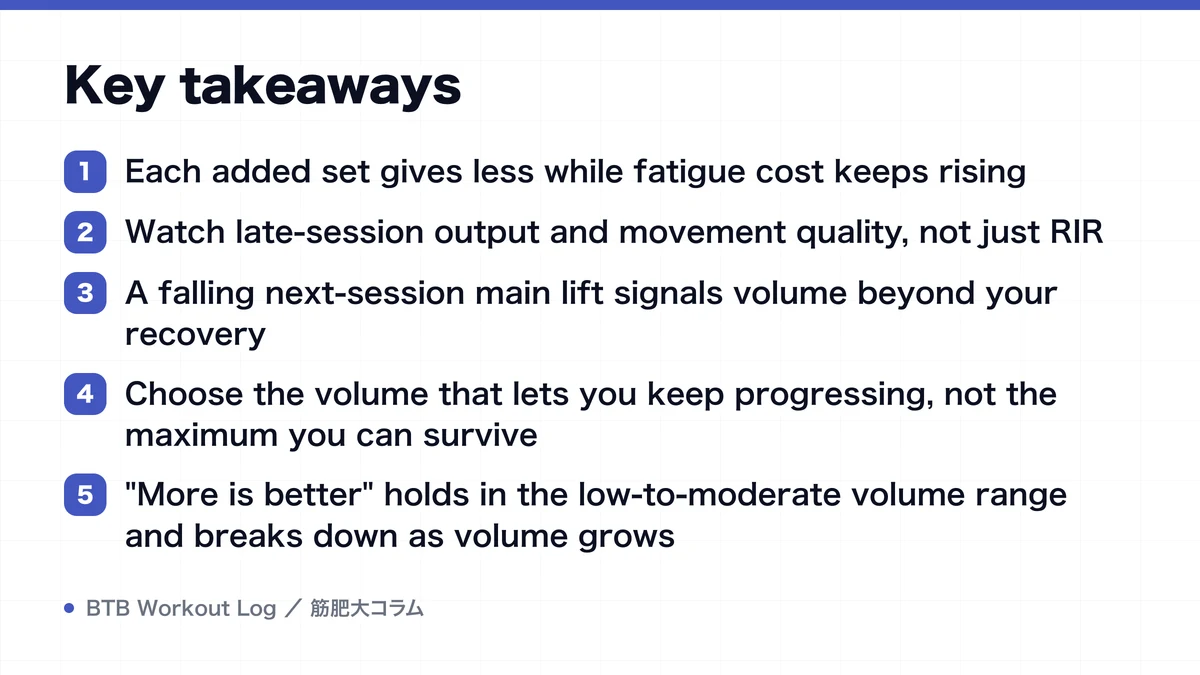
- Each added set gives less while fatigue cost keeps rising
- Watch late-session output and movement quality, not just RIR
- A falling next-session main lift signals volume beyond your recovery
- Choose the volume that lets you keep progressing, not the maximum you can survive
- "More is better" holds in the low-to-moderate volume range and breaks down as volume grows
References
- Dose-response Relationship Between Weekly Resistance Training Volume and Muscle Mass
- The Resistance Training Dose Response: Meta-Regressions Exploring the Effects of Weekly Volume and Frequency on Muscle Hypertrophy and Strength Gains
- Resistance Training Volume Enhances Muscle Hypertrophy in Trained Men
- Training to Repetition Failure or Non-failure: Systematic Review and Meta-analysis
- Proximity-to-Failure and Muscle Hypertrophy: Systematic Review with Meta-analysis