Short Rest Periods: How Saving Time Can Undermine Hypertrophy
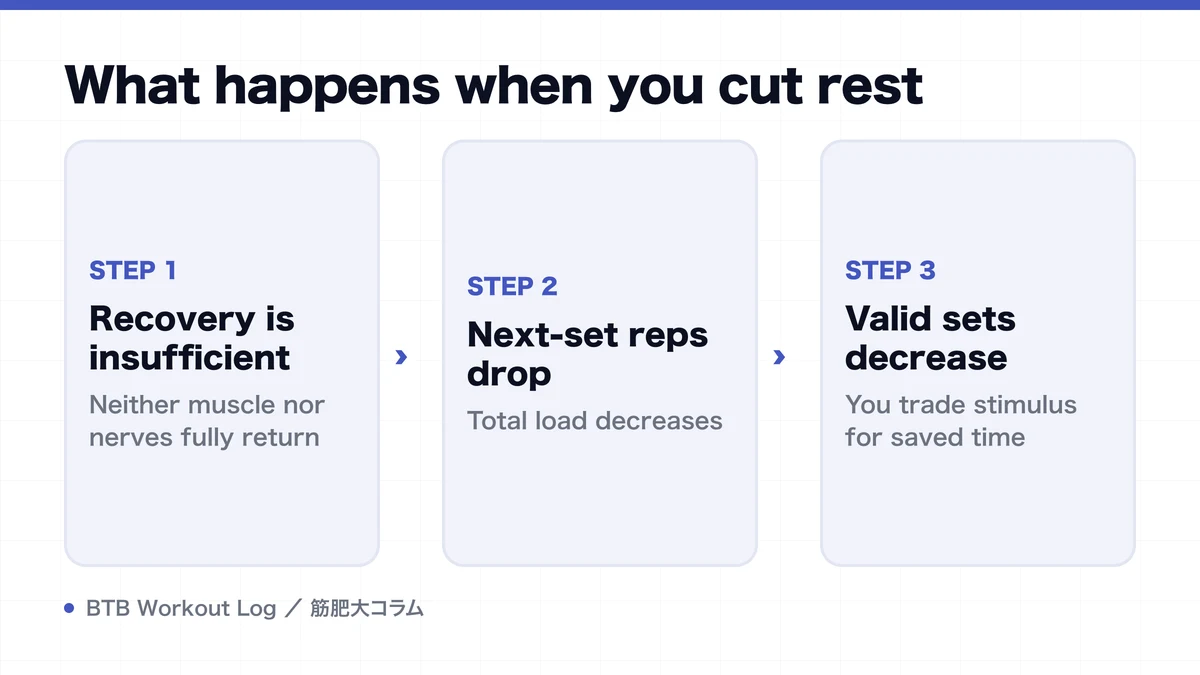
Shorten rest between sets and the next set starts before strength, breathing and focus have fully returned, making it easier for reps or movement quality to drop even at the same weight. If that decline repeats, it can even reduce the hypertrophy stimulus you bank across the week.
That said, shorter rest doesn't inherently block hypertrophy. On exercises where you can hold needed output, it raises time efficiency — so evaluate it not by "how many minutes you rested" but by what happened to the set afterward.
Shortening rest starts the next set mid-recovery
Right after finishing a set, it isn't just the target muscle that's fatigued. Energy supply for muscle contraction, the nervous system producing force, breathing and circulation, the muscles holding your posture, grip, and focus all return at different rates. Rest between sets isn't time to fully reset all of these — it's time to recover them to the level the next set requires.
Cut it short, and whatever hasn't recovered becomes the starting condition for the next set. On a heavy squat, breathing and core can become the limiter alongside the legs; on rows, grip can give out before the back does. On single-joint exercises, whole-body fatigue may be small, but if local fatigue in the target muscle remains, your ability to repeat the same load still drops.
So the effect of cutting rest by 60 seconds isn't the same across every exercise. It depends on load used, how much muscle mass is engaged, set length, proximity to failure, and whether it's late in the session — because what needs to recover shifts with these. Don't lump it all together as "shorter rest = higher intensity" — instead, separate out what specifically didn't finish recovering.
Insufficient recovery shows up as declining reps, speed and form
Pick up the same weight before you've recovered enough, and the burden per rep of force production becomes relatively larger. Bar speed drops faster, and RIR — how many more reps you had before the limit — declines faster too. If you could do 10 reps at 100kg on set one but only 6 after short rest, you haven't reproduced the same set at the same weight.
What's confusing here is that shorter rest tends to feel more like "you pushed harder." Breathlessness, burn and a higher heart rate all intensify the sense of effort, but they don't necessarily match how much force the target muscle actually produced. If breathing or grip hits its limit first, you can end a set with the prime mover still holding reserve. Conversely, on light single-joint exercises where local fatigue is the point, shorter rest may still work the target muscle sufficiently.
Don't look at rep count alone
- Rep decline: how far reps drop from set one at the same weight.
- Range of motion and form: is momentum increasing, or is the range no longer reaching the endpoint?
- Limiting factor: what ended the set — the target muscle, breathlessness, grip, or core?
- Target RIR: are you approaching the limit earlier than planned and cutting into later sets?
The mechanism behind rep decline late in a set is covered in more depth in fatigue and rep decline. Whether rest time was good or bad shows up in these changes before it shows up on a timer.
A pump or a transient hormone spike isn't the same as long-term hypertrophy
Short rest starts the next set with metabolites still elevated, so pump and burn tend to intensify. That sensation can help with focus and satisfaction during a set, but its intensity isn't a score for how much hypertrophy resulted. Acute changes and fiber growth occurring over weeks to months run on different timescales.
A large transient rise in growth hormone and similar markers from short rest doesn't guarantee long-term adaptation either. In conditions studying young men's elbow flexors, the size of an acute hormone spike hasn't tended to translate into a difference in hypertrophy or strength gain. The case for choosing rest length is more reasonably based on repeating sets that deliver needed tension to the target muscle, not on maximizing a hormone response.
This doesn't mean you should avoid a pump. Hypertrophy can occur with either short or long rest. The problem arises when reps, range of motion, or load used get sacrificed to manufacture a strong sensation, and that decline goes unnoticed. Use rest-interval guidelines as a starting point, and observe the feel of the stimulus and set quality as separate things.
Accumulated output decline affects weekly hypertrophy stimulus
The causal path from shortened rest to hypertrophy runs: insufficient rest → insufficient recovery → next-set output decline → fewer high-quality reps or sets → a change in the stimulus you accumulate long-term. Rather than connecting "shorter, so no growth" in one step, checking set quality in the middle matters.
In conditions like young trained men, 3-minute rest has tended to favor 1RM gains on bench press and squat, plus anterior thigh muscle thickness, over 1-minute rest. This shows that waiting for recovery can favor long-term adaptation more than losing work to overly short rest. But the comparison was 1 versus 3 minutes — you can't say the same gap applies to every exercise, every rest length, or every population.
Nor is it correct to simply maximize total volume load mechanically. Adding reps with broken form, or sets left with a lot of reserve, doesn't deliver equal stimulus to the target muscle. What to watch is how many recoverable hard sets you completed at your intended range of motion and RIR across the week. When adjusting weekly set count too, first check whether shortening rest has already thinned out each set's content.
Conversely, if even 90 seconds lets reps and form stay stable while load or reps progress over several weeks, simply extending rest further won't necessarily add more hypertrophy stimulus. Longer rest isn't the goal — it's a means to restore needed output.
Separating where shorter rest works from where the loss is large
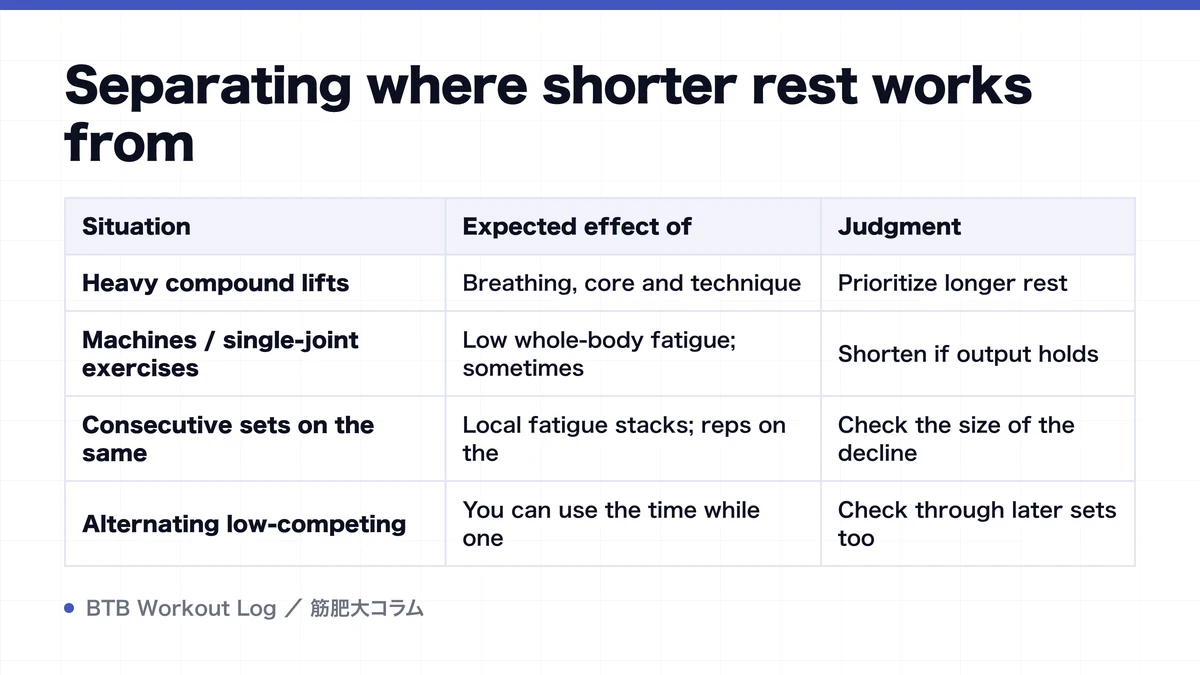
Rest time doesn't need to be standardized across your whole routine — vary it by exercise and priority. The guide isn't "shorten it because this exercise is less fatiguing" — it's whether shortening it still preserves your intended output.
| Situation | Expected effect of shortening | Judgment |
|---|---|---|
| Heavy compound lifts | Breathing, core and technique don't recover; reps tend to drop | Prioritize longer rest |
| Machines / single-joint exercises | Low whole-body fatigue; sometimes reproducible even shortened | Shorten if output holds |
| Consecutive sets on the same muscle group | Local fatigue stacks; reps on the target tend to drop | Check the size of the decline |
| Alternating low-competing exercises | You can use the time while one side rests | Check through later sets too |
| Prioritizing main lifts over accessories | Frees up back-half time while protecting main-lift quality | Don't cut rest on priority exercises |
If you need to save time, it's easier to manage the loss by resting sufficiently on main lifts and only shortening rest on accessory work where output holds up, rather than cutting every rest period uniformly. See the comparison against supersets for alternating low-competing muscle groups, and choosing between 2 and 5 minutes for that specific split.
Judge your needed rest from the gap between your first and last set
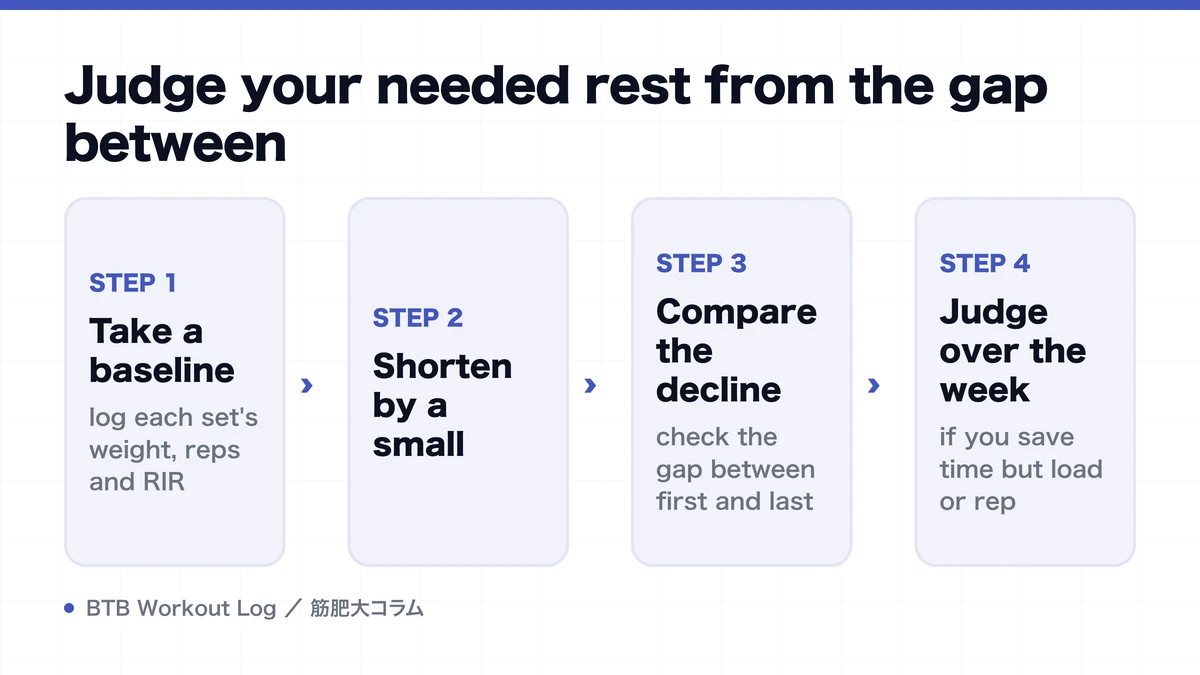
When deciding rest time, first fix current conditions across 2–3 sessions. Match exercise, weight, target reps, set count, target RIR and exercise order, and change only rest. Testing under different conditions each time makes it impossible to tell whether a rep decline came from rest, weight, or fatigue.
- Take a baseline: log each set's weight, reps and RIR at your current rest length.
- Shorten by a small amount: cut just 30–60 seconds, and do the same exercise in the same order.
- Compare the decline: check the gap between first and last set in reps, form, limiting factor, and total time.
- Judge over the week: if you save time but load or rep progress stalls, revert; if output holds equal, adopt the shorter setting.
Matching your target RIR combines well with managing RIR for making this judgment. If shorter rest reaches RIR 0 earlier than planned, you may be completing the set count but not the intended distribution.
Hypertrophy comes from the training you stack after rest, not the rest period itself. Use the timer as an adjustable variable for reproducing that quality.
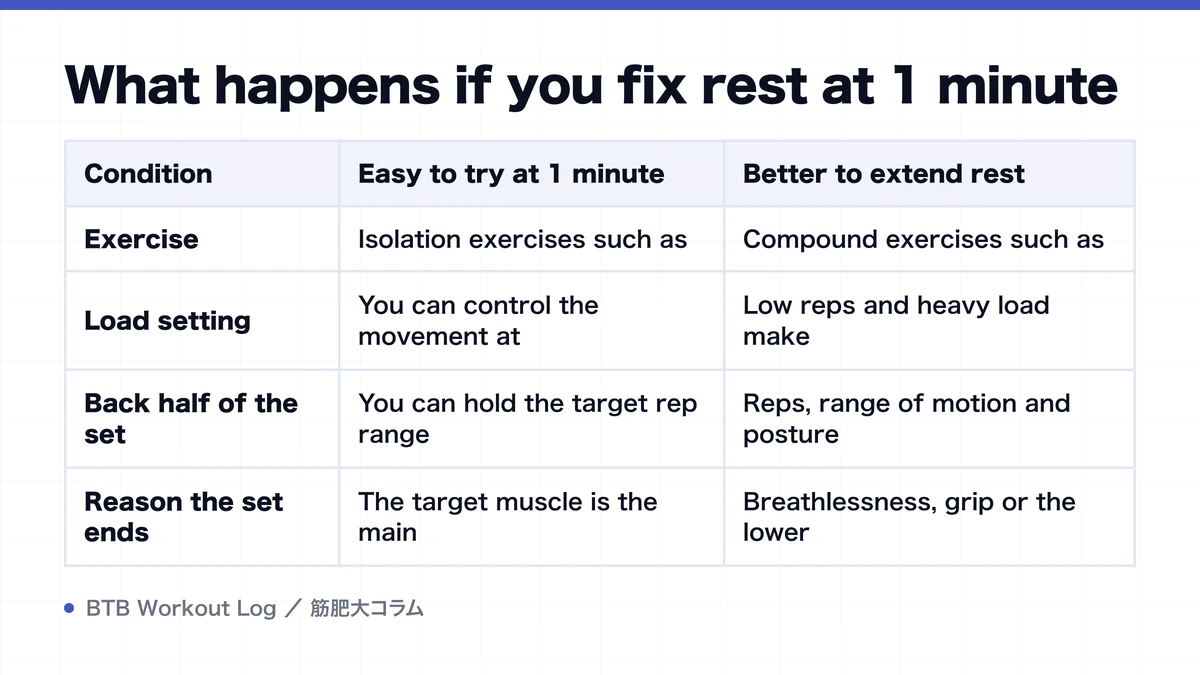
What happens if you fix rest at 1 minute
Fix rest at 1 minute and the session reliably gets shorter. The question is whether that time saving is being traded against the quality of the next set. What the judgement needs isn't "how many sets you got through in an hour" but how many sets that put enough tension on the target muscle you could reproduce for the time spent.
| Condition | Easy to try at 1 minute | Better to extend rest |
|---|---|---|
| Exercise | Isolation exercises such as curls, raises and pushdowns | Compound exercises such as squats, rows and presses |
| Load setting | You can control the movement at moderate to high reps | Low reps and heavy load make reproducing technique important |
| Back half of the set | You can hold the target rep range and range of motion | Reps, range of motion and posture break down one after another |
| Reason the set ends | The target muscle is the main limiter | Breathlessness, grip or the lower back limits you first |
You don't need to put every exercise on 1 minute. Resting fully on the compound exercises you prioritise and shortening only the accessory work costs you less. Note that adding sets in the time you free up makes the time saving and an increase in weekly sets happen at once, so you can no longer judge the effect of the rest change. You need the order of first measuring output decline at the same set count, then considering additions.
FAQ
- If reps drop from shorter rest, does pushing to the limit make it equivalent?
- Not necessarily. If breathlessness or grip hits its limit first, the set ends before sufficient tension reaches the target muscle. Check not just target RIR but range of motion, form, what actually stopped the reps, and any decline in later sets.
- If the pump is strong, does shorter rest favor hypertrophy more?
- You can't judge from pump strength alone. Shorter rest can intensify burn or a transient hormone response, but that isn't the same metric as long-term hypertrophy. Prioritize whether you hold reps and form and can progress over several weeks.
- Is it fine to use different rest lengths per exercise?
- That's fine. Longer for heavy compound lifts, shorter for machines or single-joint exercises where output recovers easily, is a workable split. Rather than one uniform number, look for the shortest rest that lets you reproduce load, reps and range of motion on each exercise.
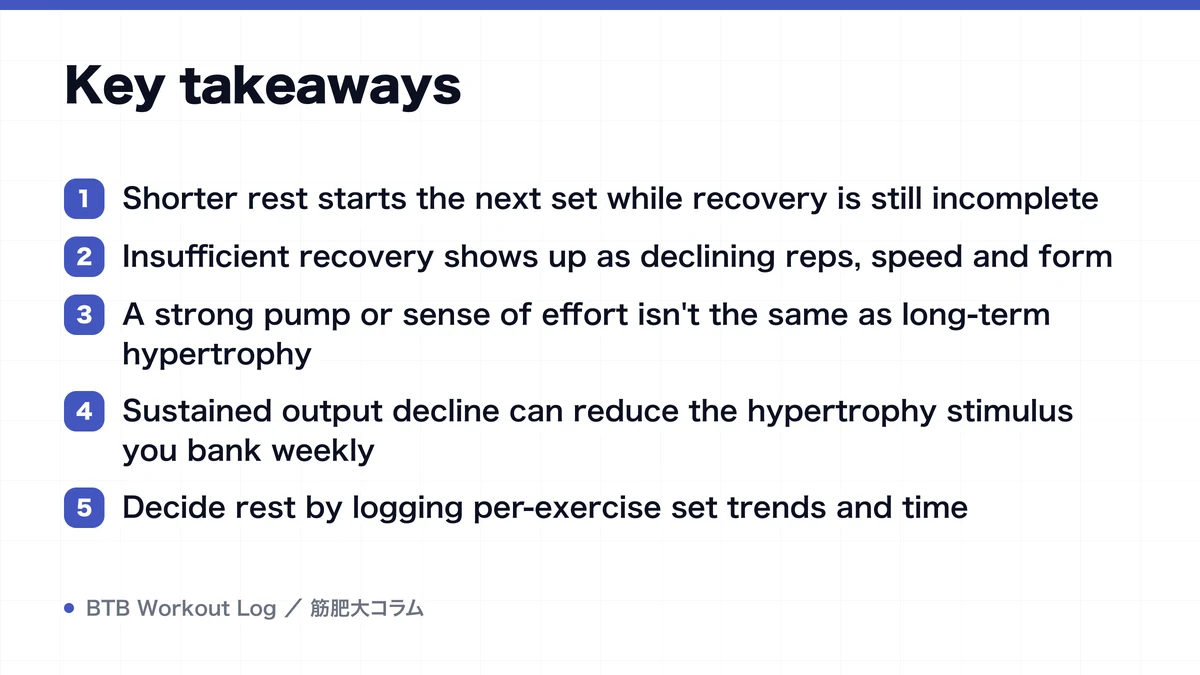
Key takeaways
- Shorter rest starts the next set while recovery is still incomplete
- Insufficient recovery shows up as declining reps, speed and form
- A strong pump or sense of effort isn't the same as long-term hypertrophy
- Sustained output decline can reduce the hypertrophy stimulus you bank weekly
- Decide rest by logging per-exercise set trends and time
- Fixing rest at 1 minute can work on isolation exercises, but costs a lot on your main compound lifts