Hypertrophy With Light Weights: Why You Don't Have to Lift Heavy
Even a light load can put growth-driving tension on muscle fibres if you carry the set far enough to approach failure — fatigue recruits more motor units as you go.
Heavy load demands high force from early on, but it isn't the only route to hypertrophic stimulus. On a light load, reps and effort are what get you there instead.
The weight on the bar isn't the same as tension on the fibres
"You need heavy weight to build muscle" has something right in it. Moving a heavy bar demands high force from the first rep, which recruits many motor units quickly. But the number on the plates is a proxy for stimulus to the muscle — it isn't the stimulus itself.
One thing that matters for hypertrophy is the mechanical tension active fibres experience while producing force. The same 20 kg loads individual fibres differently depending on exercise, form, range of motion, leverage and the person's maximal strength. Conversely, even a light external load raises the relative demand on the reps that remain once force output starts falling with fatigue.
So you can't decide "works" or "doesn't" from load range alone. Comparing high- and low-load results needs the heavy-versus-light comparison plus matching where the set was stopped and whether the target muscle was worked consistently.
On a light load, fatigue builds fibre participation as you go
What happens in a light-load set isn't the same at rep 1 as at the last few reps. Under the general principle of motor unit recruitment, low-threshold units that resist fatigue handle things while low force is enough. Early on, when there's plenty of margin, higher-threshold units aren't yet participating.
- Early: low force required — relatively few motor units can move the load.
- Mid-set: the fibres that were working fatigue, so additional motor units join to hold the same load and movement.
- Late: bar speed drops and, as failure approaches, a wider range of fibres participates in producing force.
So a light load compensates for low per-rep external demand with more reps and getting closer to failure. If heavy load is "demand high force from the start", light load is "raise the relative demand through fatigue". Both can end up delivering repeated tension to the fibres actually working.
You'll sometimes hear the late reps of a set called the "effective reps" — but it isn't established that only the last few produce growth. In practice, rather than treating a handful of reps as special, managing proximity to failure with RIR (reps in reserve) is the more reproducible judgement. Fibre recruitment is an important part of the explanation, but recruitment alone doesn't settle long-term hypertrophy — sufficient volume and recovery matter too.
Low and high load converge when effort is matched
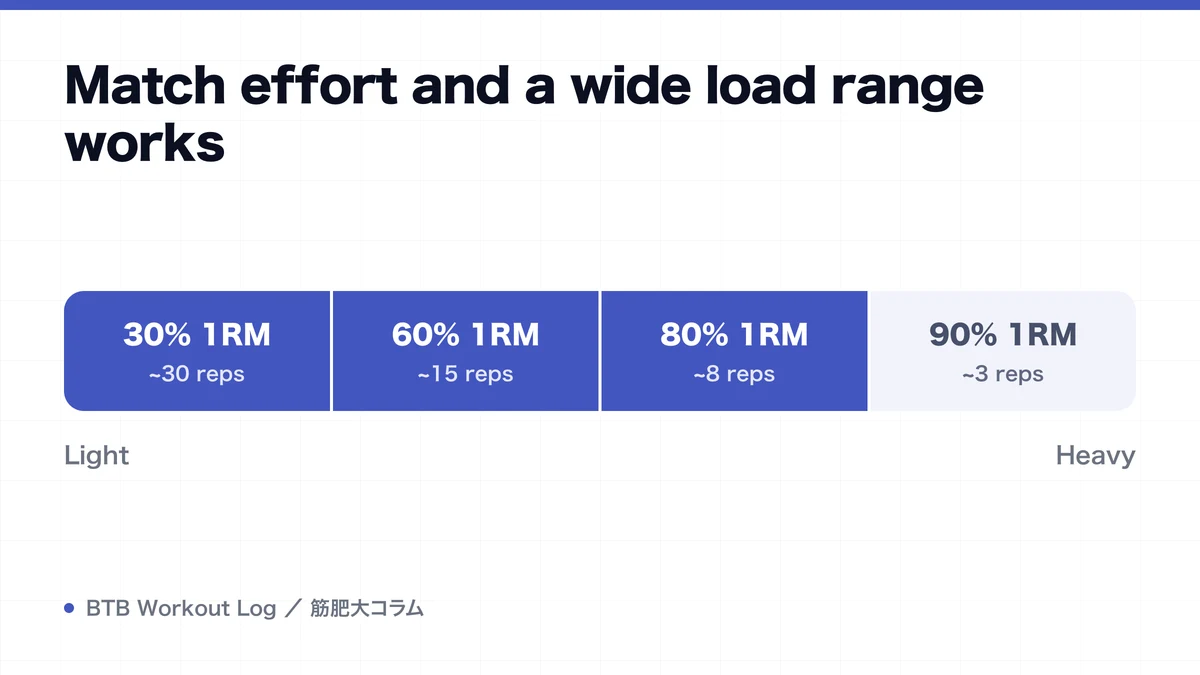
Take every set to failure and low load tends to produce hypertrophy comparable to high load. That isn't "30% works automatically" — it's a result specific to conditions where reps continued on a light load until effort was genuinely sufficient. See the write-up of Mitchell et al.'s low-load study for the details.
Schoenfeld et al.'s meta-analysis pooling several studies likewise found a small hypertrophy difference between low and high load, while maximal strength tended to favour higher load. Across both upper and lower limbs, taking sets to volitional fatigue also tends to show a small hypertrophy difference across external loads. None of this proves genetics or physiological response matter more than load alone — but it's consistent with load not single-handedly deciding the hypertrophy response.
Results do span a range. Participant training history, intervention length, how thickness or cross-sectional area was measured, and how volume was matched all shift the estimate. So the fair reading isn't "any lightness equals heavy load exactly" — it's a typical low-load range can still produce hypertrophy given sufficient effort.
Three conditions that turn a light load into a hypertrophy set
1. Don't stop too far from failure
Because a light load demands little early on, stopping with plenty of margin left ends the set before the additional motor units get called on. RIR 1–3 is a workable guide, though you don't need to fail every set. High-rep sets make it easy to misjudge how close you actually are, so occasionally testing genuine failure on a safe exercise calibrates your everyday RIR sense. Failure sets are a calibration tool, not a routine obligation.
2. Don't let load slip off the target
Shorten the range of motion, add momentum, or offload onto another muscle to hit a rep target and a rising number stops being a like-for-like comparison. Light loads push reps up, which also makes breathlessness or local burn more likely to end the set before the target does — you need to tell whether the target muscle actually gave out or you just stopped from discomfort.
3. Progress it — don't let "light" be the point
Keep the same light load and rep count indefinitely and reserve grows, so relative stimulus falls. Add a little load once you hit the top of your rep range, add reps at the same load, or complete the set while holding form and range of motion — build progressive overload under comparable conditions. Light load isn't a method for staying comfortable.
Decide when to use light loads by exercise and goal
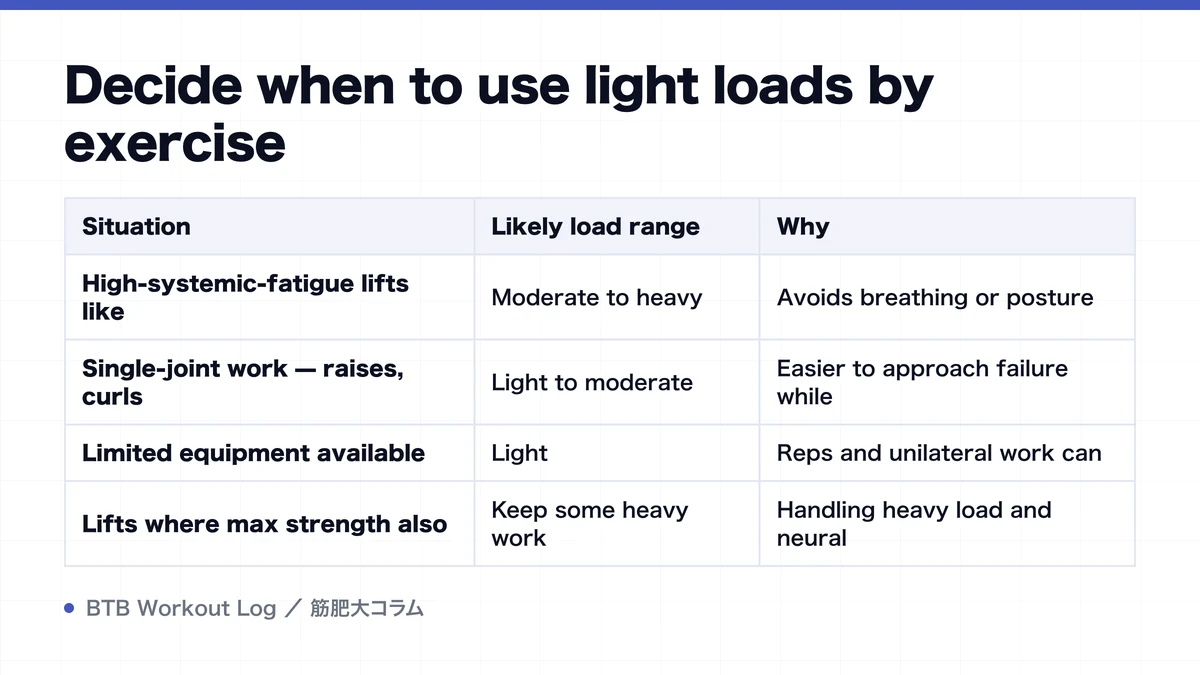
Light load being capable of hypertrophy isn't the same as making every exercise light. Load selection should weigh time, technique, local fatigue and any maximal-strength goal alongside hypertrophy potential.
| Situation | Likely load range | Why |
|---|---|---|
| High-systemic-fatigue lifts like squat | Moderate to heavy | Avoids breathing or posture limiting out first at high reps |
| Single-joint work — raises, curls | Light to moderate | Easier to approach failure while keeping the target engaged |
| Limited equipment available | Light | Reps and unilateral work can still raise relative difficulty |
| Lifts where max strength also matters | Keep some heavy work | Handling heavy load and neural adaptation are somewhat specific |
If you use light load, pick a range — say 15–25 reps — and log load and reps per set at the same form and range of motion. Hit the top of the range at your target RIR, then add a small load increment and drop back to the bottom of the range: that's how you track progress even at light loads. The rep range isn't the goal — it's a frame for keeping load adjustment consistent. Rep ranges for hypertrophy covers other ways to set it.
If reps climb on a light load and you can then add a bit of weight while holding the same movement quality, that's evidence your load selection is actually feeding progress.
The situation where "light weights are no good for hypertrophy" becomes right
Hypertrophy can happen with light weights, but part of this misconception does land. It is when you finish a light load with reps in reserve. With heavy loads, relatively high tension applies even if you leave some reps in reserve, but with light loads, the further short of failure you stop, the more likely you are to finish without recruiting enough muscle fibers.
In practice, light loads fail to work mostly when you finish in one of these ways: you stopped because you hit the target rep count, you stopped because it got hard, you stopped with room to spare before your form broke down. In none of these is the light weight itself at fault - your proximity to failure is not enough.
On top of that, low loads have practical weaknesses. Each set runs long, and your cardiovascular system or grip tends to reach its limit first; and with 0.5kg increments progress is hard to see, so judging progressive overload ends up resting on reps. If you are going to use light weights, you choose them knowing those two points and recording why the set ended.
FAQ
- How light can a load be and still build muscle?
- There's no universal cutoff, but research has confirmed hypertrophy on loads around 30% 1RM when reps are carried close to failure. Go extremely light and reps and discomfort both rise, making breathlessness or focus more likely to limit out before the target — so pick a range you can push hard on reliably.
- On light loads, should I go to failure every set?
- Failing every set isn't required. But because light loads generate little stimulus if you leave too much in reserve, RIR 1–3 is a reasonable everyday target. Occasionally checking true failure on a safe single-joint exercise helps calibrate your RIR estimate for high-rep sets.
- Can strength improve on light loads alone?
- Strength can improve, but maximal strength measures like 1RM tend to respond better to heavier training. Even with hypertrophy as the main goal, it's practical to keep some heavy work on main lifts where handling load matters, and use lighter loads on accessories.
Key takeaways
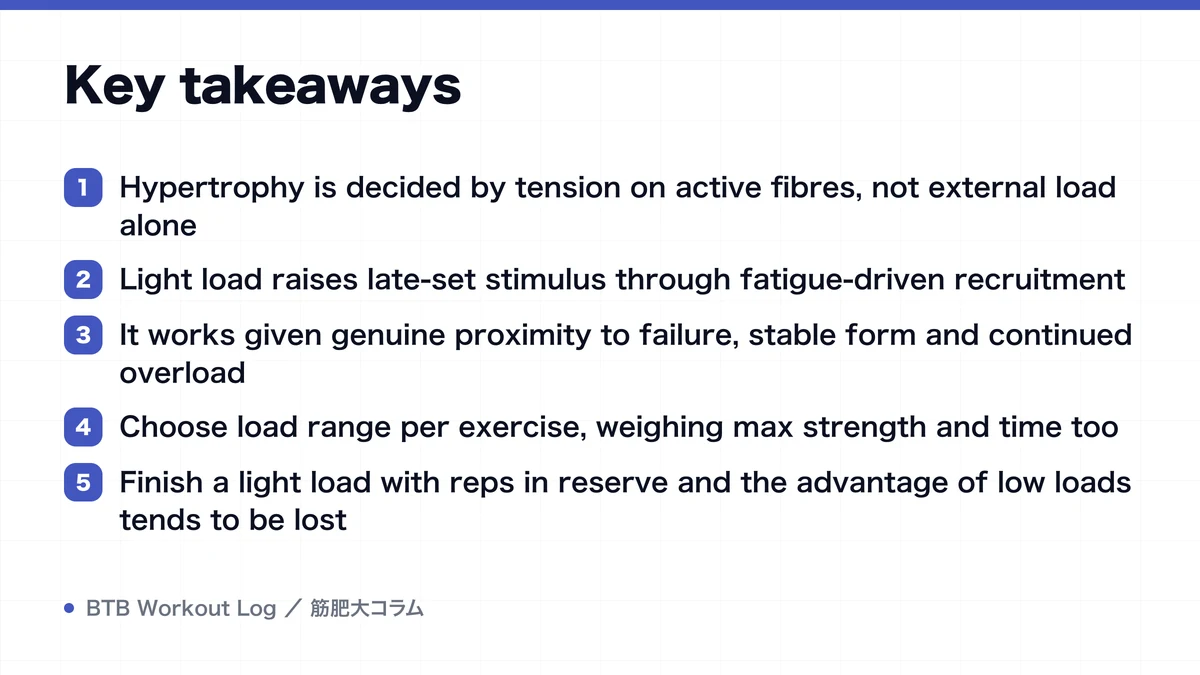
- Hypertrophy is decided by tension on active fibres, not external load alone
- Light load raises late-set stimulus through fatigue-driven recruitment
- It works given genuine proximity to failure, stable form and continued overload
- Choose load range per exercise, weighing max strength and time too
- Finish a light load with reps in reserve and the advantage of low loads tends to be lost