
Hypertrophy Workout Plans | Ready-to-Use Programs for Your Entire Body, 2–5 Days a Week
Bottom line: a practical starting point for a hypertrophy program is 10-20 sets per muscle per week, 6-15 reps, around twice a week, close to failure, adding a little weight or an extra rep over time.
That is a rough guide that fits most people, not a fixed prescription. The right amount changes with your training history, your recovery, the quality of your sets, and the load the rest of life puts on you. Here you will find the design principles research supports, ready-to-use programs for however many days you can get to the gym, and how to adjust them from your own log.
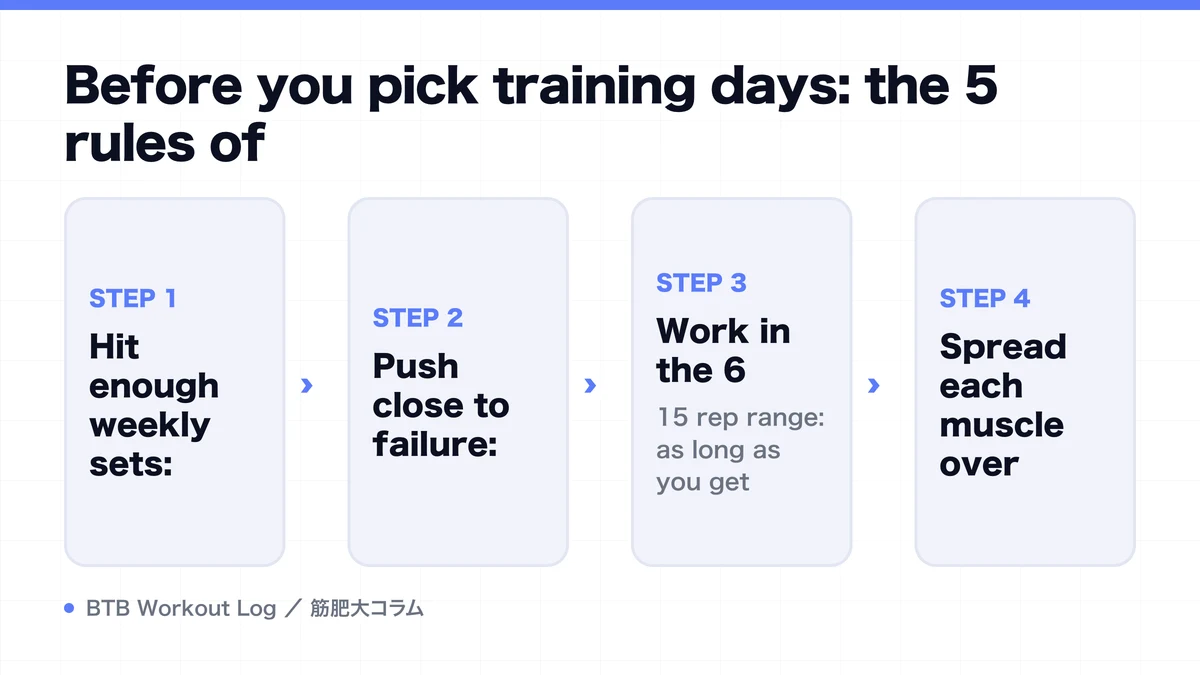
Before you pick training days: the 5 rules of muscle growth
Before we get to the programs, let's nail down the conditions under which muscle actually grows. Research keeps confirming these five:
- Hit enough weekly sets: 10-20 sets per muscle per week is a rough guide. There's a dose-response relationship between sets and hypertrophy, and multiple meta-analyses report faster growth at 10+ weekly sets (weekly sets guide).
- Push close to failure: take every set to within 1-3 reps of failure (RIR 1-3). Leave too much in reserve and the stimulus shrinks.
- Work in the 6-15 rep range: as long as you get close to failure, hypertrophy happens across a wide range of reps. In practice, 6-10 reps on the main lifts and 10-15 on accessories is an easy split to manage, but the range that suits you shifts with the exercise and the state of your joints.
- Spread each muscle over about two sessions a week: frequency itself doesn't decide how much hypertrophy you get; it's a design variable for distributing the sets you need across the week without losing their quality. Splitting the work over two sessions rather than cramming it into one tends to keep your output up on the later sets, so around twice a week is the starting point. Once a week still grows muscle if the other conditions are met.
- Progressive overload: add even a little weight or one more rep versus last time. If you're after long-term hypertrophy, tracking progress in weight and reps under the same conditions is what matters (how to apply it).
Which exercise lands on which weekday is just a means to an end. A layout that satisfies these conditions on the days you can actually train is the best program for you.
2 days a week: full body, every muscle twice
With 2 days a week, full body is the obvious call. Each session hits every major muscle group, so everything still gets trained twice a week.
| Day A | Sets x reps |
|---|---|
| Squat | 3x6-8 |
| Bench Press | 3x6-8 |
| Bent-Over Row | 3x8-10 |
| Overhead Press | 2x8-12 |
| Leg Curl | 2x10-15 |
| Biceps Curl | 2x10-15 |
| Day B | Sets x reps |
|---|---|
| Romanian Deadlift | 3x6-8 |
| Incline Dumbbell Press | 3x8-12 |
| Lat Pulldown | 3x8-12 |
| Leg Press | 2x10-15 |
| Lateral Raise | 3x12-15 |
| Triceps Pushdown | 2x10-15 |
Alternate A and B with 2-3 days between sessions (e.g. Monday and Thursday). That puts your major muscle groups at 8-12 weekly sets, plenty for beginner and intermediate growth.
3 days a week: full body to maximize frequency
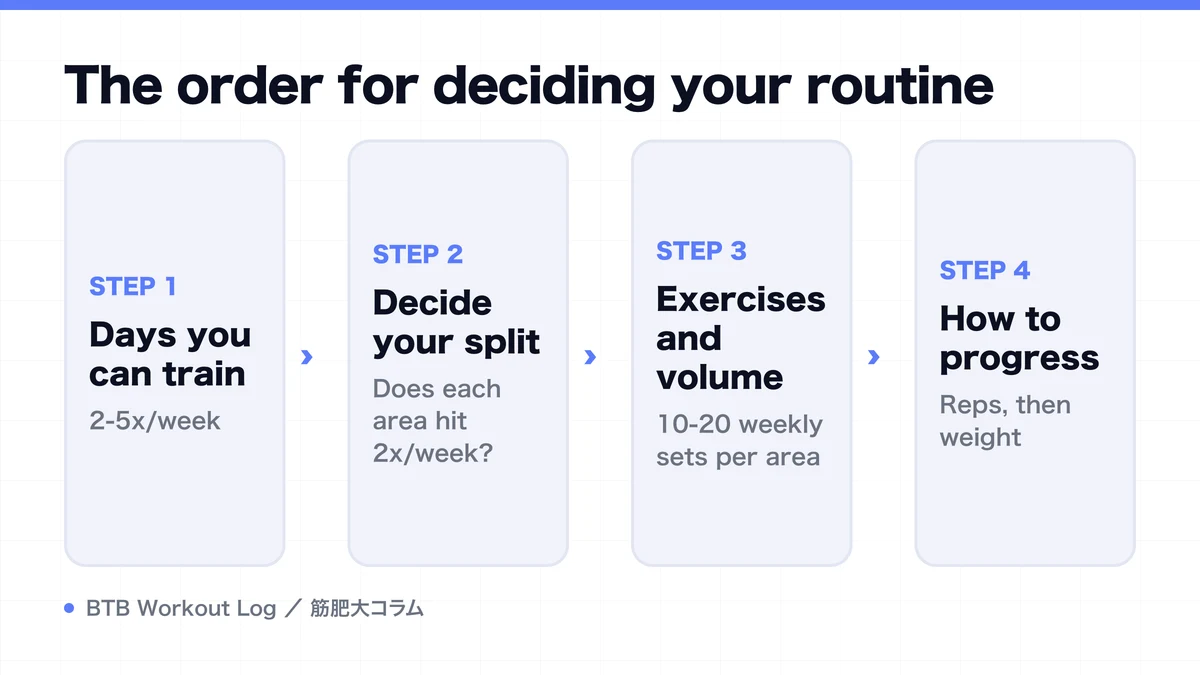
On three days a week it's easy to keep both the frequency per muscle group and the weekly sets in place, which makes full body a comfortable option. A split tends to drop each muscle to once a week, so rotate full-body days A, B, C, A and so on to hold frequency at 1.5-3 sessions (e.g. Monday, Wednesday, Friday). Add the Day C below to A and B above.
| Day C | Sets x reps |
|---|---|
| Bulgarian Split Squat | 3x8-12 |
| Dips or Chest Press | 3x8-12 |
| Seated Row | 3x8-12 |
| Hip Thrust | 2x8-12 |
| Rear Delt Raise | 2x12-15 |
| Calf Raise | 2x10-15 |
Three full-body days land your major muscle groups at 9-15 weekly sets, almost squarely in the optimal range for hypertrophy.
4 days a week: the upper/lower split
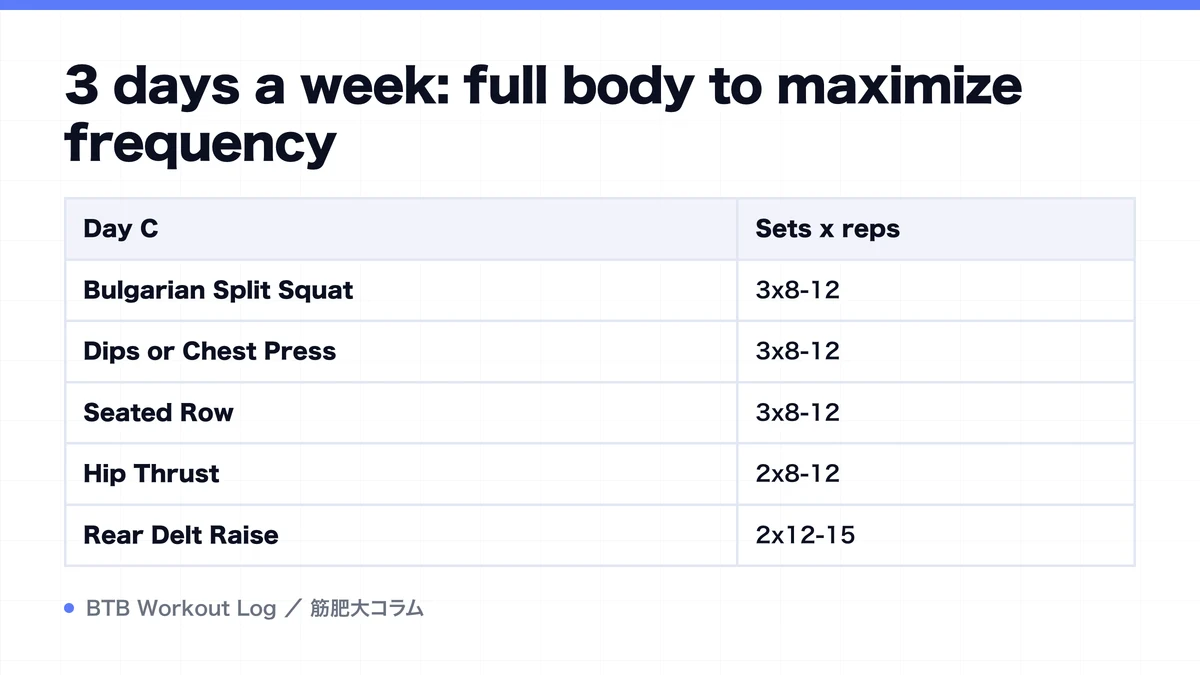
Four days a week calls for the classic upper/lower split. It keeps sessions short while comfortably delivering two workouts per muscle and 12-20 weekly sets. The skeleton looks like this; the full week of exercises is laid out in the 4-day split guide.
- Monday: Upper A (horizontal press and row focus, plus shoulders and arms)
- Tuesday: Lower A (squat-pattern focus, plus hamstrings and calves)
- Thursday: Upper B (vertical press and pull focus, plus chest and arms)
- Friday: Lower B (hinge-pattern focus, plus quads and glutes)
5 days a week: the PPL + upper/lower hybrid
With 5 days, Push/Pull/Legs plus an upper/lower pair is the easiest structure to run. Every muscle still gets hit twice a week, and each session zeroes in on fewer muscle groups so you can push them hard (e.g. Monday Push, Tuesday Pull, Wednesday Legs, Friday Upper, Saturday Lower). See the PPL routine guide for the exercise lineup.
At 5+ days a week, watch your recovery. If you're well past 20 weekly sets and progress stalls or your joints start aching, don't add more work; take a deload instead.
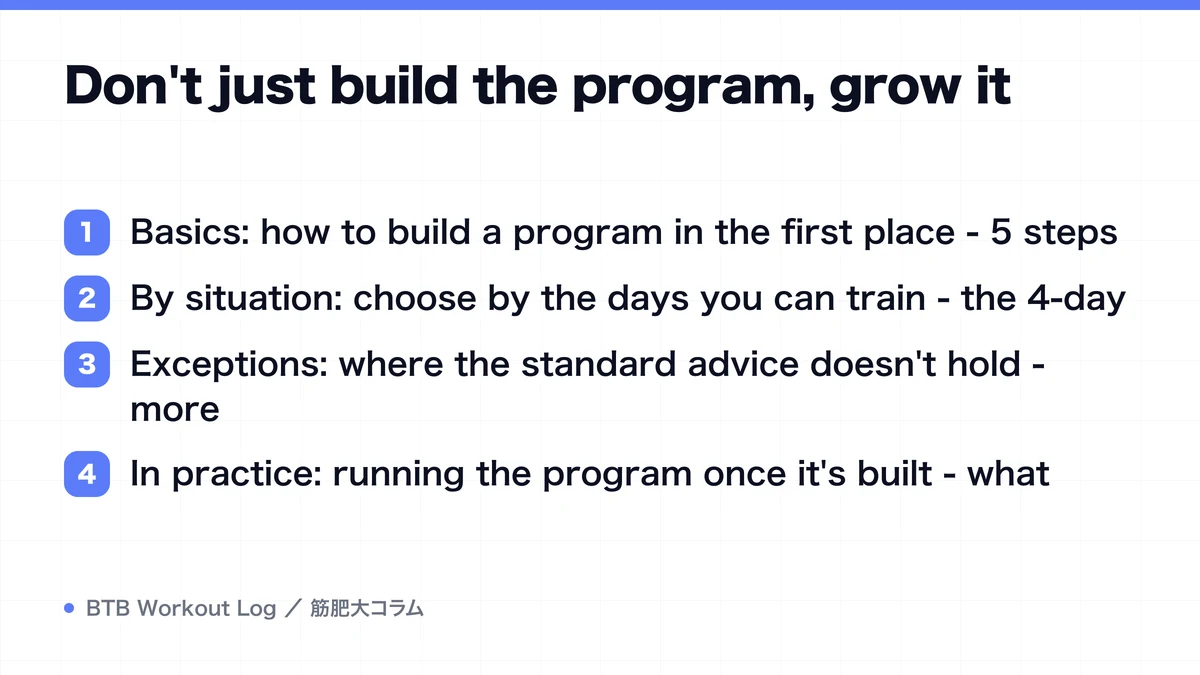
Don't just build the program, grow it
A program isn't finished when you write it down. Run it by the rules below and check how weight, reps, and form move over weeks and months, and it gets much easier to judge whether the program is working.
Progress with double progression
For an exercise programmed at 3 sets of 8-12: once you hit 12 reps on every set, add 2.5 kg next time and start over from 8. Managing progress along the two axes of weight and reps is the simplest, most fail-proof method there is.
Without a log, there is nothing to compare against
If you don't know last session's weight and reps, you can't aim for a little more than last time. With 10 exercises at 3-4 sets each, that's 30-40 numbers, and leaning on memory for all of them every session isn't realistic. That's exactly where a training log earns its keep. Just having last time's numbers in front of you makes it easier to set a target for every set.
When you want to refine the program further
That's the foundation. Where you read next depends on what you're unsure about.
- Basics: how to build a program in the first place - 5 steps to building a program / 8-12 week periodization
- By situation: choose by the days you can train - the 4-day upper/lower split / how to run PPL / PPL compared with the upper/lower split / whether 60 minutes is enough
- Exceptions: where the standard advice doesn't hold - more exercises doesn't necessarily mean more growth / free weights and machines / a fixed routine and rotating exercises
- In practice: running the program once it's built - what changes with exercise order / why too many exercises blur your progress
FAQ
- Can I keep my muscle-building workout the same every session?
- Yes. Keeping the core lifts fixed for weeks or even months is fine. What matters isn't rotating exercises but adding weight or reps to the same lifts over time (progressive overload). Revisit rep ranges or exercises only when progress stalls.
- How long should each workout take?
- Roughly 45-90 minutes. Judge your training by whether you're hitting each muscle's weekly set target (roughly 10-20 sets), not by how long you spend in the gym.
- Machines or free weights: which builds more muscle?
- With appropriate loading and a full range of motion, research finds both build muscle equally well. A practical division of labor: free weights for the heavy compound lifts, machines for safely pushing accessory work on the target muscle.
Key takeaways
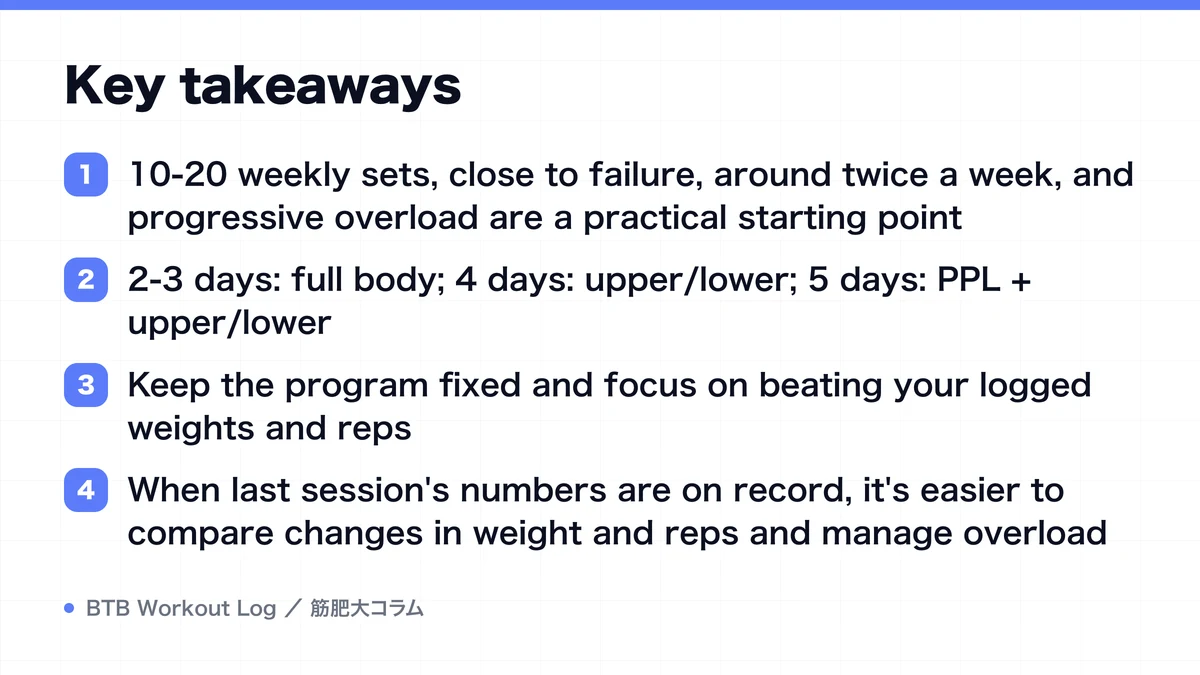
- 10-20 weekly sets, close to failure, around twice a week, and progressive overload are a practical starting point
- 2-3 days: full body; 4 days: upper/lower; 5 days: PPL + upper/lower
- Keep the program fixed and focus on beating your logged weights and reps
- When last session's numbers are on record, it's easier to compare changes in weight and reps and manage overload