Muscle Pump Doesn't Always Mean Growth | Know What Your Pump Tells You
A pump is a real sign that blood and fluid have gathered in the target area in the moment, but it isn't proof that muscle is growing over the long term.
A day with a strong pump is easy to feel good about, but a set can be genuinely effective even on a day the pump is weak. Rather than discarding the sensation, it's more reasonable to use it with a limited, specific role.
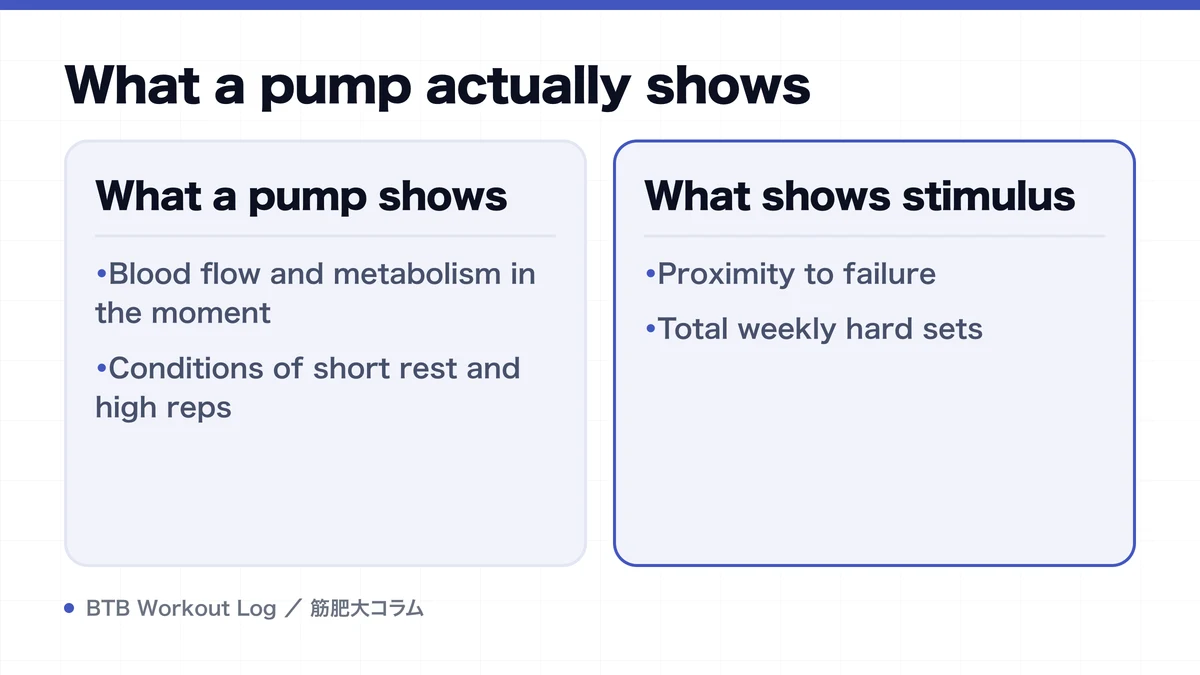
What a pump tells you is "what's happening right now"
A pump is the temporary swelling and tightness you feel as repeated movement increases blood flow to the active muscle and shifts fluid into it. It tends to be stronger with high reps, short rest between sets, and movements that keep constant tension, and it fades a while after training ends.
This sensation does have a use. If lateral raises leave your traps fatigued but your delts never feel any tightness at all, that's a cue to review load, movement path and range of motion. A bigger-than-usual left-right imbalance can point to a setup issue too. In other words, a pump can serve as supporting information for whether the target muscle was actually involved in that session.
But being involved and having received sufficient hypertrophy stimulus aren't the same thing. A pump alone can't tell you how much tension the fibers actually took on, whether that was an amount you can recover from, or whether muscle mass will be up weeks later.
Temporary swelling and long-term hypertrophy run on different timescales
A pump is an acute response lasting minutes to hours. Hypertrophy is an adaptation where contractile muscle protein and other components accumulate over the long term, as a result of repeated training and recovery. They look similar but differ in the timescale and content being observed.
The size of a pump also shifts with reps, rest time, exercise order, carbohydrate and fluid intake, and even room temperature. Since the same person training the same muscle can pump differently under different conditions, it's an unstable scorecard for comparing sessions. You could produce a strong pump with short rest and still come out behind on the program overall, if next-set reps crash hard enough that you can't bank the hard sets you need.
Research reviews on hypertrophy mechanisms, including this summary of the literature, currently find weak support for treating metabolic stress or cell swelling as an independent growth switch, and place mechanical tension at the center instead. "It swelled, so it grew" skips a step — jumping straight from an acute response to a long-term adaptation.
Growth from high reps doesn't mean the pump caused it
Part of why pump-focused thinking sounds plausible is that light-load, high-rep sets can build muscle too. A meta-analysis of 21 studies comparing low and high load found no significant difference in hypertrophy when all sets were taken to momentary failure. What needs separating here is a method that tends to produce a pump being effective versus the pump itself causing the hypertrophy.
In a light-load set, as reps continue and you approach the limit, more motor units get recruited to compensate for fatigued fibers — so the fibers that are working end up under tension. The detailed conditions for this are covered in why light loads can build muscle, and what matters isn't the lightness or the tightness — it's whether you sustained sufficient effort on the target muscle.
Using RIR alongside it makes this easier to sort out in practice. RIR is an estimate of how many reps you had left. If a high-rep set produces a strong pump but RIR is still large, it may be weak as a hypertrophy-focused hard set. Conversely, a set of 6–10 reps with a modest pump can still deliver valid stimulus if it's taken close to the limit with stable form. Evaluate RIR standards and the pump separately.
Why it's easy to mistake a pump for proof of hypertrophy
A pump is visible, touchable, and immediately rewarding. Hypertrophy, in contrast, is hard to distinguish even week to week, and gets hidden behind body weight, lighting, posture and measurement error. It's natural to want to use the strong, immediate feedback as a stand-in for a delayed result.
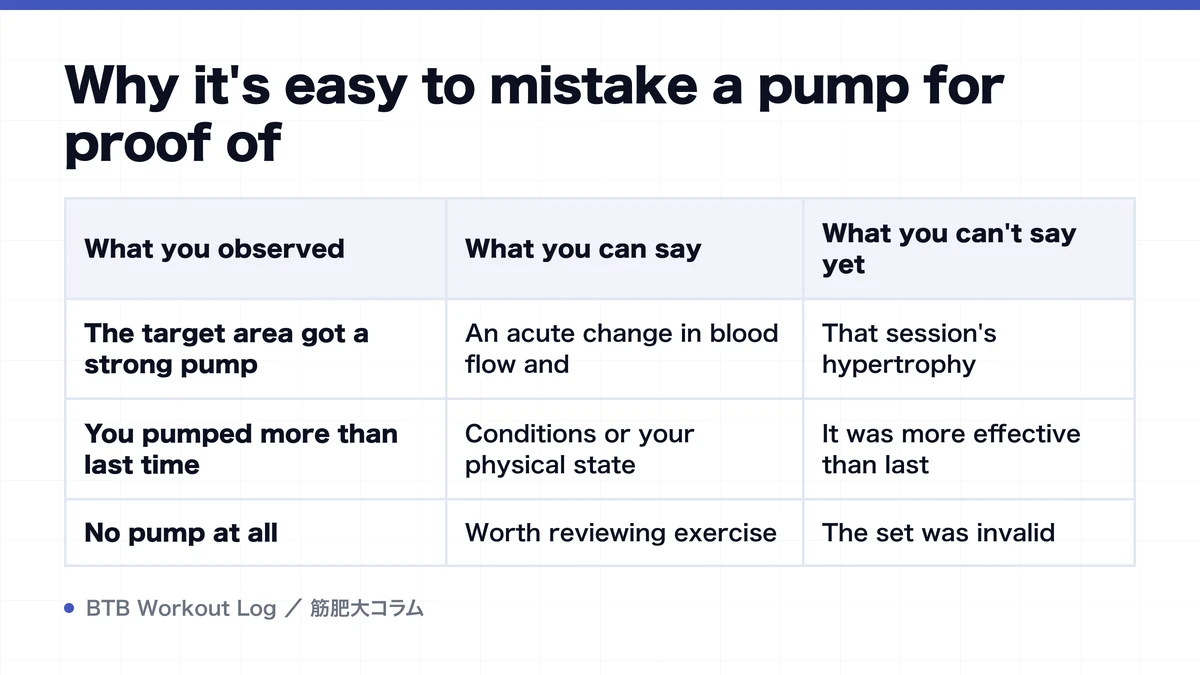
| What you observed | What you can say | What you can't say yet |
|---|---|---|
| The target area got a strong pump | An acute change in blood flow and fluid occurred there | That session's hypertrophy stimulus was sufficient |
| You pumped more than last time | Conditions or your physical state differed from last time | It was more effective than last time |
| No pump at all | Worth reviewing exercise characteristics or conditions | The set was invalid |
There's also a mix-up here between "brutal" and "effective". Short rest, drop sets and back-to-back single-joint exercises are all methods that easily produce local burn and a pump. But producing strong discomfort and banking a stimulus that builds long-term progress at a reasonable fatigue cost are different things. Making pump maximization the goal makes it easy to overlook exercise stability and next-set output.
Judge hypertrophy progress in four steps
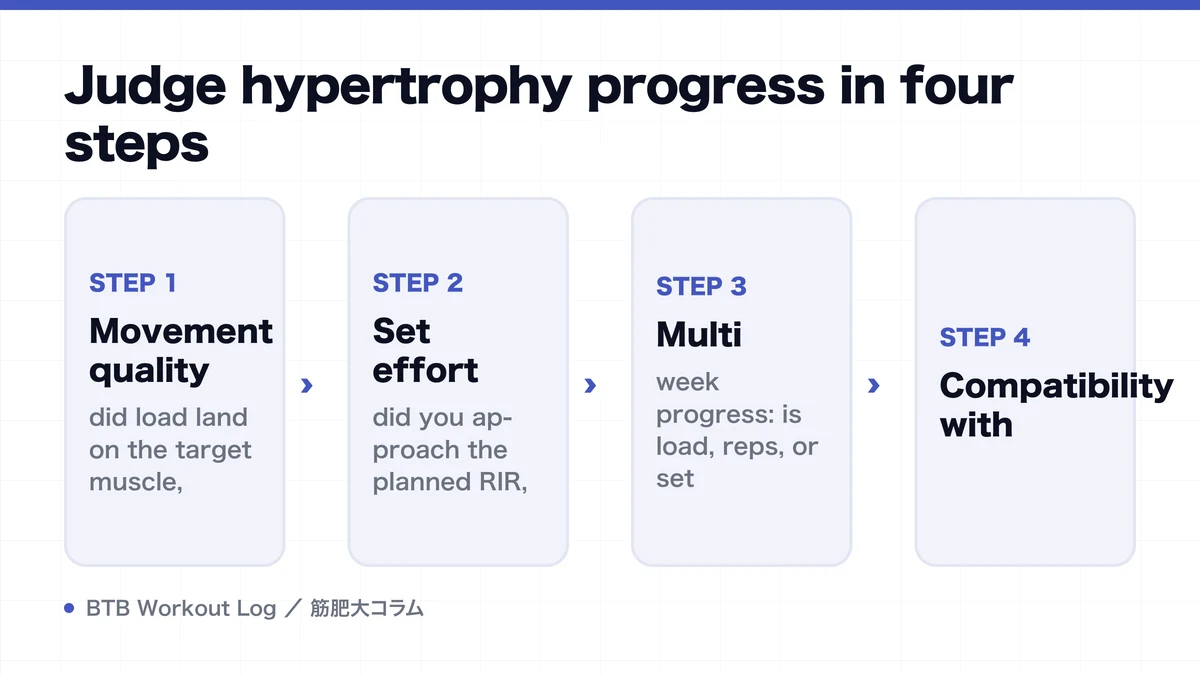
When evaluating a session, check the following order before the pump.
- Movement quality: did load land on the target muscle, with form and range of motion you can compare against before?
- Set effort: did you approach the planned RIR, rather than just grinding out the rep count?
- Multi-week progress: is load, reps, or set quality trending up under matched conditions?
- Compatibility with recovery: does output return by next time, and can you sustain the weekly volume you need?
If all four hold and "the target muscle also got a reasonable pump", the pump becomes supporting confidence in your exercise choice. But if it's strongly tight every time while load and reps stay flat for weeks, review load, rest, weekly sets and exercise selection instead of chasing a bigger pump. This is a case for separating the feeling of having worked hard from actual progressive overload.
When comparing exercises too, don't decide from one session's pump — hold form, range of motion and RIR constant across several weeks. Checking whether load or reps can climb, and whether joint discomfort or delayed recovery increase, gives you a clear reason to keep or drop that exercise.
The pump is useful as a starting point for diagnosis
On a day the pump was weak, don't jump straight to adding sets — first check whether warm-up, movement, rest or your condition differed from usual. If load, reps and RIR still matched the plan, there's no need to call that session a failure. Stacking drop sets purely to chase a strong pump back can just add recovery cost.
Conversely, if the pump is strong but your main lifts aren't progressing and later sets show a big drop in reps, suspect rest that's too short, or fatigue carried over from earlier exercises. The pump isn't the answer — it's a cue to start investigating a different metric.
Judging any of this needs a history, not a single sensation. Hypertrophy is produced by training; a log's job isn't to dismiss the sensation, but to place it correctly within your longer-term data.
Does training without a pump still build muscle?
On heavy, low-rep days, or on days when you take full rest periods, you may not get a clear pump. Hypertrophy can still progress even so. A pump is a temporary change in blood flow and fluid, and while it can reflect part of the growth stimulus, it isn't the stimulus itself.
What to check on a day without a pump isn't the sensation but the order. First, whether you could control the movement with the target muscle. Second, whether you could end the set close to the limit. Third, whether that week's weekly sets are accumulating as planned. Fourth, whether load or reps are moving on a scale of several weeks. If those four are met, the presence or absence of a pump isn't material for the judgement.
The case to watch is the reverse. If an exercise that used to pump you up suddenly stops doing so, and load and reps are falling at the same time, that may point to insufficient recovery or a decline in how well you're executing the exercise. Rather than a conclusion, the realistic use of a pump is as an entry point for reviewing your log.
FAQ
- Should I add sets on a day I don't get a pump?
- You don't need to add sets for that reason alone. If form, range of motion, load, reps and RIR all matched the plan, finish with the planned volume first. Consider adding only after checking multi-week progress and recovery, and concluding weekly sets are actually insufficient.
- Should I keep exercises that pump easily in my routine?
- They're worth keeping if they target the muscle well, don't strain the joint, and let you keep progressing load or reps. But if a strong pump comes with no progress and fatigue disrupts later exercises, review the order, rest, or the exercise itself.
- Are high-rep sets aimed at getting a pump pointless?
- No. Even light loads can create hypertrophy stimulus if taken close to the limit, and single-joint exercises can also ease joint stress. What to evaluate isn't how much you pumped — it's the effort on the target muscle and long-term progress.
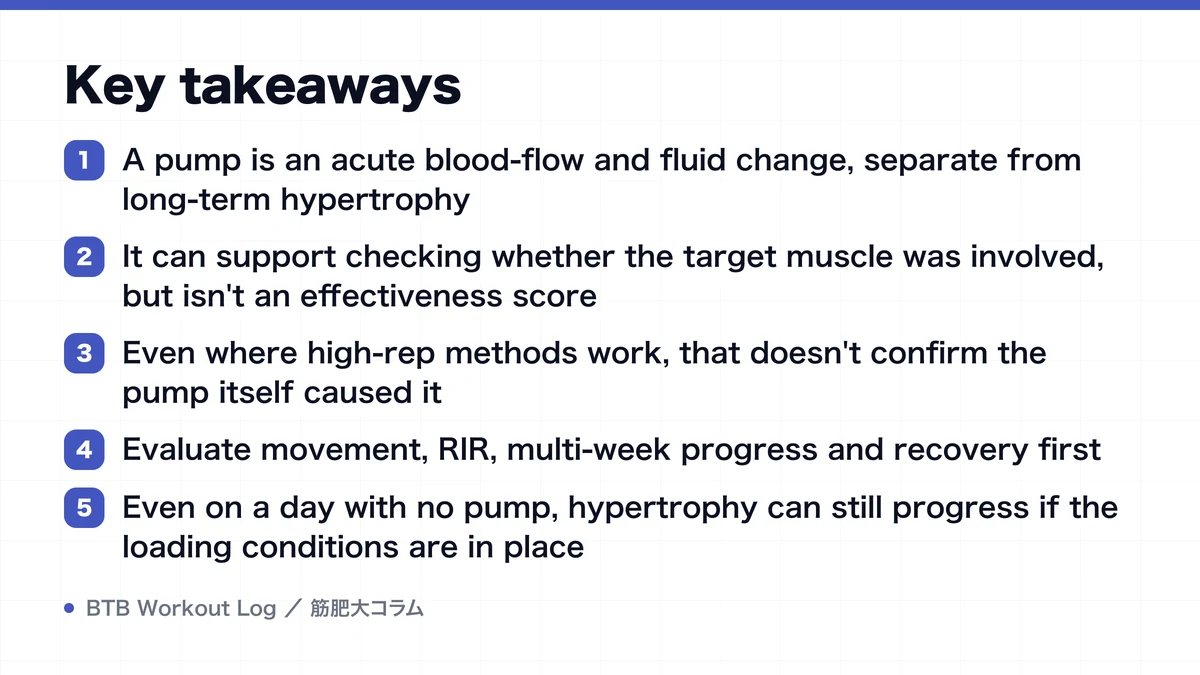
Key takeaways
- A pump is an acute blood-flow and fluid change, separate from long-term hypertrophy
- It can support checking whether the target muscle was involved, but isn't an effectiveness score
- Even where high-rep methods work, that doesn't confirm the pump itself caused it
- Evaluate movement, RIR, multi-week progress and recovery first
- Even on a day with no pump, hypertrophy can still progress if the loading conditions are in place