Hypertrophy Happens Even Without Soreness | Why "That Didn't Work Today" Isn't Something to Worry About
Even without soreness, hypertrophy can occur if the target muscle takes on sufficient mechanical tension and you can repeat that stimulus within what's recoverable. Soreness is a sensation that arises after exercise — it isn't the growth stimulus itself.
Pain tends to fade the more familiar you get with the same routine, but that doesn't mean appropriate load and effort have disappeared too. Judge stimulus not from pain, but from training content and progress over several weeks.
Why does soreness feel like "proof it worked"?
The day after trying a new exercise, or after your first high-volume session in a while, you may feel intense delayed-onset muscle soreness in the muscles you trained. Because the soreness lines up with those muscles, it's easy to assume that more pain means a stronger stimulus and more growth. But that confuses a sign that your body has registered the exercise with the extent of long-term adaptation.
Soreness is more likely after unfamiliar contractions, especially when a muscle lengthens under tension, a sudden increase in range of motion, or more sets than usual. Its intensity also depends on your training experience, familiarity with the exercise, sleep, and perception of pain. Hypertrophy, by contrast, is an increase in muscle cross-sectional area resulting from weeks and months of resistance training. How you feel the next day and how your muscles change over time operate on different timelines and depend on different factors.
Strong soreness can make a workout feel productive, but it cannot tell you how many effective sets you completed, your RIR, the quality of your form, or whether your recovery will be sufficient by the next session. Soreness can provide context, but it is no scorecard for training results. It is also not the only sensation lifters mistake for a measure of effectiveness. Our review of common training myths examines similar misconceptions to help you make more consistent training decisions.
The mechanism where growth stimulus remains even without pain
At the center of hypertrophy is mechanical tension, taken on by muscle fibers as they produce force. Handle load, and if the target muscle produces sufficient force, that physical stimulus converts into an intracellular response, setting processes related to muscle protein accumulation in motion. See this research review of hypertrophy mechanisms for detailed context.
Muscle damage, on the other hand, is a change in muscle tissue that can occur from unfamiliar exercise and can relate to soreness, but they aren't the same thing. Further, repair that restores damaged tissue and adaptation that adds more muscle protein than before to grow the muscle need to be distinguished too. More repair work doesn't necessarily mean net hypertrophy scales up proportionally.
So a state with no soreness is better interpreted not as "nothing happened" but as "the response that produces strong pain isn't prominent." If you're performing sets with sufficient effort, delivering tension through stable range of motion and form, you can accumulate growth stimulus without pain. Why you don't need to push to the limit every time connects to the relationship between failure reps and hypertrophy.
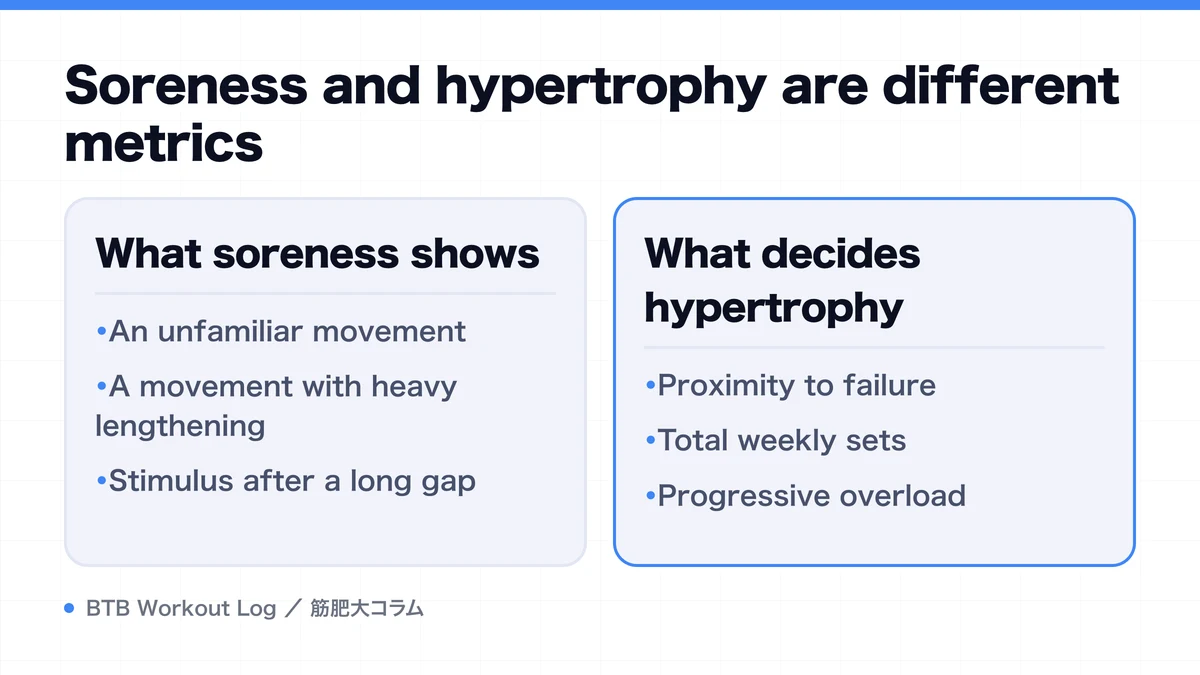
Why only soreness fades on the same routine
Keep the same exercise, range of motion and set structure, and the body gets used to how it receives that load. It's not uncommon for a routine that hurt badly the first time to produce lighter soreness after a few repeats. This isn't the training becoming ineffective — it's a protective adaptation to the same movement progressing, making excessive damage or pain less likely.
If, at the same time, reps rise at the same weight, you can do the same reps at heavier weight, or form stays stable at the same RIR, stimulus hasn't been lost. RIR is a reserve metric — how many more reps were possible. RIR 2, for instance, means the sense that roughly 2 more reps were possible while holding form. Even as pain fades, you can separately confirm whether the necessary force production is still occurring late in the set.
Conversely, switching exercises every week purely to bring soreness back, or suddenly emphasizing the lengthening phase, can raise novelty-driven pain but makes it harder to compare progress under matched conditions. Technique also has to be relearned each time, potentially raising the recovery cost that lowers next-time output. Changing exercises isn't a tool for manufacturing pain — it's a decision to use when you need to fix a stall, joint stress, or how load reaches the target muscle.
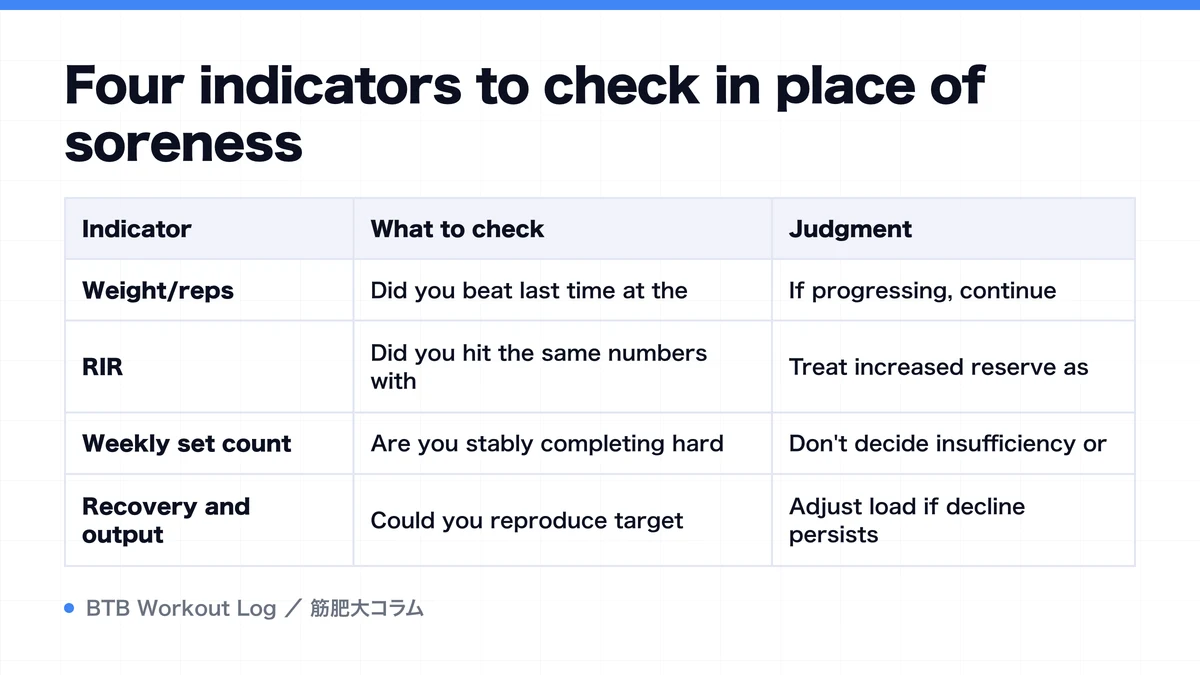
Four indicators to check in place of soreness
Before changing your routine over a pain-free week, compare the following indicators under matched conditions. Watching a trend over at least several weeks, rather than a single good or bad session, makes it easier to separate day-to-day variance from a genuine stall.
| Indicator | What to check | Judgment |
|---|---|---|
| Weight/reps | Did you beat last time at the same form and range of motion? | If progressing, continue |
| RIR | Did you hit the same numbers with more reserve? | Treat increased reserve as progress too |
| Weekly set count | Are you stably completing hard sets on the target muscle? | Don't decide insufficiency or excess from pain |
| Recovery and output | Could you reproduce target weight/reps next time? | Adjust load if decline persists |
- No pain, records trending up: current stimulus and recovery are both working — maintain the routine.
- No pain, records flat too: look for a shortfall in this order — effort level, form, weekly volume, nutrition — and change only one at a time.
- Strong pain, records declining: before adding new stimulus, recover from the cost of a recent exercise change or set-count increase.
There's no need to rush raising weight alone — reps rising at the same weight is progressive overload too. Use how to think about volume as a foundation for weekly set count, and adjust your own effective range based on RIR, exercise, frequency and recovery.
If there's no pain, weight or reps are progressing, and next-time output holds, there's little reason to change anything. If there's no pain and records also haven't moved for several weeks, check one at a time whether RIR is too far from the limit, whether load is landing on the target muscle, and whether weekly volume is too low.
Don't ignore soreness — treat it as a recovery cost signal
Soreness isn't a growth score, but it isn't information to ignore either. If strong pain narrows range of motion and lowers weight or reps even during warm-up, that body part may not have sufficiently recovered from its last load. Rather than pushing through the plan while in pain, adjustments like switching to a different body part, reducing set count, or lowering load are reasonable. See rest days and recovery for judging frequency.
What to judge isn't a binary "does it hurt or not" - it's how much the pain constrains your next training quality. Mild tightness that still allows normal range of motion and output is different from pain severe enough to change daily movement. Also, don't assume it's ordinary soreness if the pain is sharp during a specific movement or localized right around a joint - consider stopping or consulting a professional instead.
If records are progressing and you can repeat a recoverable volume, growing your current routine is a more consistent hypertrophy decision than trying to manufacture soreness again.
Conversely, if you go stretch after stretch with no soreness at all and neither weight nor reps are climbing, the issue is the amount of stimulus, not the presence or absence of soreness. The order of judgement runs like this: first look at whether your numbers are moving, and only when they aren't, question set count, range of motion, and proximity to failure.
What you miss when you rate a session as "sore = a good workout"
When soreness lingers the next day, that session feels like it was a good one. The reason is simple: soreness is one of the few pieces of feedback you get on the spot. But how strong the soreness is also varies a lot with unfamiliarity - a new exercise, an unaccustomed stretched position, a body part you haven't trained in a while.
Use it as a grade and you get misreadings in both directions. One is a false positive: strong soreness appears only because you just switched exercises, and you read it as more stimulus. The other is a false negative: soreness fades only because you kept the same routine, and you decide it has stopped working and break the routine up.
In practice, treat soreness not as a result but as supporting information about recovery cost. If soreness is strong and weight or reps drop in the next session, that is material for reviewing volume or exercise selection. If soreness is mild but your numbers are climbing, that routine is working. The main basis for judgement is the trend in weight, reps, RIR and weekly sets.
FAQ
- If soreness stops happening on the same routine, should I switch exercises?
- No need to switch just because the pain went away. You can continue if weight or reps are progressing at the same form and range of motion, and load is landing on the target muscle. Consider switching exercises if progress stalls for several weeks and joint stress or stimulus imbalance also show up.
- Does stronger soreness mean a bigger hypertrophy effect?
- Not necessarily proportional. A new exercise or sudden volume increase tends to produce strong pain, but long-term hypertrophy is judged from mechanical tension and repeated recoverable training. Pain severe enough to lower next-time output may cost more in recovery than it delivers in stimulus.
- Is it OK to train the same body part while some soreness remains?
- It can be fine if mild tightness still lets you warm up through normal range of motion without a big drop in your planned weight or reps. If strong pain changes your movement or output, rest or lighten the session — and don't assume it's ordinary soreness if it's sharp or joint-localized.
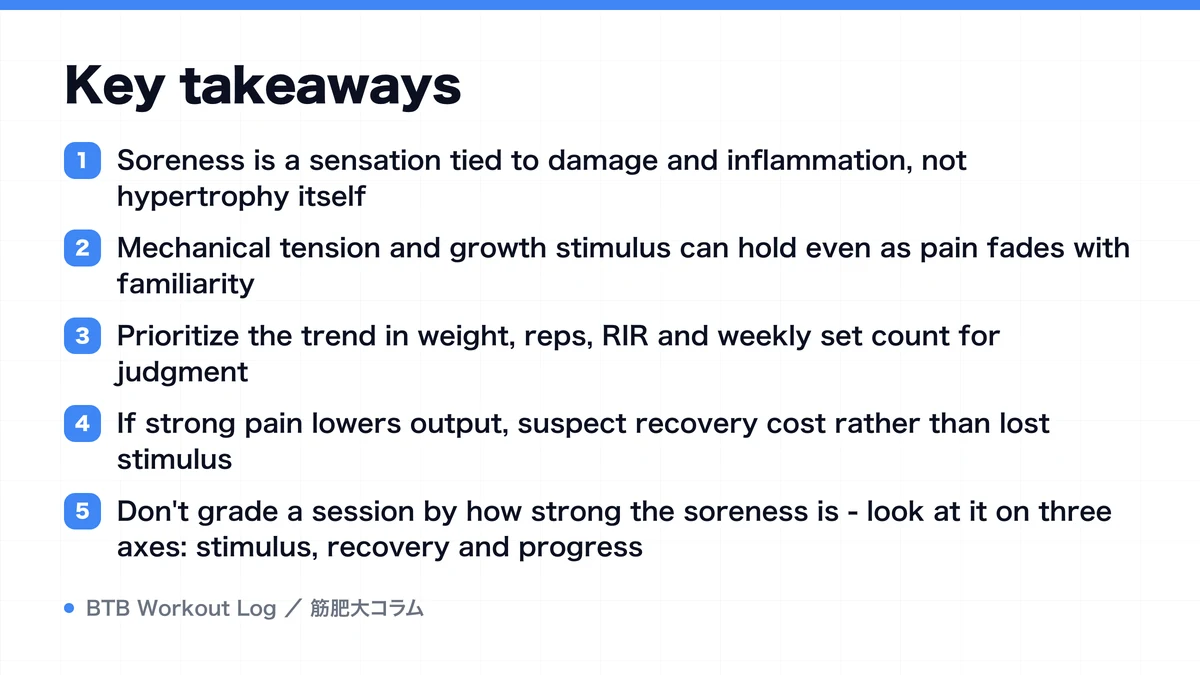
Key takeaways
- Soreness is a sensation tied to damage and inflammation, not hypertrophy itself
- Mechanical tension and growth stimulus can hold even as pain fades with familiarity
- Prioritize the trend in weight, reps, RIR and weekly set count for judgment
- If strong pain lowers output, suspect recovery cost rather than lost stimulus
- Don't grade a session by how strong the soreness is - look at it on three axes: stimulus, recovery and progress