Why Does Yesterday's Weight Feel Heavier Today? | What to Know Before You Panic About Getting Weaker
The main reason the same weight suddenly feels heavy isn't that your muscle got weaker in a day — it's that the performance you can produce that day swings with fatigue, sleep, and readiness conditions.
One off session isn't evidence of a plateau. First, you need to separate "capability has dropped" from "I can't fully express my capability today."
"Feels heavy" and "strength dropped" aren't the same thing
A weight that was 8 reps last time slows down starting on rep 5 today. What's happening here isn't necessarily a long-term drop in strength itself. Underlying capability, including muscle mass and technique, doesn't change much over a few days, but how much of that capability you can express on a given day varies. If the former is engine size, the latter is closer to that day's road surface, fuel, and driving conditions.
Concluding "I got weaker" and forcing last time's rep count with broken form changes your comparison conditions too. Conversely, overhauling set count and exercise selection just because one day was heavy makes it impossible to tell what actually caused it. Yesterday's success isn't a quota guaranteeing today's rep count — it's a baseline for tracking long-term progress under matched conditions.
What hypertrophy needs isn't a personal best every time — it's weight, reps and movement quality trending up over weeks to months. A single day's sensation is important information, but it's too noisy to judge growth or a stall from on its own.
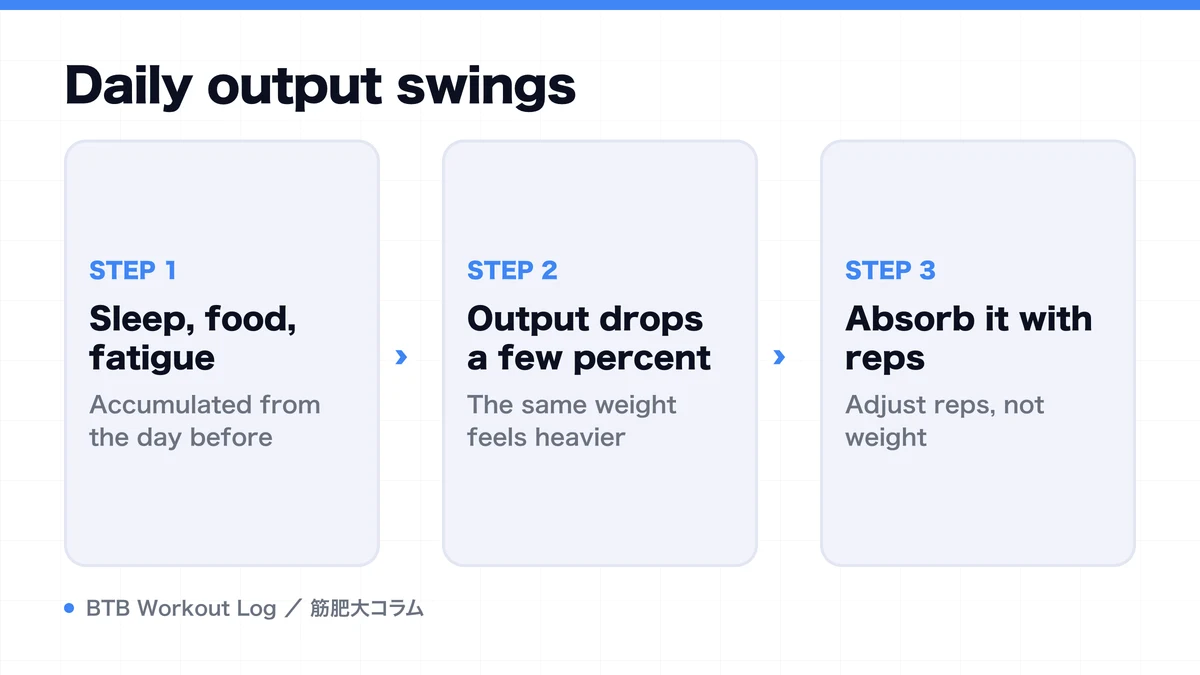
Fatigue, sleep and nutrition shift "usable output"
A representative factor moving that day's output is fatigue accumulated up to that point. This isn't limited to hard sets on the same muscle group — a lower-body session the day before, long hours of activity at work, or high volume spread across several days can all affect it. Even without soreness, if bar speed is slow from warm-up on, breathing doesn't settle as usual, or reps drop across several exercises, recovery may not be keeping pace.
How widely the fatigue spreads is also a clue. If only bench press is off while lower-body and pulling work feel normal, first suspect local chest/triceps fatigue or bench-specific technical conditions. Conversely, if pressing, pulling and legs all feel heavy from the warm-up, along with poor focus or strong drowsiness, don't try to fix it by adding sets to one body part — this is a case for reviewing overall recovery. Comparing the heaviness sensation across exercises makes it easier to narrow down candidate causes.
Sleep matters too — sleep loss can especially lower output on multi-joint compound exercises using large muscle groups. If squats or bench press feel heavy on a poor-sleep day, that alone doesn't mean the program has broken down. See deciding rest days for recovery-day thinking, and sleep loss and performance for that specific path.
A long gap between meals, less carbohydrate or fluid than usual, or heavy sweating in a hot environment can all shift how it feels too. But you don't need to pin down one single cause. It's more practical to check easy-to-change, reproducible items first — last night's sleep, sets on the target muscle over the last 48–72 hours, and pre-training food and fluid.
The same weight might not actually be lifted under the same conditions
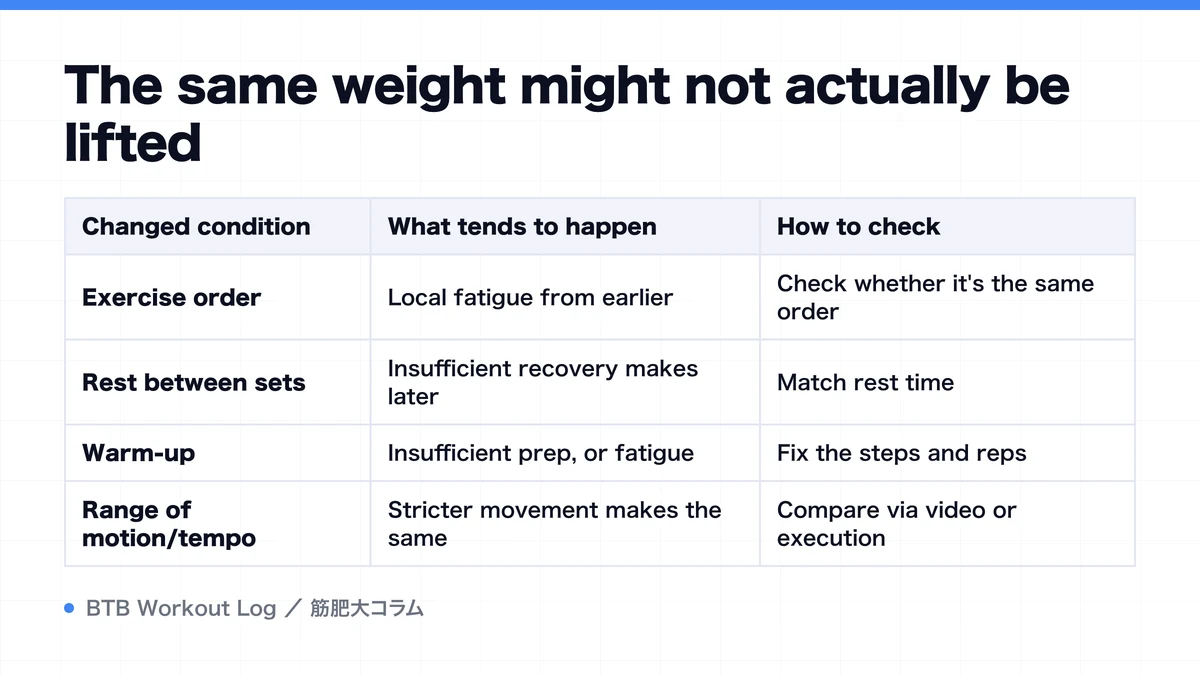
Besides physical condition, a mismatch in comparison conditions is common. Last time it was your first exercise; today it's your third. Last time you rested 3 minutes between sets; today it's 90 seconds. The rack height or bench position differs. With gaps like these, the challenge isn't the same even though the number on the plate is.
| Changed condition | What tends to happen | How to check |
|---|---|---|
| Exercise order | Local fatigue from earlier exercises lowers reps | Check whether it's the same order as last time |
| Rest between sets | Insufficient recovery makes later sets heavier | Match rest time |
| Warm-up | Insufficient prep, or fatigue from the warm-up itself | Fix the steps and reps |
| Range of motion/tempo | Stricter movement makes the same weight harder | Compare via video or execution notes |
| Equipment/setup | Changes the path or how easily force is produced | Check bench, rack, or machine number |
Rest time in particular is a variable that tends to directly affect total reps — see rest between sets for detail. Also, if your range of motion is wider than before, momentum is reduced, or you're controlling the lowering phase better, the content has improved even at the same rep count. Rather than looking at weight and reps in isolation, only once you match comparison conditions can you judge whether you're genuinely weaker today.
Decide that day's load from warm-up and RIR
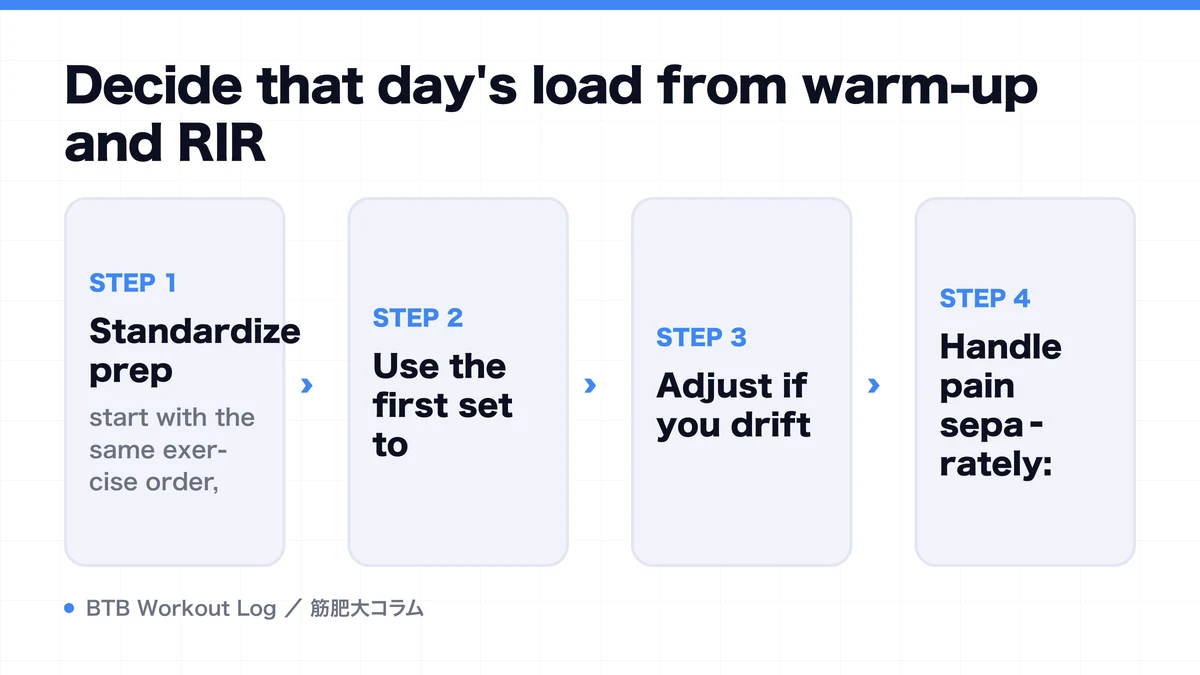
You can't fully identify the cause before starting training. That's where a standardized warm-up and RIR help. RIR is a metric for how many more reps were possible at the end of a set — RIR 2 means you left 2 reps of reserve. Run roughly the same prep every time, and watch your response during the final warm-up and first working set.
- Standardize prep: start with the same exercise order, similar warm-up weights, and the same rest.
- Use the first set to diagnose: log not just target reps but movement quality and RIR.
- Adjust if you drift from target RIR: if you're approaching the limit several reps early despite planning RIR 2, either lower weight slightly or stop at that day's lower rep floor.
- Handle pain separately: don't push through sharp pain, numbness, or unusual joint pain as just an off day.
Lowering load isn't abandoning progressive overload — it's that day's adjustment to move the target muscle at the intended RIR. Conversely, if warm-up feels light and form is stable, proceed toward your last recorded value as the target. Rather than forcing yourself to reproduce a number on a bad day, protecting stimulus quality and leaving a comparable state for next time serves long-term progress better.
What to judge isn't one day — it's the trend under matched conditions
If it's heavy just once, adjust that day's load and finish, then watch whether it returns next time on the same exercise. What deserves treatment as a problem is weight, reps, RIR or form all worsening across several sessions done under similar conditions. If several exercises across your whole body decline at once, prioritize checking sleep, total fatigue and nutrition; if it's one specific exercise, suspect exercise order, technique, or set count on that body part.
Even with ongoing decline, adding sets right away isn't necessarily the answer. If it comes with signs of fatigue, a deload or trimming weekly volume is a candidate. If you're recovering fine but only one specific exercise hasn't moved for several weeks, review rep range and progression method as a weight-plateau strategy. A single day's variance and a persistent plateau can even call for opposite fixes.
What this distinction needs is watching not just weight but reps, RIR, exercise order, rest, and condition notes on the same timeline. What to look for in your log isn't today's win or loss — it's the direction of the line under matched conditions. Whether a heavy day was an outlier or a downward trend can only be told by lining up several weeks. BTB Workout Log keeps the history you need for that judgment.
FAQ
- Should I skip training on a day something feels heavy?
- No need to skip from that sensation alone. Check movement, RIR and pain with a standardized warm-up, and continue if you can safely get intended stimulus even at lower weight or reps. Consider stopping if several exercises decline substantially or there's abnormal pain.
- Is lowering weight below last time bad for hypertrophy?
- One day's adjustment alone is unlikely to stop hypertrophy. If form breaks down or you get too close to RIR 0 at your planned weight, lowering it slightly to hold target RIR protects the set's purpose better. Evaluate from the long-term weight/rep trend instead.
- After how many consecutive heavy sessions should I call it a plateau?
- There's no fixed number, but if weight, reps and RIR worsen even across several sessions done at similar sleep, exercise order, rest and form, suspect recovery or a program issue over a temporary dip. First check whether your comparison conditions actually match.
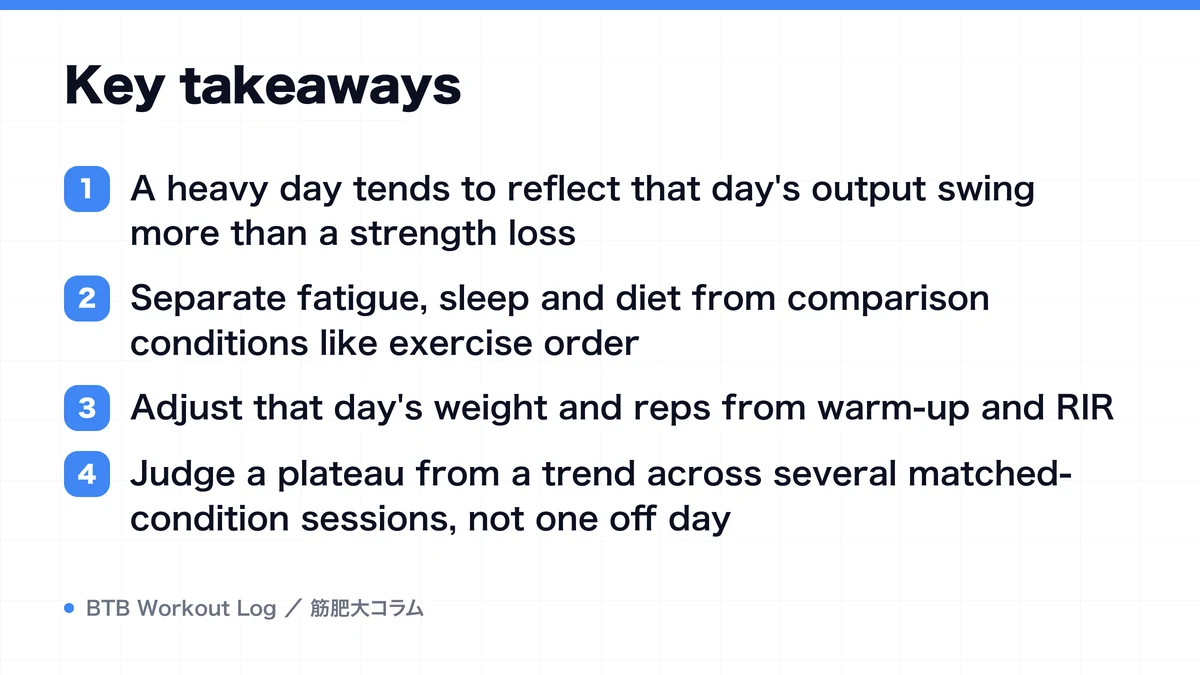
Key takeaways
- A heavy day tends to reflect that day's output swing more than a strength loss
- Separate fatigue, sleep and diet from comparison conditions like exercise order
- Adjust that day's weight and reps from warm-up and RIR
- Judge a plateau from a trend across several matched-condition sessions, not one off day