Hypertrophy: Can Adding 2.5kg Every Week Keep You Growing?
Adding 2.5kg every week can work during a phase when strength and technique are rising fast, but it isn't a permanent rule for sustaining hypertrophy. Raise weight not because "it's scheduled" but as a result of meeting your set reps at the same form, range of motion and target RIR.
What to test isn't whether you could add 2.5kg — it's whether, after adding it, you can still bank valid sets on the target muscle, with weight or reps trending up over several weeks.
Define the conditions for calling "weekly +2.5kg" a success
What's being tested here isn't whether you can add 2.5kg to the bar every week. It's whether, after adding it, you can hold your intended rep range, range of motion, form and RIR, and keep running hypertrophy-focused sets. RIR is a reserve metric — how many more reps were possible. RIR 2 means you ended the set roughly 2 reps short of the limit.
At the same 80kg, going from 8 reps at RIR 2 to 8 reps at RIR 0 means the actual difficulty rose even though weight didn't change. Conversely, raising from 80kg to 82.5kg while reps drop from 10 to 6 and range of motion shortens means you can't call that a capability gain under matched conditions. Progressive overload can only be confirmed once comparison conditions are matched — not from the number on the plate alone.
Also, since 2.5kg is an absolute value, it's a 6.25% increase at 40kg but only 2.5% at 100kg. What's a small step on the bench press can be a huge jump on lateral raises or curls. Bundling "every week," "2.5kg," and "any exercise" into one rule erases this relative difference.
Raising load is different from raising it at a fixed pace
The operation of raising weight has real meaning — if load rises while you hold the same reps, movement and RIR, that's an unambiguous record of handling more external load than before. ACSM's progression model also lays out confirming you can hit target reps before advancing load in steps — an order where the increase follows achieved capability, rather than fixing an increase date on the calendar first.
Meanwhile, comparisons taking sets to failure show comparable hypertrophy between low and high load, while 1RM strength tends to favor high load. So getting heavier every week has value as strength practice, but doesn't by itself guarantee hypertrophy. For hypertrophy purposes, the condition isn't weight alone — it's whether you can still move the target muscle, stay close to the limit, and sustain a recoverable weekly volume.
A linear load-progression plan can also serve as a tool for a defined period. But across research holding training volume matched, periodization tends to favor non-periodized approaches for 1RM strength while showing no clear difference for hypertrophy. What matters isn't how complex the program is or whether you raised load by the same amount every week — it's whether you banked valid sets over the long term and updated load to match capability.
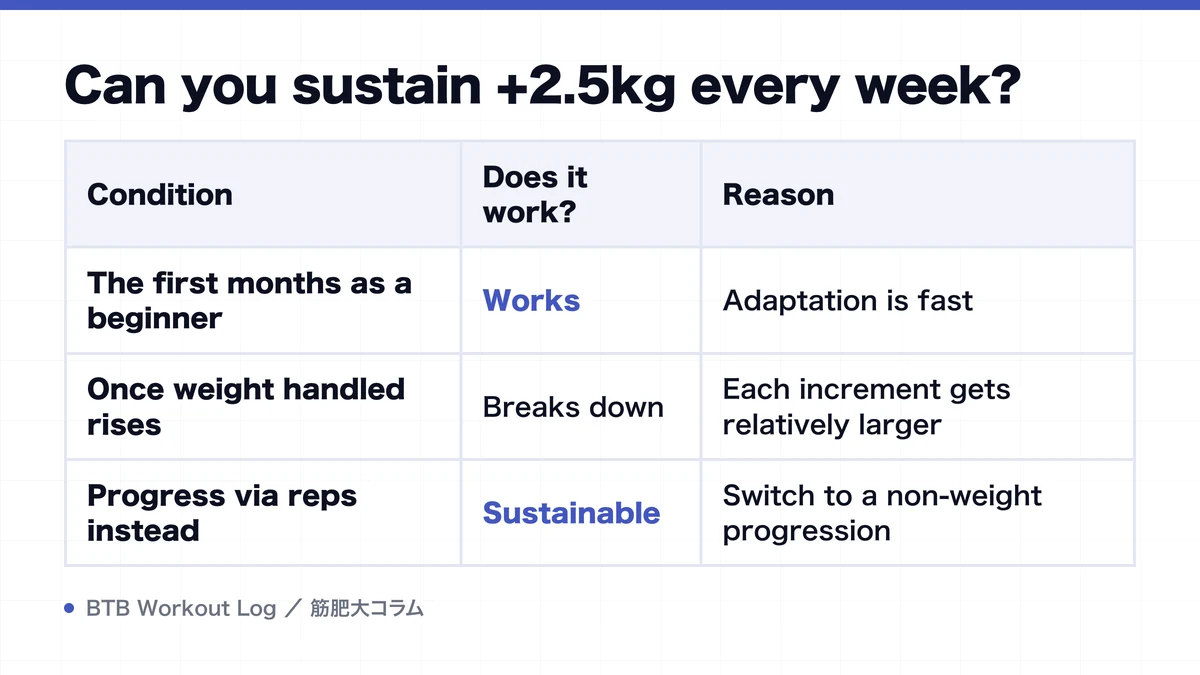
Three reasons a fixed weekly increase eventually breaks down
1. Adaptation speed isn't constant
Right after starting a new exercise or returning from a break, you can progress weekly through motor learning and strength recovery. But the more experienced you get, the smaller the gain you get in the same period. Add 2.5kg weekly for 52 weeks from 60kg, and you'd hit 190kg by year's end. That this arithmetic can't hold long-term shows a fixed increase isn't the same thing as your actual growth rate. Slowing with experience is covered in more depth in the relationship between training history and progress.
2. The right increment differs by exercise
2.5kg is small on squats or deadlifts, but on a single-arm dumbbell exercise, the equipment's smallest increment can exceed your actual capability gain. If raising weight instantly drops you out of your rep range, building reps, using micro-plates, or raising form reproducibility at the same weight preserves continuity better. See weight-first vs. rep-first progression for that switch.
3. That day's output fluctuates
Sleep, recovery since last time, exercise order, and rest time all shift that day's achievable reps even at the same underlying strength. Not hitting the planned increase once isn't failure. Conversely, if you compensate with momentum or a shortened range of motion, your log might show a weekly increase while comparability is lost. Rather than a single pass/fail, you need to watch the trend across several sessions under matched conditions.
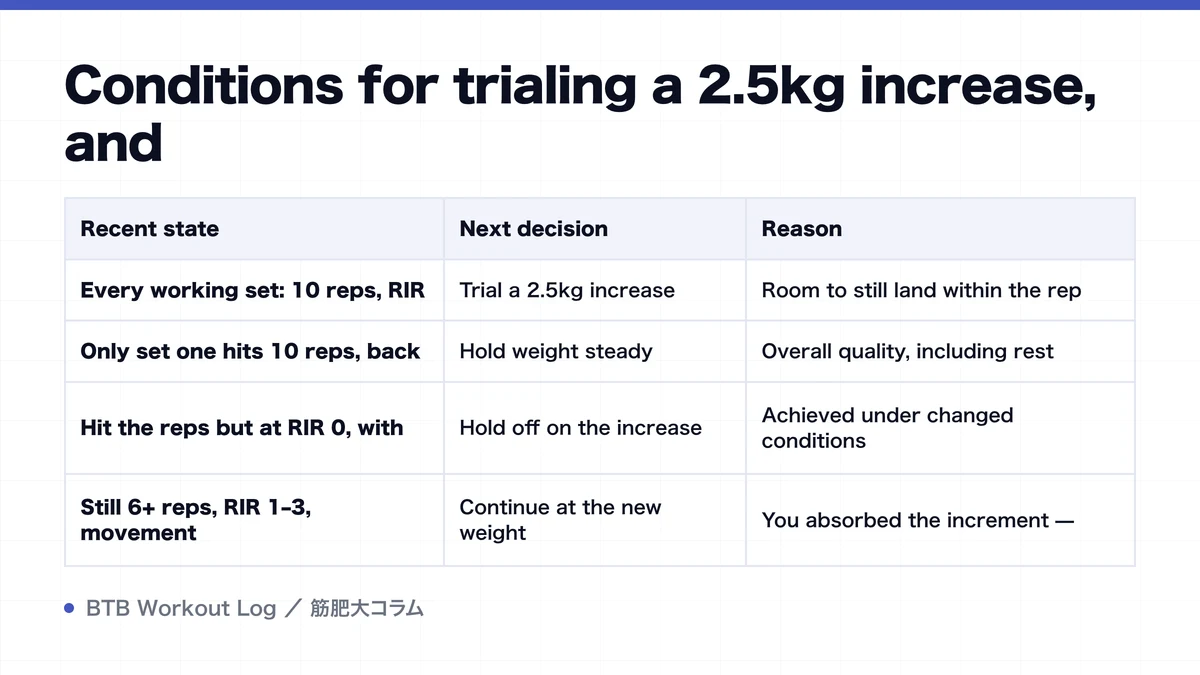
Conditions for trialing a 2.5kg increase, and conditions for holding off
Rather than a fixed schedule, use the following checklist to confirm you've "earned" the increase. As an example, assume an exercise at 6–10 reps, target RIR 1–3.
| Recent state | Next decision | Reason |
|---|---|---|
| Every working set: 10 reps, RIR 1–3, movement stable | Trial a 2.5kg increase | Room to still land within the rep range after adding weight |
| Only set one hits 10 reps, back half under 6 | Hold weight steady | Overall quality, including rest and set placement, is still unconfirmed |
| Hit the reps but at RIR 0, with momentum or shortened range of motion | Hold off on the increase | Achieved under changed conditions — not comparable to a genuine capability gain |
| Still 6+ reps, RIR 1–3, movement held after the increase | Continue at the new weight | You absorbed the increment — next, build reps |
| Below the floor after the increase, movement breaks down or pain appears | Revert or use a smaller increment | 2.5kg was too large for your current capability |
This method is double progression — build to the top of your rep range, then add weight. Some stretches will let you add 2.5kg week after week, but a week without an increase isn't a failure. On small-muscle single-joint exercises or machines with coarse weight increments, a long stretch of building one rep at a time at the same weight is normal. Conversely, on a stable compound lift during a novice phase where you're comfortably clearing the ceiling, there's no need to fear a weekly increase either. Deciding target RIR pairs well with how to use RIR.
Track 3–6 sessions after an increase to judge whether it genuinely worked
The day you add 2.5kg alone doesn't settle the hypothesis. Log each working set's weight, reps and RIR, and briefly note days you changed range of motion or form. If reps drop toward the bottom of the range right after the increase but return over the next 3–6 sessions while holding target RIR, that increase is working.
Consider holding off or reverting when, across several sessions, you can't reach the rep floor, RIR 0 becomes routine, output on later sets or next time drops substantially, or you can only lift by breaking form. In that case, either wait for adaptation at the same weight or shrink the increment. If both weight and reps have stalled, don't force it heavier — move to diagnosing a weight plateau and check weekly set count, fatigue, rest and exercise setup one at a time.
A logging app's job isn't enforcing a weekly increase — it's leaving material, from matched-condition logs, to decide whether to raise, maintain, or revert. Whether reps return after an increase is the fork in the road for whether it's sustainable. BTB Workout Log lets you view the week you increased alongside the following week.
FAQ
- Is it OK if reps drop by 2 after adding 2.5kg?
- If you're still within your set rep range and holding target RIR, range of motion and form, a rep decline right after an increase isn't a problem — maintain that weight and build reps back up. If you drop below the floor, hit RIR 0, or movement breaks down, the increment was too large.
- If I can no longer raise weight weekly, has hypertrophy stopped too?
- Not necessarily. It's still progress if reps rise at the same weight under matched conditions, if the same reps come with more reserve, or if range of motion or stability improve. Since hypertrophy and strength don't change at a constant weekly rate, judge from the trend across several sessions.
- Can micro-plates let me keep raising weight every week?
- Small increments help on exercises where 2.5kg is too large a jump. But even a smaller increment doesn't turn into an indefinite weekly-increase rule. Use it once reps, RIR and movement quality meet your standard, and hold weight steady when they don't.
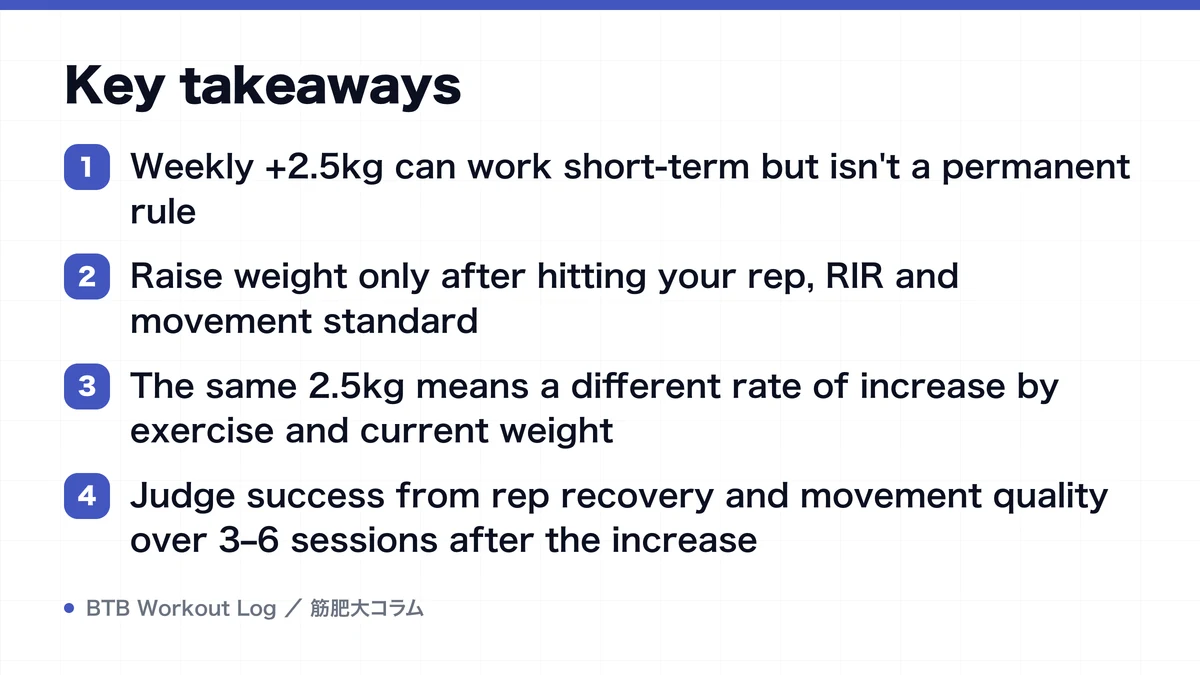
Key takeaways
- Weekly +2.5kg can work short-term but isn't a permanent rule
- Raise weight only after hitting your rep, RIR and movement standard
- The same 2.5kg means a different rate of increase by exercise and current weight
- Judge success from rep recovery and movement quality over 3–6 sessions after the increase
References
- ACSM Position Stand: Progression Models in Resistance Training for Healthy Adults
- Low- vs High-load Resistance Training for Strength and Hypertrophy: Meta-analysis
- Periodization, Strength and Muscle Hypertrophy: Systematic Review and Meta-analysis
- Linear vs Daily Undulating Periodized Training and Hypertrophy: Meta-analysis