
Does Just 1 Set Build Hypertrophy? | The Bare-Minimum Training Volume for Busy Lifters
A single set alone can produce stimulus in the direction of hypertrophy. But it means something very different depending on whether it's "1 set per exercise" or "1 set per muscle group per week," and it isn't necessarily enough to maximize growth for an intermediate or advanced lifter.
What to test isn't whether the number "1 set" works or not — it's whether the conditions are met for that set to reach the target muscle, repeat within the week, and lead to progress in weight or reps.
First, split what "just one set" actually refers to
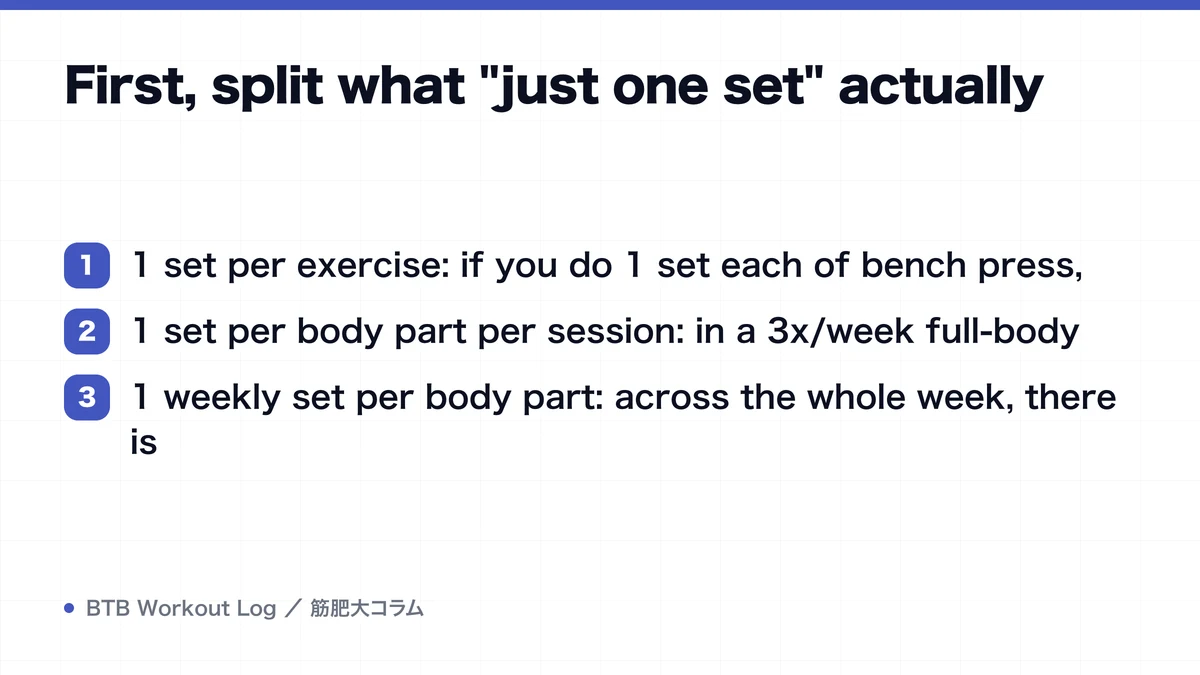
The question "is one set enough" can't be tested without fixing the unit. At minimum, these three are different prescriptions.
- 1 set per exercise: if you do 1 set each of bench press, incline press and flye for chest, that's 3 sets total on chest.
- 1 set per body part per session: in a 3x/week full-body routine, that's 3 weekly sets on that body part.
- 1 weekly set per body part: across the whole week, there is genuinely only one working set on the target muscle.
Also, counting a warm-up or a technique-checking set as "1 set" doesn't let you evaluate hypertrophy volume. What we're testing here is a working set that moves the target muscle through sufficient range of motion and finishes without leaving a lot of reserve. Since compound exercises stimulate assisting muscles too, deciding "arms got 1 set" purely from direct arm exercises is also premature — you need to look at direct and indirect sets combined across the week.
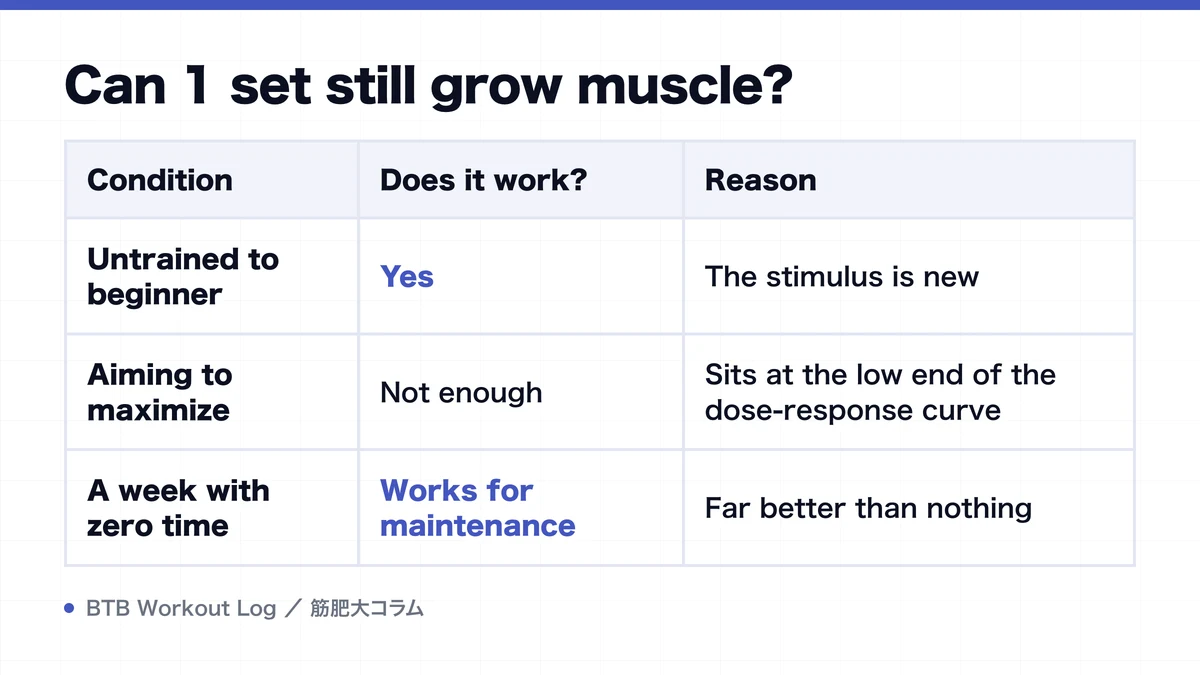
So this article's answer comes in two parts: a high-quality single set is different from zero sets and can act as a growth stimulus. But 1 weekly set can't be declared a universal minimum requirement for everyone. The starting point is recounting your actual weekly volume as training volume.
Research points to a dose-response relationship, not a minimum threshold
Meta-analyses examining weekly set count show a dose-response relationship where higher-volume conditions tend toward larger average hypertrophy. A more recent meta-regression also confirms a positive relationship between weekly set volume and hypertrophy. But it also shows diminishing returns — each added set delivers a smaller increment.
What this doesn't establish is a threshold — "low volume is invalid, and it becomes effective the instant you cross some number." Some participants and muscle groups respond even at low weekly volume, but on average there's still room to gain from raising it. Conversely, adding sets doesn't accelerate growth at the same proportional rate either. Weekly set count isn't a pass/fail number — it's a variable that trades off stimulus opportunity against recovery cost.
ACSM's position stand also recommends multiple sets at high volume for maximizing hypertrophy. What matters here is separating "maximizing" from "progressing on a minimum." Someone who just wants to avoid doing nothing in limited time, and someone chasing the largest possible growth in a defined period, need different standards for required volume. Research shows the direction for a group average, but doesn't pin down a minimum set count shared by every intermediate lifter.
The less volume you have, the less you can fudge the content of that one set
Cut set count down to 1, and the probability that single set delivers sufficient stimulus to the target muscle matters a lot. If form breaks down and an assisting muscle or your cardiovascular system hits its limit before the target does, the record "completed 1 set" and actual stimulus to the target muscle don't line up. Match exercise selection, range of motion, stable movement and appropriate rest so it's a set you can compare under consistent conditions.
Raise effort, but failing every time isn't mandatory
RIR is an estimate of how many more reps were possible. If you're only doing one set and stop at RIR 5 or more, both volume and effort level tend toward a low-dose prescription. In practice, aiming for roughly RIR 1–3 and logging where rep speed or form started breaking down makes for an easier comparison. That said, you don't necessarily need to go all the way to a rep you can't complete. Meta-analyses comparing failure and non-failure conditions haven't shown momentary muscular failure to be required for hypertrophy either. See how to think about RIR and training to the limit for detailed usage.
Trying to compensate for low volume with momentum, a partial range of motion, or excessive spotter assistance is counterproductive. It changes the comparison conditions, making it impossible to judge whether weight or reps progressed next time. What a single-set approach should prioritize isn't maximizing discomfort — it's reproducing high effort delivered to the target muscle.
Conditions where single-set training tends to work, and where it tends to fall short
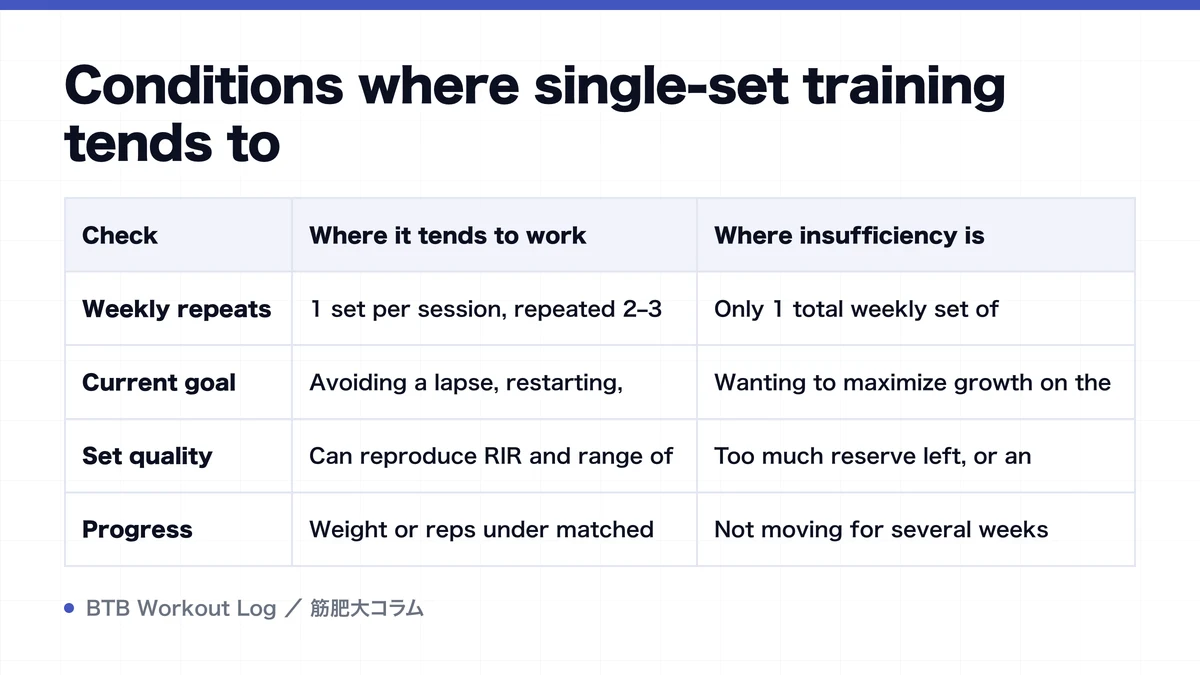
The same "1 set" means something different depending on your starting point and how it's placed within the week. Organizing this by condition, rather than a binary, lets you judge whether you have a reason to keep volume low.
| Check | Where it tends to work | Where insufficiency is suspected |
|---|---|---|
| Weekly repeats | 1 set per session, repeated 2–3 times a week | Only 1 total weekly set of stimulus to the target |
| Current goal | Avoiding a lapse, restarting, minimal allocation to a low-priority body part | Wanting to maximize growth on the target area |
| Set quality | Can reproduce RIR and range of motion on the target muscle | Too much reserve left, or an assisting muscle stops you first |
| Progress | Weight or reps under matched conditions are rising | Not moving for several weeks despite recovering fine |
| Experience | You've confirmed your response to low volume from your log | You've gained experience and the same volume now falls short of stimulus |
For example, in a 3x/week full-body routine doing 1 set per body part each session, you create 3 weekly stimulus opportunities while keeping each session short. It's not frequency itself that's magic — the benefit is that splitting a small weekly volume across multiple sessions makes it easier to hold each set's quality. Conversely, if you only go to the gym once a week and finish chest with just 1 bench press set that day, the odds of leaving room to grow are high. See training frequency too, for the relationship between frequency and weekly volume.
For intermediate-or-above lifters, it also matters not to mistake maintained strength right after switching to low volume — built up from prior higher-volume training — as "proof this volume is producing growth." Short-term performance maintenance and continued new hypertrophy aren't the same thing.
Find your own minimum effective volume by cutting back, then adding a little at a time
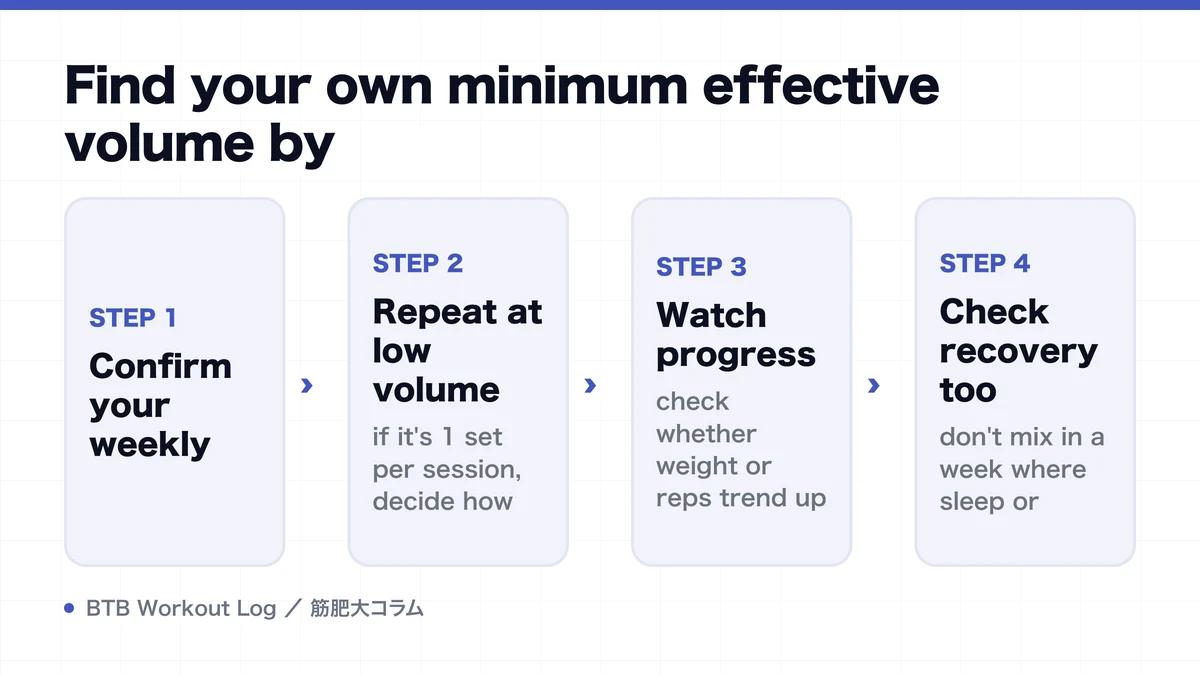
If you want to know your minimum, it's more practical to test a low volume against your own log than to adopt someone else's fixed number. But changing exercise, diet, and frequency all at once makes it impossible to judge one set's effect. Choose one target body part and hold exercise, rep range, range of motion, RIR and frequency as fixed as possible.
- Confirm your weekly volume: list out direct sets plus indirect stimulus received from compound lifts.
- Repeat at low volume: if it's 1 set per session, decide how many sessions per week and keep that condition consistent.
- Watch progress: check whether weight or reps trend up over several weeks at the same range of motion and RIR.
- Check recovery too: don't mix in a week where sleep or nutrition broke down, or a week with pain, when judging insufficiency.
- Only add when stalled: if you're recovering fine but progress has stopped, add just 1–2 weekly sets to the target muscle.
If weight or reps rise again after the addition, and you recover by next time, your old volume was likely too low for your current self. If it doesn't rise even after adding, and only back-half quality or next-time output drops, the cause may be something other than volume. Testing volume as a hypothesis, changing one thing at a time like this, lets you search out roughly where the minimum sits while sustaining progressive overload.
One set can be an entry point, but it isn't a permanent floor
On a day you're busy and can only manage 1 set, there's no need to treat that set as meaningless. If it's a high-quality set that reaches the target muscle and you can repeat it again within the week, it's still work in the direction of hypertrophy rather than nothing. It's also a valid option for a quick full-body routine, or for allocating minimal work to a low-priority body part.
On the other hand, expecting maximum growth while sticking to 1 weekly set per body part doesn't line up with the research's dose-response relationship or the recommendation for multiple sets. Especially past the intermediate level, if weight and reps aren't moving even with matched movement conditions, and sleep, nutrition and pain aren't clearly the issue, you should suspect there's room to raise volume. Rather than jumping straight to something like 10 weekly sets, add just 1-2 first and watch the response.
What judging this needs isn't how much effort you put in — it's whether you can keep repeating progress under matched conditions. Whether low volume is producing growth or is simply too low to move can only be told by looking at the trend over several weeks. BTB Workout Log keeps records from a low-volume period in the same format for comparison.
FAQ
- With only 1 set, should I push to failure every time?
- Not leaving a lot of reserve matters, but pushing to a rep you truly can't complete isn't mandatory. Aim for roughly RIR 1–3, match effort within a range that holds the target muscle, range of motion and form, and make it a set you can compare against next time.
- If I do 1 set of one exercise three times a week, does that count as 3 weekly sets?
- If each session's set is a working set on the target muscle, then yes, it's essentially 3 weekly sets. But if the target muscle also gets worked by a different exercise the same day, or gets indirect stimulus from a compound lift, factor that in when evaluating your actual weekly volume.
- How many weeks of no progress before I should add sets?
- Don't add sets from one off session — confirm that weight and reps haven't moved for several weeks at the same exercise, range of motion and RIR. If sleep, nutrition, pain and other non-volume causes aren't the issue, add just 1–2 weekly sets to the target muscle and reassess.
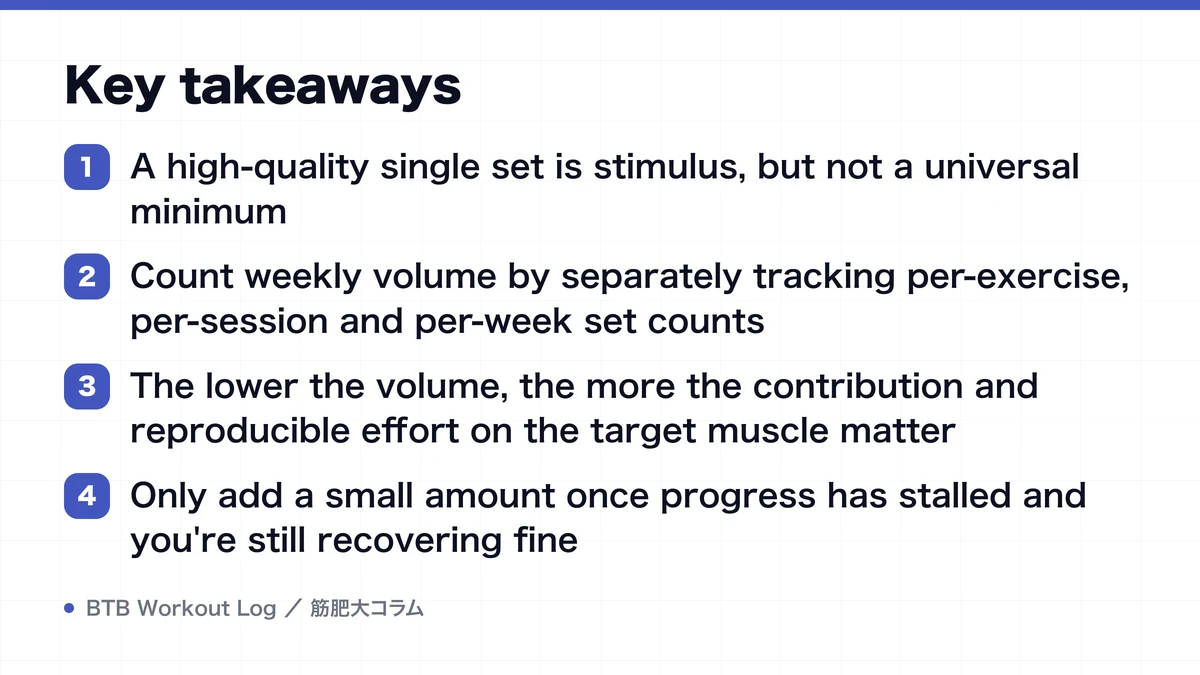
Key takeaways
- A high-quality single set is stimulus, but not a universal minimum
- Count weekly volume by separately tracking per-exercise, per-session and per-week set counts
- The lower the volume, the more the contribution and reproducible effort on the target muscle matter
- Only add a small amount once progress has stalled and you're still recovering fine
References
- Dose-response Relationship Between Weekly Resistance Training Volume and Muscle Mass
- The Resistance Training Dose Response: Meta-Regressions Exploring the Effects of Weekly Volume and Frequency on Muscle Hypertrophy and Strength Gains
- ACSM Position Stand: Progression Models in Resistance Training for Healthy Adults
- Training to Repetition Failure or Non-failure: Systematic Review and Meta-analysis