
Hypertrophy in 60 Minutes or Less: Do You Need Longer Workouts?
Sixty minutes can be enough. The number itself isn't what matters — it's whether you can spread the weekly hard sets you need across sessions and still protect rest periods and set quality on your priority exercises.
What to test isn't "did it finish quickly" — it's whether work to the target muscle and progress over several weeks held up inside the time limit. Crossing 60 minutes isn't a threshold where hypertrophy suddenly changes.
What has to be true for "60 minutes is enough"
Session length doesn't directly represent stimulus received. Sixty minutes with long equipment waits, rushed rest periods that cost you reps, and sixty minutes where every planned set finished cleanly are not the same session. Sweat, pump and how wrecked you feel don't settle sufficiency either.
A 60-minute programme passes when the weekly hard sets allocated to the target muscle actually happen at your intended load, reps, range of motion and RIR. A hard set means holding the movement while getting genuinely close to failure; RIR estimates how many reps you had left. Warm-up sets or technique reps don't count the same as hypertrophy sets.
You also need output to hold on later exercises, recovery by next time, and load or reps advancing over several weeks. So the unit of judgement isn't one 60-minute session — it's the week, and the session after. Cut time and hold those conditions and it's enough; strip several main sets every time and it isn't.
Research backs the design, not a 60-minute line
There's no study comparing 60 and 90 minutes directly that establishes a universal boundary. What's available is the relationship between weekly volume, frequency, rest periods and hypertrophy. So rather than declaring 60 minutes optimal, the sensible test is whether you can satisfy those known variables inside 60.
Weekly sets and muscle gain show an average dose-response relationship. That doesn't mean more is unlimited better, or that everyone needs the same fixed number. If your current volume is producing progress, you don't need to pad sets to fill time. If progress has stalled and you still have recovery capacity, there's room to nudge weekly sets up gradually.
Frequency research supports spreading weekly volume across more days. If one session can't fit everything into 60 minutes, moving the same weekly sets to another day often protects per-set output better than cutting rest. On rest periods specifically, a study comparing one and three minutes in trained lifters found the three-minute condition favoured strength and some measures of muscle thickness. A time limit isn't grounds for cutting rest uniformly on your priority exercise.
Block out time before you start rushing exercises
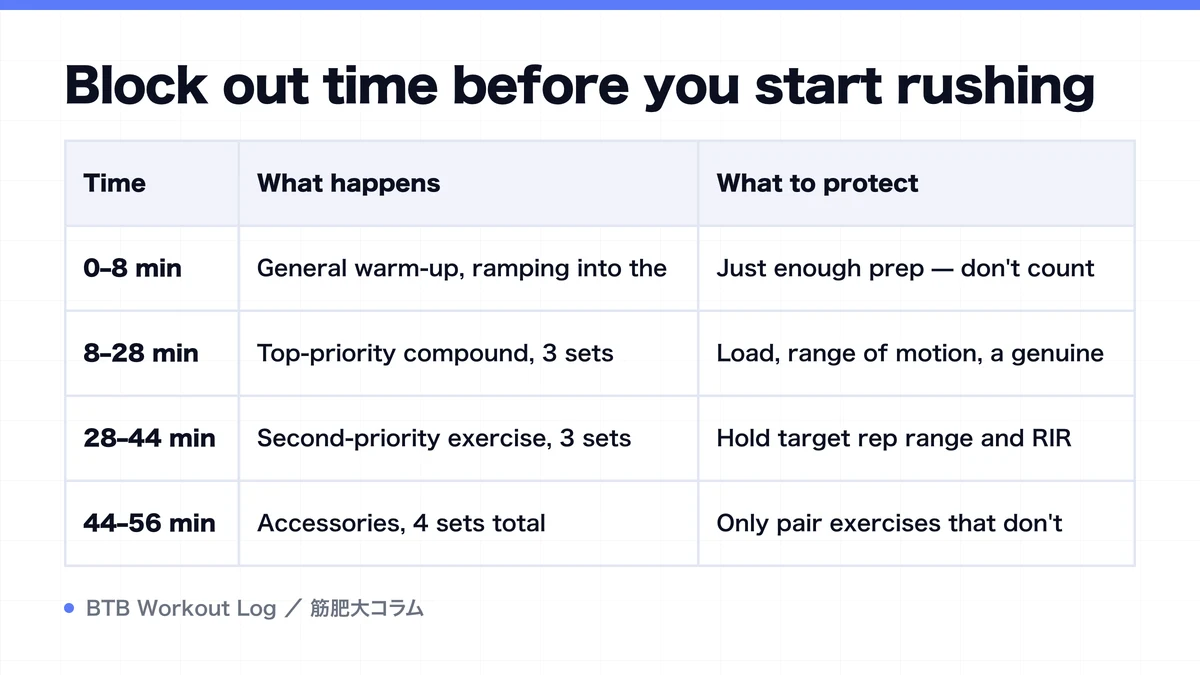
Making 60 minutes work means deciding priority and time blocks before you start. This assumes roughly ten hard sets in a session — it's a layout, not a set count everyone needs.
| Time | What happens | What to protect |
|---|---|---|
| 0–8 min | General warm-up, ramping into the main lift | Just enough prep — don't count warm-up sets as hard sets |
| 8–28 min | Top-priority compound, 3 sets | Load, range of motion, a genuine 2–4 minutes of rest |
| 28–44 min | Second-priority exercise, 3 sets | Hold target rep range and RIR even late |
| 44–56 min | Accessories, 4 sets total | Only pair exercises that don't compete for resources |
| 56–60 min | Buffer to log and finish up | Record load, reps, sets, RIR |
The point isn't rushing the first compound. If you need to save time, cut travel between exercises, overlapping accessories and pointless extra sets first. If you superset, don't pair exercises that heavily compete for the same muscle group, breathing or grip — that costs quality on one side. Use the comparison with straight sets as the guide, and keep priority exercises solo by default.
Four conditions for enough hypertrophy in 60 minutes
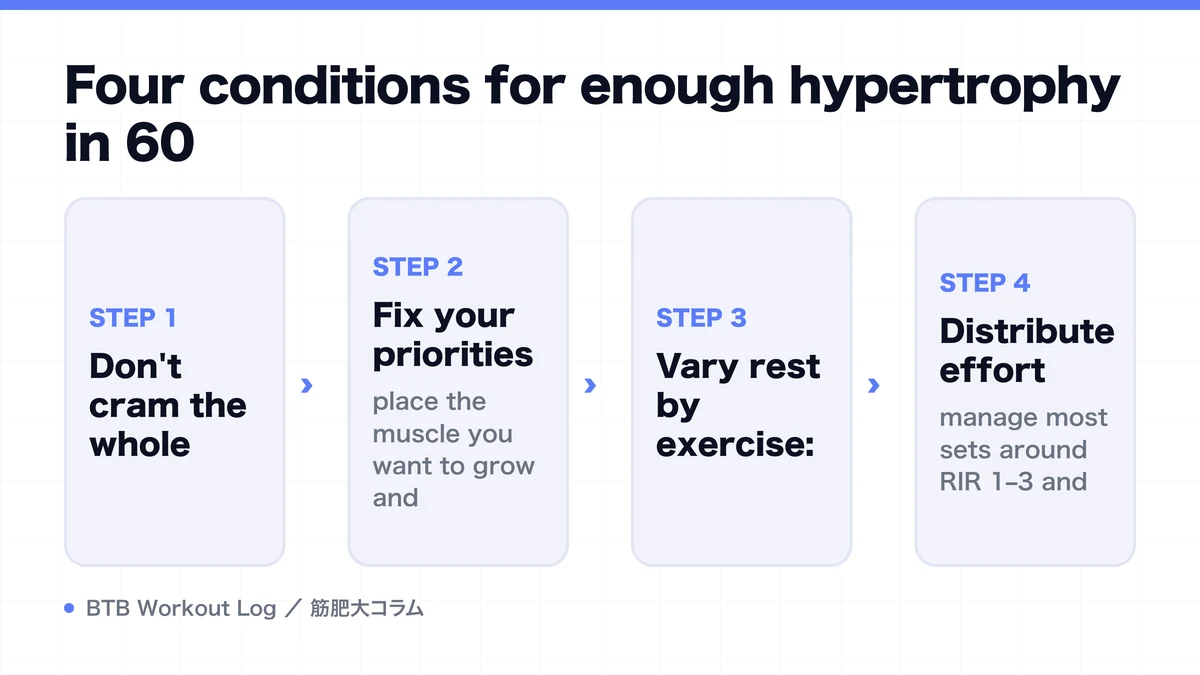
- Don't cram the whole week into one session: decide weekly hard sets per muscle group first, not session length. If the back half breaks down at 60 minutes, use how frequency relates to weekly sets and move volume to another day while holding the weekly total.
- Fix your priorities: place the muscle you want to grow and the main lift you're tracking early. Fewer, reproducible exercises you can actually track beats piling on similar-role exercises, and it also cuts setup and transition time.
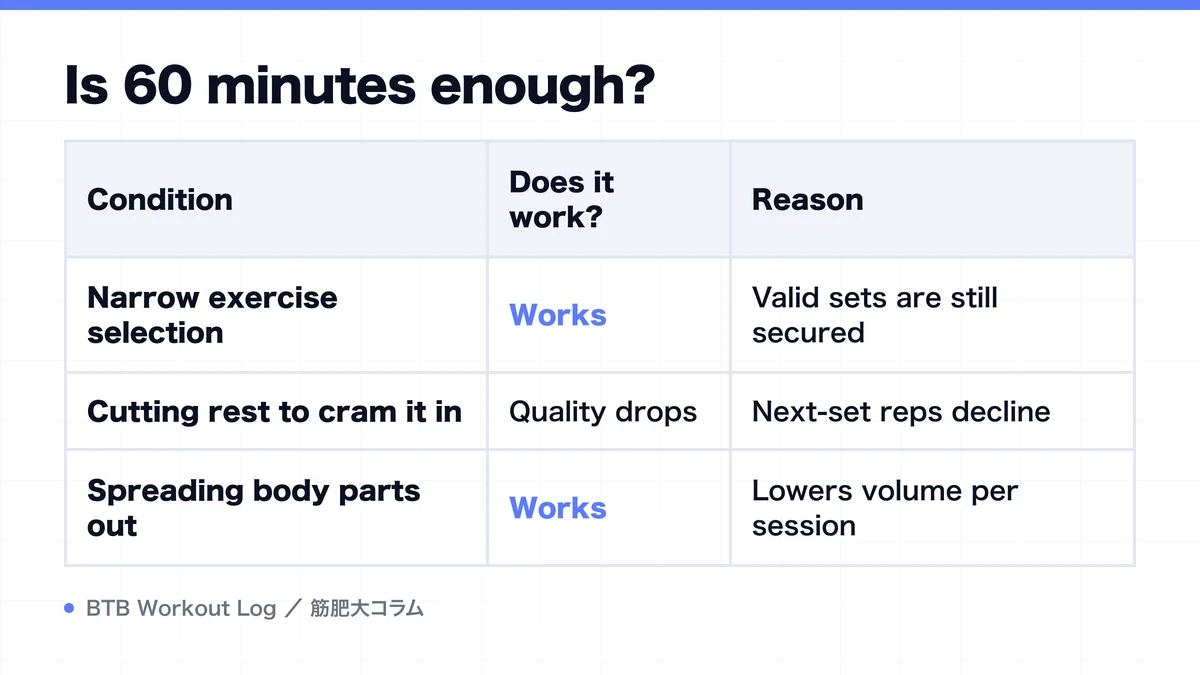
- Vary rest by exercise: wait for output to return on heavy compounds, and keep stable single-joint work as short as quality allows. A blanket "one minute for everything" buys you 60 minutes at the cost of weakening your main sets.
- Distribute effort: manage most sets around RIR 1–3 and reserve failure for safe accessory work near the end, so early fatigue doesn't drag down every set that follows. The right RIR range still shifts with load and exercise, so weigh it alongside movement consistency and progress from last time.
Someone training three days a week may need to pack more into one session; someone training four to five can spread it into shorter slots. More frequency raises total travel and setup time, so it doesn't automatically save time across the week. Choose based on both the 60-minute session and the total time you can actually find across the week.
Situations where insisting on 60 minutes backfires
Sixty minutes is a useful cap, but treating it as the goal itself can distort the design. Someone who can only get to the gym once or twice a week and needs to cover many muscle groups in one session may go over 60 minutes just completing the plan with adequate rest. The same applies on days with extensive warm-up ramps for heavy lifts, days including form work or rehab, or in a gym where equipment waits run long.
Signs of a real shortfall: the same priority exercise gets cut for time every session, reps crash specifically once rest gets shortened, range of motion narrows, or breathing or grip limits out before the target. If load or reps repeatedly fall next session even though you completed the plan, suspect overcrowding or insufficient recovery.
In that case, cut lower-priority exercises first, then move sets elsewhere in the week, and only extend the cap if the required work still doesn't fit. Conversely, if you finish under 60 minutes with your planned quality and volume intact and you're progressing, there's no need to add sets just because the clock has room. The idea that longer is better and treating 60 minutes as sacred share the same flaw — putting the clock above what's actually inside it.
Judge your own 60-minute programme over four weeks
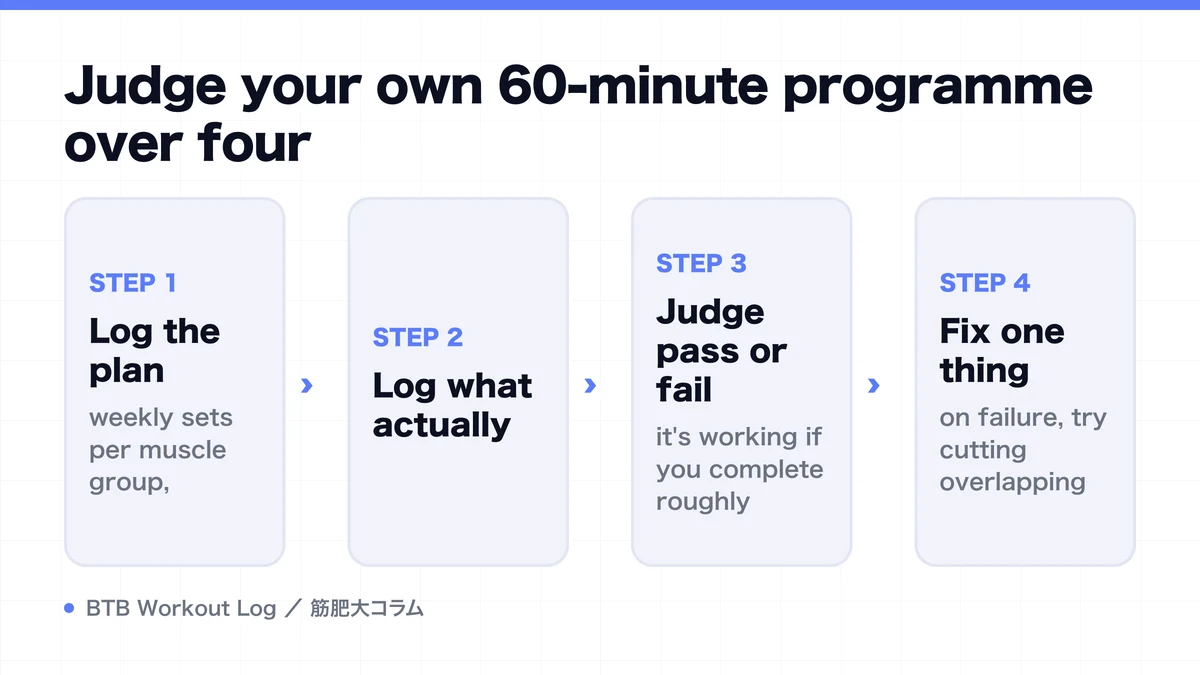
In practice, hold the 60-minute version for about four weeks and compare it with what came before. Keep exercises, weekly frequency and target rep ranges as matched as you can, and don't change another major variable alongside time. Judge on the trend across several sessions, not one good or bad week.
- Log the plan: weekly sets per muscle group, priority exercises, target sets per exercise, your rest policy.
- Log what actually happened: not just duration — completed sets, load, reps, RIR, range of motion.
- Judge pass or fail: it's working if you complete roughly your planned main sets, load or reps hold or rise under matched conditions, and you recover by next time.
- Fix one thing: on failure, try cutting overlapping exercises, moving sets to another day, pairing accessories, and only then trimming rest.
Using your log as evidence lets you judge whether progress kept repeating after the cut, rather than just how satisfying a short session felt.
FAQ
- Can three 60-minute sessions a week still cover the whole body?
- Yes. Vary which muscle group each session prioritises and distribute the required hard sets across the week — you don't need equal volume for every muscle every session. If reps or range of motion fall late, move sets to another day or cut overlapping exercises.
- What rest period fits inside 60 minutes?
- Don't set the same time for every exercise. Rest long enough on priority compounds for output to return, and keep stable single-joint work as short as it can be while holding load, reps, range of motion and RIR. Prioritise the next set's quality over the clock.
- What should I cut if I can't finish the plan in 60 minutes?
- Cut low-priority, overlapping exercises and pointless extra sets first. Then move weekly volume to another day and pair only accessories that don't compete for resources. Cutting rest or range of motion on your main lifts first tends to trade time for set quality.
Key takeaways
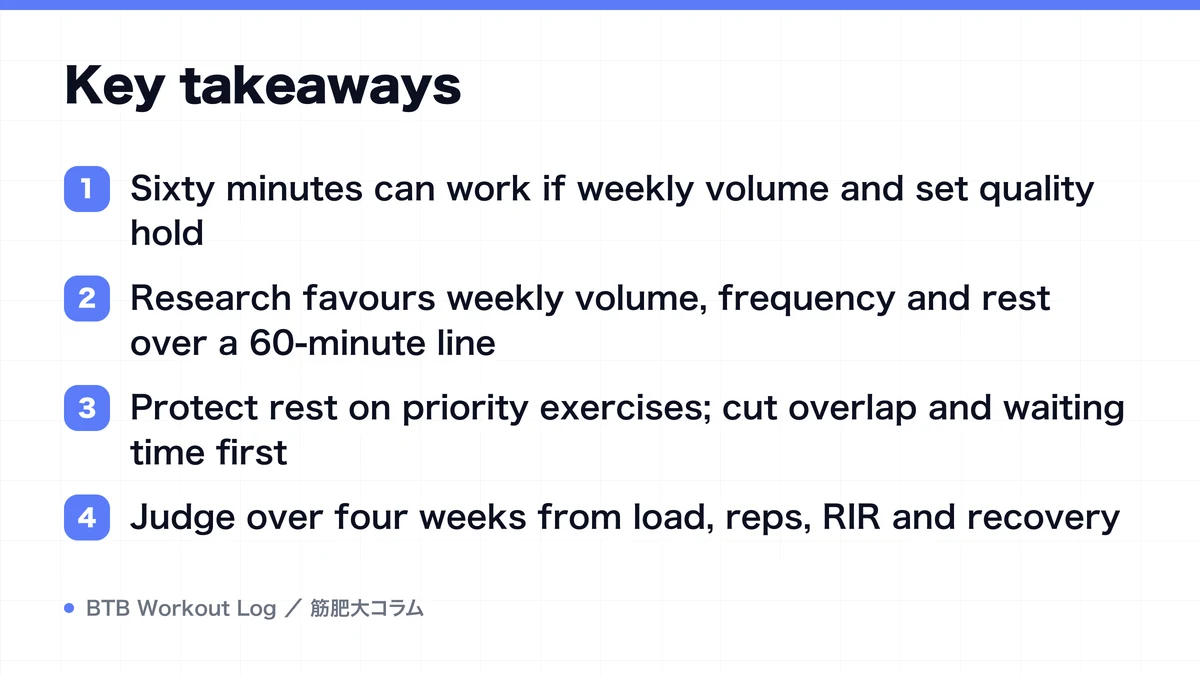
- Sixty minutes can work if weekly volume and set quality hold
- Research favours weekly volume, frequency and rest over a 60-minute line
- Protect rest on priority exercises; cut overlap and waiting time first
- Judge over four weeks from load, reps, RIR and recovery
References
- Dose-response Relationship Between Weekly Resistance Training Volume and Muscle Mass
- Resistance Training Volume Enhances Muscle Hypertrophy in Trained Men
- Resistance Training Frequency and Muscle Hypertrophy: Systematic Review and Meta-analysis
- Longer Interset Rest Periods Enhance Strength and Hypertrophy in Trained Men