Hypertrophy After Six Months at the Same Weight: Can You Still Grow?
Hypertrophy is possible even at the same weight. But the answer splits depending on whether, over six months, only "the number on the plate" stayed the same, or whether reps, set count, range of motion and RIR all stayed unchanged too.
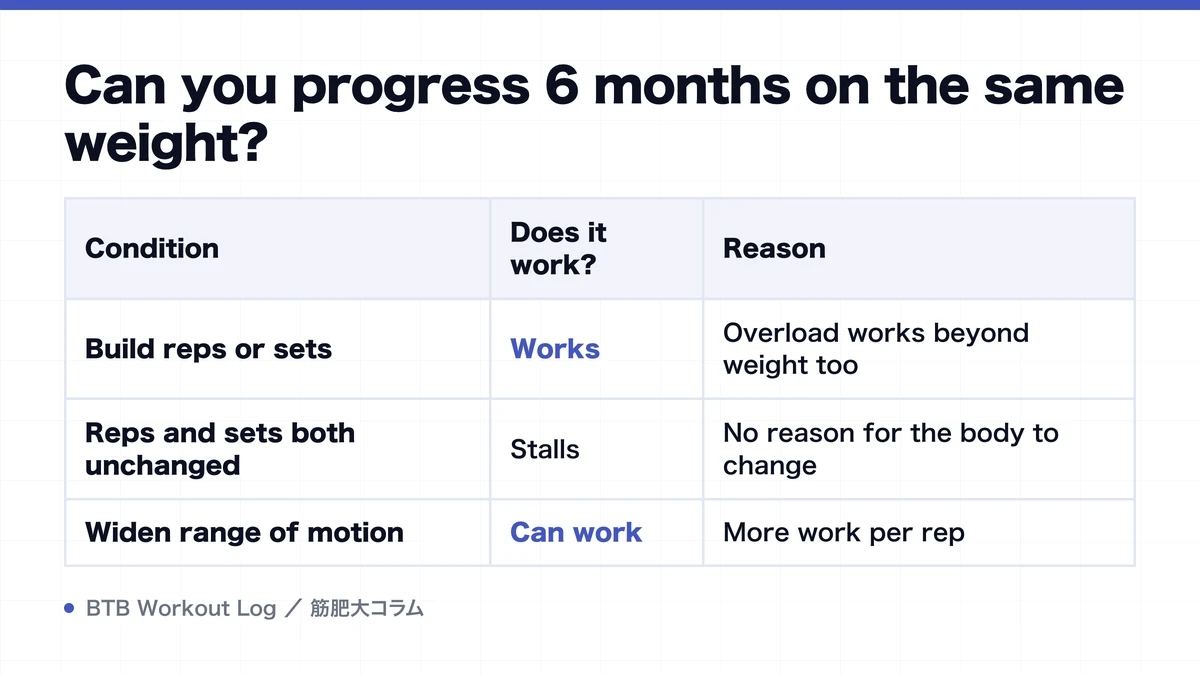
Growth can hold up through a period where reps or movement quality keep progressing at the same weight, with sufficient effort maintained. If every condition stayed literally fixed for six months, the case for expecting continued hypertrophy is weak.
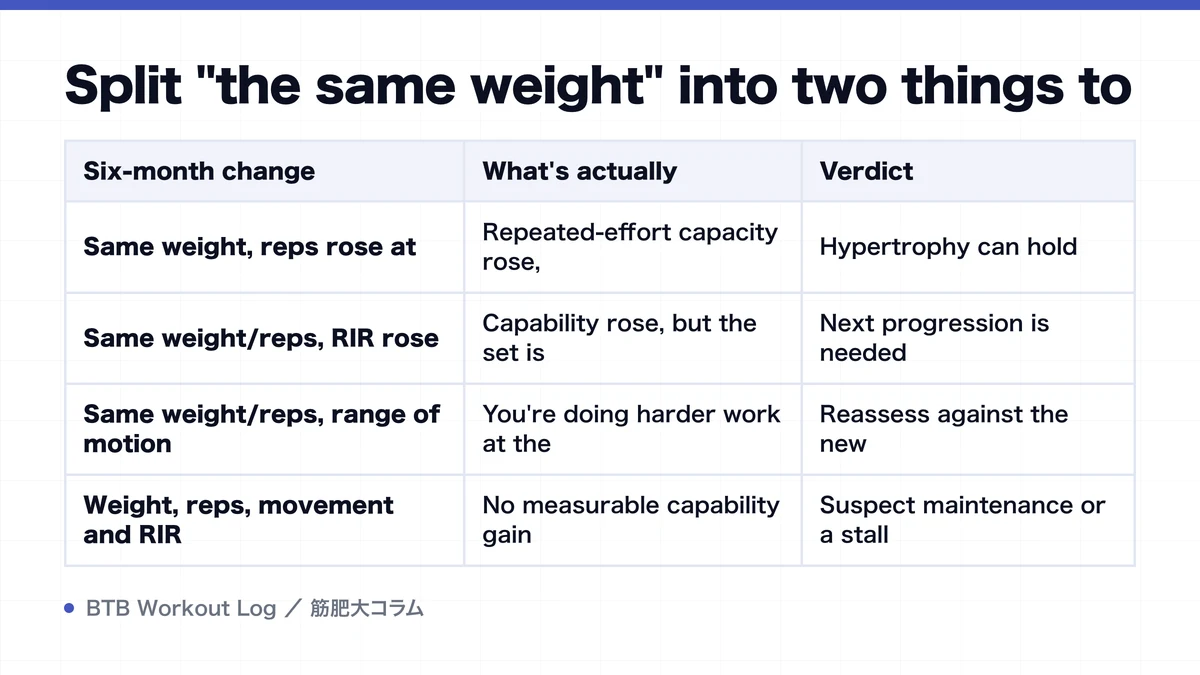
Split "the same weight" into two things to test
What to test isn't the fact you used the same external load — it's how the challenge to the muscle changed over six months. Someone who's used the same 20kg dumbbell but went from 8 reps to 14, and someone who's still cutting off at 10 reps with room to spare, are receiving different stimulus.
| Six-month change | What's actually happening | Verdict |
|---|---|---|
| Same weight, reps rose at comparable RIR | Repeated-effort capacity rose, and the challenge updated too | Hypertrophy can hold |
| Same weight/reps, RIR rose | Capability rose, but the set is easier than before | Next progression is needed |
| Same weight/reps, range of motion or control improved | You're doing harder work at the same number | Reassess against the new condition as baseline |
| Weight, reps, movement and RIR unchanged long-term | No measurable capability gain visible | Suspect maintenance or a stall |
It also matters not to treat six months as one block. The same weight might be sufficient stimulus for the first two months but too light once capability rises over the remaining four. "Did hypertrophy occur at all at any point in six months" and "did you keep growing at the same rate through the whole six months" are different questions.
RIR here is an estimate, at the end of a set, of how many more reps were possible. To test a fixed weight, you first have to separate every condition besides "what weight it was."
Relative difficulty decides stimulus more than absolute weight
Generally, given sets taken close to the limit, hypertrophy can occur at either low or high load. So "it was 20kg for six months" alone doesn't establish invalid training.
That said, that finding doesn't show "repeating the same content forever means continued growth." If someone starting at RIR 1 for 20kg × 10 reps ends up at RIR 5 for the same 10 reps months later, the externally visible weight and reps are identical but relative difficulty has dropped. Light weight can produce hypertrophy not because it's fine to finish easily, but because you can push the set far enough to deliver sufficient stimulus to the active fibers.
You don't necessarily need to fail every set, but if your stopping point sits too far from the limit, the case for using fixed weight weakens. Matching your RIR standard and comparing how many reps you can do at the same weight makes it easier to read capability gains that don't show up on the plate.
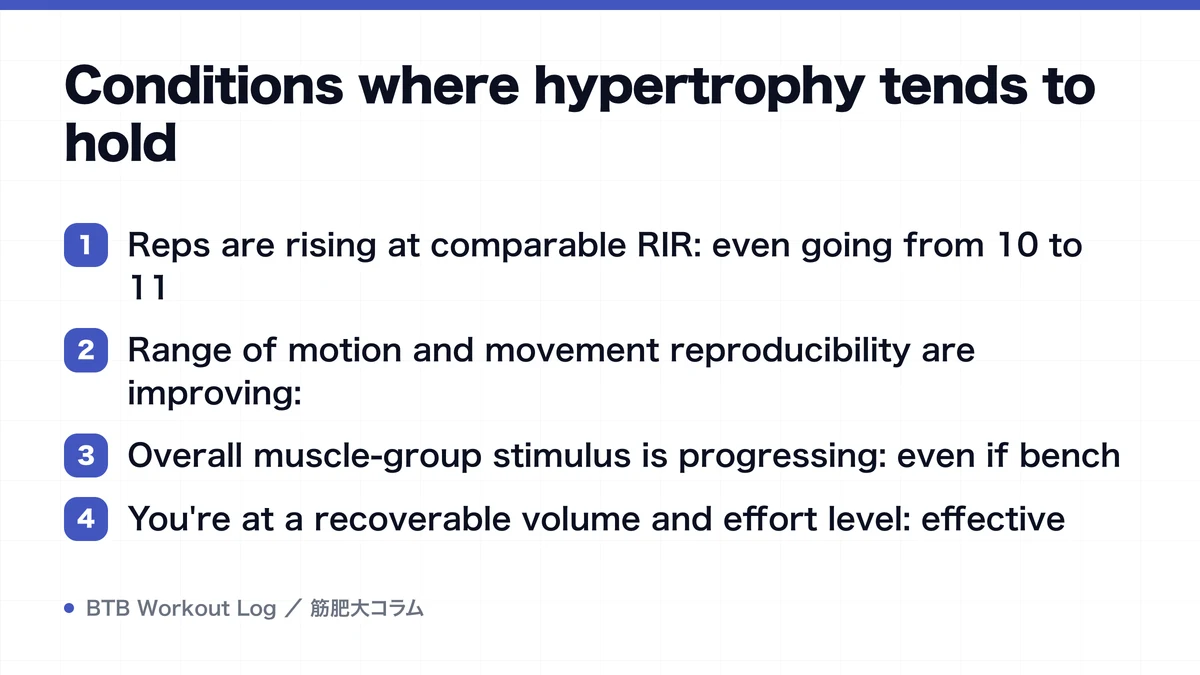
Conditions where hypertrophy tends to hold even at fixed weight for six months
Even keeping weight fixed, you can't rule out hypertrophy during a stretch that meets the following conditions.
- Reps are rising at comparable RIR: even going from 10 to 11 reps is a capability gain if form matches. On dumbbells or machines with coarse weight increments, building reps first is especially useful.
- Range of motion and movement reproducibility are improving: reducing momentum, matching depth, or holding load on the target muscle through the whole segment all raise the demand of the work. But a day you changed conditions shouldn't be compared straight against old records — treat it as a new baseline day.
- Overall muscle-group stimulus is progressing: even if bench press weight is unchanged, if dumbbell press reps or chest's weekly hard sets have properly risen, room remains for the pecs as a whole to grow. A stall on one exercise isn't the same as a stall across the whole muscle group.
- You're at a recoverable volume and effort level: effective set count isn't a fixed number — it shifts with exercise, RIR, frequency, sleep and nutrition. Too little makes progress harder, and too much, if it wrecks back-half output, hurts quality too.
In other words, using the same weight isn't itself the problem. The problem is a state where you can't confirm progressive overload through any other channel and the body is simply repeating a challenge it's already adapted to.
Signs that maintaining the same weight alone isn't enough
Six months is a length that's hard to explain from a single good or bad session. Still, rather than scrapping the whole program just because "weight hasn't gone up in six months," look for the following signs using the last 4–8 weeks of matched-condition data.
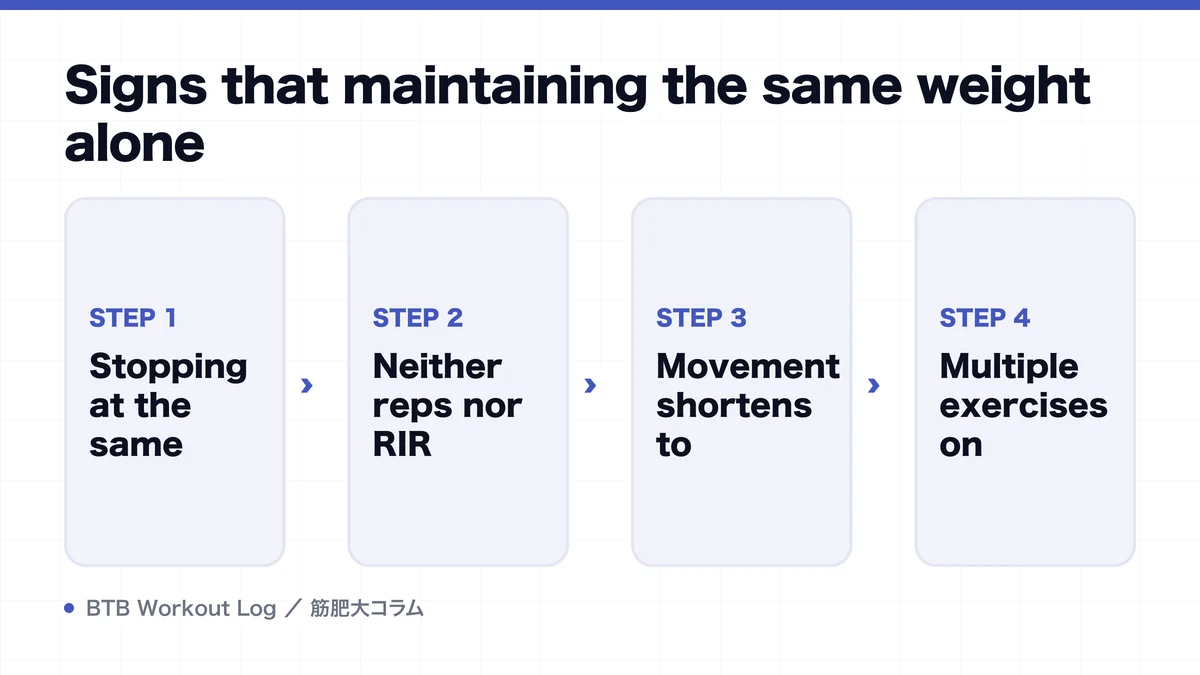
- Stopping at the same rep count with reserve left: if RIR is rising, you're mid-capability-gain. Either build toward your set rep ceiling, or raise weight by a small amount.
- Neither reps nor RIR move: if this continues across several sessions at the same equipment, range of motion and rest, it's a stall candidate. Check sleep, energy intake, pain and frequency first.
- Movement shortens to preserve the number: holding 10 reps via a narrowed range of motion or momentum isn't the same challenge as before. It's easier to judge if you revert to comparable form, even at lower weight.
- Multiple exercises on the same muscle group stall together: a single exercise might reflect a technique or exercise-fit issue. If several exercises and body measurements are flat long-term, it raises priority for reviewing stimulus dose or recovery conditions.
A training log isn't a direct measurement of hypertrophy — it's a proxy for judging progress. Reps not rising alone doesn't confirm muscle mass is unchanged; layer in matched-condition measurements, body weight, and other exercises on the same muscle group. Conversely, you can't treat body weight rising alone as evidence of target-muscle growth either.
Even for a stall candidate, adding sets isn't automatically the answer. If volume is already too high for your recovery, adding more backfires. First audit the content of your volume and recovery, and change only one variable at a time.
Decide "continue, raise, or adjust" from 4 weeks of logs
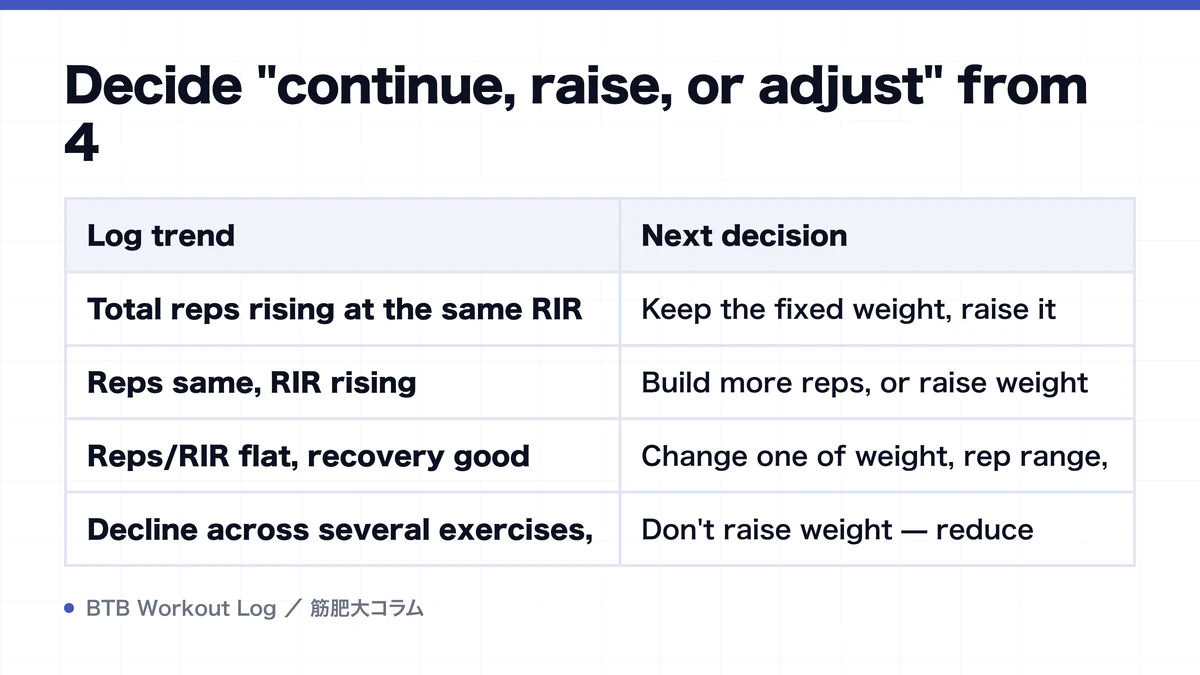
Rather than relying on six months of memory, first fix your comparison conditions for just 4 weeks. Choose 1–2 exercises per muscle group that make progress easy to track, and match equipment, seat position, grip, range of motion and rest time. Then log each working set's weight, reps and RIR, and watch the trend across several sessions rather than a single day's peak.
| Log trend | Next decision |
|---|---|
| Total reps rising at the same RIR | Keep the fixed weight, raise it once you hit the rep ceiling |
| Reps same, RIR rising | Build more reps, or raise weight by the smallest increment |
| Reps/RIR flat, recovery good | Change one of weight, rep range, or weekly set count |
| Decline across several exercises, recovery poor too | Don't raise weight — reduce volume or frequency and reassess |
At 8–12 reps, an easy method is double progression: only move to the next weight once every set reaches near the ceiling, then rebuild reps from the floor. What matters isn't adding a plate every week — it's gradually updating capability under matched conditions. If that update keeps happening even at fixed weight for six months, there's still room to grow; if every indicator has stalled, that's the signal to adjust.
Training is what produces hypertrophy, but this makes it harder to overlook what actually changed within "the same weight." If you're progressing at the same weight, reps and set count need to be the ones moving. BTB Workout Log lets you track both of those changes.
FAQ
- If the next dumbbell up is too heavy, should I stay at the same weight?
- It's fine to build reps at the same weight all the way to your ceiling. If you hit the ceiling and the jump is still too large, use added reps, a unilateral variation, or micro-plates — pick whichever progression is smallest without breaking form or RIR.
- If reps rise at the same weight, can I conclude hypertrophy occurred?
- It doesn't directly prove hypertrophy, but rising reps at the same range of motion, form, rest and RIR is a strong sign of raised repeated-effort capacity. Layer in body measurements and the trend on other exercises to judge.
- If weight hasn't changed in six months, should I switch exercises?
- Don't decide from weight alone. It's still a candidate to continue if reps or RIR are progressing. If everything is flat, check recovery and weekly volume first, and adjust one of weight, rep range, or set count. Consider switching exercises if there's pain or a reproducibility issue.
Key takeaways
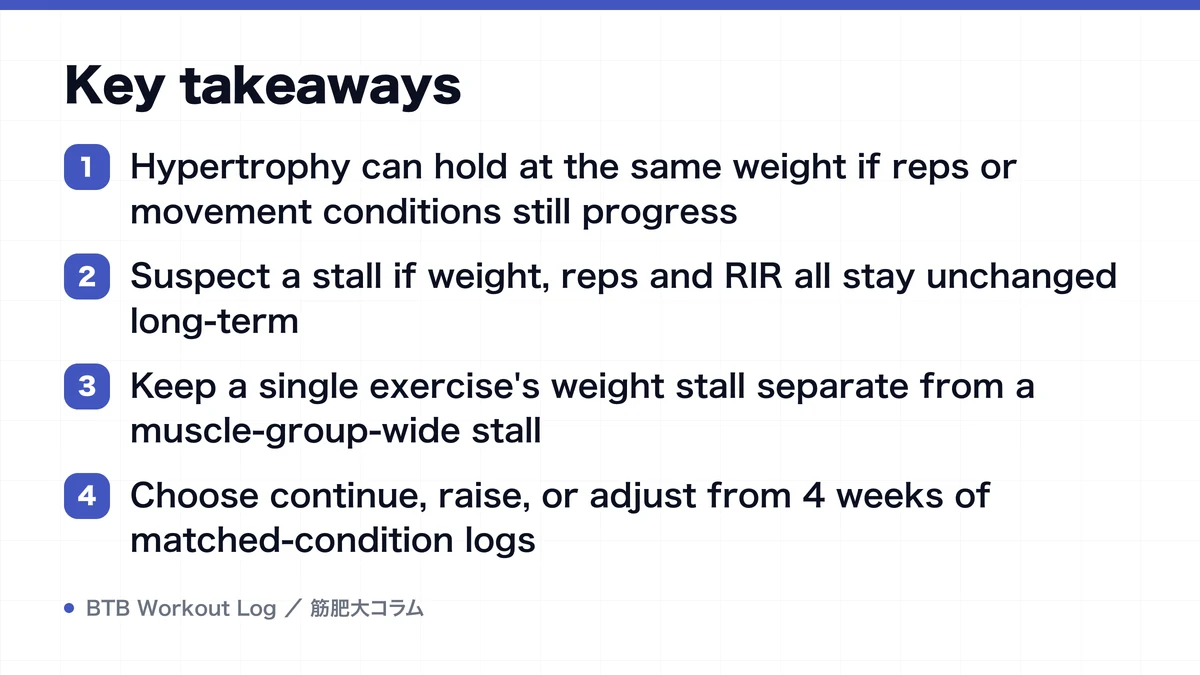
- Hypertrophy can hold at the same weight if reps or movement conditions still progress
- Suspect a stall if weight, reps and RIR all stay unchanged long-term
- Keep a single exercise's weight stall separate from a muscle-group-wide stall
- Choose continue, raise, or adjust from 4 weeks of matched-condition logs
References
- Low- vs High-load Resistance Training for Strength and Hypertrophy: Meta-analysis
- Muscle Hypertrophy Is Independent of Load Across Upper and Lower Limbs When Effort Is Matched
- ACSM Position Stand: Progression Models in Resistance Training for Healthy Adults
- Training to Repetition Failure or Non-failure: Systematic Review and Meta-analysis
- Proximity-to-Failure and Muscle Hypertrophy: Systematic Review with Meta-analysis