Hypertrophy: Why Full Range of Motion Is the Default and Shallow Reps May Cost You Gains
Full range of motion is the default because it works the target muscle across a wide muscle length while keeping movement conditions reproducible session to session. It doesn't mean "deeper is always better" — pushing a joint to its physical limit.
Decide start and end points that suit the exercise and your body, and use as your reference the range where you can keep load under the target muscle's control. Partial range isn't invalid — it's an option to use when you can name the purpose.
Full range isn't "move the joint to its physical limit"
"Full range" in training doesn't mean the joint's maximum physical excursion — it means moving end to end through the range where you keep load on the target muscle and control your position. On a squat, dropping to a depth where your heels lift, your pelvis loses position, or pain appears isn't full range. On a dumbbell fly, lowering your arms indefinitely isn't the goal either — the bottom is wherever your chest can still receive the load with your shoulders stable.
So full range isn't one shared angle for everyone. Its endpoints shift with your build, joint mobility, equipment path and the exercise's purpose. What should stay as constant as possible is the endpoints for the same person on the same exercise. Go deeper one session and shallower the next, and rising load or reps aren't a comparison of the same work. Range of motion isn't a stylistic flourish on top of form — it's a training condition alongside load and reps.
It's the default because it keeps stimulus and comparisons broad
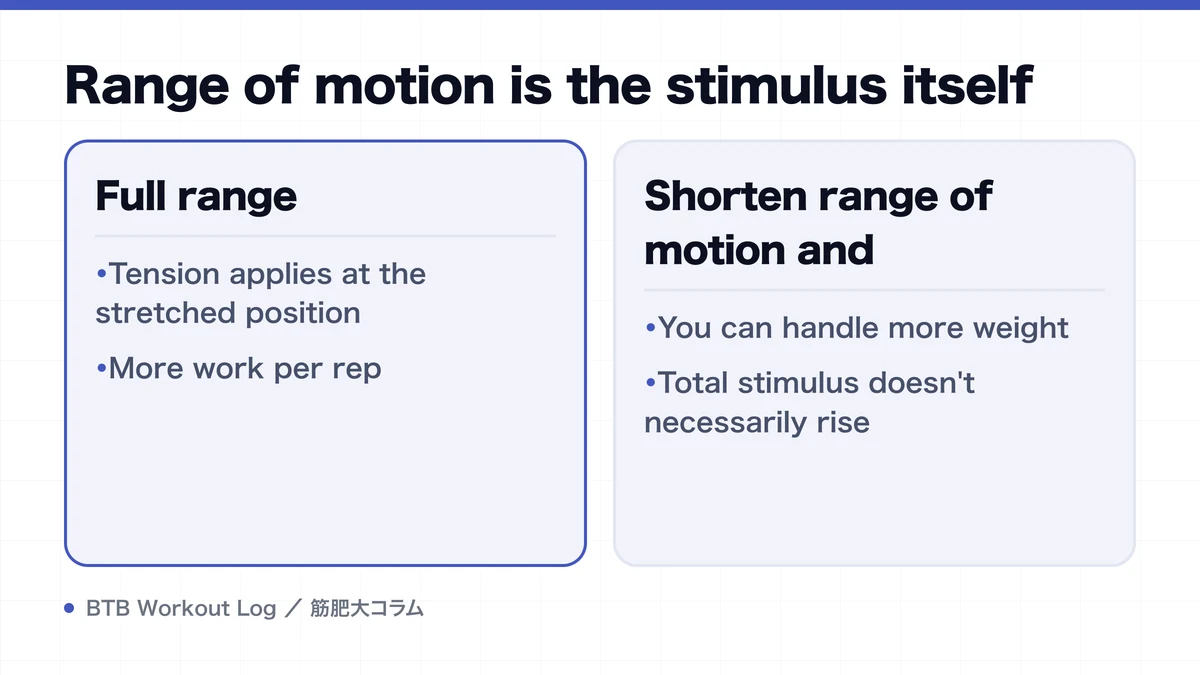
For hypertrophy, the mechanical tension fibres experience while producing force is considered a central stimulus. Move a joint and the target muscle's length, the external load's moment arm, and how easily you can produce force all shift continuously. So the same load doesn't deliver identical stimulus at every point in a rep. Full range is the standard more likely to give the target a chance to produce force across different lengths and joint angles, compared with repeating only a short section.
The other reason is that it makes progress easier to judge. Chase heavier load and, beyond just the fatigued final reps, your turnaround point can creep shallower over weeks without you noticing. Log "up 5 kg" under those conditions and you can't separate genuine progress from getting better at moving load through a shorter range. This overlaps with the trap covered in why load alone isn't enough.
Fix full range as your baseline first and you have solid ground for comparing load, reps and RIR (reps in reserve). This isn't a claim that full range always maximises hypertrophy on every exercise — it's that it's a starting point where you can actually interpret what a change was the result of.
Neither "deeper is better" nor "heavier is better" is sufficient
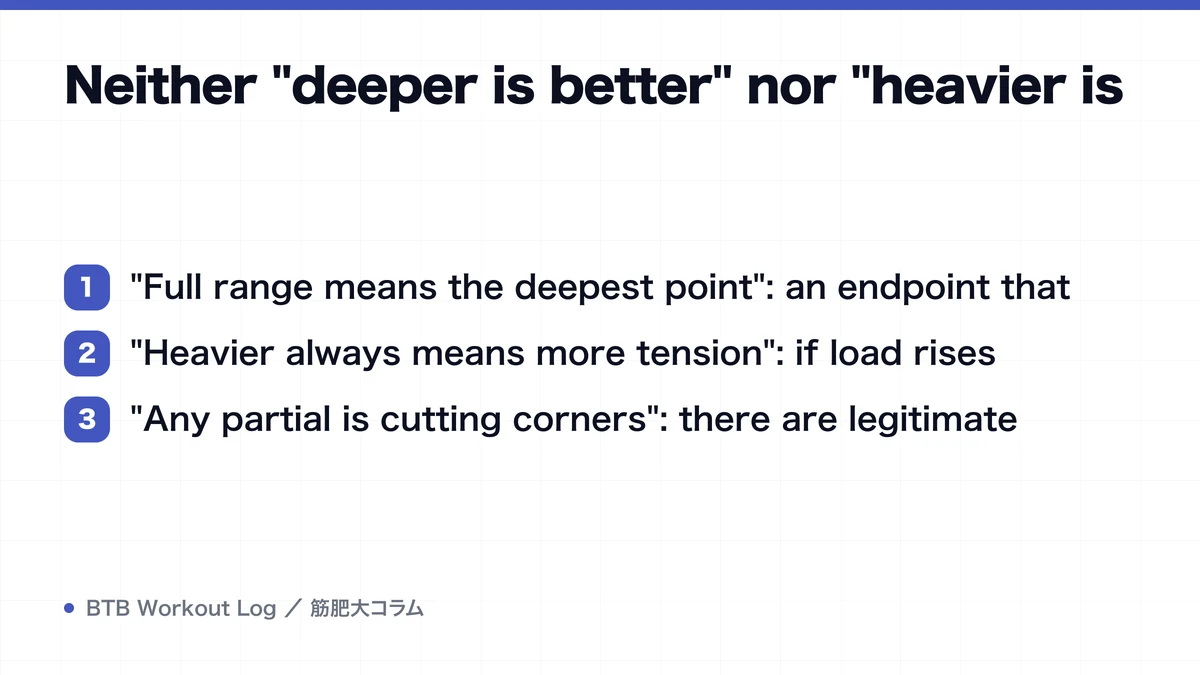
Confusion around range of motion arises from treating full range as a simple travel distance. In practice, keep these three apart.
- "Full range means the deepest point": an endpoint that comes with pain or a broken posture isn't necessarily the effective range for the target. Don't turn it into a race to the point just before you lose control.
- "Heavier always means more tension": if load rises alongside a shorter range, more momentum and more compensation from other body parts, you can't simply compare the tension the target actually received.
- "Any partial is cutting corners": there are legitimate reasons to limit a range — loading a specific muscle length, targeting a weak section, or continuing to train pain-free within a smaller arc.
There's a misreading in the other direction too. Having technically used full range doesn't automatically make a set effective. Too-light load with plenty left in reserve, or momentum doing the work instead of the target muscle, can leave a wide range of motion under-stimulated regardless. Range of motion is a variable to weigh together with RIR, load, set count and movement speed. Only once an RIR standard is matched too does a comparison with last time mean anything.
Change the range and the conditions for producing force change too
Partway through a rep, muscle length and the mechanics around the joint shift together. Some exercises put more tension on the muscle at longer lengths; depending on the resistance direction, load can drop off entirely at the endpoint on certain equipment, while some machines load hardest at a shortened position. So "how far did the bar or handle travel" alone can't tell you which section the target muscle actually worked through.
The benefit of full range isn't stimulating every angle equally — it's experiencing the exercise's natural resistance curve as a whole. From there, if one section is under-stimulated, you can add a different exercise or a deliberate partial to cover it. Limit yourself to a short section from the start and it becomes hard to see which muscle length you're skipping and what needs covering.
Reading research needs the same care — don't isolate range of motion on its own. Hypertrophy depends on several variables together — frequency, intensity, volume, mode — and studies differ in exercise, participants, how range of motion is defined, and measurement site. Rather than applying an average result to every exercise you do, it's more practical to establish a reproducible full range first and watch your own response and progress. The comparison between full range and partials is covered in choosing between full range and partials, and the causal chain behind the change in stimulus is covered later in this article.
Default to full range, use exceptions with a stated reason
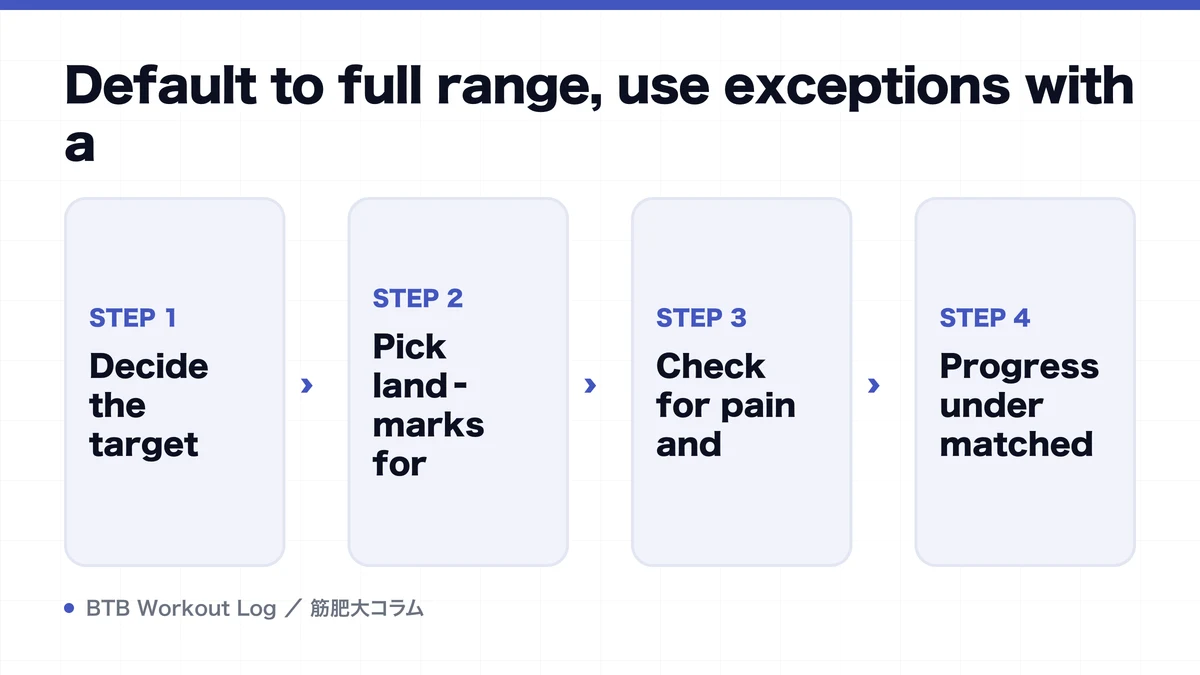
Rather than asking "how deep is normal", decide range of motion per exercise in this order to keep it reproducible.
- Decide the target muscle and the exercise's role: a fly stretching the chest and a chest press moving heavy load stably prioritise different endpoints even at the same shoulder joint.
- Pick landmarks for start and end: the bar touching your chest, knee and hip position lining up, the handle reaching a specific point — use markers you can verify, not memory or a video.
- Check for pain and compensation: sharp pain, joint instability, heavy momentum, or another area fatiguing before the target all mean that endpoint or load needs revisiting.
- Progress under matched conditions: hold range of motion and form fixed while adding reps or load in small steps — that's the state where progressive overload is actually interpretable.
Before switching to partials
If you're choosing a partial, check you can state a reason in one sentence beyond "I want to lift more". Adding stimulus at a longer muscle length, practising a specific weak section, training the target pain-free around a joint issue, or adding reps safely after a full-range set — these purposes justify limiting the range. If it just crept shallower without you deciding to, dropping load and returning to your baseline range comes first.
Log short notes on range of motion conditions alongside load and reps — "pause at the chest", "thighs below parallel", "stretched half only" — not just the numbers.
How does widening your range of motion change the stimulus on the muscle?
Widening your range of motion is not simply squatting deeper - it is bringing joint angles that were carrying no load under load. What gets added is usually the side where the muscle is stretched long, so the hardest point of a rep moves even at the same weight.
When the joint angle changes, the leverage changes with it. On exercises where the moment arm gets longer at the bottom, the force the muscle has to produce goes up even with the same plates. The weight you can handle drops when you widen your range of motion not because you got weaker, but because the loaded section has extended into the harder side. So once you change your range of motion, resetting weight, reps, and RIR is the starting assumption.
Put the other way round, chasing weight alone while supposedly holding your range of motion quietly breaks the conditions you compare progress against. Even if you handle more weight than last time, it is not the same movement if your depth got shallower. In your log, holding the endpoint you decided for that exercise - how far you lower - constant, on top of weight and reps, is the minimum condition for a comparison to hold.
FAQ
- If my joints are stiff, should I still force full range?
- You don't need to force the maximum angle. Treat the range just short of pain or a broken position — where you can still keep load on the target — as your full range for now. As mobility improves, widen the endpoints gradually and evaluate that separately from your load and rep records.
- Does partial range mean no hypertrophy?
- Partials can still produce hypertrophy given the right section loaded, sufficient effort and sufficient sets. But the skipped section gets less stimulus, so the practical approach is establishing full range as the baseline first and adding partials for a stated purpose — extra stimulus at a long muscle length, or practice on a weak section.
- My range of motion shrank slightly after adding load — is that progress?
- That's hard to call progress under matched conditions. If you're using it as a temporary transition while adapting to a new load, log the shortening and count it achieved once you restore your target range. If it keeps shrinking every time, revisit your load increment or RIR target.
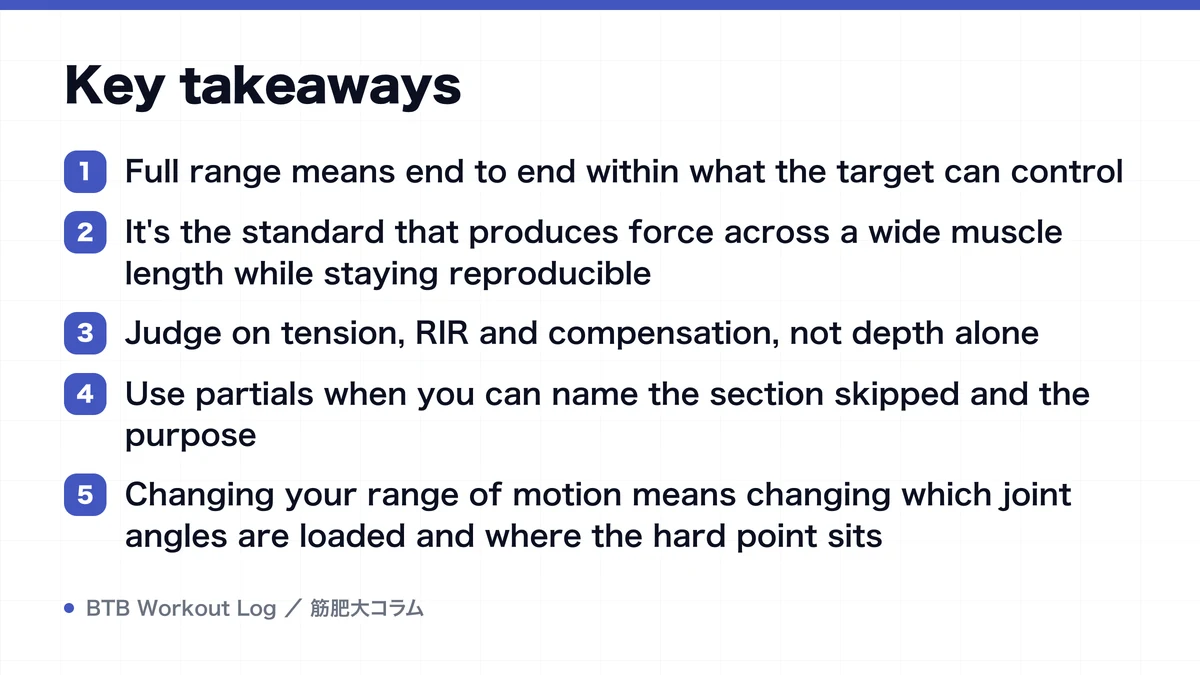
Key takeaways
- Full range means end to end within what the target can control
- It's the standard that produces force across a wide muscle length while staying reproducible
- Judge on tension, RIR and compensation, not depth alone
- Use partials when you can name the section skipped and the purpose
- Changing your range of motion means changing which joint angles are loaded and where the hard point sits
References
- The Mechanisms of Muscle Hypertrophy and Their Application to Resistance Training
- Mechanisms of Muscle Hypertrophy: Current Understanding and Future Directions
- The Influence of Frequency, Intensity, Volume and Mode of Strength Training on Whole Muscle Cross-sectional Area in Humans
- ACSM Position Stand: Progression Models in Resistance Training for Healthy Adults