Progressive Overload: 5 Ways to Increase Weight and Reps
Progressive overload is the principle of updating your training demand little by little as your body adapts. You can progress through reps, sets, range of motion, and difficulty, not only through weight.
What matters is not pushing one of those numbers up every session, but confirming - across several weeks of logs kept under matched conditions - that the demand on the target muscle and your ability to produce force are moving forward over the long run.
Progressive overload is not "adding weight every session"
Muscle recovers from the stimulus it takes in training and adapts to that demand. Once it has adapted, simply repeating the same conditions for a long stretch leaves little room to draw out further adaptation. Progressive overload is the practice of continuing to update the demand in line with your current capacity.
Adding plates is the easiest version to picture, but it is not the definition itself. Early in your training life the weight may go up almost every session, but the more experience you accumulate, the more progress slows to a weekly or monthly pace. If you use the misconception that you must add weight every session as your yardstick, it becomes easy to update the numbers alone by shortening your range of motion or adding more momentum.
Overload is also a principle for advancing the stimulus, not a replacement for recovery or nutrition. If you add demand but cannot recover from it, and your output keeps falling session after session, that is not long-term progress.
Match your comparison conditions before weight and reps
If you take 80kg from 8 reps to 9 but your range of motion shortened, your rest got longer, and your RIR moved from 2 toward 0, you cannot say your capacity rose under the same conditions. RIR is an estimate of how many more reps you could have done at the end of a set. On top of weight and reps, keeping RIR, range of motion, form, rest, and exercise order roughly matched makes the comparison with last time easier to read.
Why weight alone cannot tell you whether you are growing lays out the conditions the number on the plates does not include. On the other hand, the feeling of having worked hard - pump, soreness, being out of breath - can be used as a same-day response, but on its own it does not show weeks of progress. The difference between effort and long-term progress leads into overload compared with the feeling of hard work.
Your comparison conditions do not have to be completely identical. In the gym your condition and the availability of equipment change. Rather than passing or failing on one short-term session, read the trend in weight and reps across several sessions run under similar conditions.
Five patterns of progressive overload that drive hypertrophy
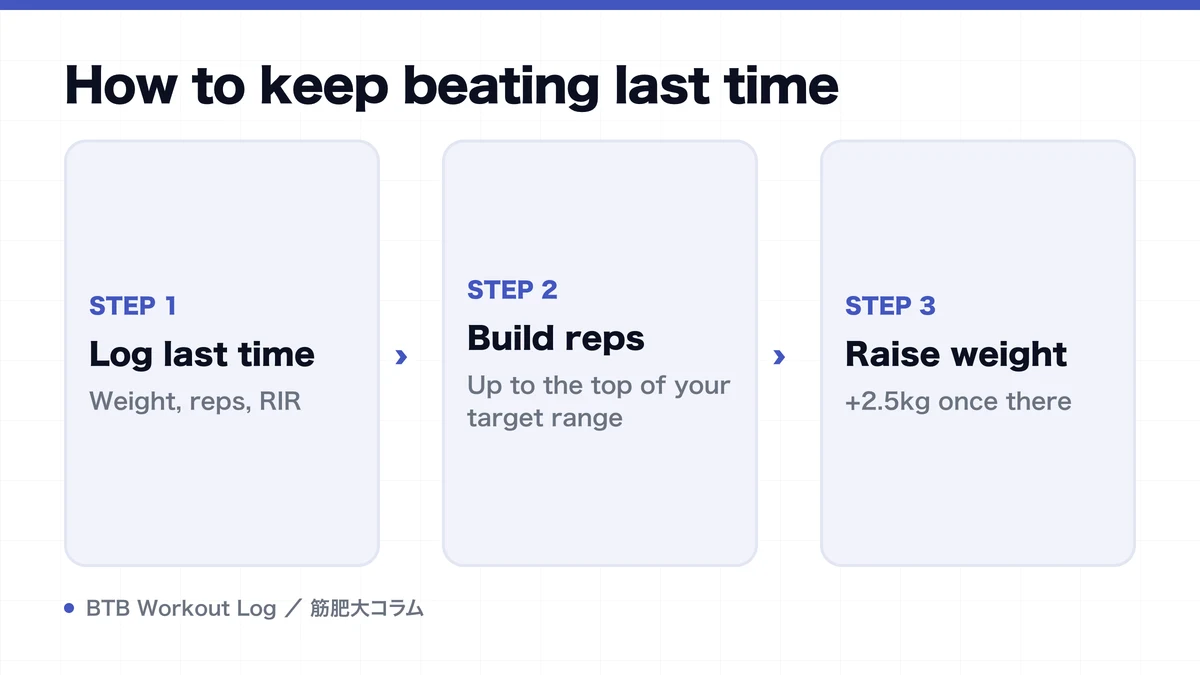
| Method | What counts as progress | Main use case |
|---|---|---|
| ① Add weight | Go heavier at the same reps, RIR, and movement conditions | After reaching the top of the rep range |
| ② Add reps | Do more reps at the same weight, RIR, and movement conditions | Phases where you want to progress in small steps |
| ③ Add sets | Hold the quality of each set and your recovery before the next session | When progress has stopped and there is room for more volume |
| ④ Advance range of motion or form | Define the endpoints and movement standards, then reproduce them | When you want to keep the weight and increase the work the target muscle does |
| ⑤ Raise density or difficulty | Adjust rest and exercise conditions in stages without breaking your output | When fitting around time limits or the nature of the exercise |
You do not move all five at once. If you change sets and range of motion in the same week you raise the weight, you lose track of why it worked or failed. The default is to progress either weight or reps, and to use the other variables only when you need them. Adding sets carries a recovery cost, and cutting rest can raise the work done in the same time while dropping the reps in each set.
Range of motion and form cannot be compared on "it felt cleaner". Decide standards you can reproduce next time, such as the bottom position, a pause, and whether momentum is allowed. If you can hold the same weight, reps, and RIR through a deeper range of motion, that is easier to score as the demand having advanced.
Connect weight and reps with double progression
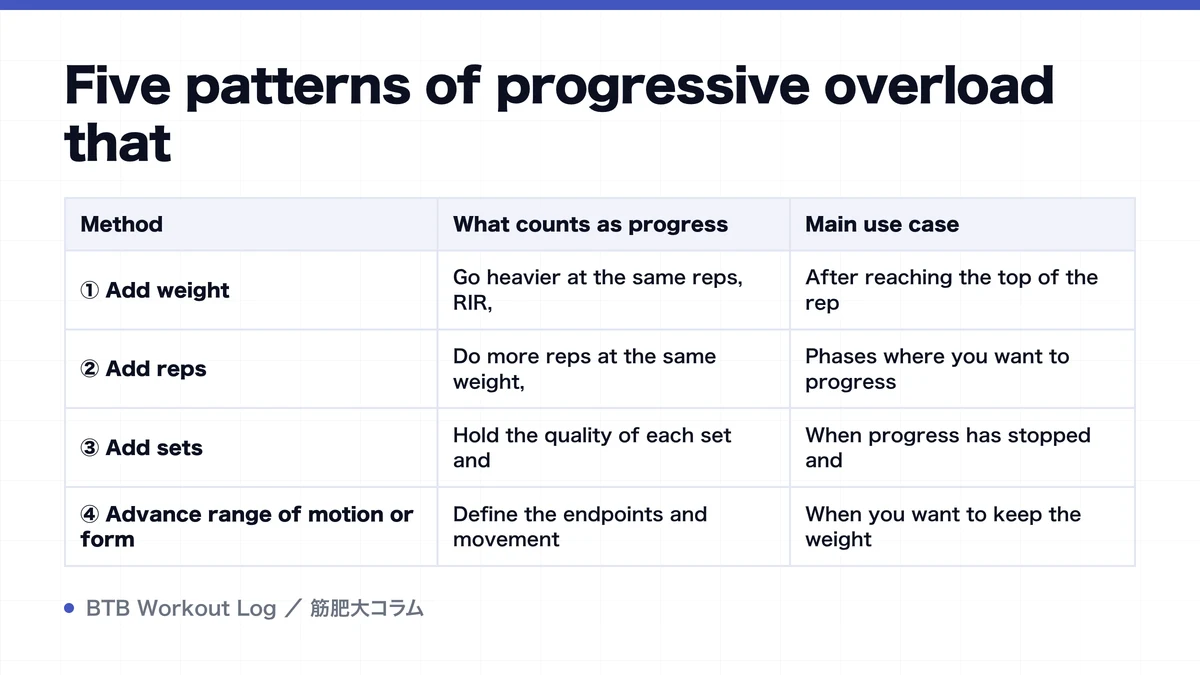
Double progression is the easiest system to work with for hypertrophy. For example, set a range of 8-12 reps and build the reps of each set at the same weight. Once your target sets reach the top of the range and you can still hold range of motion, form, and RIR, raise the weight by the smallest increment available and start stacking again from near the bottom of the range.
- Decide a rep range and target RIR that suit the exercise.
- Build each set, or your total reps, a little at a time at the same weight.
- Once you can reproduce the top of the range several times, add weight in the smallest step.
- Check that you can still hold the bottom rep count and your movement conditions after the increase.
More reps at the same weight is clear progress too, as long as the conditions are matched. The roles of weight and reps are compared in why reps matter as much as weight, and the criteria for choosing between them in add weight or add reps. For when to use "one more rep than last time", testing the plus-one-rep approach is the practical read.
Running on a fixed plan of 2.5kg every week ignores the percentage increase relative to your current weight and the increments your equipment allows. For when it works and when to switch, see testing a 2.5kg increase every week.
When more weight and more reps lead to hypertrophy
When you raise the weight while holding the same reps, range of motion, form, and RIR, the target muscle is asked for a larger force output. The advantage of using added weight is that it lets you keep updating a demand that produces high mechanical tension in line with your capacity. That said, if going heavier shortens your range of motion and the assisting muscles reach failure before the target muscle, the stimulus you were aiming for has not necessarily increased. For the causal chain, see how adding load drives growth.
More reps shows that you were able to repeat the same external load more times than before. If you go from 8 reps to 9 at the same RIR and the same movement conditions, you may have advanced your repetition capacity rather than simply moved one rep closer to failure. The flow of stacking those small gains up to the top of the rep range and carrying them into the next weight is set out in how adding reps drives hypertrophy.
A heavier lift is both a cause that advances the stimulus and a result of the muscle mass, neural adaptation, and technical improvement you built up to that point. Do not judge hypertrophy on a single personal best; look at several sets and the trend across several weeks.
Progress does not stop just because the weight stays the same or you change exercises
Even after six months at the same weight, if your reps have gone up, your range of motion has settled, and you are handling it at the same RIR, you have progressed outside of weight. Conversely, if weight, reps, RIR, and movement conditions have all stayed unchanged for a long time, that is material for considering an update to the demand. The decision points are covered in detail in staying at the same weight for six months.
You can also run progressive overload while changing exercises. Pick at random every session, though, and you have no observation points left to compare. Either fix your main exercises, or use an A/B rotation so the same exercise comes back on a regular cycle, and compare against the same exercise from last time. The conditions are covered in overload when you change exercises.
Even when your lifts go up, your muscle mass has not necessarily increased in the same proportion. Your numbers can also rise through how you use your nervous system, through form, and through familiarity with the exercise. For the gap between strength and hypertrophy, see why you get stronger without getting bigger, and evaluate weekly hard sets and recovery alongside it.
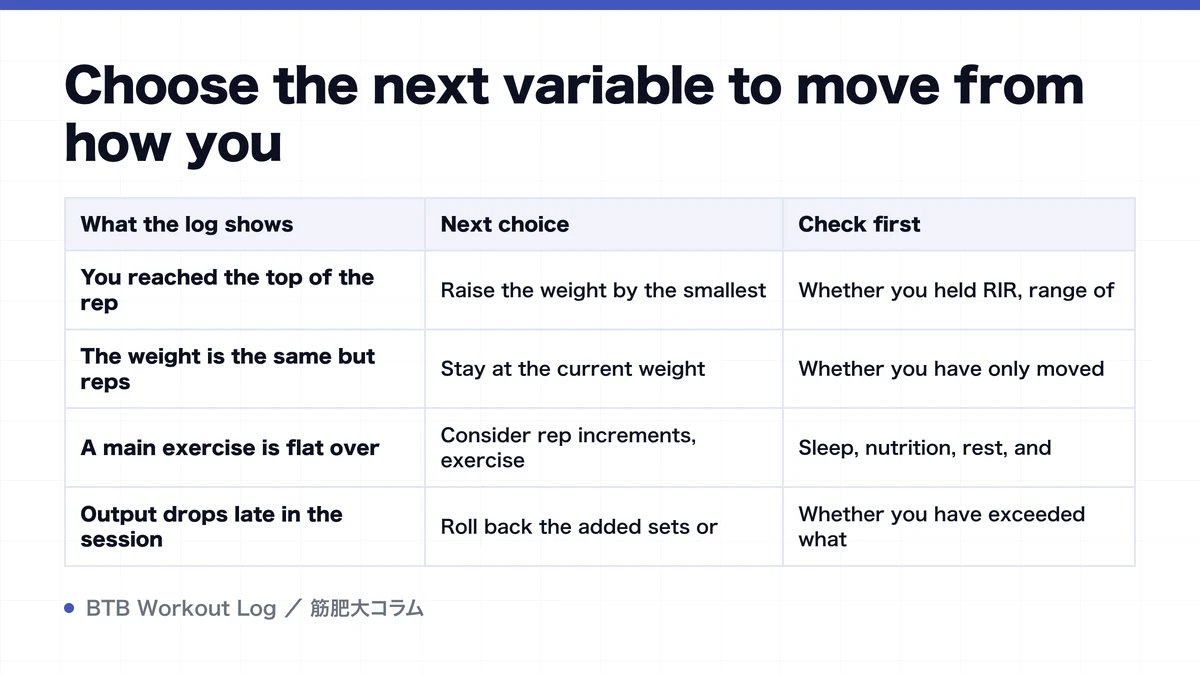
Choose the next variable to move from how you are stalling
| What the log shows | Next choice | Check first |
|---|---|---|
| You reached the top of the rep range | Raise the weight by the smallest step | Whether you held RIR, range of motion, and form |
| The weight is the same but reps are climbing | Stay at the current weight | Whether you have only moved closer to failure |
| A main exercise is flat over several sessions | Consider rep increments, exercise placement, and weekly volume | Sleep, nutrition, rest, and residual fatigue |
| Output drops late in the session and next time | Roll back the added sets or adjust the load | Whether you have exceeded what you can recover from |
| You changed equipment or rotated exercises | Compare against past logs under the same conditions | Whether you are directly comparing kg across different exercises |
It also matters not to call a plateau on one session. Short sleep, exercise order, and equipment differences all make your numbers wobble. First look at the trend across 2-4 sessions run under close to the same conditions, and if you are progressing, hold. If you have stopped but your output is down across the whole body, sort out recovery before adding demand. When only the exercise in question has stalled and you have capacity to spare, try the candidates in the table one at a time.
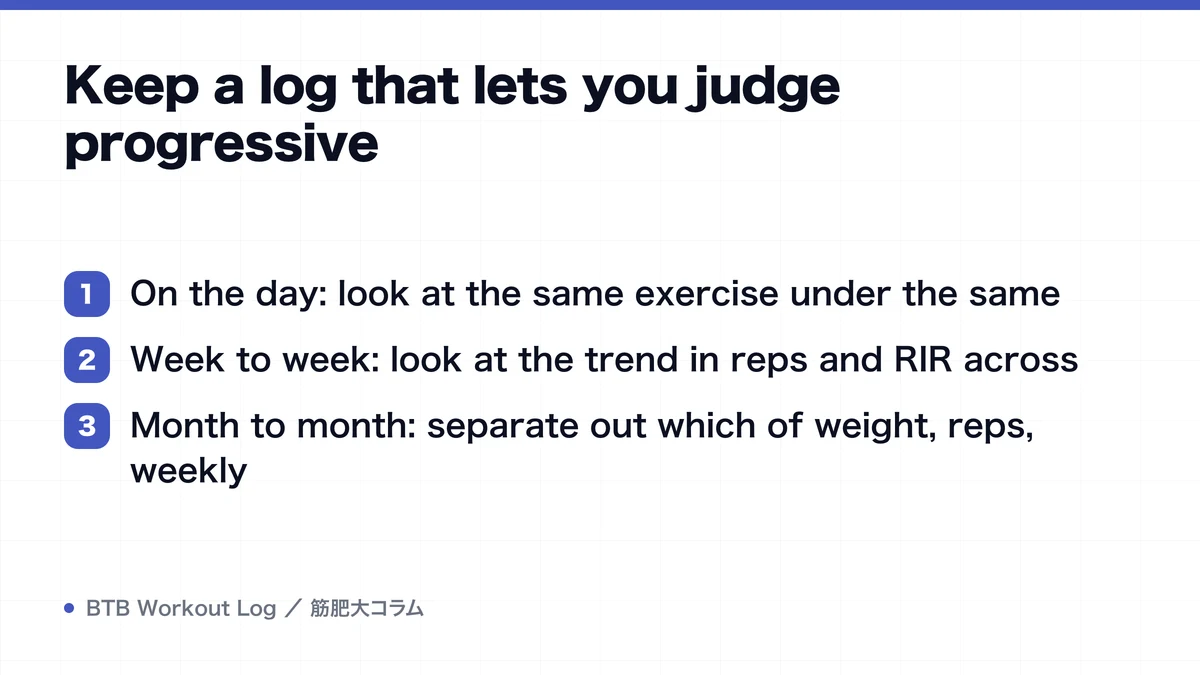
Keep a log that lets you judge progressive overload
Record the basics: exercise, weight, and reps for each set. Add target or actual RIR, range of motion and technique standards, and rest periods as needed. You do not need lengthy notes every session. Brief cues such as "RIR2," "pause at chest," or "no momentum" are enough to capture conditions that affect comparisons.
- Each session:Check your previous performance on the same exercise under the same conditions, then decide whether to add 1 rep or the smallest available weight increment.
- Each week:Look at rep and RIR trends across multiple sets, rather than a single best performance.
- Each month:Assess weight, reps, weekly sets, and recovery separately to identify what has improved and where you have hit a plateau.
BTB Workout Log lets you check your previous performance and trends for each exercise, giving you the information to choose what to progress today. Logging does not cause hypertrophy by itself. Comparable data helps you update your training targets and identify what is behind a plateau (how to use a workout logging app).
FAQ
- Does every session have to include more weight to count as progressive overload?
- No. You can also add reps at the same weight, range of motion, form, and RIR, add sets while holding their quality, or widen a range of motion you can reproduce. What you look at is whether the demand has moved forward across several weeks.
- How fast should I increase the load?
- Rather than fixing it by the calendar, add the smallest increment available at the point where you hit the top of your set rep range while holding your target RIR and movement conditions. The more experience you accumulate the longer the interval between updates becomes, so use progress in reps as well.
- I keep applying overload but I'm not growing. Why?
- It may be that only the numbers went up while range of motion or RIR changed, that you are not recovering from the added volume, or that sleep or nutrition is short. Compare 2-4 sessions under the same conditions, and isolate the cause instead of changing weight, reps, and weekly volume all at once.
- Does changing exercises make progressive overload impossible?
- As long as you keep your main exercises, or run something like an A/B setup where the same exercise comes back on a regular cycle, you can keep tracking it. Do not compare weights directly between different exercises; compare against the same exercise from last time with range of motion and RIR matched.
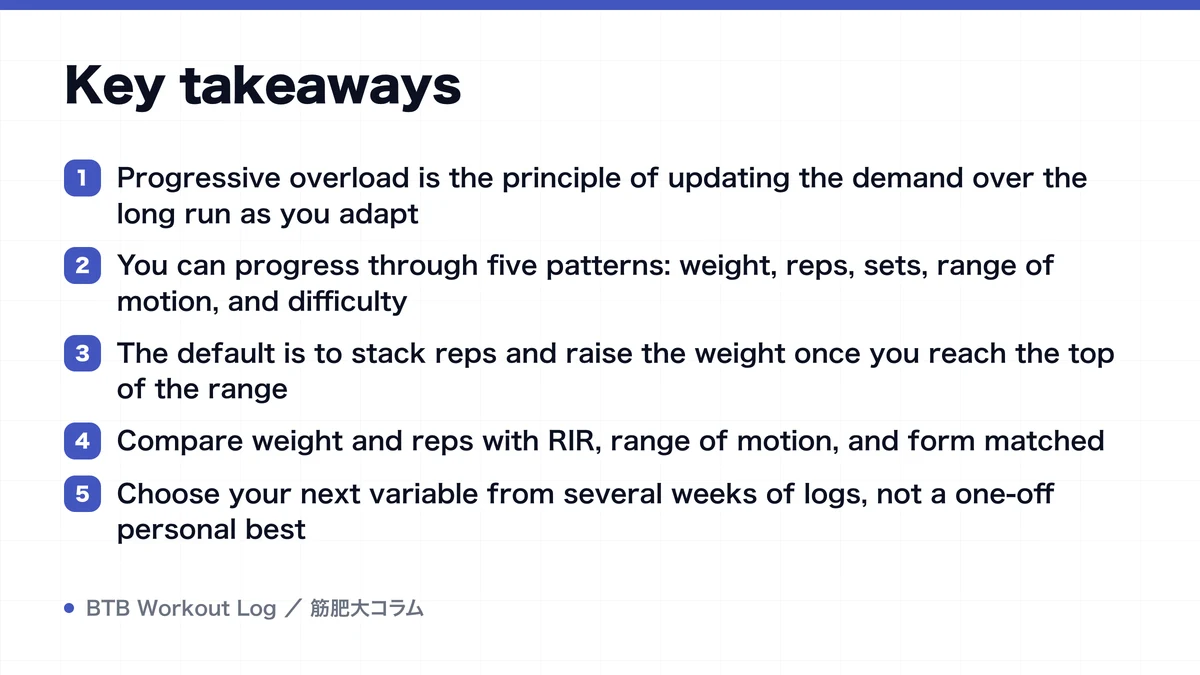
Key takeaways
- Progressive overload is the principle of updating the demand over the long run as you adapt
- You can progress through five patterns: weight, reps, sets, range of motion, and difficulty
- The default is to stack reps and raise the weight once you reach the top of the range
- Compare weight and reps with RIR, range of motion, and form matched
- Choose your next variable from several weeks of logs, not a one-off personal best
References
- ACSM Position Stand: Progression Models in Resistance Training for Healthy Adults
- Dose-response Relationship Between Weekly Resistance Training Volume and Muscle Mass
- Low- vs High-load Resistance Training for Strength and Hypertrophy: Meta-analysis
- Proximity-to-Failure and Muscle Hypertrophy: Systematic Review with Meta-analysis