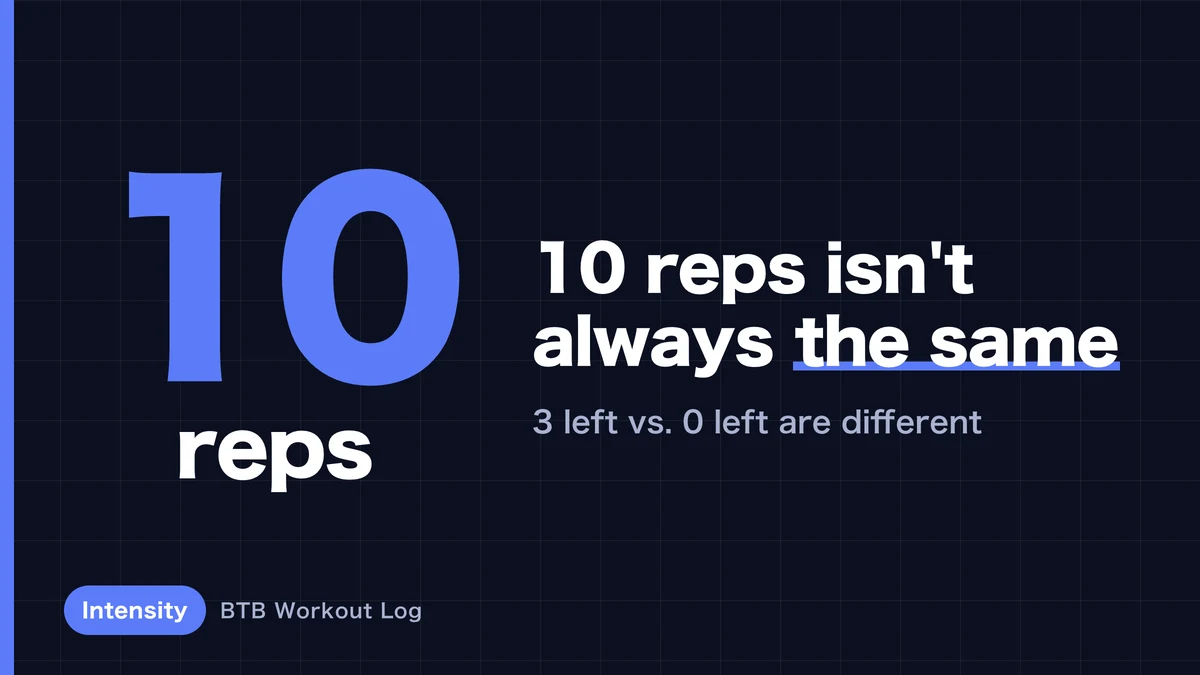
Hypertrophy: Why Some Sets of 10 Reps Build More Muscle
Ten reps isn't a measure of stimulus — it's just where you stopped the set. The same 10 reps carry different growth stimulus depending on how close you got to failure, the load, movement quality and how the target muscle was actually used.
Start by not treating a set of 10 taken near failure and a set of 10 stopped with five left in the tank as the same "10 reps".
Where "do 10 and you get the same stimulus" breaks down
Around 10 reps is easy to hold form on for many exercises, which makes it a convenient way to build a hypertrophy set. But convenient isn't the same as 10 having some special effect of its own. Reps only mean something once combined with load and effort.
If a load fails at rep 10, that set was RIR 0 — not one more rep possible. If someone who could manage 15 at that load stops at 10, that's RIR 5. Both log as "10 reps", but the distance to failure is completely different. Even for the same person, set 1's 10 reps might be RIR 4 while a fatigued set 4's 10 reps is RIR 1.
A common mistake is assuming a rep range automatically fixes intensity too. "Do 8–12" alone isn't enough — without also specifying how many you left in reserve, everything from near-warm-up sets to genuine limit sets falls under the same prescription. Deciding load from reps also needs a check on how much margin remains at your target rep count.
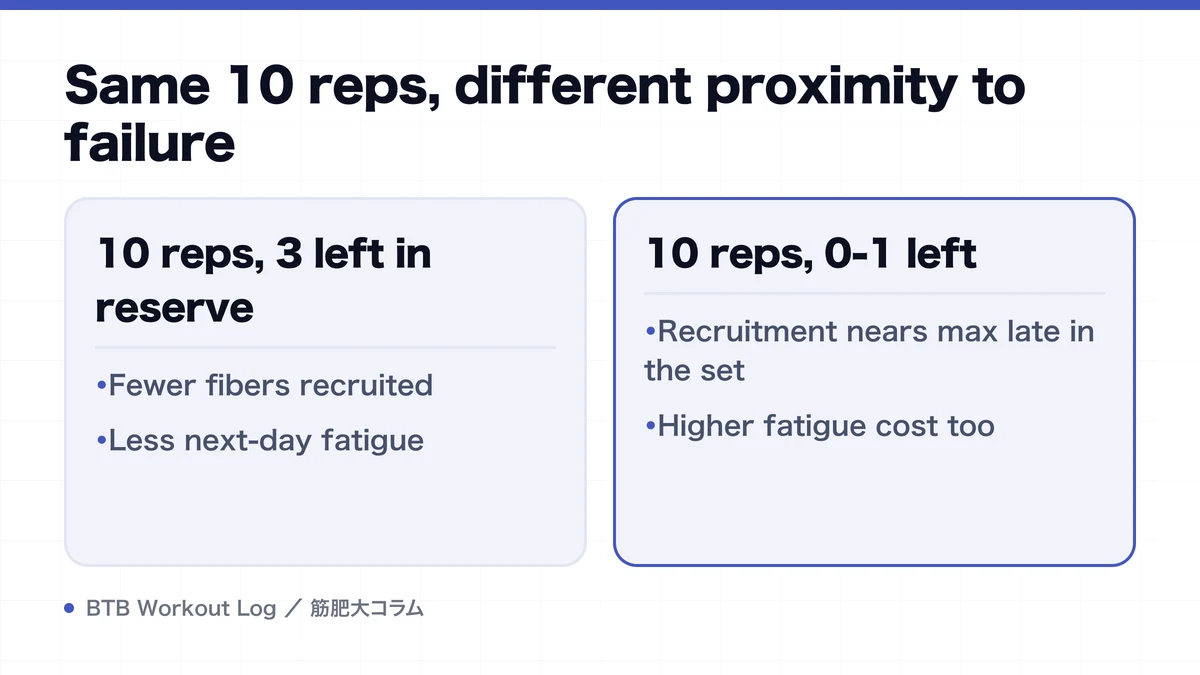
What mainly separates them is how close rep 10 got to failure
Muscle doesn't count reps and flip a growth switch. It receives the mechanical tension linked to hypertrophy when fibres produce sufficient force and the necessary motor units get recruited as the set progresses. Heavy loads demand high force from early on; light loads recruit more as fatigue builds and you approach failure.
RIR (reps in reserve — how many you had left) is the practical way to approximate this. RIR 1–3 at the end of 10 reps generally falls in the range that's usable as a hypertrophy-focused hard set. RIR 5 or more may deliver a smaller stimulus as a standalone working set, depending on purpose and the wider programme. Push all the way to RIR 0 and stimulus can rise — along with a bigger risk of breakdown in form and more fatigue carried into the next set.
Still, treating "only the last few reps count" as a fixed rule oversimplifies too. The relationship between proximity to failure and hypertrophy spans a range, and going to failure every set isn't established as necessary. What matters isn't the surface number 10 — it's whether you can repeat sufficient effort within what you can recover from. Keeping managing intensity by RIR separate from the costs and benefits of failure makes it easier to judge what 10 reps actually meant.
Change the load and the force demand and fatigue behind 10 reps changes too
Finish 10 reps at the same RIR on a different exercise or load and the set isn't the same kind of thing. Heavier loads demand more force per rep, building strength adaptation and skill handling heavy weight, but can demand more of joints and form. Lighter loads make it easier to stack reps, but take longer to approach failure, and local burn or breathlessness can become the limiter first.
Research overall suggests hypertrophy can occur across a fairly wide load range once effort is matched. That doesn't mean any load will do. Stop a light load you could manage 25 reps on at 10 and you still have a lot in reserve — not comparable to a load that's genuinely near failure at 10. The lighter the load, the more it matters to confirm you actually reached sufficient effort.
Comparing reps across exercises needs the same caution. Ten reps at 100 kg on a squat and ten at 50 kg on a leg extension differ in muscles used, stability, range of motion and systemic fatigue. Don't judge "which is better" by rep count alone — choose the load range that fits each exercise's role. Choosing between heavy and light is the useful framing for that.
Same load, same 10 reps — different movement, and the comparison breaks
Even with load and RIR matched, form changes what demand the target muscle actually faces. Ten strict reps through a full range and ten where the range shortened late and momentum finished the set aren't the same repetition. The latter isn't automatically worthless, but if you're tracking progress against last time, strict reps and assisted reps need to stay separate categories.
Exercise setup matters too. Change bench angle, grip, or foot and back positioning and the same 10 reps split load between target and assisting muscles differently. Slow tempo down a lot and time under load and usable weight both change — that isn't the same condition as 10 reps at your usual tempo. Slower isn't automatically superior; keeping the speed that lets you reproduce the intended movement is what preserves comparability.
Rest period and exercise order matter too. Ten reps after three minutes' rest and ten resumed after 60 seconds start from different fatigue levels. Approaching failure on a short rest can still mean load or reps fall on later sets and quality work across the session shrinks. When comparing with last time, keep rest and order roughly matched — thinking through interval design is useful here too.
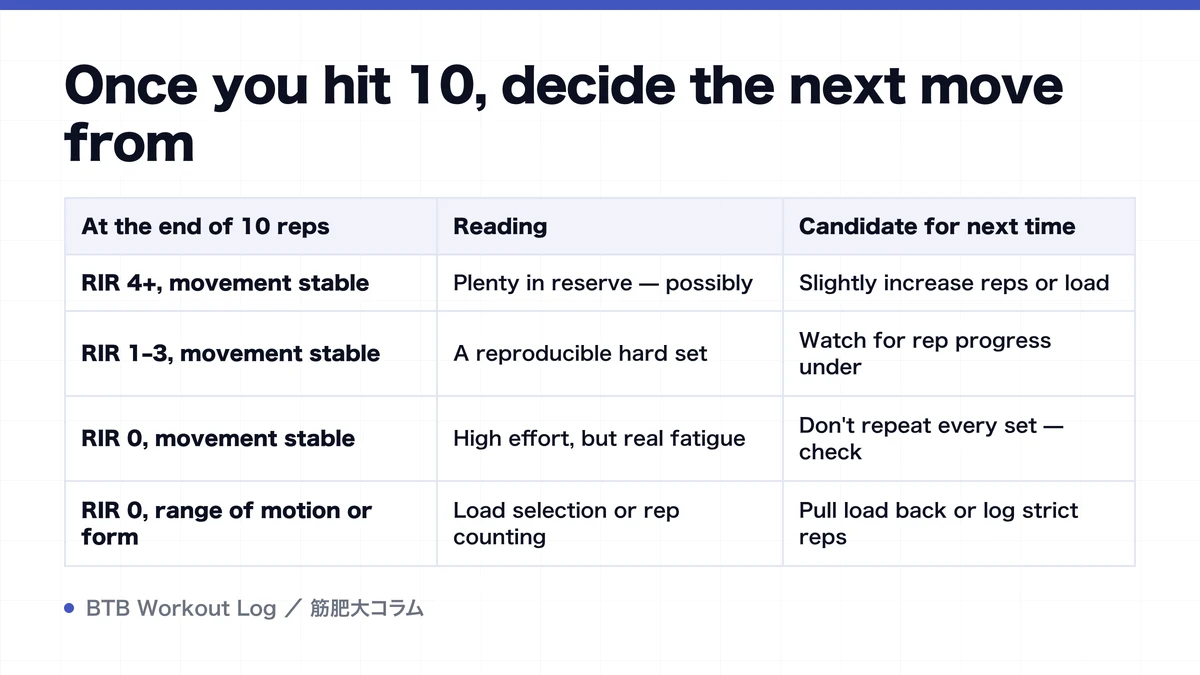
Once you hit 10, decide the next move from RIR and form
Once you've done a hypertrophy working set of 10, don't just note "done" — carry the state at the end of the set into next time's decision.
| At the end of 10 reps | Reading | Candidate for next time |
|---|---|---|
| RIR 4+, movement stable | Plenty in reserve — possibly lighter than intended | Slightly increase reps or load |
| RIR 1–3, movement stable | A reproducible hard set | Watch for rep progress under matched conditions |
| RIR 0, movement stable | High effort, but real fatigue cost too | Don't repeat every set — check recovery |
| RIR 0, range of motion or form breaking down | Load selection or rep counting needs revisiting | Pull load back or log strict reps only |
This table isn't a verdict on the whole programme from one set. RIR is a subjective estimate, and error runs high while you're still unfamiliar with an exercise. Occasionally testing how many reps you can actually get on a safe machine exercise calibrates your "two left" sense — you don't need to force failure on free weights to do it.
Reps also swing with the day's sleep, food, pain, and fatigue from earlier exercises. Don't move load up or down off one set of 10 — watch the trend across several sessions under matched conditions. If RIR deteriorates sharply across multiple sets, check whether set count and rest fit your recovery, not just the load.
Turn a rep count into a record you can set your next load from
In practice, set a rep range and target RIR per exercise and fix movement conditions as much as you can. Aiming for 8–12 at RIR 1–3, if you hit 10 at RIR 3, try 11 at the same load next time. If you hit 10 at RIR 0, either stabilise rep quality at the same load or consider a small load reduction.
Log at minimum load, reps and RIR per set. For key exercises, add a short note on rest period, range of motion and any form change. If 10 reps at the same load moves from RIR 0 to RIR 2, capability may have risen even though the rep count didn't change. Conversely, if range of motion shrank to keep hitting 10, that's hard to call progress even though the number looks the same.
Hit the top of your rep range at your target RIR with stable form, then add a small increment to load. Running that progressive overload loop needs you to watch a trend under matched conditions rather than blending in 10-rep sets from different exercises or conditions. The job of your log is turning 10 reps from a target into evidence.
FAQ
- Should I avoid targeting 10 reps for hypertrophy?
- No need. Around 10 reps is manageable on many exercises. Just don't grade a set on the number 10 alone — decide your target RIR, form and range of motion too. A load where 10 reps lands you at RIR 1–3 is a practical choice.
- Should every set hit the same 10 reps at the same load?
- Not required. Later sets naturally lose reps at the same load as fatigue builds. Rather than shortening range of motion to force 10, holding your target RIR and form and logging the actual count — 10, then 9, then 8 — gives you something you can actually compare.
- How do I judge RIR accurately at the end of 10 reps?
- Build a history on the same exercise and form, and occasionally take a safe machine exercise to true failure to check your estimate against reality. If you manage more reps than expected at the same load next time, you were probably leaving more in reserve than you thought. Calibrate over time, not from one instance.
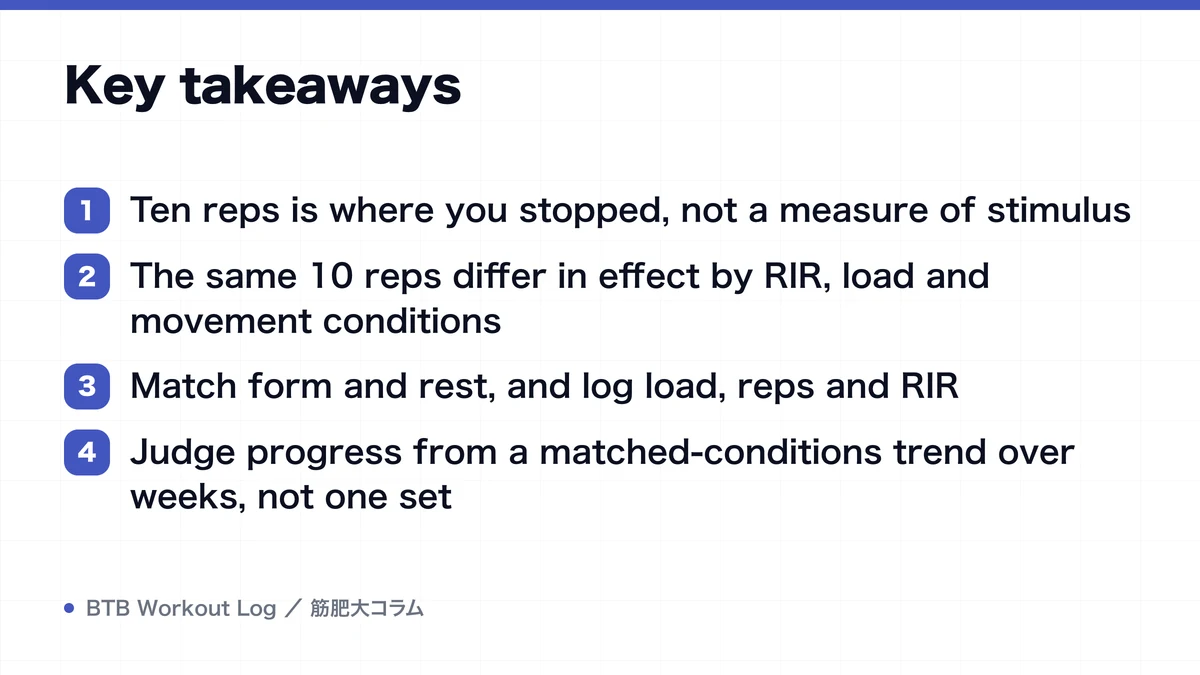
Key takeaways
- Ten reps is where you stopped, not a measure of stimulus
- The same 10 reps differ in effect by RIR, load and movement conditions
- Match form and rest, and log load, reps and RIR
- Judge progress from a matched-conditions trend over weeks, not one set
References
- Low- vs High-load Resistance Training for Strength and Hypertrophy: Meta-analysis
- Resistance Exercise Load Does Not Determine Training-mediated Hypertrophic Gains in Young Men
- Training to Repetition Failure or Non-failure: Systematic Review and Meta-analysis
- Proximity-to-Failure and Muscle Hypertrophy: Systematic Review with Meta-analysis
- Repetitions in Reserve Is a Reliable Tool for Prescribing Resistance Training Load