Why Back Training Never Feels Like It's Working | Tips for Building Muscle You Can't See
The back uses several muscles at once, pulling together with the arms and forearms, and it's a body part you can't easily watch move with your own eyes. That's why stimulus feels spread out and "where it worked" tends to stay ambiguous.
A weak sensation doesn't mean stimulus isn't landing. Use contraction feel as a cue for adjusting form, and judge an exercise's effectiveness from reproducible movement and progress over several weeks.
Three reasons the back specifically is hard to feel
Even calling it "the back" in one word, the lats, traps, rhomboids and spinal erectors don't sit in the same place or do the same job. Pulling from overhead involves the lats heavily; pulling horizontally strongly engages the muscles that retract the shoulder blades too. Back exercise selection splitting into vertical and horizontal pulls isn't just about appearance — the movements play different roles. Expecting one strong contraction feel across the whole back makes it easy to conclude "I feel nothing" even when muscles are genuinely working.
Second, pulling exercises don't end at the shoulder joint or shoulder blade alone. The biceps bending the elbow, the forearms gripping the bar, and the core holding posture all participate at the same time. Forearm tightness or biceps fatigue is easy to perceive, so that sensation can overshadow tension on the back side. This isn't wrong — the arms working is a natural part of a compound movement. What becomes a problem is when grip or the elbow flexors hit their limit before the target back muscles do, ending the set early.
Further, the back is hard to see directly in a mirror — unlike the chest or upper arm, it's difficult to watch muscle shortening with your eyes and correct in real time. You end up inferring movement in your upper arm and shoulder blade, happening behind your body, purely from the path in front of you. Because multiple muscle groups, multiple joints, and limited visual feedback all compound together, it fits reality better to assume back sensation inherently carries noise.
A weak "I can feel it working" doesn't necessarily mean failure
Pump or burn isn't the long-term result itself
A pump or burn from high-rep movement is easy to notice and gives a real sense of having completed the set. But that in-the-moment sensation also shifts with rep count, rest, and unfamiliar movement. Automatically rating an exercise that produced a strong pump highly, and discarding one with a quiet sensation, risks overlooking the load or range of motion you could handle, and continued progress. The relationship between contraction feel and hypertrophy effect needs separating out as its own question — see whether a stronger "I can feel it working" makes an exercise better.
"Squeeze your shoulder blades together" isn't the universal correct cue for every back exercise
The lats' main job is pulling the upper arm toward the torso. On rows targeting the mid-traps or rhomboids, though, shoulder blade retraction matters more. Standardizing on one cue — maximally squeezing shoulder blades together on both lat pulldown and rows — can misalign target and movement. On vertical pulls, drive the elbow toward the hip; on horizontal pulls, match the elbow path and shoulder blade movement to whichever area you're targeting — think about it by purpose.
Continually lowering weight in pursuit of sensation isn't right either
Lowering load while learning form is valid, but lighter isn't always better. What matters is holding intended range of motion while still returning to a weight that demands sufficient effort late in the set. Sensation is information for probing "am I moving correctly" — it isn't a reason to avoid progressing load.
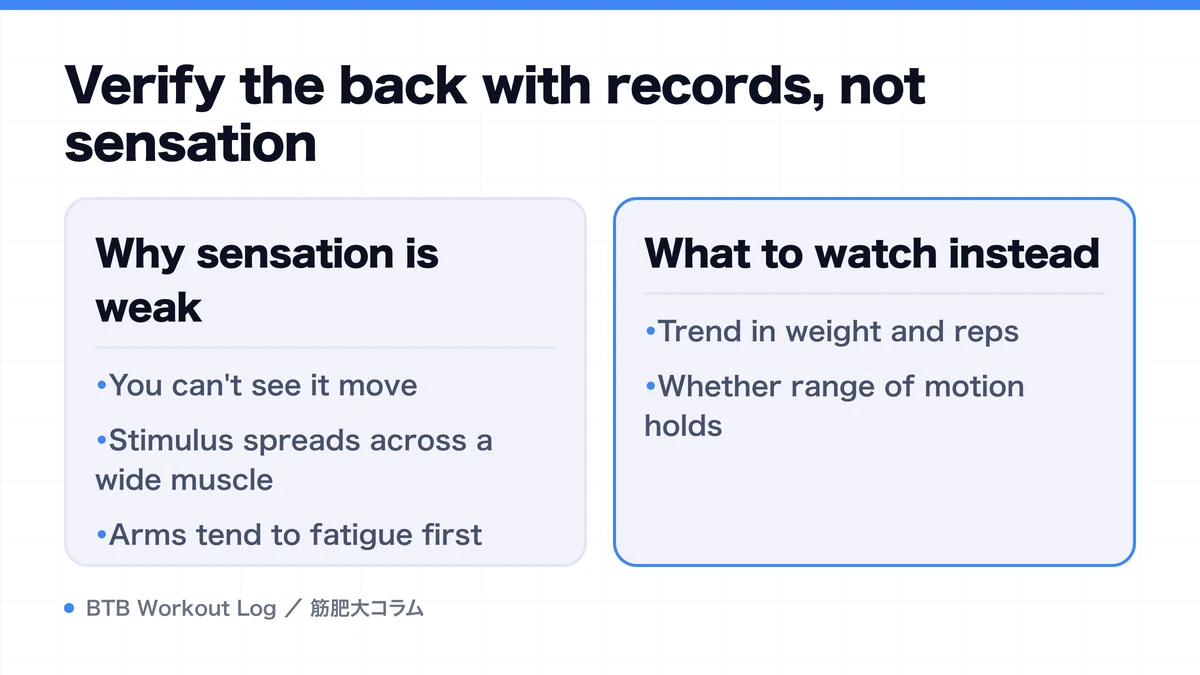
Use sensation, but don't let it be the sole judge
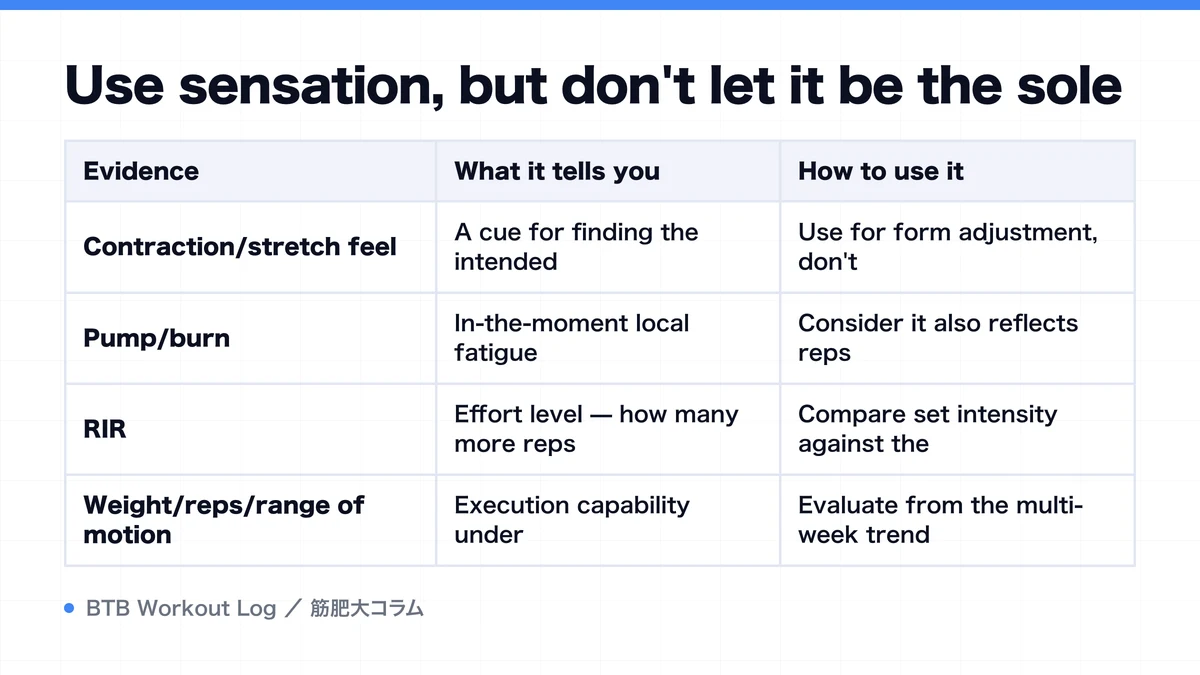
Even on traditional lat-focused pulling exercises, muscle activation patterns can shift with exercise choice and execution conditions. But a single-timepoint muscle-activity study alone doesn't settle long-term hypertrophy — you need a view that covers sustained load, volume, frequency, and range of motion over time. Rather than one signal — "my lats felt contracted today" — watch whether several pieces of evidence point the same direction.
| Evidence | What it tells you | How to use it |
|---|---|---|
| Contraction/stretch feel | A cue for finding the intended path | Use for form adjustment, don't let it alone decide pass/fail |
| Pump/burn | In-the-moment local fatigue | Consider it also reflects reps and rest |
| RIR | Effort level — how many more reps were possible | Compare set intensity against the same standard |
| Weight/reps/range of motion | Execution capability under matched conditions | Evaluate from the multi-week trend |
| Pain/numbness | A warning to consider stopping or correcting | Don't chase it as "feeling it work" |
RIR is a metric for how many more reps were possible. Even with weak back sensation, if you can reach your intended RIR without breaking movement, you can compare effort level. Conversely, even with a strong sensation, if form or range of motion changes every time, comparison against last time stays ambiguous. Rather than eliminating subjective sensation, combining a defined subjective cue with numbers is the realistic approach.
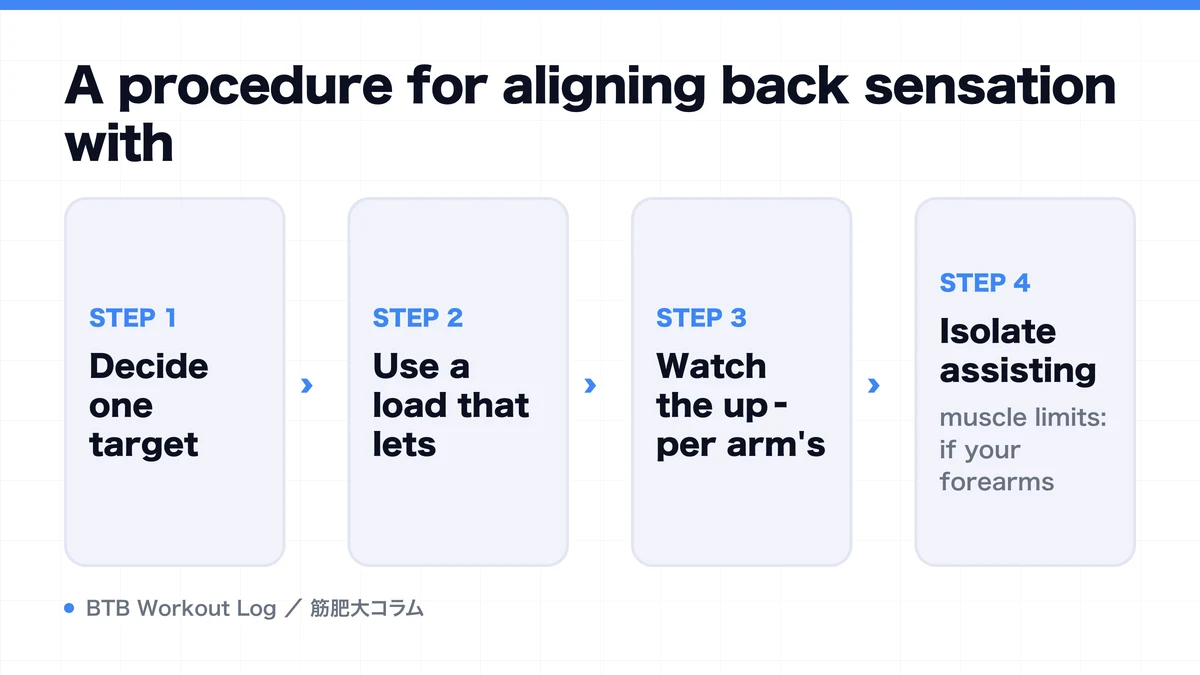
A procedure for aligning back sensation with form
- Decide one target first: decide upfront whether you're doing a vertical pull targeting the lats, or a horizontal pull targeting upper-back thickness. Consider purpose and stability separately, as in comparing lat pulldown and pull-ups for pulldowns, or comparing barbell row and seated row for rows.
- Use a load that lets you reproduce the path: if you're only continuing reps through momentum or a changing torso angle, lower load once. Your standard is whatever range lets you match start position, endpoint, and tempo.
- Watch the upper arm's movement, not your hands: drive the elbow toward the hip on vertical pulls, and toward whichever direction matches your target on horizontal pulls. Think of your hands as the contact point connecting you to the equipment — don't focus purely on gripping.
- Isolate assisting-muscle limits: if your forearms consistently give out first, try straps; if lower-back holding breaks down first, try a chest-supported row — methods that reduce the bottleneck. Change one thing at a time and compare what shifted.
- Repeat the same exercise several times: changing grip or exercise every time resets both motor learning and comparability. Repeat matched conditions within a pain-free range and check how sensation and numbers stabilize.
Filming from the side or behind also helps. You can check whether you're arching your chest excessively, whether range of motion shortens only late in the set, and whether there's a big left-right imbalance. Video doesn't directly measure muscle stimulus, but it's material for correcting hard-to-see back movement.
Decide keep-or-change from progress over several weeks
When evaluating a back exercise, first check whether you can repeat the intended range of motion without pain, then whether you can push close to the limit of the intended movement rather than grip or biceps. Once those conditions are matched, watch whether weight or reps rise at the same RIR. If sensation stays modest but numbers progress and form is stable, there's little reason to rush switching exercises.
Conversely, even with a strong pump, if weight and reps decline over several weeks and range of motion shortens too, reconsideration is warranted. Check not just the exercise but back's weekly volume, recovery since last time, and your RIR estimate. Before adding sets to chase more sensation, confirm you can still sustain progressive overload on the sets you already have.
Since vertical and horizontal pulls play different roles for the back, tracking their records separately makes judgment easier. The division of labor: sensation guides that day's form, records decide whether to keep or change the exercise.
FAQ
- Is it OK to continue an exercise with no back sensation if weight or reps are progressing?
- If there's no pain, you're holding intended range of motion and form, and weight or reps are progressing at the same RIR, there's no need to switch exercises just because sensation is weak. Also check video and any left-right imbalance, and judge from multiple indicators.
- How do I fix it if only my biceps fatigue on lat pulldowns?
- First lower load and repeat a path driving the elbow toward the hip rather than pulling with your hands. If grip gives out first, straps are an option. If your arms still consistently limit you, change grip or range of motion one at a time and compare.
- Should I use straps every time to feel my back working?
- Not required. They're useful for sets where grip hits its limit before the intended back muscle does, but unnecessary if you can complete the movement without them. You can split it by purpose — bare-handed for warm-up, straps only for hard sets.
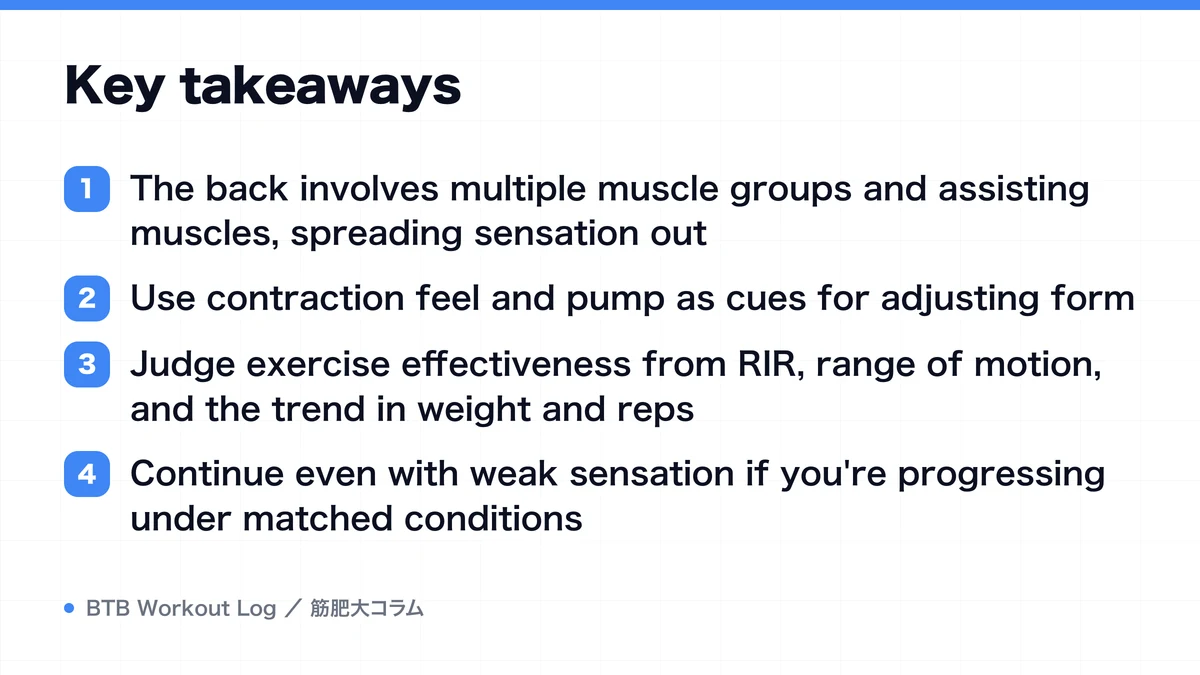
Key takeaways
- The back involves multiple muscle groups and assisting muscles, spreading sensation out
- Use contraction feel and pump as cues for adjusting form
- Judge exercise effectiveness from RIR, range of motion, and the trend in weight and reps
- Continue even with weak sensation if you're progressing under matched conditions
References
- Variations in Muscle Activation During Traditional Latissimus Dorsi Exercises
- The Mechanisms of Muscle Hypertrophy and Their Application to Resistance Training
- The Influence of Frequency, Intensity, Volume and Mode of Strength Training on Whole Muscle Cross-sectional Area in Humans
- Repetitions in Reserve Is a Reliable Tool for Prescribing Resistance Training Load