Can You Build Muscle All Over Training 3 Days a Week? A Realistic Guide for Busy Lifters
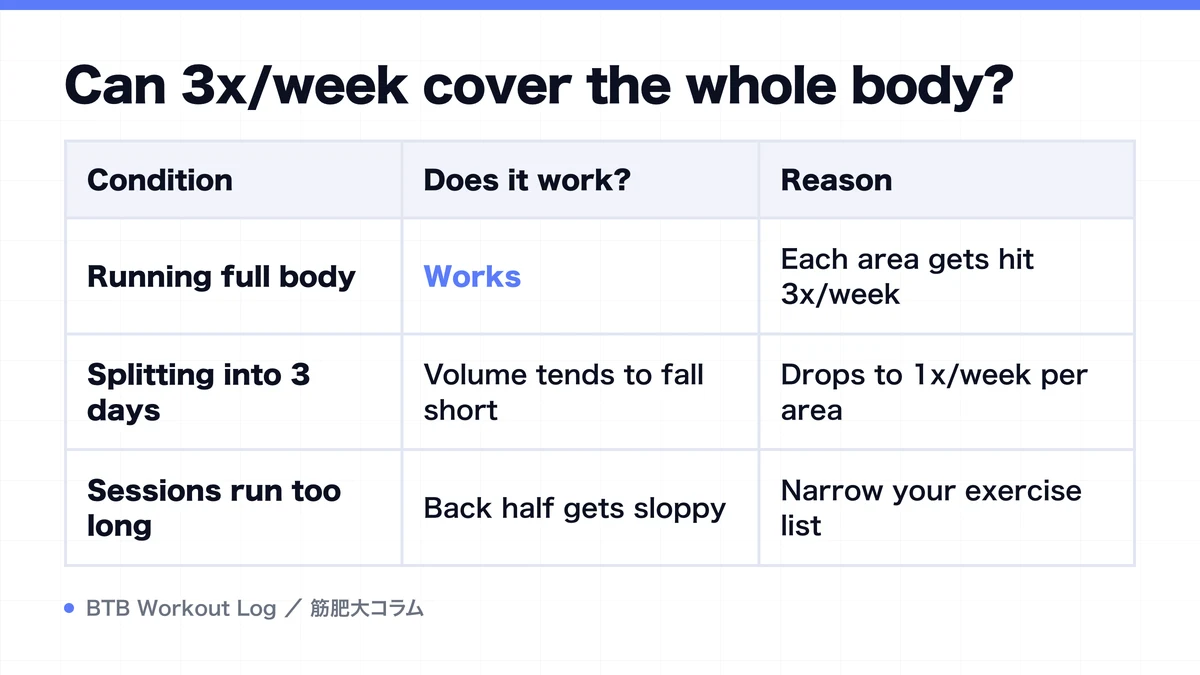
Yes. If you distribute the volume each muscle group needs and hold sufficient effort and progressive overload, three full-body sessions a week can drive whole-body hypertrophy.
Just showing up three times isn't enough to call it sufficient, though. You need to check the exercise selection covers the whole body, set quality holds, you're recovering, and progress is actually happening over several weeks.
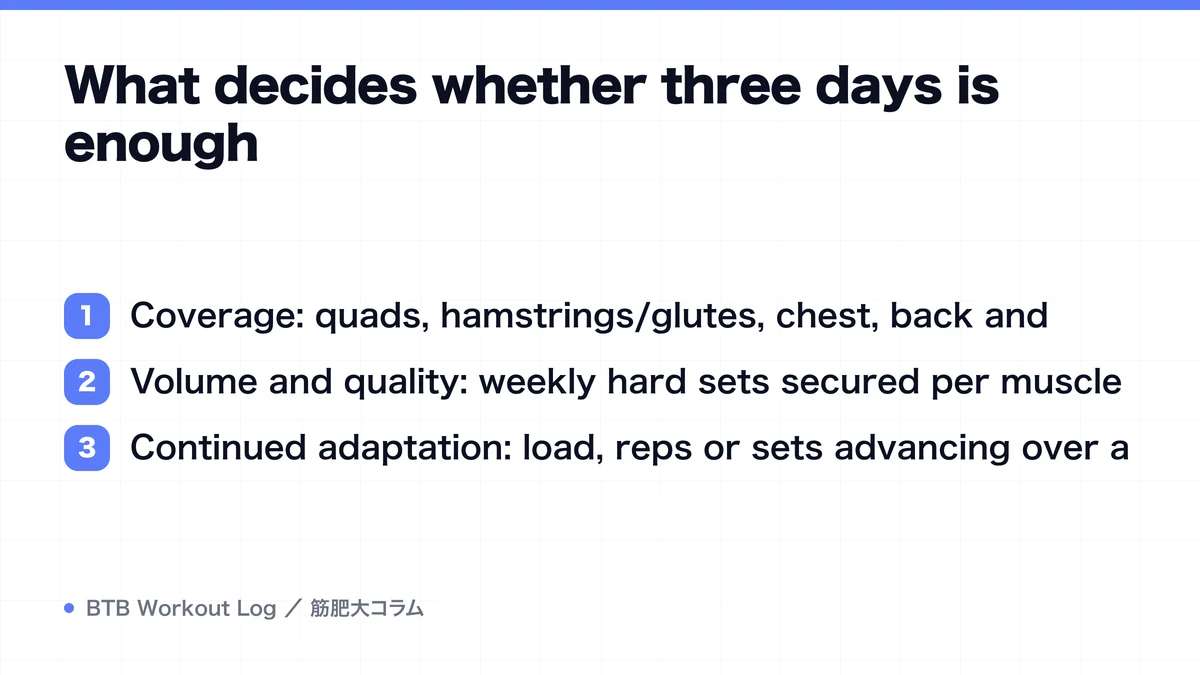
What decides whether three days is enough
The question isn't whether three is some magic minimum. What matters is whether, within those three sessions, you can consistently deliver recoverable effective stimulus to every target muscle in the body. Training days are the container; what actually drives hypertrophy is weekly volume per muscle group, per-set effort, and a mechanism for advancing load.
"Grow the whole body enough" gets clearer split into at least three conditions.
- Coverage: quads, hamstrings/glutes, chest, back and shoulders trained weekly, with direct sets for arms or calves added as needed.
- Volume and quality: weekly hard sets secured per muscle group, with the target and range of motion held into the back half.
- Continued adaptation: load, reps or sets advancing over a stretch of weeks at the same form and effort.
Conversely, a session packed with full-body exercises where the back half turns into going-through-the-motions, and a lagging area's numbers don't move for weeks, isn't "enough" just because you showed up. Judge on stimulus and adaptation per muscle group, not whether you completed the plan.
Research weighs volume and effort more than "three days"
Systematic reviews and meta-analyses of frequency show that with weekly volume equated, raising frequency alone adds little or nothing clear for hypertrophy. So three days isn't automatically worse than four to six. Frequency's main job is distributing required sets across more days so each set's output holds. The wider picture is in training frequency.
Weekly set count does show an average dose-response relationship with hypertrophy. But where useful volume tops out, and where recovery cost starts winning, moves with experience, exercise selection, RIR, sleep and nutrition. Rather than applying one set count to everyone, it's more realistic to distribute a recoverable amount across three days and nudge only the muscle groups whose progress has stalled.
Taking every set to failure isn't required either. RIR is your estimate of reps left, and keeping your main working sets around RIR 1–3 secures enough effort while still leaving room to manage the next exercise and next session's recovery. What the research supports isn't a guarantee that "three days always works" — it's the conditional view that it can work if you deliver adequate volume and near-limit effort within three sessions.
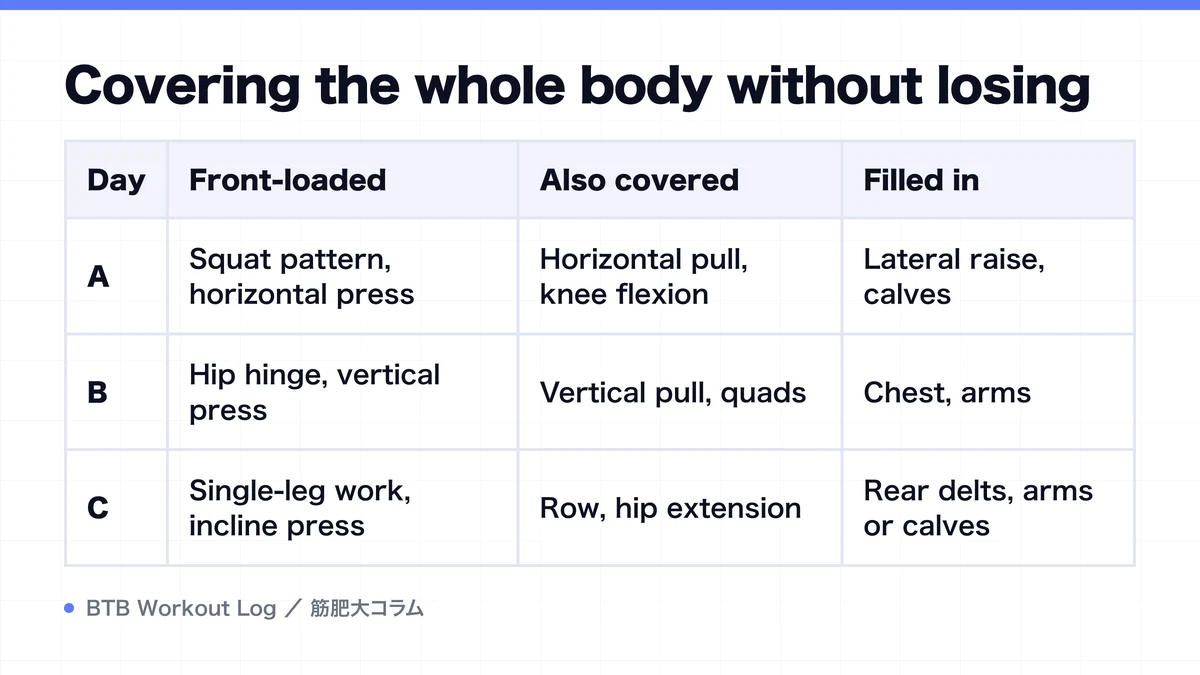
Covering the whole body without losing late-session quality
Three-day full body doesn't need the exact same exercises in the exact same order every time. Keep a leg pattern, a push and a pull in every session, but rotate which muscle group and angle goes first, and no single group is always the one left tired and pushed to the end. For the choice between full body and a split itself, see full body versus a split at three days; here's a layout that works.
| Day | Front-loaded | Also covered | Filled in |
|---|---|---|---|
| A | Squat pattern, horizontal press | Horizontal pull, knee flexion | Lateral raise, calves |
| B | Hip hinge, vertical press | Vertical pull, quads | Chest, arms |
| C | Single-leg work, incline press | Row, hip extension | Rear delts, arms or calves |
This isn't a fixed sheet — it's a way of distributing movements and priority. Starting main movements at two to three working sets keeps any one session from being overloaded, which makes it easier to accumulate stimulus across the week. Bench press loads triceps as well as chest; rows load biceps as well as back — pile on direct arm sets while ignoring that indirect load and recovery can suffer. Counting every indirect set as equal to a direct one is too coarse, though; decide the top-up amount from how arms are actually progressing and how fatigued they are.
Training the same muscle group three times a week doesn't mean every session has to be equally heavy or equally close to failure. Use lower-to-moderate reps on your priority day and moderate-to-high reps on the others, managing RIR within a range where form holds on both. The point of that wave isn't elaborate periodisation — it's spreading joint load and local fatigue while still stacking quality sets.
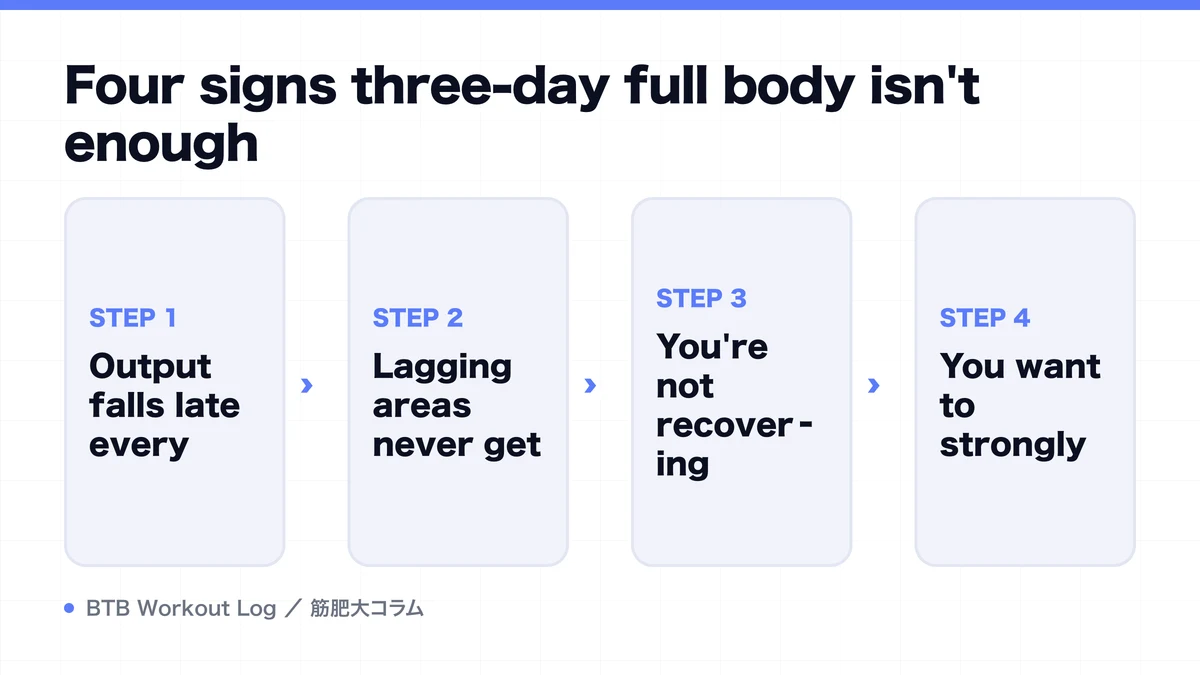
Four signs three-day full body isn't enough
Before the number of days becomes the constraint, the limit on how much fits into one session often arrives first. Any of the following persisting means it's time to revise the design.
- Output falls late every session: load, reps or range of motion won't stabilise on the later exercises. Trim exercises, or move the area you want to grow earlier on a rotating basis.
- Lagging areas never get direct stimulus: the main movements eat all the time, leaving side delts, arms or calves untouched for weeks. Cut a redundant overlapping exercise to make a short slot.
- You're not recovering by next time: not just soreness — reduced output on the same movement or lingering joint discomfort. Revisit fatigue sources like taking every set to failure or repeating the same heavy exercise every session.
- You want to strongly prioritise one area: if the goal is maximising one region — back or legs — rather than general development, the extra volume that area needs may not fit into the back half of three sessions.
Even if you can't add a day, that isn't reason to abandon full body immediately. Try rotating which day fronts the priority area, trimming exercises whose effects overlap, or pairing non-competing muscle groups in supersets first. If quality still doesn't recover, changing the split's arrangement while staying at three days is the next option.
Judge "was it enough" from four to six weeks of records
A programme's success isn't decided by one pump or next-day soreness. Log weekly hard sets per muscle group, load, reps and RIR on the main lifts, and exercise order first, then hold the broad structure for four to six weeks. Change everything weekly and you can't tell whether the three-day frame is the problem or the exercises and volume are.
Signs it's working
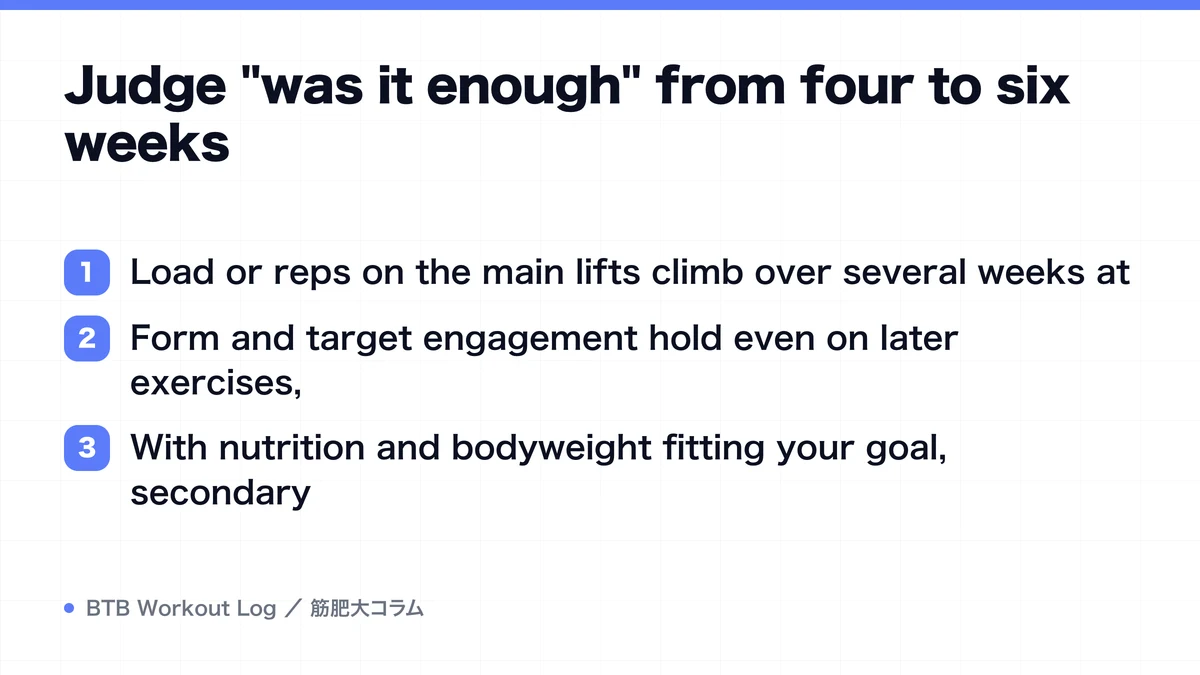
- Load or reps on the main lifts climb over several weeks at similar RIR and range of motion.
- Form and target engagement hold even on later exercises, and output returns by next time.
- With nutrition and bodyweight fitting your goal, secondary indicators like circumference or photos move the same direction over the long run.
Signs it needs adjusting
- Load and reps stall across several muscle groups while only RIR keeps getting harder to hit.
- Only the later exercises on a specific day keep declining, and it recovers when you reorder.
- Adding sets drops next-session output and it doesn't return for weeks.
If the stall is limited to one area, move it earlier or adjust its sets by one or two while holding everything else and observing. If fatigue is systemic, cut total volume or failure sets rather than adding anything. With progressive overload and recovery both running, three days a week isn't "too few" — it's a design that keeps the required stimulus sustainable.
What produces hypertrophy is the three sessions themselves; the log is there to tell you what to add and what fatigue to cut back next.
FAQ
- How many exercises should one three-day full-body session have?
- Don't decide purely by count. Build around a main leg pattern, a push and a pull, then fill in lagging areas. Starting with four to six main exercises plus a short accessory slot, and adjusting from late-session output and weekly sets, is easier to manage than cramming exercises in from the start.
- Can I run three days back to back?
- It can work, but full body at high effort three days running tends to erode output on the same movements. Insert rest days if you can; if you can't, vary exercises, rep ranges and which area you prioritise, and ease off volume on whatever muscle carries the most fatigue from the day before.
- Is three-day full body enough for an advanced lifter?
- It's an option if the goal is overall size. But advanced lifters typically need more volume for specific areas, and late-session quality or time tends to become the constraint. If a lagging area's numbers won't move, adjust exercise order, set distribution or the split.
Key takeaways
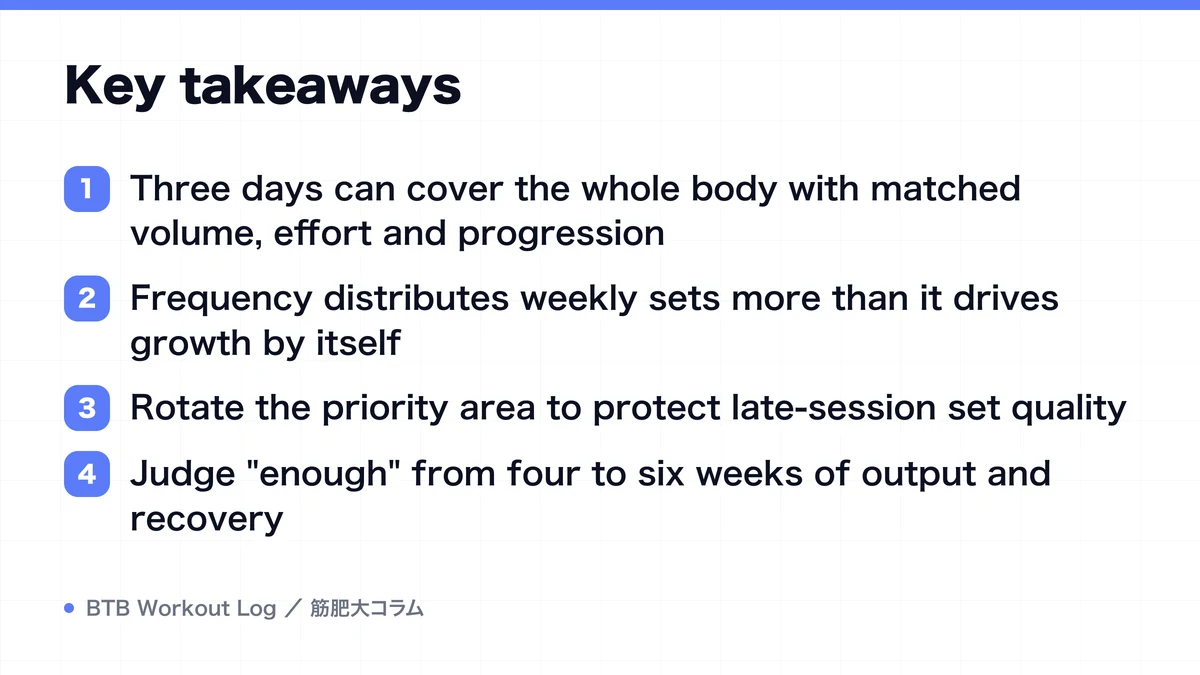
- Three days can cover the whole body with matched volume, effort and progression
- Frequency distributes weekly sets more than it drives growth by itself
- Rotate the priority area to protect late-session set quality
- Judge "enough" from four to six weeks of output and recovery
References
- Resistance Training Frequency and Muscle Hypertrophy: Systematic Review and Meta-analysis
- The Resistance Training Dose Response: Meta-Regressions Exploring the Effects of Weekly Volume and Frequency on Muscle Hypertrophy and Strength Gains
- Resistance Training Volume Enhances Muscle Hypertrophy in Trained Men
- Training to Repetition Failure or Non-failure: Systematic Review and Meta-analysis
- Proximity-to-Failure and Muscle Hypertrophy: Systematic Review with Meta-analysis