Does a 3-Rep Max Weight Also Build Hypertrophy? | What Weight Chasers Should Know About Efficiency
A weight you can only lift 3 times can still produce hypertrophy. Three reps of large force production can deliver sufficient stimulus, but since one set has few reps, the condition is that you make up weekly volume with multiple sets or moderate-rep sets.
What to test isn't just "does 3 reps still work" — it's also whether you need a genuine 3RM every set, and whether it's worth the time and fatigue as your main hypertrophy lift.
First, separate "can only do 3" from "stopping at 3"
3RM is a weight where you can complete 3 reps with matched form and range of motion, but not a 4th. If you fail on rep 3, that's RIR 0 — zero reps in reserve. Conversely, a set at a weight you could do 5 reps with, stopped at 3, is RIR 2 — the same 3 reps but not a genuine 3RM.
Blurring this distinction means "performed 3 reps of heavy weight" as a record tells you nothing about stimulus or fatigue. A 3-rep warm-up, a working set finished at RIR 2, and a 3RM test are all different things. What we're checking here is whether 3RM-level external load can be used for hypertrophy — not whether doing a single set of 3 reps is sufficient on its own.
The broader load-band comparison is covered in choosing between heavy and high-rep work. Here, we look more narrowly at the conditions for pushing to the low-rep end near 3 reps specifically.
Why heavy triples can produce stimulus, and what research actually shows
Heavy load demands large force from the very first rep. If the target muscle can produce force through sufficient muscle length and range of motion, even a short 3-rep set can place high tension on the fibers. Having fewer reps isn't itself a reason stimulus drops to zero.
Schoenfeld et al.'s 2017 meta-analysis, pooling low- and high-load conditions taken to failure, found hypertrophy roughly comparable while maximal strength favored high load. But "high load" in that analysis is a broad band — anything above 60% 1RM. It supports that heavy load can still produce hypertrophy, but it isn't research showing that 3RM specifically is optimal. Room should remain when applying it to the narrow condition of 3RM specifically.
ACSM's position stand also allows 1–12RM to be cycled for intermediate-and-above lifters, while emphasizing 6–12RM and recommending multiple sets at high volume for hypertrophy. In other words, 3RM isn't a banned move outside the effective range, but it isn't the standard main battleground for hypertrophy either. In practice, it's reasonable to place it as a low-rep slot within your rep range.
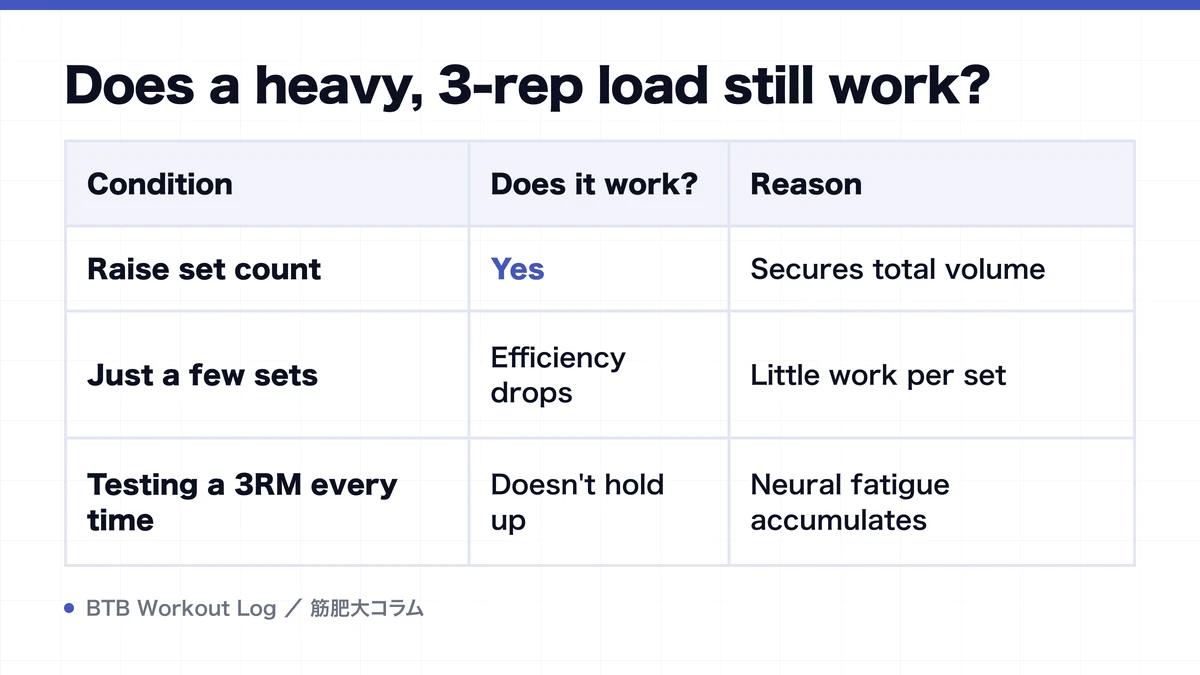
Connect stimulus to weekly volume rather than repeating a true 3RM
A true 3RM hits RIR 0 on rep 3, making every set a failure set. But meta-analyses comparing failure and non-failure conditions haven't shown reaching failure every time to be necessary for hypertrophy or strength gains. If you're using 3-rep working sets on an ongoing basis, leaving 1–2 reps of reserve makes it easier to hold form and next-set output consistent. Strictly speaking, that's no longer a true 3RM — it's "a heavy set of 3 at RIR 1–2."
The other issue is volume. Even 3 sets of 3 reps totals only 9 reps — fewer repetition opportunities than, say, 3 sets of 8 on the same exercise. Weight times reps can't fully compare stimulus across different load bands, but it's also premature to assume that a couple of low-rep sets alone replace your usual hypertrophy-focused weekly volume. Either place moderate-rep back-off sets alongside the heavy work, or secure volume on a separate day within the week.
Heavy load also needs more time to recover between sets. If short rest lowers next-set reps or range of motion, you lose the benefit of choosing heavy weight in the first place. Start from 3–5 minutes and adjust to whatever length lets you reproduce the same technique and RIR on the next set. It helps to log training volume and rest between sets as separate items.
Conditions where heavy triples fit well, and conditions where you'd rather skip them
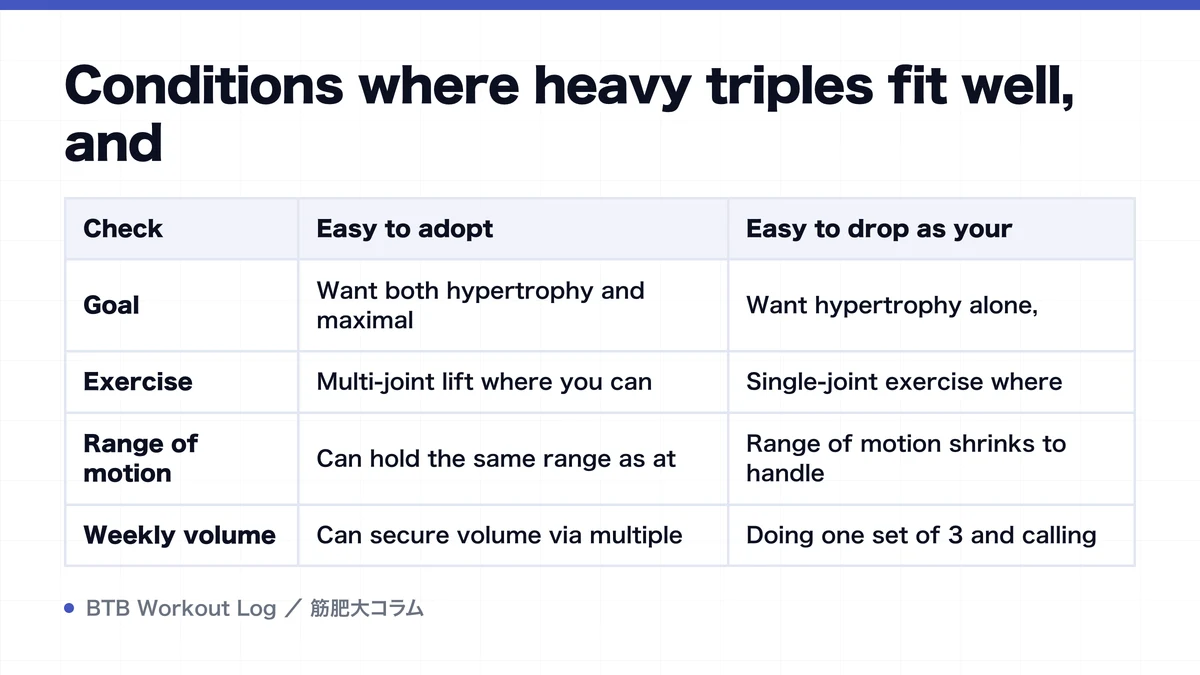
The value of a 3-rep set isn't decided by physiology alone — whether hypertrophy is possible — it's decided by whether you can reproduce stimulus on that specific exercise.
| Check | Easy to adopt | Easy to drop as your main lift |
|---|---|---|
| Goal | Want both hypertrophy and maximal strength | Want hypertrophy alone, efficiently, in less time |
| Exercise | Multi-joint lift where you can hold path and posture even heavy | Single-joint exercise where success hinges on momentum or assisting muscles |
| Range of motion | Can hold the same range as at moderate reps | Range of motion shrinks to handle the weight |
| Weekly volume | Can secure volume via multiple sets or a different rep range | Doing one set of 3 and calling the target muscle done |
| Recovery | Later sets and next-time output hold | Joint discomfort or technical decline keeps recurring |
On exercises like bench press or squat, where you can hold the whole body stable, low-rep practice also feeds maximal strength gains. But aiming for a 3RM on lateral raises or curls tends to let posture or momentum, rather than the target muscle, become the ending reason, making hypertrophy progress hard to read. Machines can be candidates too if they let you fix movement conditions at heavy load, but "it's a machine" alone doesn't guarantee safety.
There's also no reason to stubbornly insist on 3 reps through pain. Heavy load isn't a required qualification test for hypertrophy — it's a tool to choose when it fits your goal and exercise.
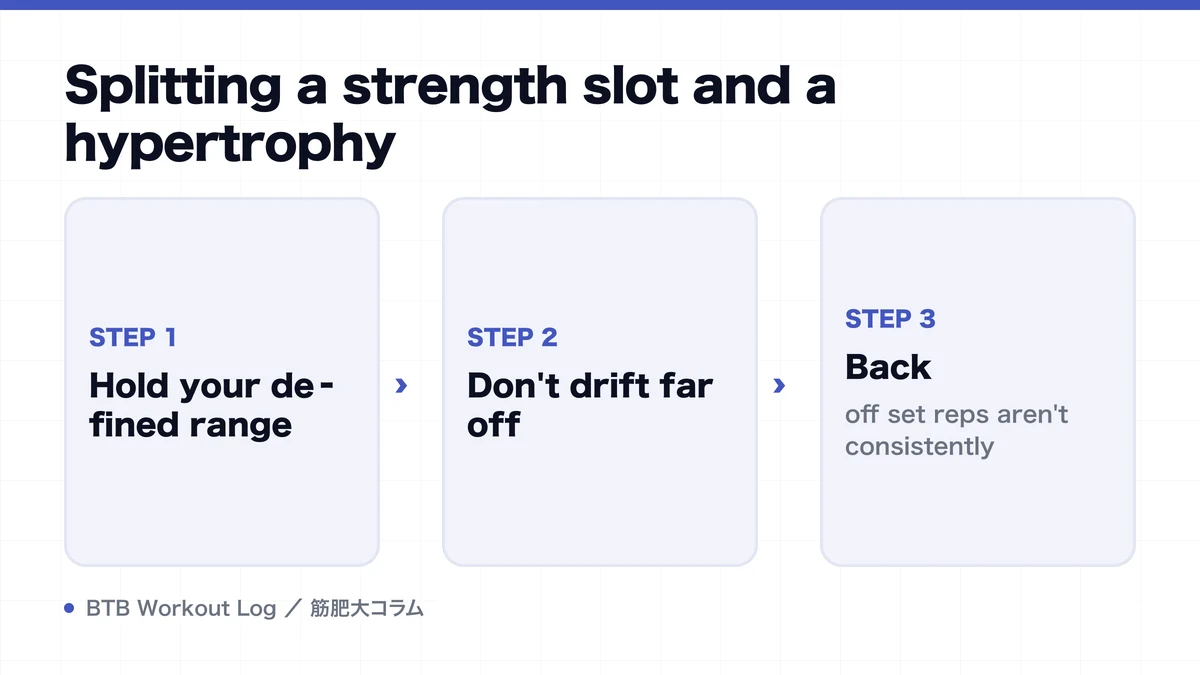
Splitting a strength slot and a hypertrophy slot makes it easier to run
If you want both hypertrophy and heavy-load familiarity, split roles within the same session. For example, start with 2–4 sets of heavy triples at RIR 1–2, then drop weight for 2–4 back-off sets of 6–10 reps. This is a starting suggestion, not a fixed prescription required on every exercise. Redistribute your current weekly set count between the heavy slot and the moderate-rep slot rather than substantially raising it.
Decide your weight-increase condition first
- Hold your defined range of motion and 3 reps on every heavy set.
- Don't drift far off your target RIR through the last set.
- Back-off set reps aren't consistently declining.
Raising weight purely from "I could do 3" alone risks mistaking a shortened range of motion or drifting toward RIR 0 for progress. Only once weight, reps, RIR and range of motion are matched under the same conditions can you compare it as genuine progressive overload. If you're not used to estimating RIR, practice using RIR at low-to-moderate weight first before bringing it into your heavy slot.
If hypertrophy is your only goal and 3-rep sets need long rest that keeps you from completing your planned weekly volume, reverting to roughly 5–10 reps isn't a step backward. Choosing a rep range that lets you deliver repeatable stimulus to the target muscle in fewer sets and less time is the more reasonable choice.
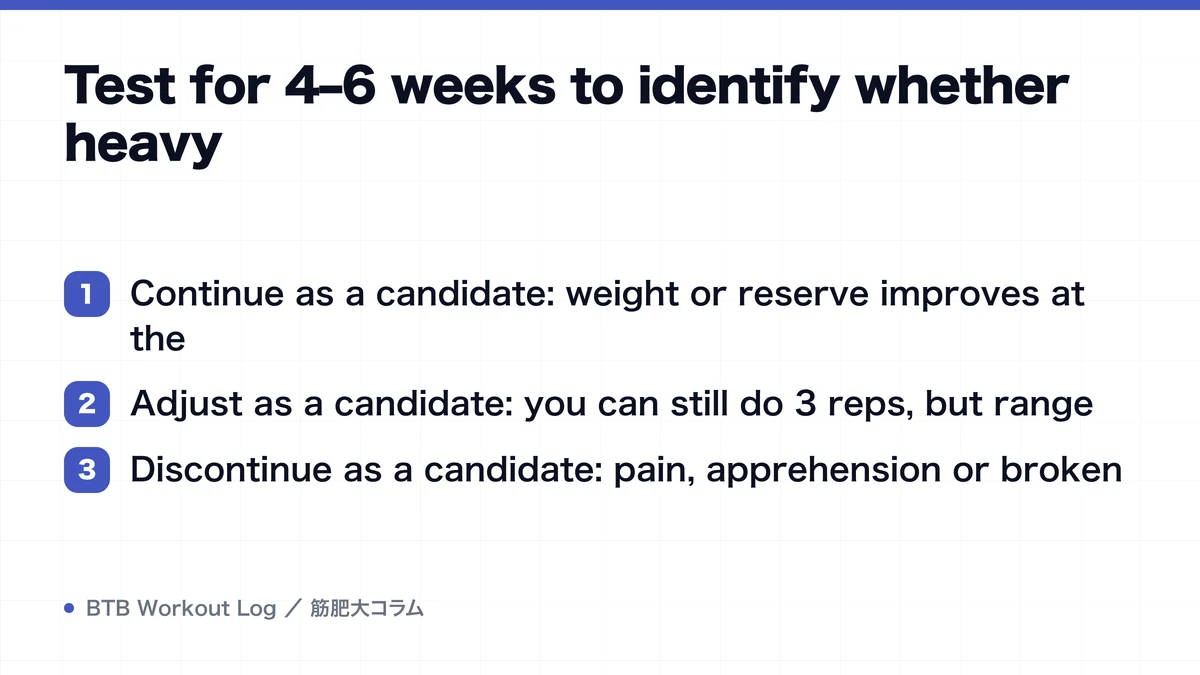
Test for 4–6 weeks to identify whether heavy load "works" for you
Whether a 3-rep set fits you can't be judged from one success or one strong bout of fatigue. Pick one exercise suited to heavy load and trial it for 4–6 weeks without substantially changing frequency, back-off sets, diet or sleep. Log, every time: the heavy set's weight, reps and RIR, range of motion, rest time, output on later sets, and joint status.
- Continue as a candidate: weight or reserve improves at the same movement, and back-off sets plus next-time output hold too.
- Adjust as a candidate: you can still do 3 reps, but range of motion is shrinking and later-set volume or next-time output keeps declining.
- Discontinue as a candidate: pain, apprehension or broken form recurs and doesn't resolve even after lowering load.
A short-term weight increase includes technical adaptation too, so it isn't standalone proof muscle grew. Even so, whether you can raise matched-condition output while maintaining your needed weekly volume for hypertrophy is material for deciding whether to keep the 3-rep slot. Over the long term, also use measurements or photos under matched conditions as supporting evidence.
Hypertrophy is possible even at 3RM level, but the condition for adopting it isn't "you could lift something heavy" — it's that you could repeat both stimulus to the target muscle and your weekly volume.
FAQ
- Should every 3-rep set be pushed all the way to a true 3RM?
- Reaching a true 3RM every time isn't necessary. For ongoing working sets, a weight you can finish 3 reps with at RIR 1–2 makes it easier to keep form and next-set output consistent. Treat a genuine 3RM as a separate, occasional test.
- How many sets of 3 reps are enough for hypertrophy purposes?
- There's no universal set count. It depends on your current weekly volume, that exercise's contribution to the target muscle, and later-set quality. Rather than trying to hit your full volume with 3-rep sets alone, adjust across the whole week using moderate-rep back-offs or sets on a separate day.
- Can heavy triples be used on single-joint exercises too?
- It's not impossible, but momentum, a shortened range of motion, and joint discomfort tend to end the set, making it a hard rep range to build your main lifts around. Including machines that let you fix the path even at heavy load, prioritize whether the target muscle can reproduce the movement.
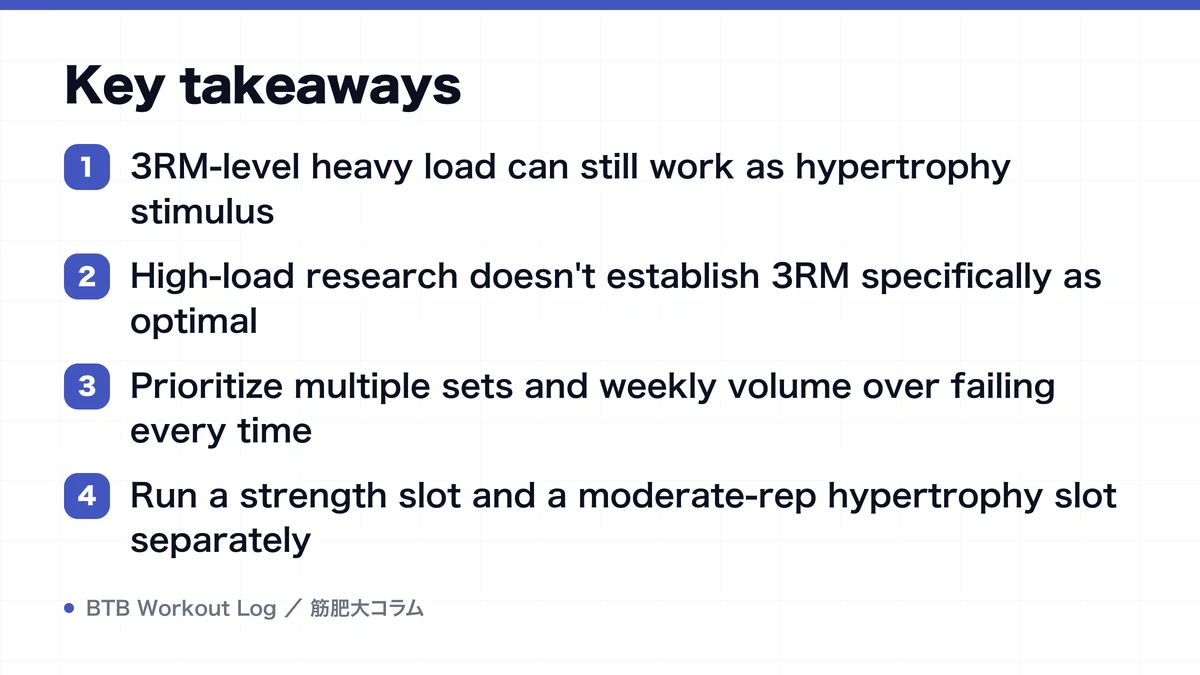
Key takeaways
- 3RM-level heavy load can still work as hypertrophy stimulus
- High-load research doesn't establish 3RM specifically as optimal
- Prioritize multiple sets and weekly volume over failing every time
- Run a strength slot and a moderate-rep hypertrophy slot separately