A Stalled Lift Doesn't Mean No Hypertrophy | Why You Don't Need to Panic When the Numbers Stop
Weight used not rising alone doesn't establish that hypertrophy has stopped. Strength is affected not just by muscle mass but by motor skill, neural adaptation, fatigue, and the rep range being measured.
That said, a weight plateau shouldn't be ignored either. You need to separate whether reps and reserve are also stalled under the same conditions.
How far does the weight-hypertrophy link actually hold?
This belief spreads for real reasons. Muscle cross-sectional area is one foundation for force production, and raising muscle mass long-term likely raises the ceiling on force you can produce too. If the weight you can handle at the same exercise, range of motion and form has risen over several months, that's a practical clue that training is producing some adaptation.
Especially early in training, motor learning and strength gains happen fast, and muscle-mass change tends to occur alongside them, so it's easy to have the experience "the more plates go up, the more my body changes." Weight is also a clear number, easier to check daily than a mirror or a measurement.
Up to here, it's reasonable. The misconception starts once you treat strength as muscle mass itself and declare a period where weight isn't moving as zero hypertrophy. Weight is a useful proxy, but it isn't a direct measurement of hypertrophy.
The weight you lift isn't decided by muscle mass alone
How much you can lift on a given exercise is the sum of several factors. Weight can rise from better movement even with mass unchanged, and it can also fail to show up in the number even with mass rising, if you haven't practiced producing that force in the specific movement.
- Motor skill: as path, turnaround, bracing and joint coordination tighten up, the same mass becomes easier to lift.
- Load specificity: practicing heavy load builds familiarity producing force near your 1RM; training centered on high reps can translate less of the same mass into 1RM.
- That day's fatigue and readiness: fatigue carried from before, sleep, exercise order and rest all shift achievable weight.
- Measurement conditions: change range of motion, tempo, equipment, grip or form, and even the same weight represents a different level of difficulty.
So a 1RM or top-set weight is a composite performance metric that includes muscle mass — it isn't "muscle size" itself. It runs the other way too: since technique alone can raise weight, you also can't declare "got stronger = grew by that much."
Research examples where strength and hypertrophy move separately
Schoenfeld et al.'s 2017 meta-analysis, comparing low- and high-load training, found hypertrophy comparable between load conditions while 1RM strength gains favored high load. Generally, comparable muscle adaptation doesn't guarantee an equal change in maximal strength (see choosing between heavy and high-rep work).
That doesn't mean "moving light weight casually gives the same result," though. The comparisons included in the meta-analysis had sets taken to momentary strength failure as a condition. In practice you don't necessarily need to go to failure every time, but the lighter the load, the more you drift from the study conditions without securing sufficient effort.
Moesgaard et al.'s 2022 meta-analysis also found, in comparisons matched for training volume, that periodized programs favored 1RM strength over non-periodized ones, while showing no clear difference in hypertrophy. Generally, changes in maximal strength and changes in muscle mass can fail to align.
These are group averages, not evidence that can confirm or deny an individual's hypertrophy from weight alone. What they show is a boundary: strength and hypertrophy relate, but they aren't the same adaptation.
Progress can occur even without adding a plate
Progressive overload doesn't only mean adding a plate every time. Even at the same set weight, under matched comparison conditions, the following changes suggest your capability or training stimulus is still advancing.
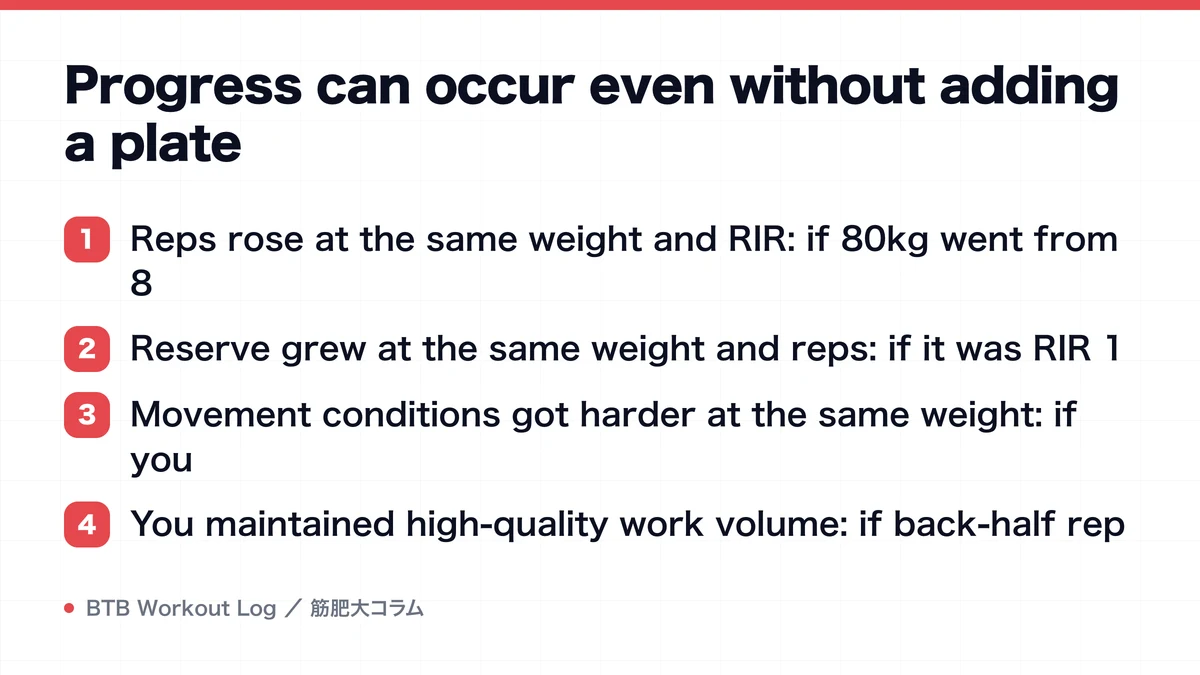
- Reps rose at the same weight and RIR: if 80kg went from 8 to 10 reps, repeated-effort capacity has grown even at the same plate weight.
- Reserve grew at the same weight and reps: if it was RIR 1 before and is RIR 3 now, you're completing the same work with more room. RIR is a self-estimate of how many more reps were possible (see how to use RIR).
- Movement conditions got harder at the same weight: if you widened range of motion, reduced momentum, and held reps while keeping load on the target muscle group, the challenge has effectively gotten harder.
- You maintained high-quality work volume: if back-half rep decline shrank, or you added valid sets within what's recoverable, weekly stimulus has changed.
Conversely, if reps rose because you shortened range of motion, added momentum, or extended rest, capability gain and condition changes are mixed together. To treat a rep increase as progress, you need to match form, range of motion, rest and RIR as closely as possible first.
The combination of records for judging a hypertrophy stall
Hypertrophy progress isn't judged from one number — layer indicators that play different roles. Rather than a single good or bad day, watching the trend across several sessions on the same exercise, or across a whole training block, reduces noise.
First fix training conditions
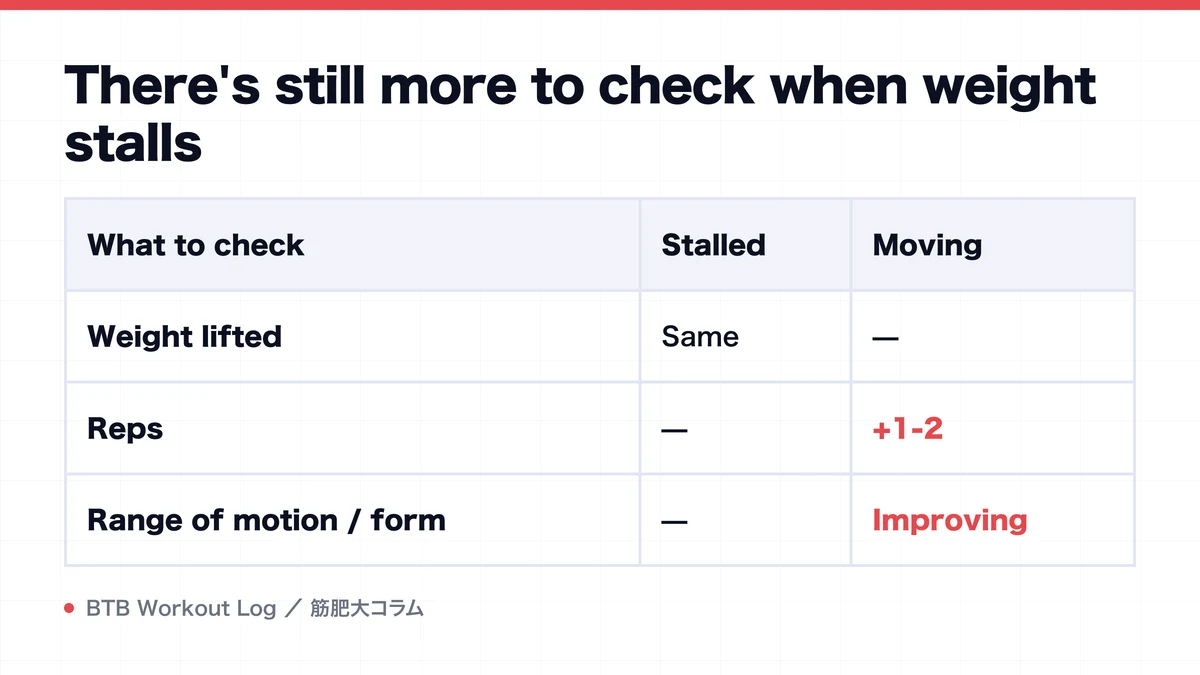
Match not just exercise name but equipment, seat position, grip, range of motion, tempo, exercise order and rest between sets. Then compare weight × reps and RIR together as a set. If reps or reserve are rising at the same weight, don't immediately call it a stall. Conversely, if only weight rose while reps crashed and form changed, that's not necessarily hypertrophy-relevant progress.
Next, watch weekly stimulus and recovery
Check the target muscle group's weekly hard sets, each set's RIR, frequency, and how much later sets decline. If performance suddenly drops across several exercises alongside poor fatigue and sleep, suspect insufficient recovery before insufficient stimulus. If needed, reassess under matched conditions after a deload to separate apparent stalling caused by fatigue.
Use body-side indicators as supporting lines
Weekly average body weight, measurements taken under matched conditions, and photos with the same lighting and posture all help. But body weight moves with water and gut contents, and measurements move with position and pump. Don't treat a small short-term difference as a confirmed muscle-mass change — watch whether the trend continues in the same direction as your training records.
Don't judge from weight alone — use records of reps and volume trend under matched conditions as material. Even when weight has stalled, reps or range of motion may still be improving. BTB Workout Log can serve as the log you use to catch that.
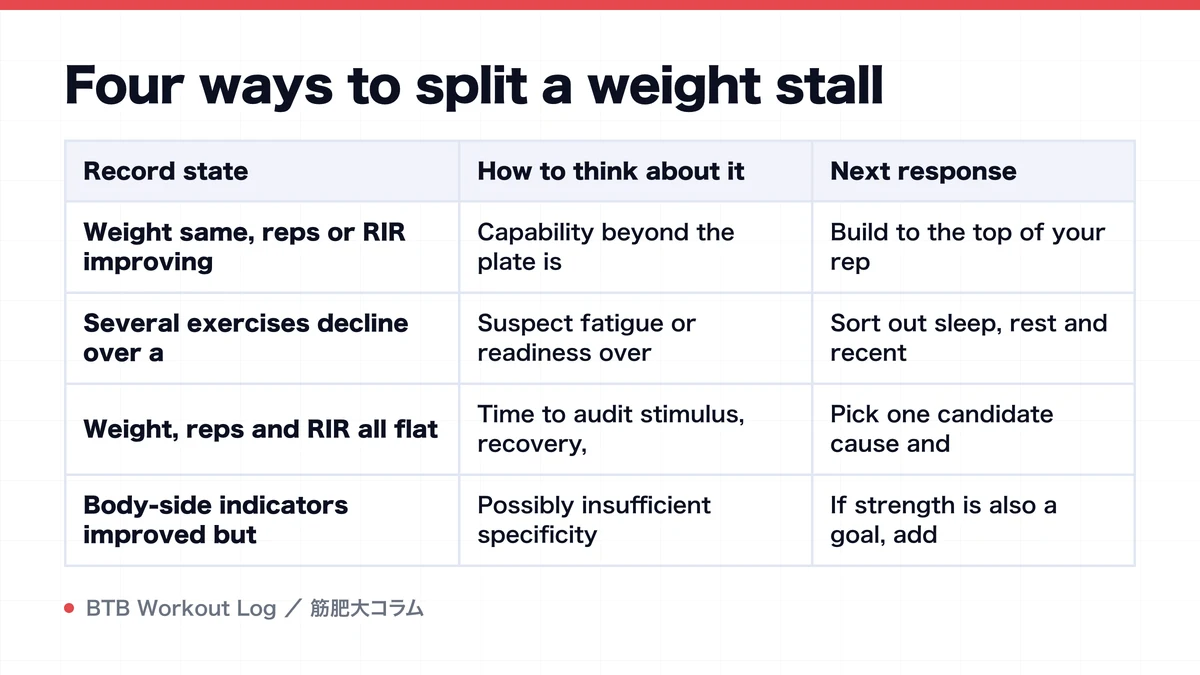
Four ways to split a weight stall
| Record state | How to think about it | Next response |
|---|---|---|
| Weight same, reps or RIR improving | Capability beyond the plate is progressing | Build to the top of your rep range, then add a small increment |
| Several exercises decline over a short period | Suspect fatigue or readiness over muscle mass | Sort out sleep, rest and recent load, then remeasure |
| Weight, reps and RIR all flat across one whole block | Time to audit stimulus, recovery, or nutrition | Pick one candidate cause and adjust a single variable, like set count |
| Body-side indicators improved but 1RM is flat | Possibly insufficient specificity to maximal strength | If strength is also a goal, add some low-rep, heavy-load practice |
What to avoid most is changing exercise, set count, frequency and diet all at once just because weight stalled once. That makes it impossible to tell what worked, and risks losing accumulated skill too. Match conditions and check the trend, and only move the variable tied to the cause once things beyond weight have stalled too.
Weight used matters, but it's only part of the picture. Rather than "weight not progressing = no hypertrophy," watching how weight, reps, RIR, movement conditions, weekly stimulus, recovery and body-side changes all move together lets you separate a stall worth waiting out from one that needs a fix.
FAQ
- How many weeks of no weight progress should I consider a hypertrophy stall?
- There's no universal number of weeks — intervals between increases naturally get longer past the intermediate level. Check whether reps also aren't rising at the same form, range of motion, rest and RIR, and whether that trend continues across several sessions or a whole block.
- If reps rise at the same weight, is that proof hypertrophy is happening?
- It doesn't directly prove hypertrophy, but a rep increase under matched conditions and RIR is a strong clue that repeated-effort capacity has risen. Judge together with body-weight or measurement trends, weekly set count, and recovery status.
- Should I regularly test 1RM even for hypertrophy purposes?
- Not required. A 1RM test is heavily affected by familiarity with maximal effort and fatigue. It's easier to continuously track hypertrophy-training progress by watching weight, reps and RIR under matched conditions within your normal rep range.
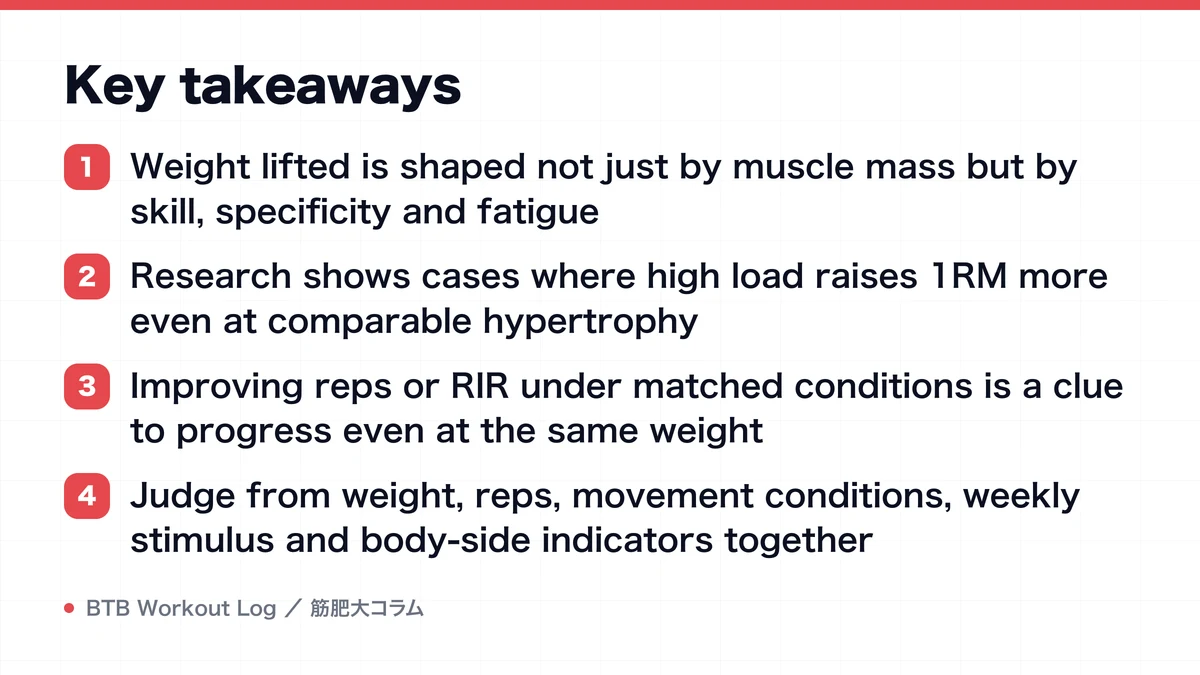
Key takeaways
- Weight lifted is shaped not just by muscle mass but by skill, specificity and fatigue
- Research shows cases where high load raises 1RM more even at comparable hypertrophy
- Improving reps or RIR under matched conditions is a clue to progress even at the same weight
- Judge from weight, reps, movement conditions, weekly stimulus and body-side indicators together