Hypertrophy Takes More Than Heavier Weights: The Pitfalls of Chasing Load
Rising load is an important marker of progress, but on its own it can't confirm sufficient stimulus for hypertrophy. At the same weight, reps, proximity to failure, range of motion, form and weekly sets all change what the muscle actually receives.
What matters isn't the number on the plates alone — it's whether, under matched conditions, you made the target muscle do more work and kept accumulating that stimulus within what you can recover from.
The gap in "heavier means more muscle"
Load lifted is legible and easy to log. Handle more than last month under matched conditions and strength or motor adaptation has probably improved — so chasing load isn't wrong in itself. The problem is treating the fact that load rose as proof stimulus to the target rose too.
Add 5 kg to your bench but stop touching your chest, let your hips float, add momentum or take longer between sets, and that isn't progress under matched conditions. Lifting more through a technical shortcut can be useful for a lifting competition without your pecs having done any more work than before. Conversely, hold the same weight but do more reps at the same form, or hold a wider range of motion, and you may well be progressing.
Progressive overload isn't "add a plate every session" — it's raising the demand on the body over time. Load is one lever for that demand, not the only score that counts.
External load and stimulus to the muscle aren't the same thing
The weight on a bar is external load; force actually produced by the muscle also depends on joint angle, moment arm, movement speed and how much assisting muscles contribute. The same 50 kg on different exercises isn't comparable stress on the target. Change range of motion or form on the same exercise and where load lands, and how the muscle gets used, both shift.
For hypertrophy, what matters is putting enough tension on the target and keeping fibres recruited into the back end of the set. That's where RIR — reps in reserve, how many you had left — earns its keep. A set of 5 at 100 kg with 5 in reserve and a set of 10 at 80 kg with 1 in reserve can't be ranked by load alone: the first produces high force with plenty of margin, the second is lighter but pushed close to failure. See managing intensity by reserve for the fuller picture.
Meta-analyses comparing low and high load report that with effort matched, hypertrophy can occur across a wide load range, while maximal strength tends to favour heavier loads. In other words, heavier load is a strong tool for hypertrophy — it isn't a simple "heavier means more stimulus" proportionality. See choosing between heavy and light for how to weigh that.
Hypertrophy progress doesn't fit into one number
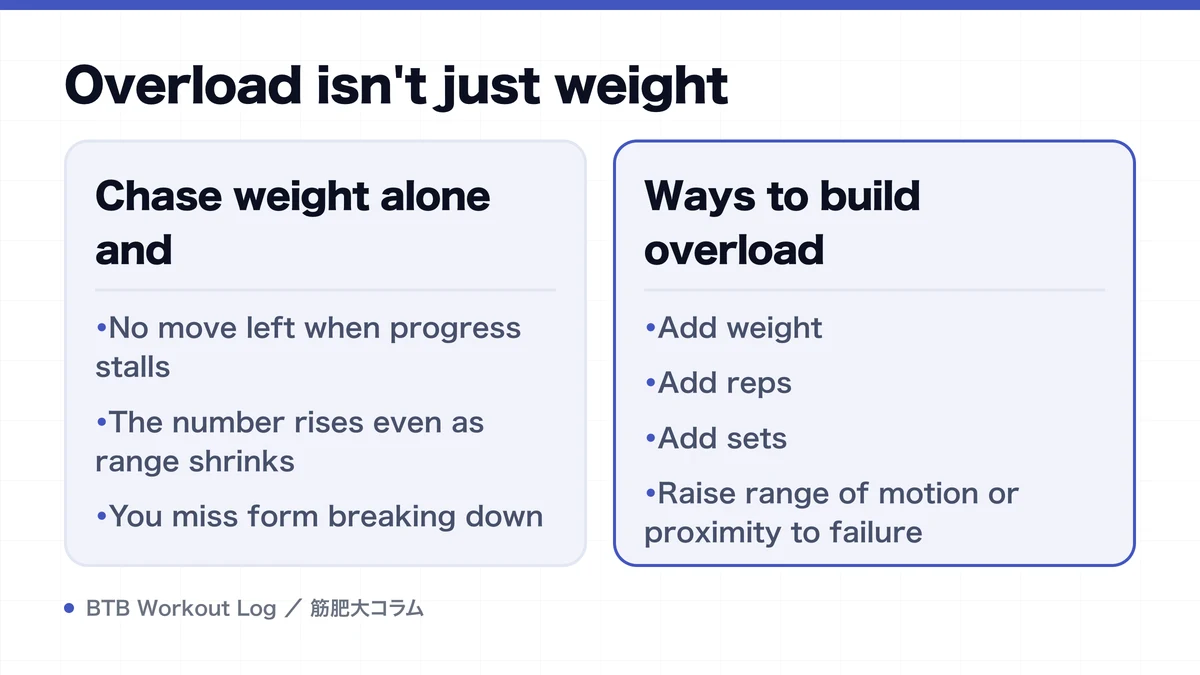
Watching numbers besides load isn't about hunting for a flattering metric — it's about telling what you held constant apart from what improved. Each of these answers a different question.
| Metric | What it tells you | What to match to compare it |
|---|---|---|
| Load and reps | Performance produced on that exercise | Form, range of motion, RIR |
| RIR | How close the set actually got to failure | Load, reps, exercise order |
| Range of motion and form | Whether the target faced the same demand | Tempo, momentum, equipment settings |
| Weekly hard sets | A rough gauge of stimulus banked for the muscle group | RIR, exercise selection, recovery state |
| Recovery and pain | Whether you're ready for the next stimulus | Sleep, food, frequency |
Go from 8 to 9 reps at 80 kg and performance improved at the same load. But if only that ninth rep used a shortened range of motion, it's hard to count as progress under matched conditions. Staying at 8 reps for 80 kg while RIR moves from 1 to 3 can mean that load has become easier — next time you might add a rep, or add load within what form allows. See deciding load from reps for more on that relationship.
Racing load alone breaks the comparison
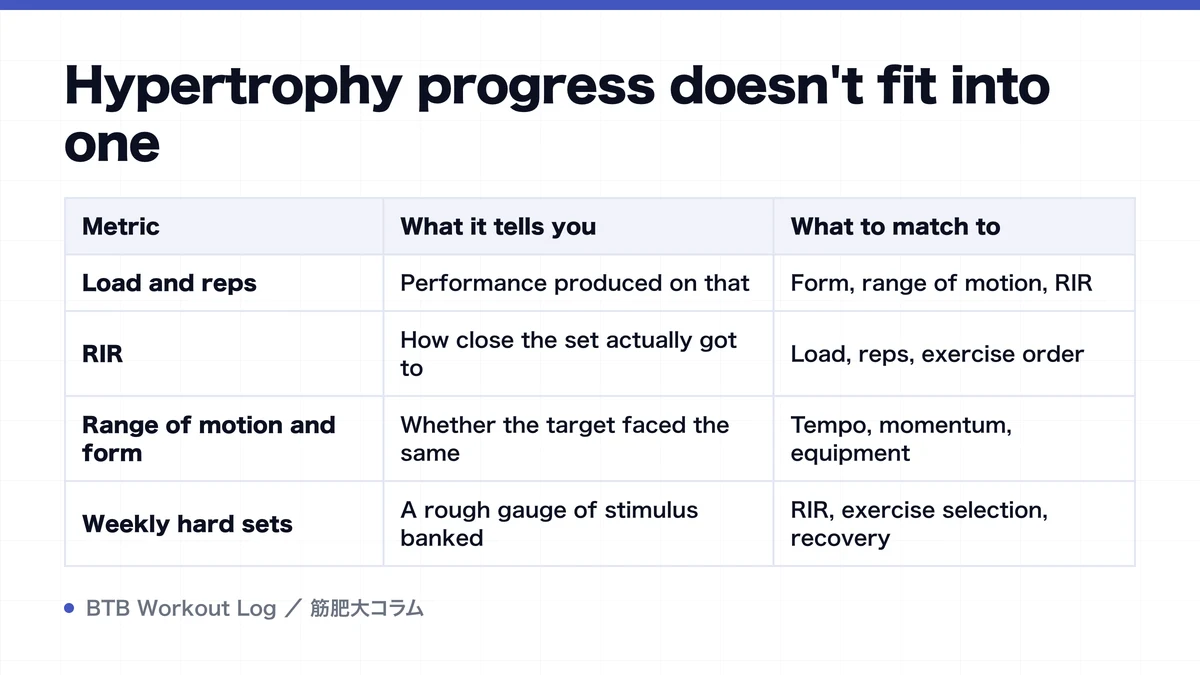
Make a new load your target every session and the body finds efficient ways to hit it: more momentum, a shorter range of motion, offloading onto a stronger assisting muscle. That's not weak willpower — it's a normal motor strategy — but for judging hypertrophy it wrecks the comparison.
The other trap is reps or total sets collapsing to buy the heavier load. Force a jump from a weight where you managed 3×10 and finish at 4, 3, 2 reps and the target muscle gets far fewer useful reps. Using a heavier range isn't the problem; whether you can still sustain the volume the goal actually needs is. A simple "load × reps × sets" figure can't fully capture weekly stimulus, but you should still confirm you're banking recoverable hard sets — that leads into managing volume.
Holding load steady isn't automatically correct either. The same load, reps and RIR for weeks running can mean you've adapted and progress has actually stopped. The question isn't "never raise load" — it's are you at the point where raising load still lets you hold comparable form and the volume you need.
Raise load once the conditions are met
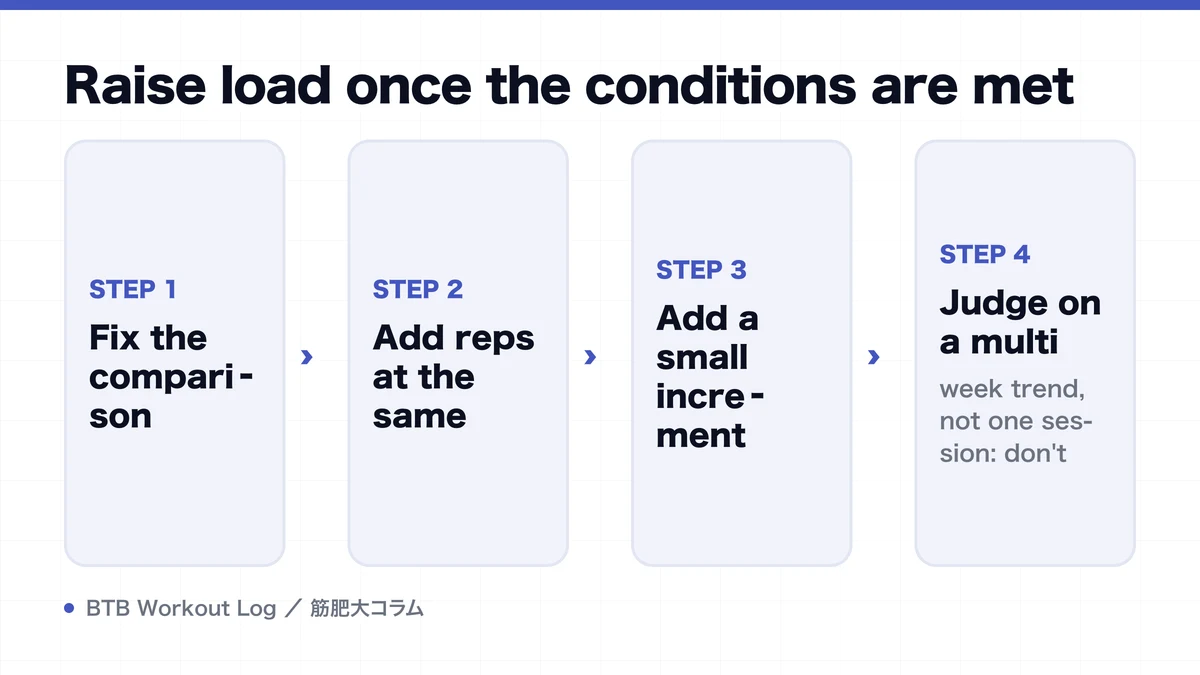
Double progression — moving load, reps and RIR together — is a manageable method in practice. Set a rep range and target RIR per exercise, then decide in this order.
- Fix the comparison conditions: equipment settings, range of motion, form, rest between sets and exercise order as matched as you can.
- Add reps at the same load: without missing your target RIR, watch whether each set approaches the top of the rep range.
- Add a small increment once you hold the top reliably: pick an increase that still leaves you inside the range's bottom and holding form after the raise.
- Judge on a multi-week trend, not one session: don't mistake day-to-day noise from sleep or exercise order for a plateau.
Targeting 8–12 reps at RIR 1–3, for example, try the next load once every set gets close to 12 with form held. Dropping back to around 8 reps after the increase is expected. If you fall below the range's bottom or lose form even at RIR 0, the jump was too big — accumulate more reps at the old load, or use smaller plates.
If nothing moves for several weeks, you don't have to force load up regardless. Separate whether weekly sets are too low, or high enough that fatigue lingers, whether rest is too short and late sets suffer, and whether bodyweight, food and sleep are holding steady. Addressing a load plateau belongs with programme strategies for breaking a plateau.
Log the conditions the comparison needs, not just the load
A log with only load in it can't tell you why numbers stalled or why they rose. At minimum, record load and reps per set, and add a short note on RIR or form changes for key exercises. Add weekly sets per muscle group and you can separate one exercise's load PR from the stimulus the whole programme actually banked.
Judge on whether load or reps trended up over several weeks under matched conditions, whether you're holding your target RIR, and whether you're sustaining weekly hard sets while still recovering — not on "how many kilos this week". Keep load central to that judgement without using it alone, and you avoid both forced increases and false plateaus.
Training is what produces hypertrophy. A log kept in comparable form is what tells you whether it's time to raise the load.
Sometimes "how many reps you did" shows more than "how many kg you lifted"
Weight shows the load applied from the outside; reps show how many times you have the capacity to repeat that load. Even at the same 80kg, a day you stopped at 6 reps and a day you managed 9 differ in both the amount of work the muscle produced and how close you came to failure. Look only at the weight column and none of that difference is left.
Reps have another practical advantage. Plates only move in 2.5kg steps, but reps move one at a time. Even in a phase where it is too early to raise the weight, if you gain one rep at the same weight, the same RIR, and the same range of motion, you can record that as progress. The finer the increments in which you can confirm you are moving forward, the harder it is to mistake it for a plateau.
The condition for not misreading this is to match weight, RIR, range of motion, and rest when you compare. A rep gained by extending your rest, or by cutting your range of motion, is a change in conditions rather than capacity. As a rough guide, once you can hit the top of your target rep range on several sets, raise the weight by the smallest step and go back to the bottom of the range.
FAQ
- If load is rising, can I assume hypertrophy is on track?
- If it's rising at the same exercise, range of motion, form and RIR, that's a strong signal. But load can also rise from motor learning, added momentum or a shortened range of motion. Check reps, weekly sets and how the target is actually being loaded, and judge on the long-term trend.
- If load stalls for a while, does that mean hypertrophy has stopped?
- Not necessarily. More reps at the same load, finishing the same reps with more in reserve, or steadier range of motion and form all count as progress. But if every indicator stays flat for weeks, revisit volume, fatigue, nutrition and sleep.
- When is the right time to add load?
- A good marker is hitting the top of your chosen rep range at your target RIR and matched form across several sets. Keep the increase small enough to still hold the range's bottom afterward, and revert if reps drop sharply or form breaks down.
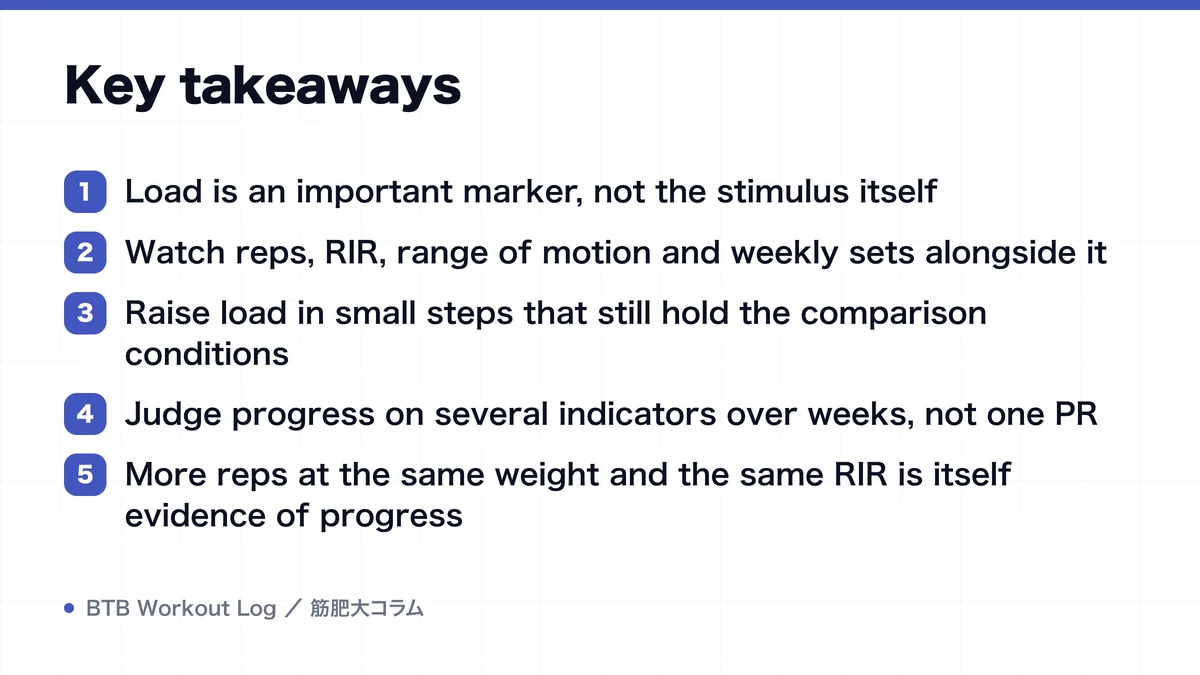
Key takeaways
- Load is an important marker, not the stimulus itself
- Watch reps, RIR, range of motion and weekly sets alongside it
- Raise load in small steps that still hold the comparison conditions
- Judge progress on several indicators over weeks, not one PR
- More reps at the same weight and the same RIR is itself evidence of progress
References
- Low- vs High-load Resistance Training for Strength and Hypertrophy: Meta-analysis
- Resistance Exercise Load Does Not Determine Training-mediated Hypertrophic Gains in Young Men
- Proximity-to-Failure and Muscle Hypertrophy: Systematic Review with Meta-analysis
- Repetitions in Reserve Is a Reliable Tool for Prescribing Resistance Training Load
- ACSM Position Stand: Progression Models in Resistance Training for Healthy Adults
- Dose-response Relationship Between Weekly Resistance Training Volume and Muscle Mass