
Too Many Exercises? Why Your Hard Work Isn't Showing Clear Progress
Run too many exercises and you rarely repeat the same movement under the same conditions — which makes it impossible to tell whether a change in load, reps or RIR came from getting stronger or from swapping the lift or its position in the session.
Variety isn't the problem. The problem is adding exercises without deciding what each one is for, and moving the yardstick you measure progress with at the same time.
The catch in "hit it from every angle to be safe"
For chest: flat, incline, decline, flyes, machine, dips. The longer the list, the more thoroughly covered it feels. And there's real value in picking movements your joints tolerate and combining different directions of force. But adding an exercise is not the same event as confirming progress.
Hypertrophy doesn't move fast enough to see day to day. So in practice you use a proxy: hold the same exercise, range of motion and form, and watch how the load or reps you can handle at a similar level of effort change over time. Swap the exercise every session and you've swapped the ruler every session too. "That felt good" and "that was a nice change" survive; "I'm more capable than I was" doesn't.
So the issue isn't that a long exercise list stops hypertrophy. It's that the resolution at which you can read what your programme did drops. Worth separating: are you genuinely broadening coverage, or scattering the evidence?
Progress is read as a like-for-like comparison with last time
Load going up isn't progress for hypertrophy if range of motion shortened, momentum crept in and you only got there by grinding to failure. Load staying the same while reps go up at the same form, same range of motion and similar RIR is a much stronger signal. RIR tells you how many reps you had left, which is what lets you hold effort roughly constant between sets (using RIR).
For that comparison to work you need a stretch where exercise, equipment, form, range of motion, order in the session and rep range stay reasonably still. Go barbell one week, dumbbell the next, machine after that, and the difference in the numbers contains motor learning, stability demands and the resistance profile of the equipment — not just strength. A new exercise where reps jump quickly usually reflects getting familiar with the movement, not muscle gained in a fortnight.
Progressive overload isn't adding weight every session. It's raising reps, load or set quality in steps under conditions you can hold constant. Without at least one exercise where the conditions are fixed, you can't tell whether overload advanced or the measurement conditions moved.
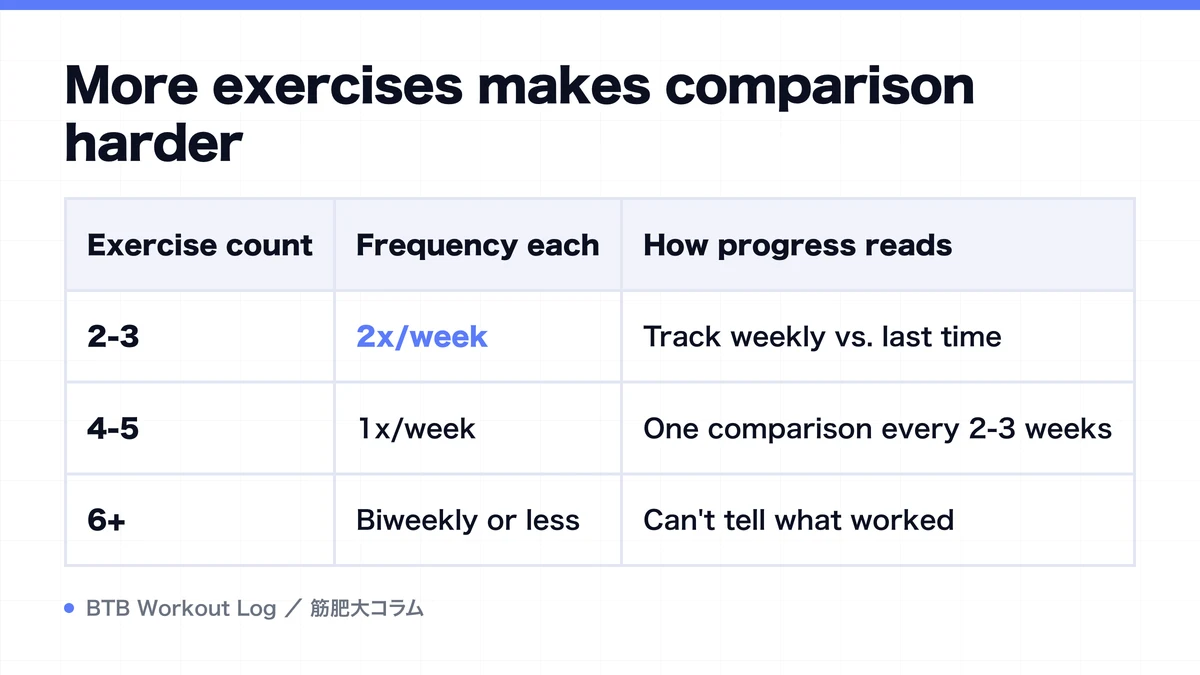
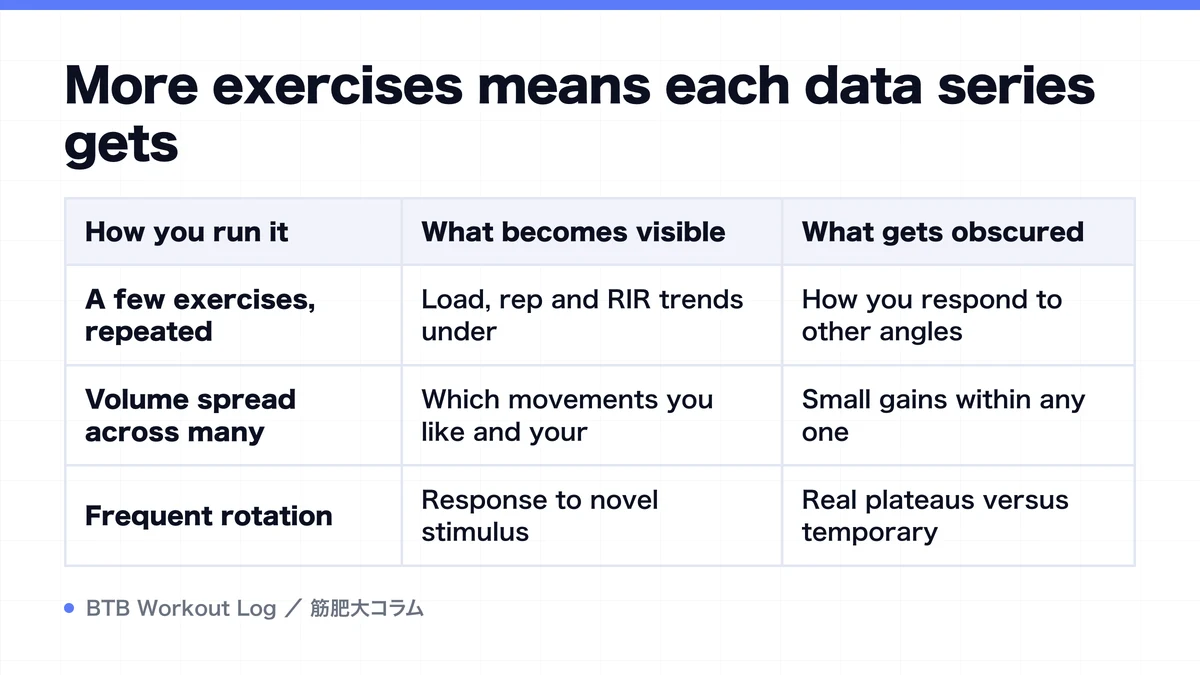
More exercises means each data series gets thinner
Split a muscle group's weekly volume across many exercises and each one yields fewer comparable sets. Rotate them week to week and the gap before you return to the same movement stretches out too. The further back the last data point, the more sleep, bodyweight, equipment and session order differ — and the easier it is to read normal noise as progress or a plateau.
| How you run it | What becomes visible | What gets obscured |
|---|---|---|
| A few exercises, repeated | Load, rep and RIR trends under fixed conditions | How you respond to other angles and equipment |
| Volume spread across many | Which movements you like and your joints tolerate | Small gains within any one exercise |
| Frequent rotation | Response to novel stimulus | Real plateaus versus temporary unfamiliarity |
Session order is another source of confusion. Add exercises and a press that used to go first ends up third. If reps drop there, your pressing capacity hasn't necessarily fallen — you may be measuring local fatigue from what came before. Change exercise count, order and set count together and there's no way to say which one moved the number.
The more lifts you watch, the easier it also becomes to cherry-pick the one that went up. A personal best on one of six means little if the other five declined under the same conditions. Deciding your anchor in advance keeps you from grading the programme on its most flattering entry.
Weekly volume itself is an important variable for hypertrophy (training volume). But two people with identical weekly sets per muscle group can have very different ability to read per-exercise progress. Keep the measure you use for total volume separate from the one you use to chase overload on individual lifts.
Keep the variety, cut the overlap in roles
Trimming exercises doesn't mean reducing everything to a handful of compounds. If you have a reason — you want a different direction of force, you want a muscle loaded at long lengths, you want direct work for a specific area, a movement doesn't agree with a joint — then multiple exercises each have a job. The problem is stacking near-identical lifts "just in case".
When you tidy up, give each muscle group an anchor exercise you track progress on, and arrange accessories with distinct roles around it. For chest that might be a horizontal press as the reference, supported as needed by a different press angle and a fly variation. What stays depends on your whole programme design; there's no exercise count that's right for everyone.
For anything you're thinking of adding, ask what it covers that existing lifts don't. If the answer overlaps, it drops down the list. And if you rotate accessories without touching the anchor, you keep a shared yardstick across programme changes. Variety and measurability aren't a trade-off once you separate the fixed part from the variable part.
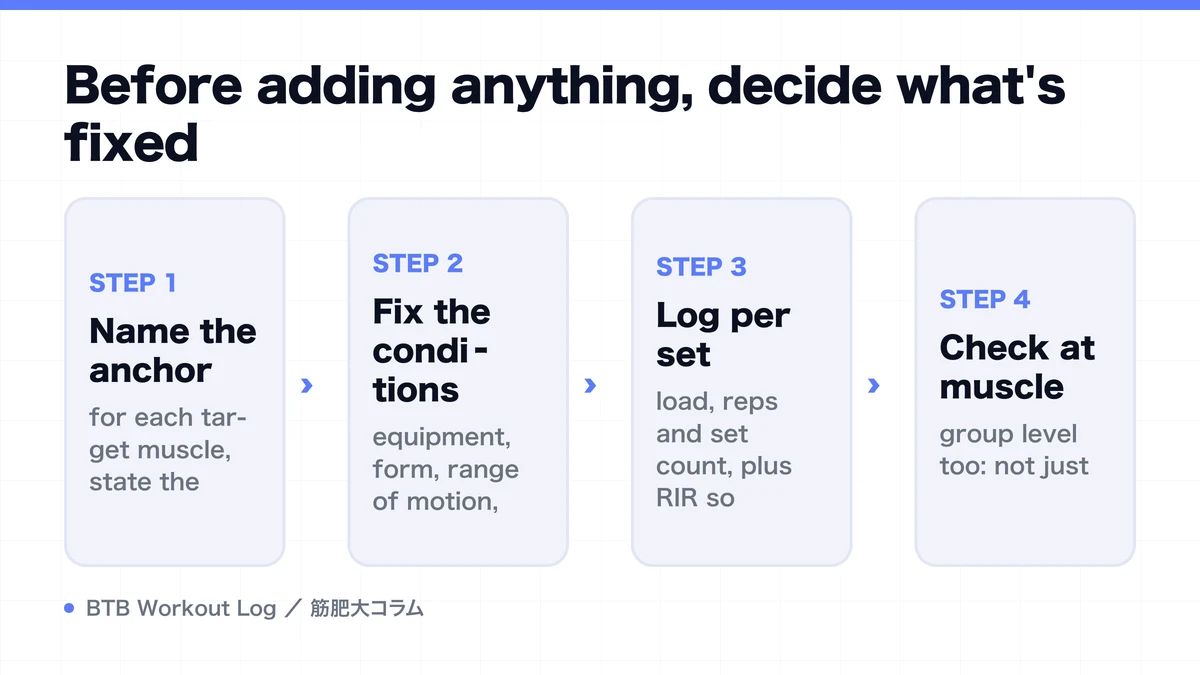
Before adding anything, decide what's fixed and what you'll log
Working through exercise selection in this order keeps things clear.
- Name the anchor: for each target muscle, state the lift you're tracking progress on for now.
- Fix the conditions: equipment, form, range of motion, session order and rep range as steady as you can hold them.
- Log per set: load, reps and set count, plus RIR so you can correct for differences in effort.
- Check at muscle-group level too: not just per-exercise gains, but weekly hard sets per muscle group and how recovery looks.
- One change at a time: pain, equipment limits, a lift that doesn't hit the target, or a plateau across several sessions — pick the reason, then add or swap a single exercise.
One bad session isn't a reason to add exercises. Daily output swings with sleep and stress, so wait until several like-for-like entries line up before reading a trend. If the anchor isn't moving, accessories are flat too, and weekly volume and recovery both check out, that's when exercise fit and stimulus distribution become fair suspects. The more you've logged, the narrower the decision gets.
A training log fits this topic when you use it not to add exercises but to carry data from fixed conditions into the next decision. Whether to add an exercise comes down to how many you're running now and how much like-for-like comparison you're actually getting — and BTB Workout Log keeps the gap between appearances of each exercise visible as well.
FAQ
- How many exercises per muscle group should I cap it at?
- There's no universal ceiling. Keep an anchor lift you can track, then judge each accessory on whether it does something different. If several serve the same purpose and the gaps between appearances are long enough that you can't compare with last time, that's the sign you've overdone it.
- Won't my body adapt to the same exercise and stop growing?
- As long as you can keep raising load, reps or set quality in steps, the stimulus isn't static. Joint discomfort, a lift that doesn't hit the target muscle, or a genuine plateau under stable conditions are reasons to change — novelty on its own isn't a reason to swap weekly.
- When is the right time to swap an exercise out?
- When several like-for-like sessions — same order, form and RIR — show no progress and there's no obvious problem with recovery or weekly volume. Pain and equipment changes are exceptions to handle immediately; otherwise swap one exercise at a time and compare before and after.
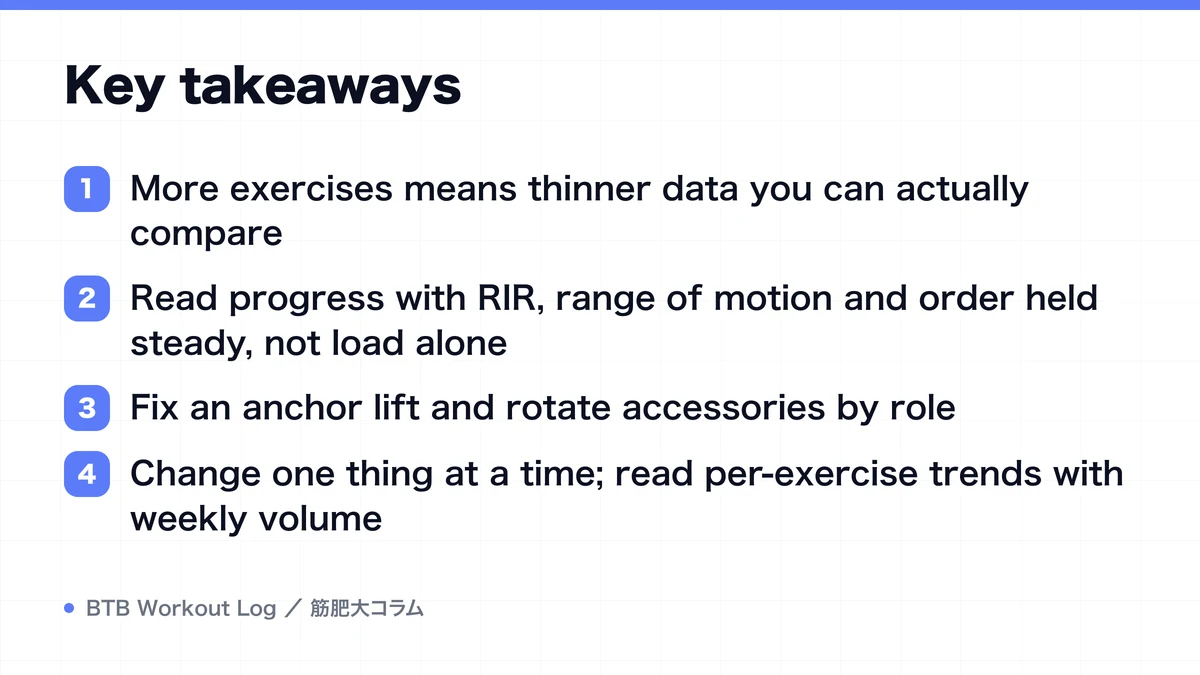
Key takeaways
- More exercises means thinner data you can actually compare
- Read progress with RIR, range of motion and order held steady, not load alone
- Fix an anchor lift and rotate accessories by role
- Change one thing at a time; read per-exercise trends with weekly volume