Squat vs. Leg Press: Which Builds Bigger Thighs? | Comparing Their Effect on the Quads
For growing the quads alone, leg press uses external stability to make it easier to push the quads close to the limit, and it suits adding on extra sets. But squats — for someone who can reproduce depth and knee movement and whose quads are the main limiter — are a strong option too. There's no winner shared by everyone.
The standard isn't lifted weight — it's stimulus to the quads, recoverable fatigue, time, ease of tracking progress, and body fit. The choice shifts with whether squat skill or overall lower-body strength is also part of your goal.
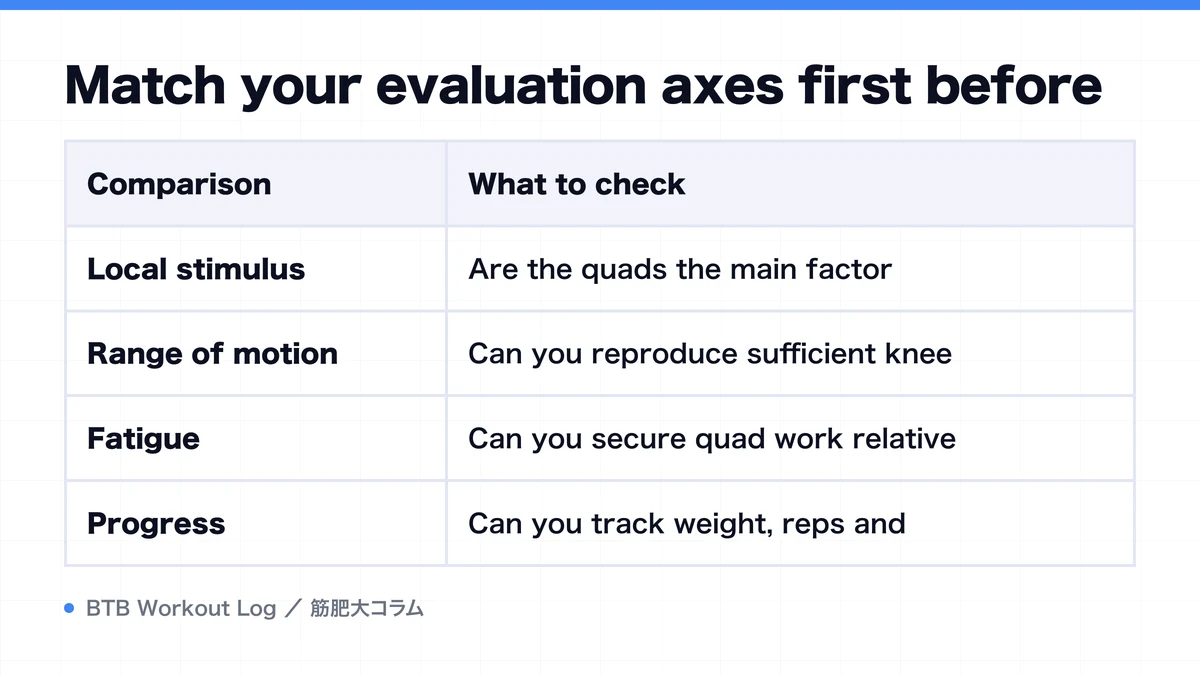
Match your evaluation axes first before comparing quad hypertrophy
Squat is a free-weight exercise where you stand up carrying a barbell; leg press is a machine exercise where your back and pelvis are supported by a pad and you push a platform with your feet. Even as the same multi-joint leg exercise, the posture control demanded and how load transmits aren't the same. Comparisons like "the harder exercise works better" or "more plates loaded means more effective" can't evaluate the quads' actual work.
What matters here isn't squat 1RM or competition skill — it's growing the quads long-term. So compare on these five. General equipment differences connect to the free-weight-vs-machine comparison, but here we focus narrowly on how much work you can deliver to the knee-extensor muscles.
| Comparison | What to check |
|---|---|
| Local stimulus | Are the quads the main factor ending the set? |
| Range of motion | Can you reproduce sufficient knee flexion every time within your tolerance? |
| Fatigue | Can you secure quad work relative to core, breathing, and glute fatigue? |
| Progress | Can you track weight, reps and RIR under matched conditions? |
| Individual fit | Does it fit your build, joints, skill, and available equipment? |
RIR is a metric for "how many more reps were possible" at the end of a set. To compare quad hypertrophy, you need to run both exercises at comparable RIR, with weekly effective set count not too different either. If one side leaves more reserve or gets more sets, you're comparing a difference in effort or volume, not exercise name.
Hypertrophy effect shifts with whether you can reproduce a movement that sufficiently works the quads
Squats are also easily limited by things beyond the quads
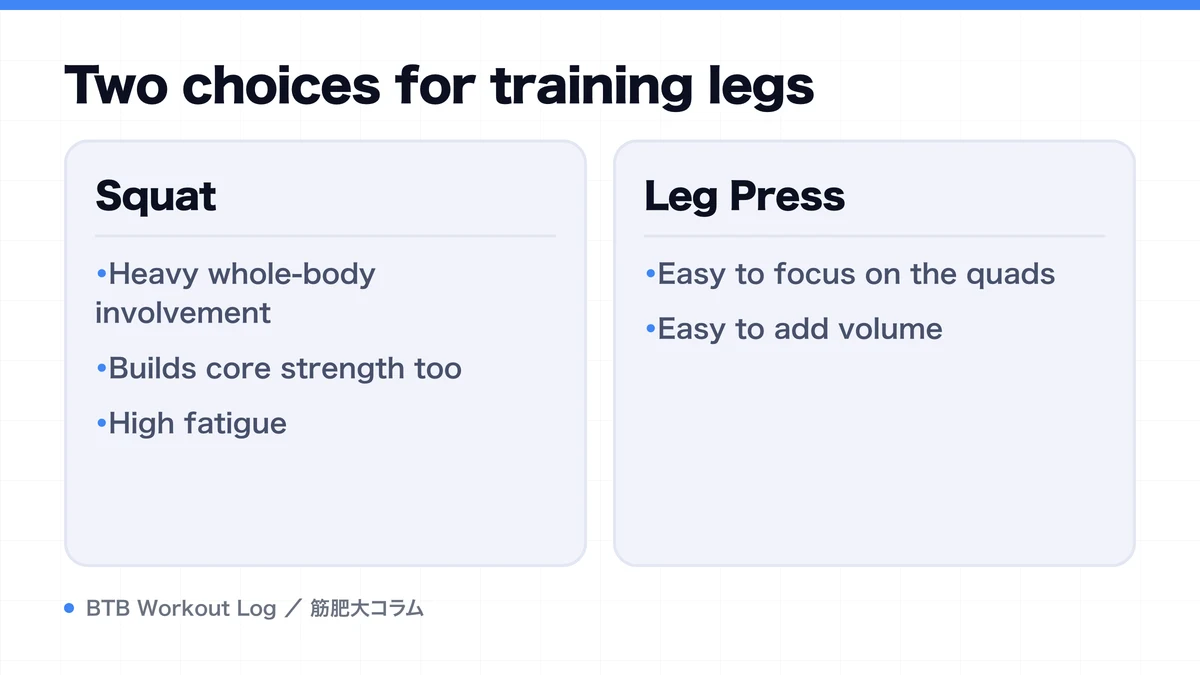
On squats, it isn't just the knee-extending quads working - the hip-extending glutes and adductors, plus the core and upper back holding posture, all engage. Someone who can stably squat to sufficient depth and hold the knee flexion/extension pattern can deliver substantial work to the quads too. But for someone limited first by breathing, bar-holding, forward lean, or balance, the set can end while the quads still have reserve.
Femur and torso length, and the range of motion your ankles and hips allow, differ by person. A large forward lean isn't automatically a failure, but if depth keeps changing session to session, or only glutes or lower back hit their limit first despite wanting to prioritize the quads, there's room to reconsider the cost relative to your goal.
Leg press trades stability for needing the machine to fit you
On leg press, the backrest and path support your body, so you don't need to spend attention on balance or bar-holding, making it easier to repeat knee flexion/extension. For someone whose quads approach their limit first, it's a choice that makes local stimulus easier to produce. But settings - placing feet high on the platform, only repeating a shallow range, or forcing depth that moves the pelvis substantially - change the movement even on the same machine.
Neither exercise is unconditionally better the deeper you go. What matters first is being able to control and repeat your intended range within your joint tolerance. When splitting between full range and partials, log a range-of-motion-changed set as a separate condition. Since hypertrophy can occur across a wide load range, being able to load more plates on leg press than on squats doesn't by itself mean leg press wins. Consider load-range choice separately, as in comparing heavy and light load.
Compare fatigue and time by the effect on your whole week, not one set's difficulty
Squats require practicing stable movement, setting up the rack and safeties, and a gradual warm-up. They demand high focus, and muscle groups besides the quads plus breathing tend to constrain the set too, so for some people the same quad set count carries a larger weekly fatigue cost. In exchange, one exercise distributes work to quads, glutes, adductors and core, so it's efficient if you want to train the whole lower body with few exercises.
Leg press has external stability, making it easier to focus purely on quad reps even after squats or a hinge exercise. It can let you still bank quad sets even in a week with heavy upper-body or lower-back fatigue. But a heavy set is still very demanding locally, and once you factor in loading/unloading plates, waiting for the machine, and seat adjustment, it isn't always faster.
When comparing, watch not just breathlessness or soreness during the exercise but subsequent exercises and your next leg session too. If leg press reps crash substantially every week after squats, or quad output doesn't return by next time, there's an option to lower squat set count or effort level. If the same thing happens after adding more leg press, you can't say a machine is automatically low-fatigue either.
If combining both, adding leg press also raises weekly quad sets by that amount. It matters not to simply stack them beyond a recoverable amount for the sake of exercise variety — first replace part of an existing exercise and check how weight, reps and recovery change.
Don't compare kilos side by side — track progress within each exercise's own matched conditions
You can't compare 100kg barbell squat against 200kg leg press. Leg press platform angle, sled weight, lever ratio and friction differ by machine, so the displayed kg doesn't load the body the same way. Judge whether squat or leg press progressed within that exercise's own record.
On squats, match weight, reps, sets and RIR, plus squat depth, stance, and shoe or heel setup. On leg press, log machine, backrest and seat position, foot width and height, and lowering depth. If reps rise from shallower depth, more momentum, or a changed foot position, don't count that as progressive overload under matched conditions.
In practice, set a range like 8–12 reps, and once every set reaches the ceiling at intended RIR and range of motion, raise load by the smallest increment next time. A slight rep drop right after raising load is expected. What matters is being able to build up under matched conditions across several sessions. If joint response or form breakdown worsens, don't count a rising number as good progress.
Hold conditions fixed for roughly 4–6 weeks and compare rep gains, RIR, and recovery by next time — this avoids switching exercises purely on impression.
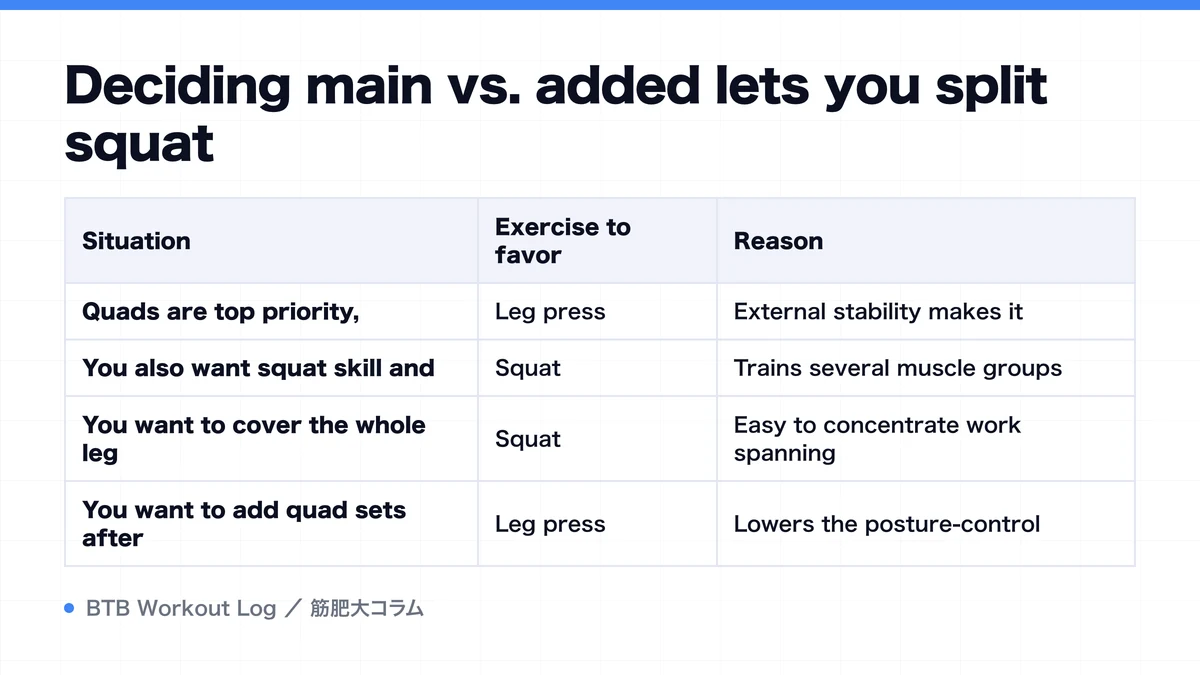
Deciding main vs. added lets you split squat and leg press by role
| Situation | Exercise to favor | Reason |
|---|---|---|
| Quads are top priority, core/balance limits first | Leg press | External stability makes it easier to focus on quad reps |
| You also want squat skill and overall lower-body strength | Squat | Trains several muscle groups while practicing the intended movement |
| You want to cover the whole leg with few exercises | Squat | Easy to concentrate work spanning knee and hip joints into one exercise |
| You want to add quad sets after your main lift | Leg press | Lowers the posture-control demand, easier to bank local sets |
| A fixed path doesn't fit your build, can't safely reproduce depth | A squat variant that fits, or a different machine | Don't force a leg press that doesn't fit |
| Quads approach their limit on both, recovery is good too | Combine both | Split main/added, or split by day |
If combining both, an easy-to-understand structure is doing squats for movement skill and high output in the first half of leg day, then leg press to add quad sets in the back half. The order isn't fixed, though — if quad hypertrophy alone is the priority and squat skill isn't a goal, it's fine to put leg press first and progress it as your main lift. You could also split it — squat on one leg day of the week, leg press on the other.
There's no need to continue a painful exercise as "proof it's working." If sharp pain or discomfort persists even after adjusting load, range of motion, stance or seat setting, drop the exercise and consult a medical or exercise professional if needed. There's no need to avoid a squat that doesn't fit your body out of loyalty to leg press, or to keep using a machine that doesn't fit purely from squat aversion.
When quads alone are what you're evaluating, many people will find leg press easier to choose as either main or added work. But if squats sufficiently limit on the quads, and you can reproduce range of motion and progress while also needing the whole-body role, there's no reason to replace it. Keep this goal separate from training your entire lower body from squats alone, and pick whichever fills the gap in your weekly routine.
FAQ
- Can leg press alone still grow the quads?
- If you hold sufficient range of motion and effort on leg press and can raise weight or reps under matched conditions, it can serve as your main quad exercise. But if overall leg development or squat skill is also a goal, consider a hip-dominant exercise or squat variant separately.
- Which should come first, squat or leg press?
- Put whichever holds the role you most want to build first. If you prioritize squat skill and high output, squat first; if local quad stimulus is the top priority, leg press first is fine too. Once you change the order, hold it fixed for several weeks to compare.
- If my knee feels off, is leg press safer?
- Being a machine doesn't automatically make it safer. On both squat and leg press, choose a pain-free load, foot position and range of motion, and control the movement. If sharp pain or discomfort persists even after adjusting the setup, stop and consult a professional.
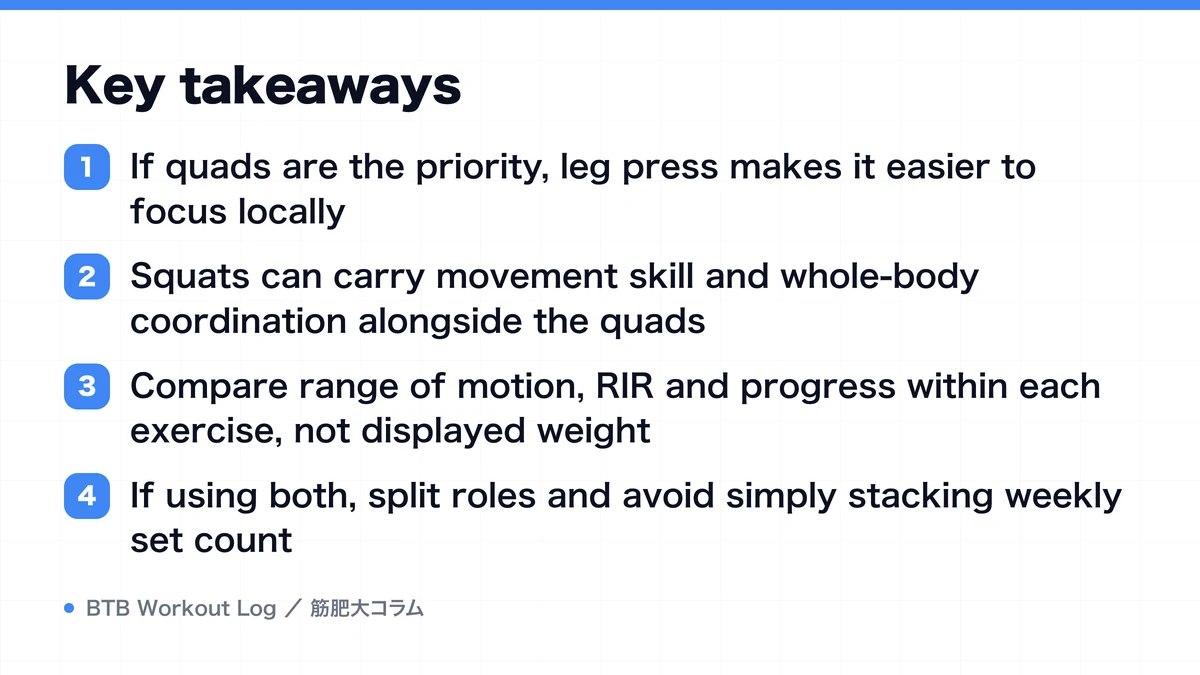
Key takeaways
- If quads are the priority, leg press makes it easier to focus locally
- Squats can carry movement skill and whole-body coordination alongside the quads
- Compare range of motion, RIR and progress within each exercise, not displayed weight
- If using both, split roles and avoid simply stacking weekly set count
References
- Low- vs High-load Resistance Training for Strength and Hypertrophy: Meta-analysis
- Muscle Hypertrophy Is Independent of Load Across Upper and Lower Limbs When Effort Is Matched
- Dose-response Relationship Between Weekly Resistance Training Volume and Muscle Mass
- The Resistance Training Dose Response: Meta-Regressions Exploring the Effects of Weekly Volume and Frequency on Muscle Hypertrophy and Strength Gains
- ACSM Position Stand: Progression Models in Resistance Training for Healthy Adults