How to Choose a Workout Log App | Turning a Log You Abandon Into One You Actually Keep
Logging is a practical way to move hypertrophy from "going by feel" to "something you can verify". If you don't know last session's weight and reps, you can't compare progress under the same conditions, and it becomes harder to isolate the cause of a plateau.
What matters when choosing an app isn't the number of features but three things: your previous numbers are visible right away, input is fast, and volume is calculated for you.
Why a log makes hypertrophy decisions easier
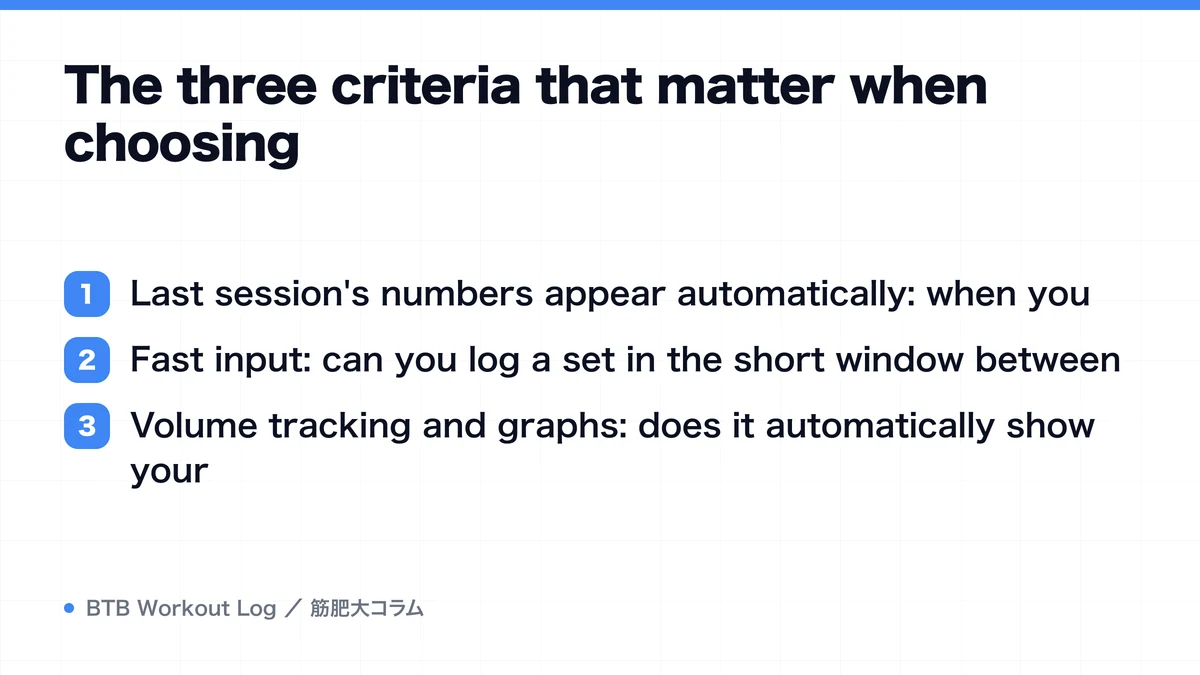
The core principle of hypertrophy is progressive overload - applying at least slightly more load than last time. The problem is whether you can remember "last time" accurately. If you train 10 exercises at 3-4 sets each, memorizing 30-40 weight and rep numbers every session is impossible. Without a log, the numbers you're aiming for today become vague, and whether you're growing tends to come down to feel. Simply logging, on the other hand, gives you a clear target on every set: "last time was 80 kg for 9 reps - today I'm going for 10."
Three things worth tracking
| What | Details | Why it matters |
|---|---|---|
| Exercise, weight, reps | Every set (+ RIR) | Enables progressive overload and sets tomorrow's target |
| Volume | Weekly sets per muscle group and total load | Manage stimulus and decide when to add or reduce (details) |
| Bodyweight | Weekly trend | Track lean bulk or cut pace |
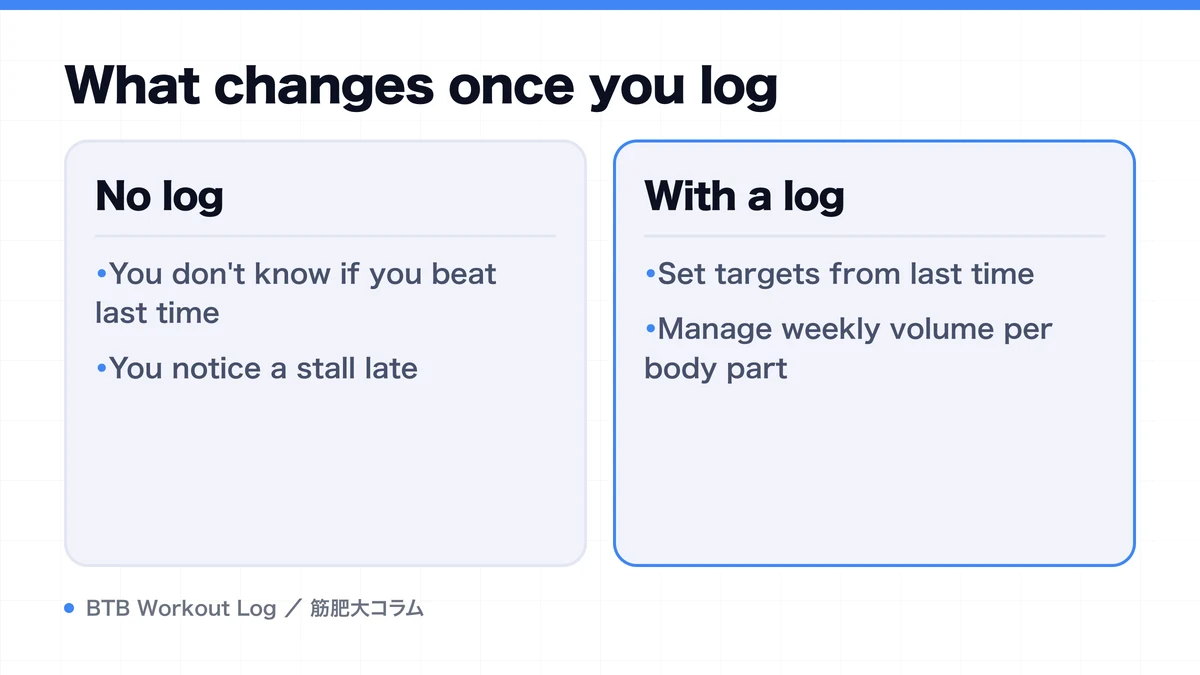
The three criteria that matter when choosing an app
- Last session's numbers appear automatically: when you select an exercise, do your previous weight and reps appear immediately? This is the most important feature - it's what makes executing progressive overload fast and reliable.
- Fast input: can you log a set in the short window between sets? Fewer taps means you'll stick with it.
- Volume tracking and graphs: does it automatically show your weekly sets per muscle group and trend over time? (weekly sets guide)
Features don't matter if you don't use the app. Prioritize the app you'll actually open every session over the most feature-rich option.
The real reason most people stop logging
Everyone agrees logging works. Most people still quit. The reason is almost always one thing: input friction. Searching for the exercise, typing in the numbers, hitting save, then doing it again for the next set - by the time you're exhausted between sets, that friction compounds and after a few days you stop opening the app. Consistent logging is not a willpower problem; it's a friction problem. The right tool shows your last numbers instantly, takes a few taps to log a set, and handles volume totals automatically. Reducing that friction is the whole game.
BTB Workout Log: built for consistent logging
All three criteria above are the reason BTB Workout Log was built. Select an exercise and your last weight and reps appear on screen immediately, so your target for the set is clear before you pick up the bar. Logging a set takes just a few taps. Weekly hard sets by muscle group are tallied automatically. No ads, fully offline - gym signal dead zones don't interrupt your focus between sets. If your goal is to progressively overload every session instead of leaving it to chance, start by building the right environment for tracking it.
FAQ
- Is workout logging actually necessary?
- Yes. Progressive overload is easier to manage when you know your previous weight and reps. With a log, it's easier to aim for "slightly more than last time", and easier to isolate the cause of a plateau.
- App or notebook: which is better?
- Whichever one you'll actually use every session. Apps handle previous-session display, volume totals, graphs, and historical lookup far more efficiently. But if the input process of a particular app frustrates you and you stop opening it, a notebook is better. Consistency beats features.
- What should I focus on most in a tracking app?
- Automatic display of last session's numbers. The moment you select an exercise and your previous weight and reps appear, you have a clear target for the set and progressive overload becomes effortless to execute. Fast input and volume tracking come next.
Key takeaways
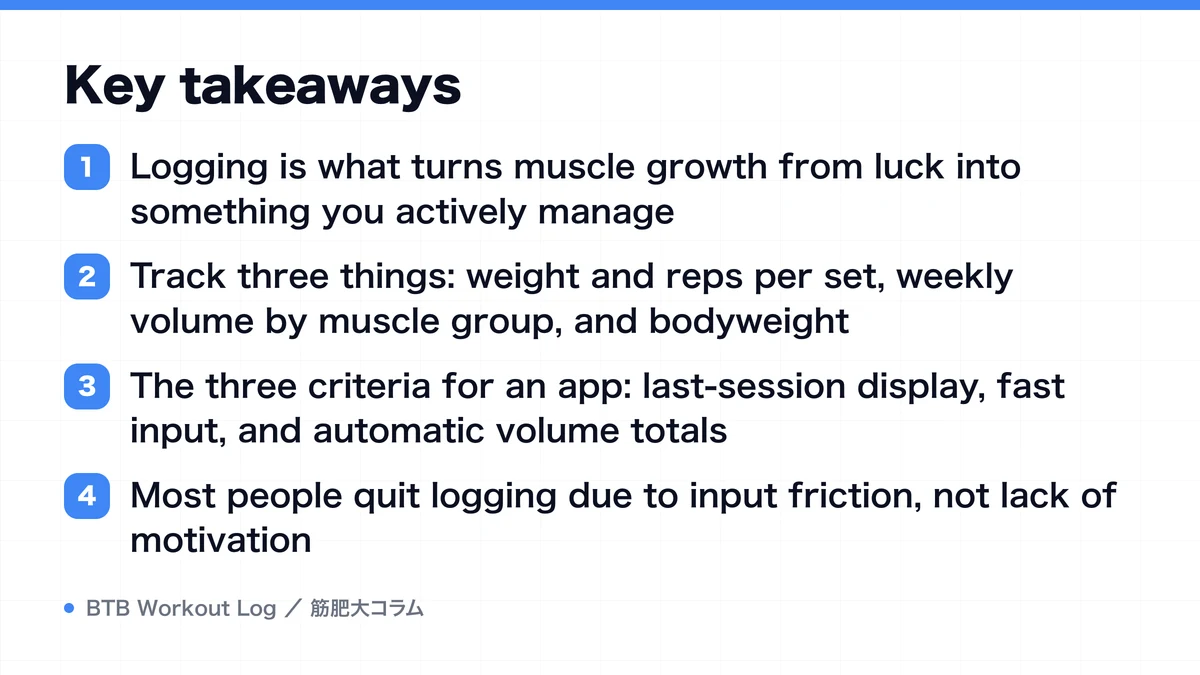
- Logging is what turns muscle growth from luck into something you actively manage
- Track three things: weight and reps per set, weekly volume by muscle group, and bodyweight
- The three criteria for an app: last-session display, fast input, and automatic volume totals
- Most people quit logging due to input friction, not lack of motivation
References
- ACSM Position Stand: Progression Models in Resistance Training for Healthy Adults
- Dose-response Relationship Between Weekly Resistance Training Volume and Muscle Mass
- Proximity-to-Failure and Muscle Hypertrophy: Systematic Review with Meta-analysis
- Nutrition Recommendations for Bodybuilders in the Off-Season