
Hypertrophy: Why 3 Average Months Beat One Perfect Workout
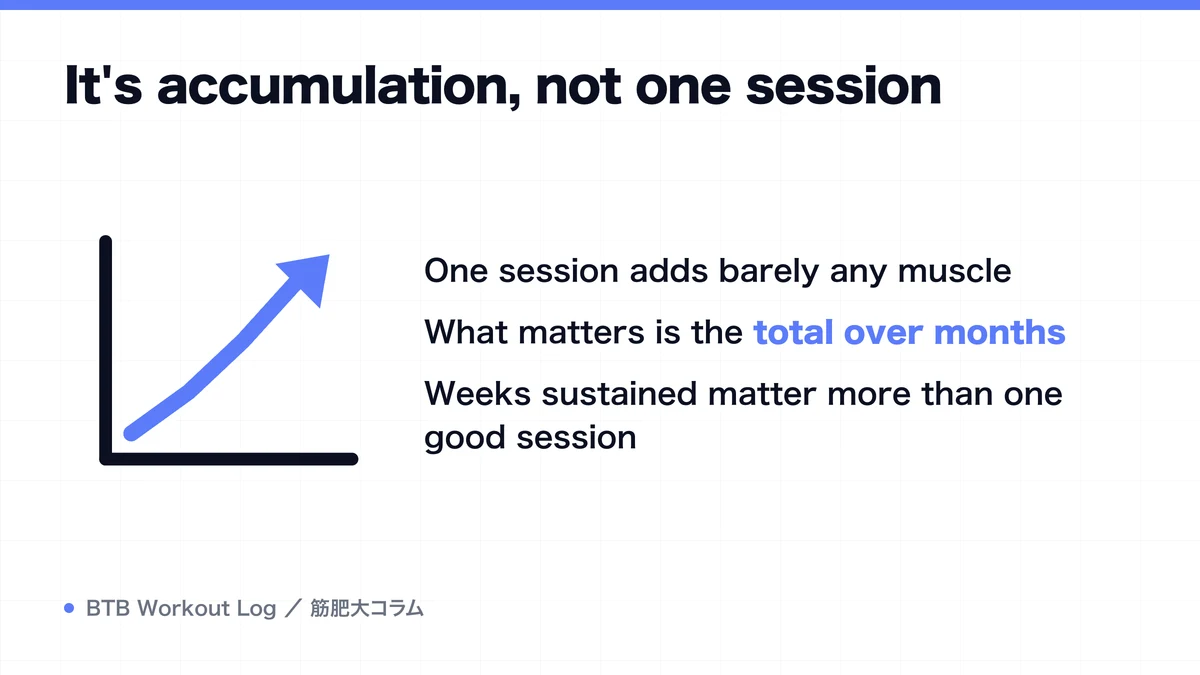
What drives hypertrophy isn't how good one session was. It's whether you repeated a recoverable stimulus for weeks and months, and nudged the load forward while you did.
A day with perfect exercise order, perfect effort and a great pump contributes nothing to long-term adaptation if it doesn't connect to the sessions after it. The timescale you judge on has to widen from "today" to "the last few months".
Why one perfect session feels like it matters most
Right after training you get obvious feedback: pump, fatigue, sweat, a sense of having done the work. Get through every exercise as planned and hit your target reps on every set and the day reads as a success. Have load dip slightly, or fail to feel the target muscle, and it reads as wasted.
But these are mostly signals about your state right now. Long-term progress happens with little soreness (soreness and hypertrophy), and feeling wrecked doesn't certify that useful overload occurred (effort feel versus progressive overload). A session is easy to observe; hypertrophy can only be judged after many rounds of stimulus and recovery. That lag is what inflates the importance of any single day.
Chasing "perfect" also pushes you to take every set to failure and bolt on unplanned exercises. If the fatigue that creates wrecks your output or your schedule next time, you bought today's extra work by giving up next week's opportunity. Even training to failure is a variable to judge across the week, not within one day.
What happens in one session isn't what happens over months
Resistance exercise raises muscle protein synthesis afterwards — an acute response, and an important one for understanding how tissue is repaired and rebuilt. But a 2024 systematic review is careful to warn against conflating that post-session response with the long-term hypertrophy measured in repeated training interventions. The acute response helps explain the mechanism; it isn't a test that reads out final growth from a single session.
On a timeline, one session is a link in this chain:
- Apply a load that's sufficient relative to your current capacity.
- Eat and rest, and recover from what you did.
- Attempt load, reps or sets again under the same movement conditions.
- Advance one of those variables in step with the adaptation.
Only when that loop closes repeatedly do small changes become a long-term difference. There's a ceiling on the stimulus one session can deliver, and adding volume to that day alone doesn't complete the loop if recovery and the next stimulus don't follow. That's precisely why the ACSM progression model frames load, volume and frequency as things you advance according to experience and goal: adaptation isn't finished in one go, and it needs updating against your current capacity.
What accumulates over months isn't just session count
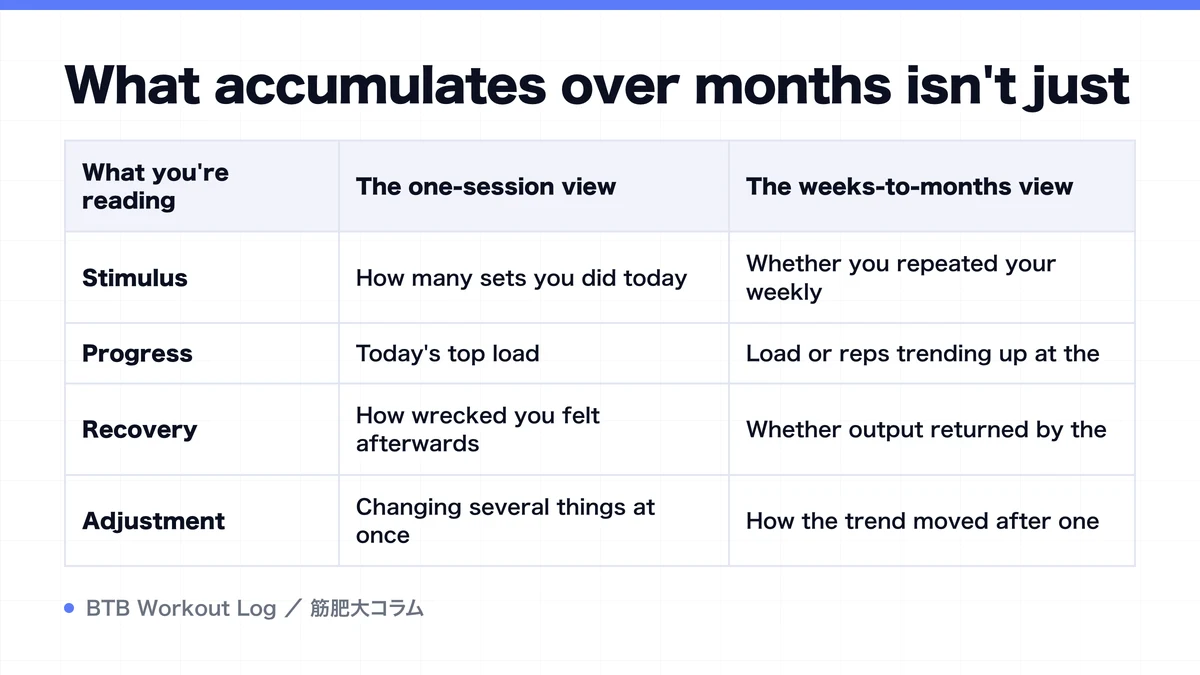
"Consistency matters" is useless as a decision rule if it just means counting gym visits. The four things worth accumulating are recoverable stimulus, comparable progress, adherence, and a history of adjustments.
| What you're reading | The one-session view | The weeks-to-months view |
|---|---|---|
| Stimulus | How many sets you did today | Whether you repeated your weekly hard sets per muscle group |
| Progress | Today's top load | Load or reps trending up at the same form, range of motion and RIR |
| Recovery | How wrecked you felt afterwards | Whether output returned by the next session for that muscle |
| Adjustment | Changing several things at once | How the trend moved after one change |
Weekly sets and hypertrophy show an average dose-response relationship, but the question isn't "what's the most sets I managed in a day" — it's how much weekly volume you repeated, and at what quality. The useful range moves with training history, exercise selection, RIR, frequency, sleep and nutrition. Finding a volume you can repeat while watching recovery handles individual variation far better than staging one heroic day.
Progress works the same way. A given day's personal best is shaped by motor skill, how you feel and where the lift sat in the session. For hypertrophy it's more practical to read several records taken under near-identical conditions and ask whether load or reps are trending up. You don't need every metric to rise every time. The value is in running progressive overload through a few cycles — adding reps, then adding load once you hit the top of the range.
Consistency doesn't mean showing up and phoning it in
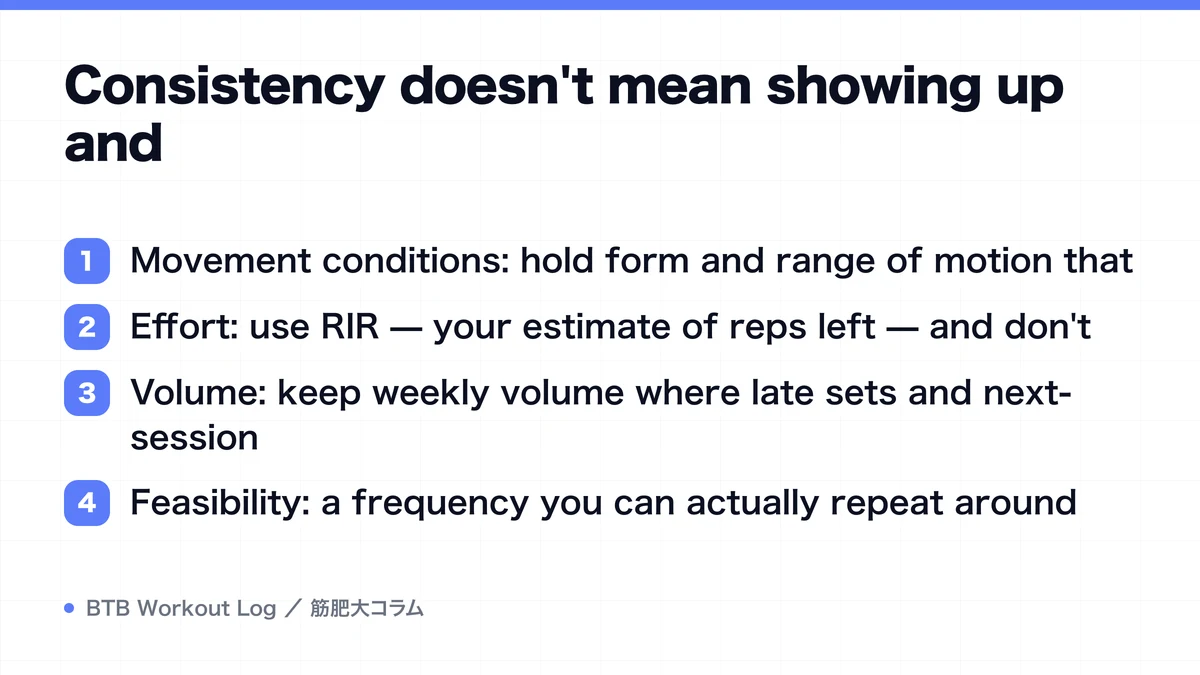
Valuing months of accumulation isn't licence to coast through each session. Loads that are too light, far too much left in reserve, and unstable range of motion don't add up to a comparable stimulus however often you repeat them. What you need isn't 100% every time — it's a quality floor you can defend long-term.
- Movement conditions: hold form and range of motion that target the intended muscle at roughly the same standard.
- Effort: use RIR — your estimate of reps left — and don't drift far outside your intended range.
- Volume: keep weekly volume where late sets and next-session output don't keep collapsing.
- Feasibility: a frequency you can actually repeat around work and life without derailing.
With that floor in place, adjust exercise order, rep ranges and set additions on top of it. What works against you is cutting sleep to force one high-quality day, ignoring a joint that's complaining, or skipping the next session — all of which can lower total stimulus across months. Raise the number of quality repetitions rather than the height of any single peak.
In practice, decide the judgement window before the session
Reacting to every session's result makes it impossible to separate normal ups and downs from a programme problem. Hold your main exercises, rep ranges, form and rest periods comparable for roughly four to eight weeks first. That window isn't a fixed rule — adjust it knowing that progress gets smaller with experience, and that your weekly frequency determines how many attempts at each lift you get.
What to record each session
Load, reps, set count and RIR, plus a short note whenever you meaningfully change form or range of motion. Being able to line up near-identical records matters more than any single day's best. If output drops once and sleep, session order or stress explain it, that isn't a failed programme.
What to check weekly
Hard sets per muscle group, how much of the plan you actually completed, and your output when you train that muscle again. Completing the planned volume while load and reps keep falling in the back half is a recovery-and-distribution problem, not a cue to add sets. Stable reserve and reps climbing across several sessions is evidence to keep the current design.
At the end of the window, change one thing
Records trending up and recovery holding: continue. Several metrics flat but recovery fine: adjust one of load, rep target or weekly sets. Output dropping and recovery poor together: cut volume or consider a deload. Pairing one hypothesis with one change is what leaves you, months later, with a volume and progression that fit you.
Spotting a plateau in your log needs a trend, not a single number. Use records to drive the hold / add / cut decision rather than to fill boxes (how to use a training log). What's working isn't any one session — it's the sum of several months, and BTB Workout Log exists so you can look back at that sum.
Don't dismiss a single session — just don't judge on one
Prioritising the months doesn't make today meaningless. One session is the smallest unit of accumulation. Its value just isn't "was it perfect" — it's whether you applied enough stimulus, recovered, and could continue next time under conditions you can still compare.
Protect the loop rather than manufacture great days. Don't let a single good or bad session move the programme; adjust on weeks of output and months of change. On that timescale, the anxiety of chasing perfection turns into repetition that actually builds muscle.
FAQ
- If one session goes badly, have I broken the accumulation?
- You can't conclude that. Temporary drops from how you feel or where the lift sat in the session are normal. Don't wreck your form forcing the numbers to balance — log it, and judge from how load, reps and RIR move across several near-identical sessions.
- Will running the same programme for months grow muscle by itself?
- Time alone isn't enough. Hold form and range of motion, secure sufficient effort and a recoverable weekly volume, then check that load or reps are actually progressing. When both progress and recovery stall, adjust one variable at a time.
- Over what period should I judge hypertrophy progress?
- One session is far too short. Read load, rep and RIR trends over four to eight weeks under stable conditions, and judge noisier measures like appearance and circumference over months. More experienced lifters see smaller changes, so a longer window can be appropriate.
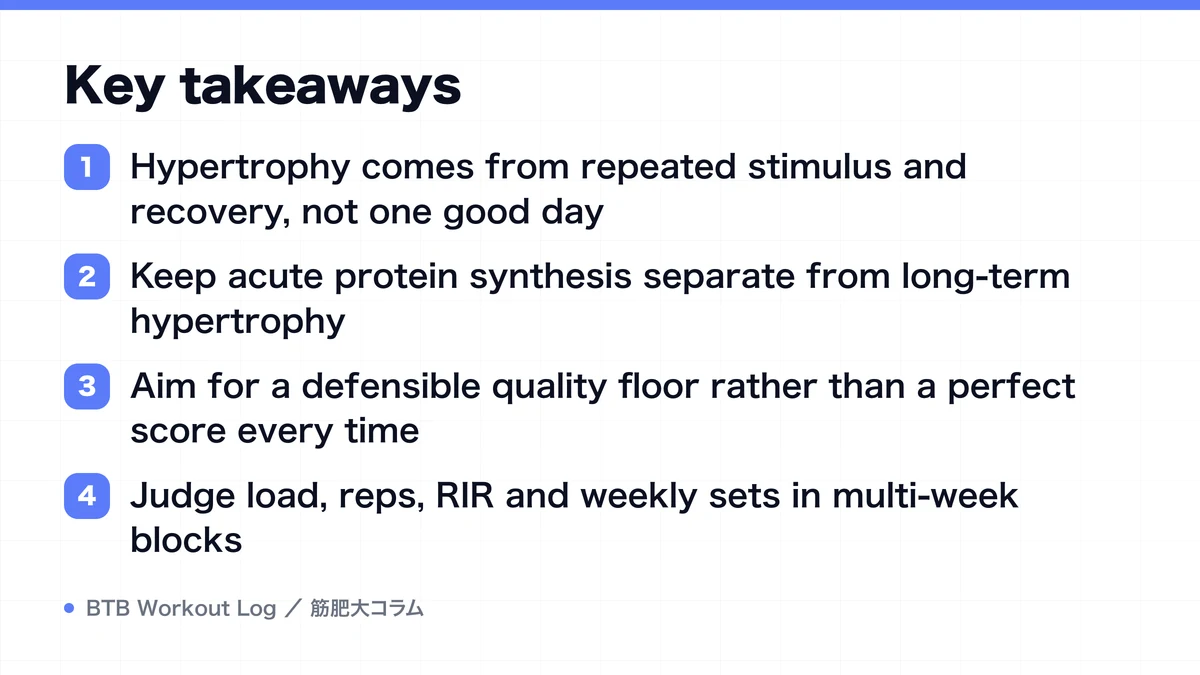
Key takeaways
- Hypertrophy comes from repeated stimulus and recovery, not one good day
- Keep acute protein synthesis separate from long-term hypertrophy
- Aim for a defensible quality floor rather than a perfect score every time
- Judge load, reps, RIR and weekly sets in multi-week blocks