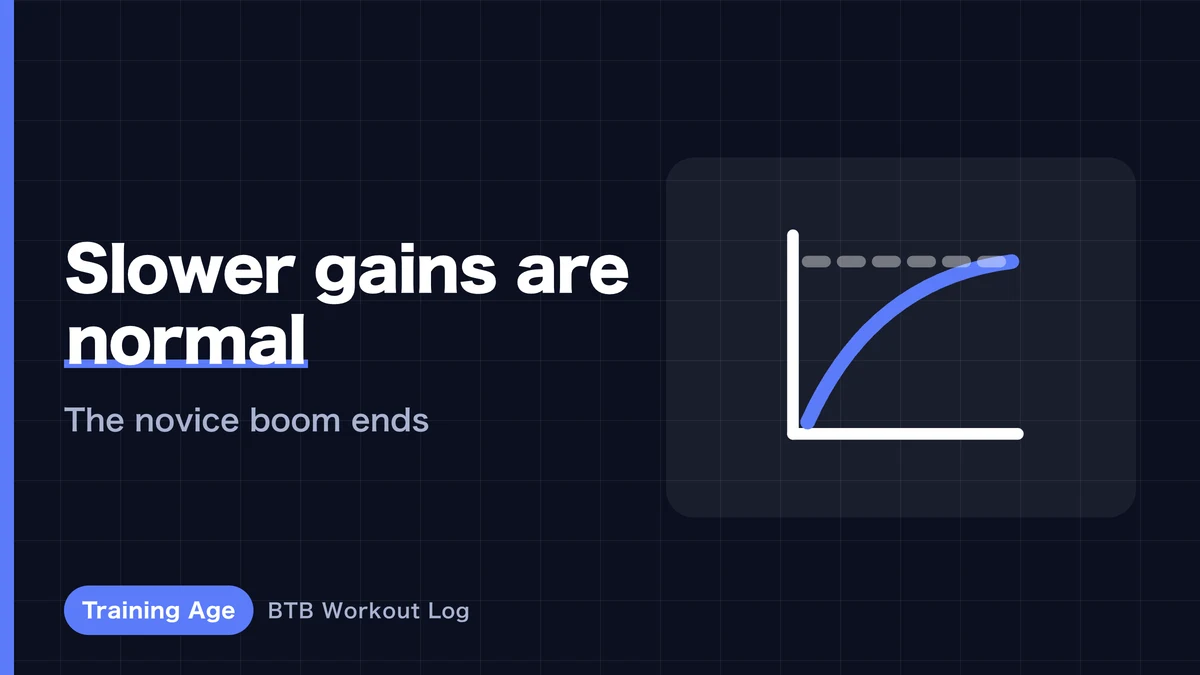
Why Does Muscle Growth Slow Down the Longer You Train? | What's Really Behind the Intermediate Wall
The main reason muscle gets harder to build the longer you've trained isn't years themselves — it's that a body that has already gained substantial adaptation experiences less relative intensity from the same stimulus, and has less remaining room to improve.
Growth capacity doesn't suddenly disappear. What looked like a large gain as a beginner shows up as a small increment for an experienced lifter, which is why designing stimulus and measuring progress both need higher precision.
Years of training itself don't stop hypertrophy
Rather than "stopped growing because it's been 5 years," training history is a guide to how much adaptation has accumulated. Even the same 5 years leads to different outcomes depending on consistency, load setup, nutrition, and breaks taken. You can't decide "you've maxed out" from years alone.
Early on, resistance training itself is a new stimulus to the body. Even a low weekly set count or a simple load setup easily exceeds current capability, and weight handled tends to rise fast through learning form and neural adaptation. But you can't attribute all of this early weight increase to muscle mass gain — lift numbers also improve just from technique stabilizing and getting familiar with the exercise.
As you gain experience, form and movement reproducibility improve, and the large technical gains available in the novice phase shrink. At the same time, the muscle has adapted to past load too, so the same weight, reps and set count as before become closer to work that maintains current capability than a new demand that drives growth. This is the first reason it feels like "I'm putting in the same effort but progress is slower."
That said, training history alone can't predict an individual's annual hypertrophy rate. Beginners and experienced lifters differ in program, starting muscle mass, and measurement method too, and even long-term data tracking the same person has limits. Rather than fixing "an experienced lifter gains X kg a year," it's more reasonable to treat years as one piece of information about accumulated adaptation.
The same routine gets relatively lighter for a stronger body
You don't need a different exercise every session for hypertrophy, but simply repeating the same routine under the same conditions means the relative size of the stimulus keeps shrinking. For someone who can now do 80kg for 8 reps, their old 70kg × 8 is the same number but no longer as demanding as it was. Muscle hasn't shrunk — reserve has grown through adaptation.
That's where progressive overload comes in. Not just weight — gradually advance reps at the same weight, RIR at the same reps, range of motion, movement reproducibility, and weekly hard sets. RIR is an estimate of how many more reps were possible before the limit. Even 80kg × 8 reps carries different stimulus conditions at RIR 1 versus RIR 4, so the more experienced you are, the more you need to match what's behind the number, not just the number itself.
But refreshing stimulus is different from frequently swapping exercises. Every time you switch exercises, the effect of relearning technique mixes in, making it hard to tell whether strength genuinely rose or you just got used to the movement. Holding your main lifts steady for a defined period and targeting small progress in weight, reps and RIR first makes an experienced lifter's small changes easier to track.
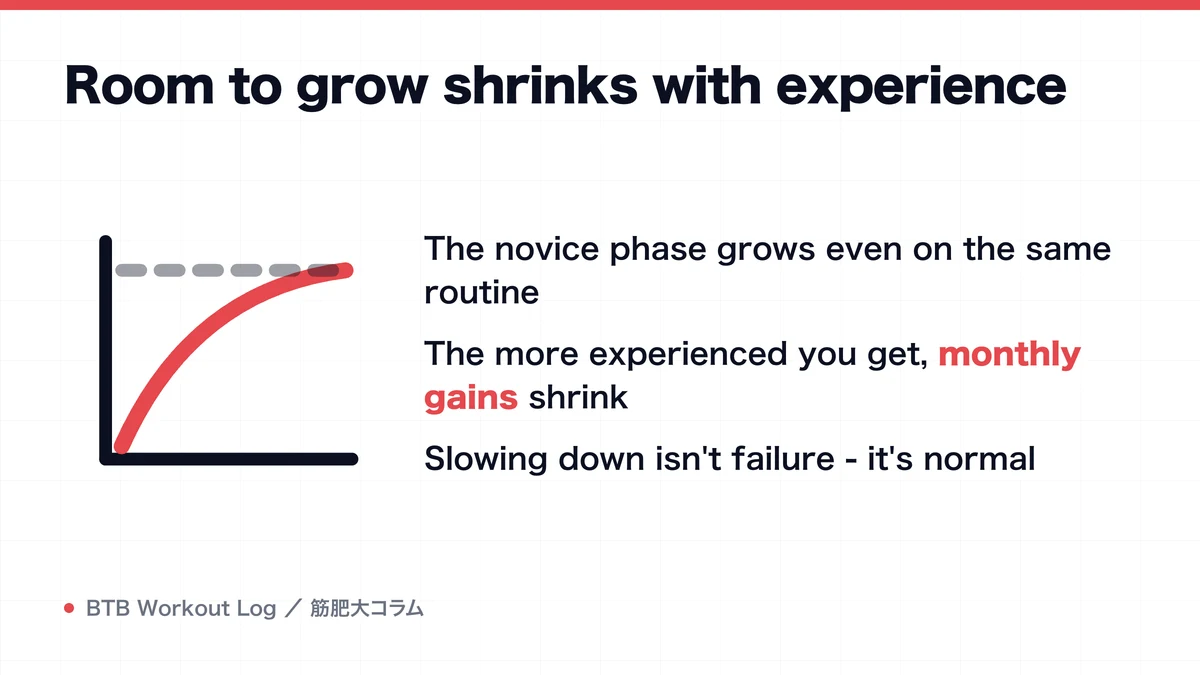
The added benefit doesn't scale with added stimulus
Early on, even a little stimulus leaves a lot of room to respond, but for someone who's already gained muscle and training capability, the demand needed to add more gets steeper. This is diminishing returns. Raising weekly set count can raise hypertrophy stimulus, but each added set doesn't necessarily deliver the same benefit every time. Research on the dose-response relationship also shows diminishing effect as volume rises.
Meanwhile, more sets also raises local fatigue, joint stress, session time, and the recovery demand until next time. Experienced lifters can handle heavier weight than beginners, so the same single set doesn't necessarily produce less fatigue. Even as your capacity to raise stimulus grows, recovery capacity doesn't necessarily expand at the same rate, narrowing the gap between the range you can target growth in and the range you can't recover from.
So when progress is slow, adding a lot of sets at once isn't necessarily reasonable. First check whether your current sets are done at sufficient RIR with stable form, and only then move something small if needed — say, 1–2 weekly sets per body part. See why raising set count too much backfires for the detailed pitfalls. If reps or output on the target exercise keep dropping for several weeks after adding, the addition may be raising fatigue more than benefit.
Judge "progress is slow" separately from "nothing is progressing"
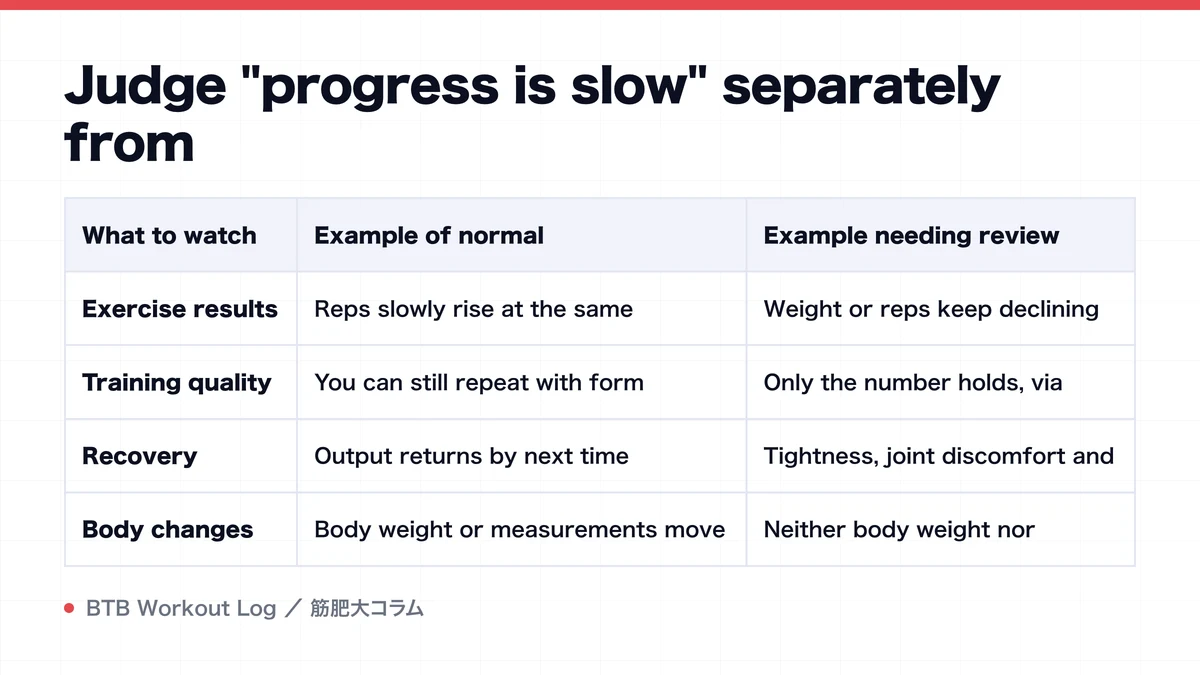
Experienced-lifter progress is small, so it's invisible from a single personal best or a few days' body-weight change. Conversely, it's also premature to declare hypertrophy stalled just because weight hasn't risen for a while. Strength is influenced by technique, fatigue and exercise familiarity, and muscle-mass changes easily get buried in noise from home measurement. Separate "normal slowdown" from "a stall that needs a fix" by tracking several indicators under matched conditions.
| What to watch | Example of normal slowdown | Example needing review |
|---|---|---|
| Exercise results | Reps slowly rise at the same weight and RIR | Weight or reps keep declining across several exercises |
| Training quality | You can still repeat with form and range of motion held | Only the number holds, via momentum or shortened range of motion |
| Recovery | Output returns by next time | Tightness, joint discomfort and poor sleep compound together |
| Body changes | Body weight or measurements move slightly over a long period | Neither body weight nor measurements move, against your goal |
Reps rising by one at the same conditions, doing the same reps at a larger RIR than before, or holding stable range of motion without breaking form — these are all progress, even if small. Why weight alone isn't a fair baseline is covered in why "weight not progressing" doesn't mean "no hypertrophy".
Conversely, if results decline across several exercises alongside signs of fatigue, suspect insufficient recovery before insufficient stimulus. If results are flat but you feel good and each set's quality is high, there's room to make a small change to volume or rep range. What matters is judging from a trend over a defined period, not a single off day.
Experienced lifters should choose a design that reproduces small progress over big changes
Once progress has slowed, expecting a weight update every session creates strain. At 8-12 reps, double progression - gradually building reps at the same weight, then adding the smallest increment once you stably meet the ceiling - is an easy-to-use method. If reps drop back to the floor right after a weight increase, that isn't a step backward.
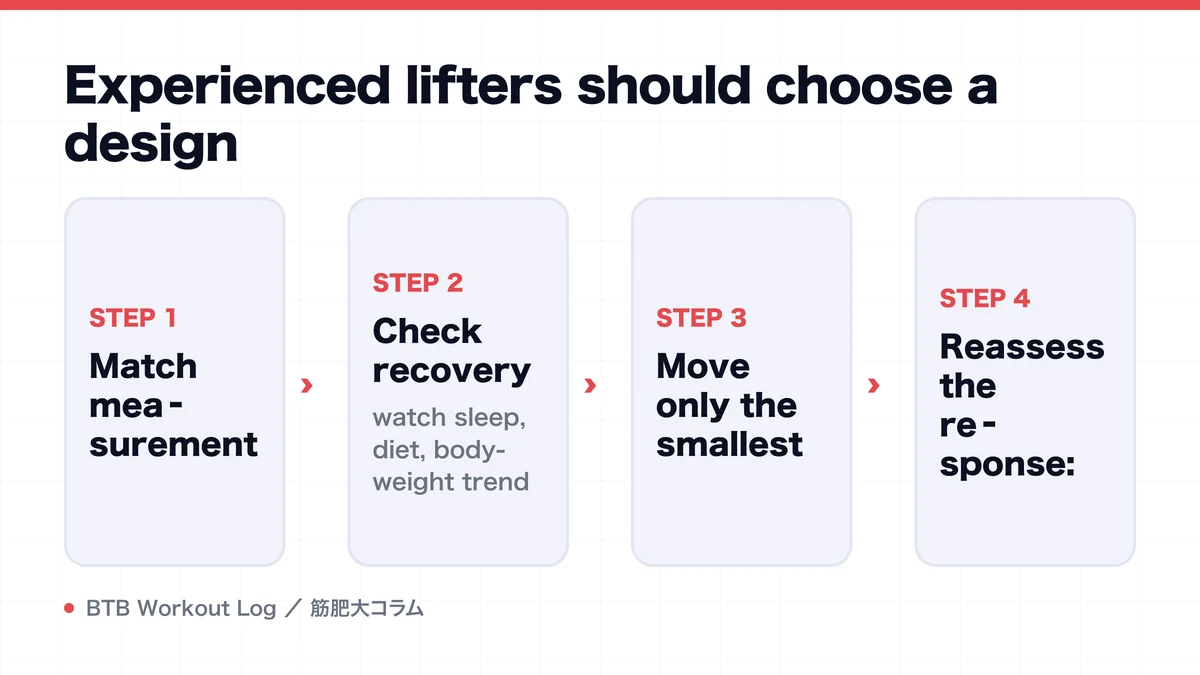
Fix the order in which you make changes
- Match measurement conditions: match exercise, range of motion, rest, set order and RIR to make records comparable.
- Check recovery: watch sleep, diet, body-weight trend and joint status to confirm fatigue isn't hiding output.
- Move only the smallest variable: change one of weight, reps, set count or frequency, and watch the trend over several weeks.
- Reassess the response: maintain if progress returns; if decline continues, revert the addition or consider a deload.
Generally, hypertrophy gain can grow larger as weekly volume rises, but the added benefit tends to shrink progressively. That said, a group average can't uniquely determine your own optimal set count. Since the effective range shifts with exercise, RIR, frequency, nutrition and recovery, treat weekly sets not as a fixed correct answer but as a starting point for testing your response.
The smaller growth gets, the more a log's job shifts from hunting for a dramatic gain to distinguishing a small, reproducible bit of progress from a change that's exceeded your recovery. The more detailed physiological picture is explored in the mechanics of why experience slows gains. Whether a slowdown is a normal course or a genuine plateau can be told apart by comparing monthly gain size. BTB Workout Log keeps the long-term history you need for that comparison.
The more experienced you are, the longer the window you need for evaluation. In the beginner phase the numbers move week to week, so even 1 month is enough to judge, but for experienced lifters the same amount of change can take 3 months. Judge on too short a window and you will mistake a normal slowdown for a plateau and keep repeating changes you don't need.
FAQ
- After how many years of training does hypertrophy get harder?
- There's no universal number of years. Accumulated adaptation differs by break periods, starting muscle mass, program quality and nutrition. Rather than years, judge your stage from how long it takes matched-condition weight or reps to progress.
- Should I add sets once progress slows down?
- A small addition is a candidate if your current sets are done at sufficient RIR with stable form and recovery is no issue. But since the effect diminishes rather than scaling with set count, add it small — not all at once — and watch the target body part's results and fatigue as you adjust one variable.
- If weight hasn't moved for several weeks, has hypertrophy stopped too?
- You can't judge from weight alone. Check reps at the same weight, RIR, range of motion, form, and the long-term trend in body weight or measurements too. Only once several indicators have stalled, and recovery conditions still show no change, should you consider reviewing load or volume.
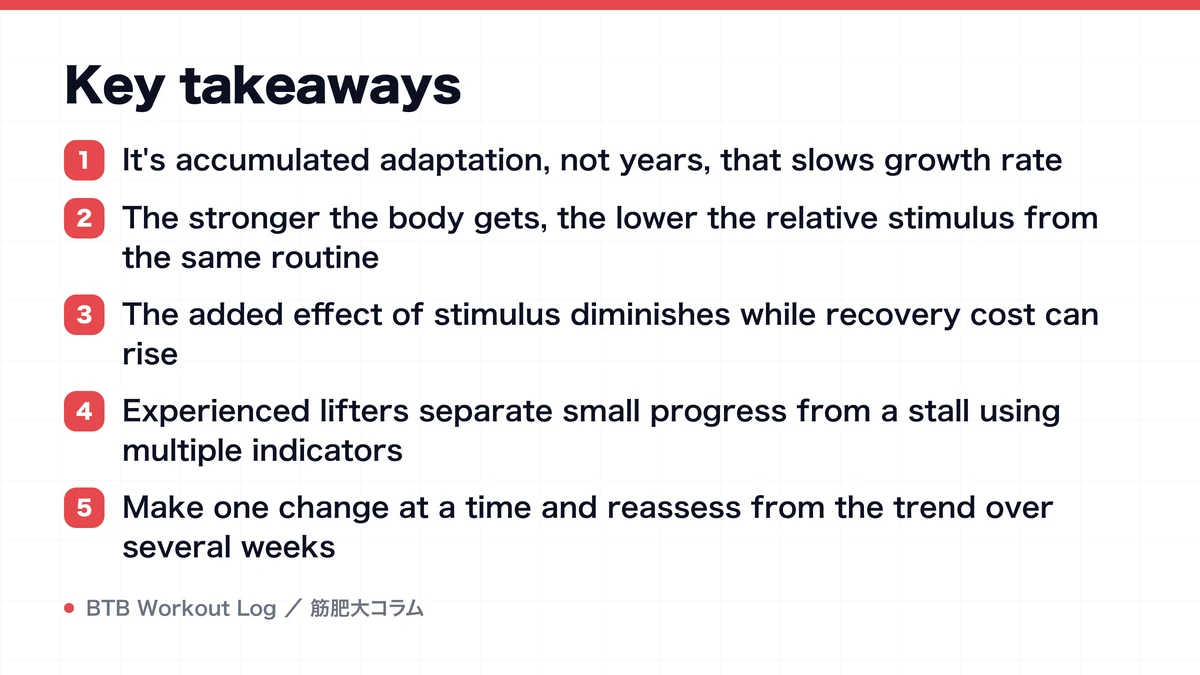
Key takeaways
- It's accumulated adaptation, not years, that slows growth rate
- The stronger the body gets, the lower the relative stimulus from the same routine
- The added effect of stimulus diminishes while recovery cost can rise
- Experienced lifters separate small progress from a stall using multiple indicators
- Make one change at a time and reassess from the trend over several weeks
References
- ACSM Position Stand: Progression Models in Resistance Training for Healthy Adults
- The Resistance Training Dose Response: Meta-Regressions Exploring the Effects of Weekly Volume and Frequency on Muscle Hypertrophy and Strength Gains
- Resistance Training Volume Enhances Muscle Hypertrophy in Trained Men