Does a 30-Rep Weight Really Build Hypertrophy? | Good News for Home Gym Lifters, Put to the Test
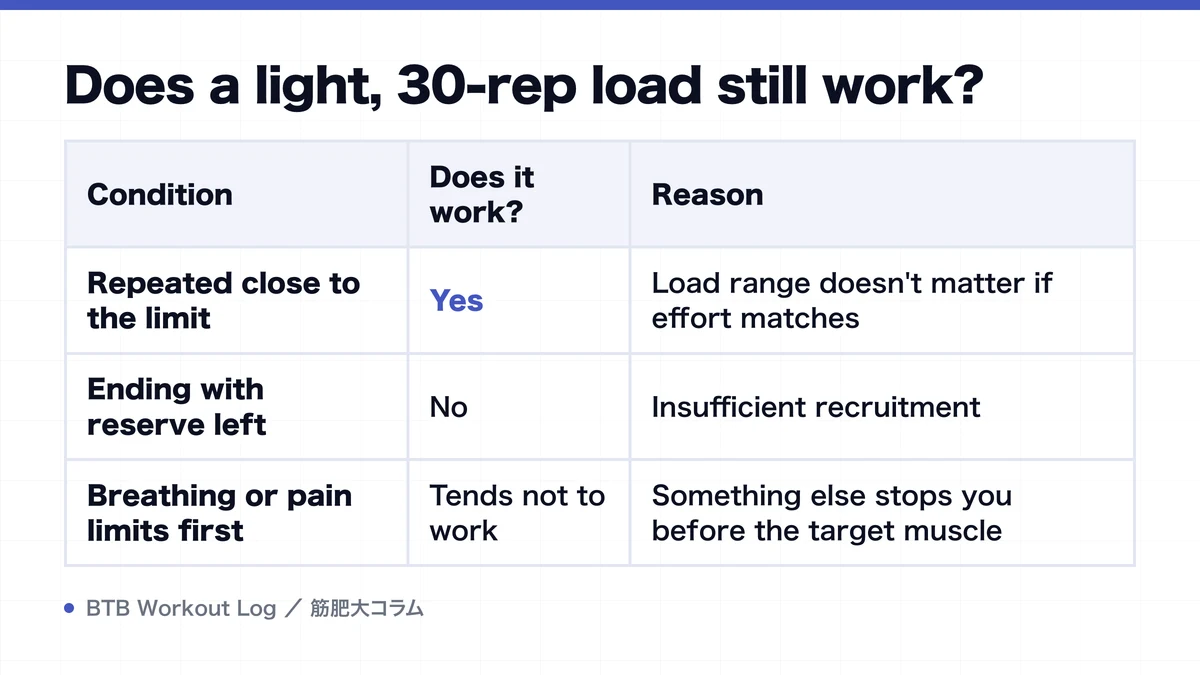
A light weight that reaches its limit around the 30th rep can still produce hypertrophy. But the number 30 alone isn't sufficient. The condition is genuinely working the target muscle, approaching the limit while holding form, and being able to recover from and progress that stimulus.
What to test isn't "could you do 30 reps" — it's what ended that set, and whether you can raise load or reps over the following weeks. We'll separate the effectiveness of low load in general from the conditions for keeping a 30-rep set in an actual routine.
"A weight that lets you do 30 reps" and "30% 1RM" aren't the same
"A weight that lets you do 30 reps" usually means a load near 30RM — one where you can complete roughly 30 reps with correct movement. 30% 1RM, often used in research, is 30% of the weight you can lift just once. Since achievable reps shift with the individual, exercise and movement speed, 30% 1RM doesn't mean everyone hits their limit at 30 reps. Confusing the two makes it impossible to correctly compare the load tested in research against your own set.
The question here isn't an easy 30 reps like a warm-up — it's whether a working set where the next rep with the same form gets difficult around the 30th rep can be used for hypertrophy. RIR (Repetitions in Reserve) describes remaining reps at the endpoint — RIR 2 means an estimated "2 more were possible." Finishing 30 reps at RIR 8 is lighter than what's under test here; finishing 25 reps at RIR 1 is a sufficiently demanding set even within the same low-load range.
So the judging axis isn't reps alone — it's a combination of relative load, RIR, range of motion, form, and what actually ended the set. 30 isn't a boundary separating effective from ineffective — it's just one rep range for running a low-load set.
How far does research support low load around 30 reps?
A 2017 meta-analysis comparing low and high load defined low load as ≤60% 1RM and high load as >60%, pooling studies where every set was taken to momentary muscular failure. Hypertrophy was comparable between the load bands, while 1RM strength favored high load. In other words, you can't say muscle won't grow without heavy weight, but you also can't say low load equals high load for every purpose.
In the well-known Mitchell et al. trial, young men performed unilateral knee extension for 10 weeks, and no significant difference in quadriceps hypertrophy was found between a 30% 1RM condition taken to failure across 3 sets and an 80% 1RM condition also across 3 sets. This supports that hypertrophy is possible at low load, but it wasn't a trial testing exactly 30 reps. The load percentage 30% 1RM and the rep ceiling 30RM need to be read as separate things. See a breakdown of the Mitchell 2012 study for design detail.
These results are also averages, covering conditions like a single-joint leg exercise, young men, and a defined duration. There's no guarantee the same result holds for someone whose breathing limits first on squats, or whose lateral raise motion leaks into the traps. What research supports is the range "low load with sufficient effort can act as hypertrophy stimulus too" — not a prescription that "you should choose 30 reps on every exercise."
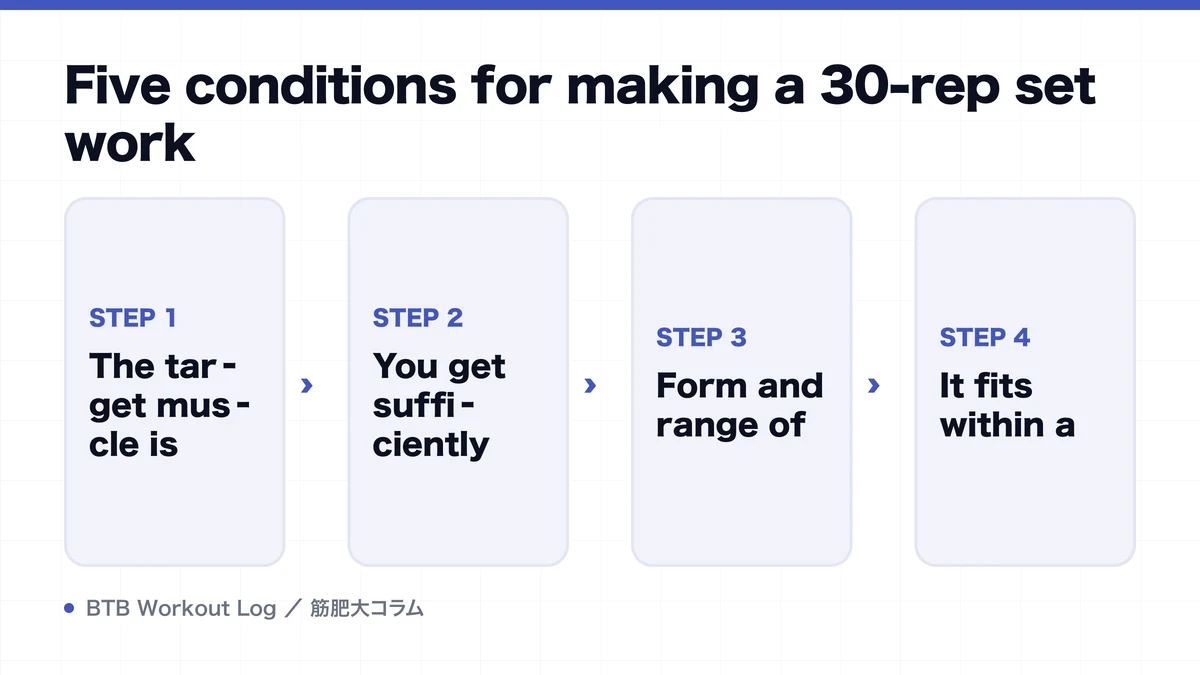
Five conditions for making a 30-rep set work for hypertrophy
- The target muscle is what ends the set: 30 reps stopped by cardiovascular strain, grip, holding posture, or joint discomfort doesn't necessarily mean the target muscle was sufficiently worked.
- You get sufficiently close to the limit: at low load, early reps are light, so leaving too much reserve makes valid stimulus hard to reach. That doesn't mean complete failure is mandatory every set — start by logging RIR and check whether you can reproduce roughly RIR 1–3.
- Form and range of motion hold: pushing to 30 reps by adding momentum isn't progress under matched conditions. Keep load on the target muscle consistent from the first rep to the last.
- It fits within a recoverable volume: if too many high-rep sets keep lowering the same muscle group's next-time results, you've raised recovery cost by more than the added stimulus.
- It progresses over the long term: raise total reps at the same weight, movement and RIR, or add a small increment once you hit your set ceiling. Just doing 30 reps every time isn't progressive overload on its own.
Of these five, what ends the set is especially easy to overlook. A muscle's local limit and an inability to tolerate breathlessness or pain aren't the same thing. If you adopt low load, evaluate not just the achievement of "did 30 reps" but which muscle, at what phase of the movement, and for what reason stopped it.
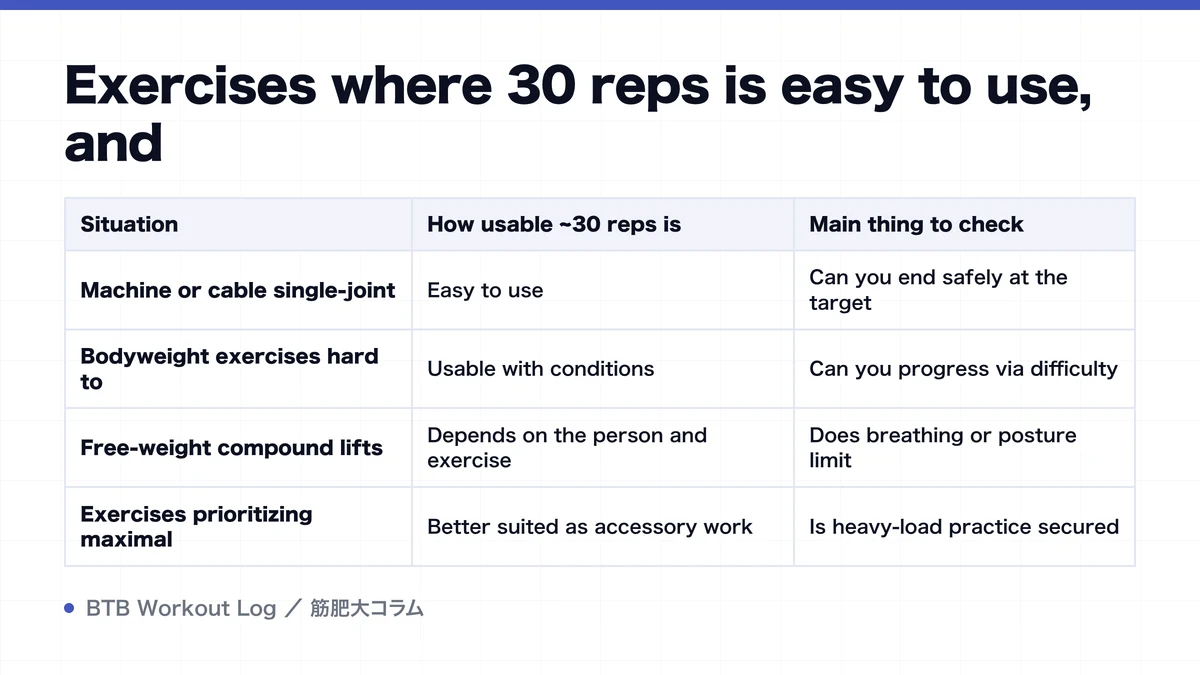
Exercises where 30 reps is easy to use, and exercises where you'd rather raise load
| Situation | How usable ~30 reps is | Main thing to check |
|---|---|---|
| Machine or cable single-joint exercises | Easy to use | Can you end safely at the target muscle's limit? |
| Bodyweight exercises hard to load-adjust | Usable with conditions | Can you progress via difficulty or range of motion? |
| Free-weight compound lifts | Depends on the person and exercise | Does breathing or posture limit before the target muscle? |
| Exercises prioritizing maximal strength | Better suited as accessory work | Is heavy-load practice secured elsewhere? |
| Exercises where RIR stays large even at 30 reps | Prone to insufficient load | Is there room to raise weight or difficulty? |
On exercises like lateral raises, leg extensions, or cable curls — where you can end safely while holding movement — a roughly-30-rep range is easy to trial. On squats or deadlifts, though, aiming for 30 reps can leave some people limited by breathing, grip, or core before the target muscle. Don't decide by exercise name alone — judge from your own stopping reason.
Light external weight doesn't necessarily mean low joint stress either. Repeating the same movement many times, or a path that shifts under fatigue, can create a different kind of stress. Rather than pushing through pain to reach 30 reps, choose an exercise you can repeat without strain. See how to think about rep range for using a broad range together with this.
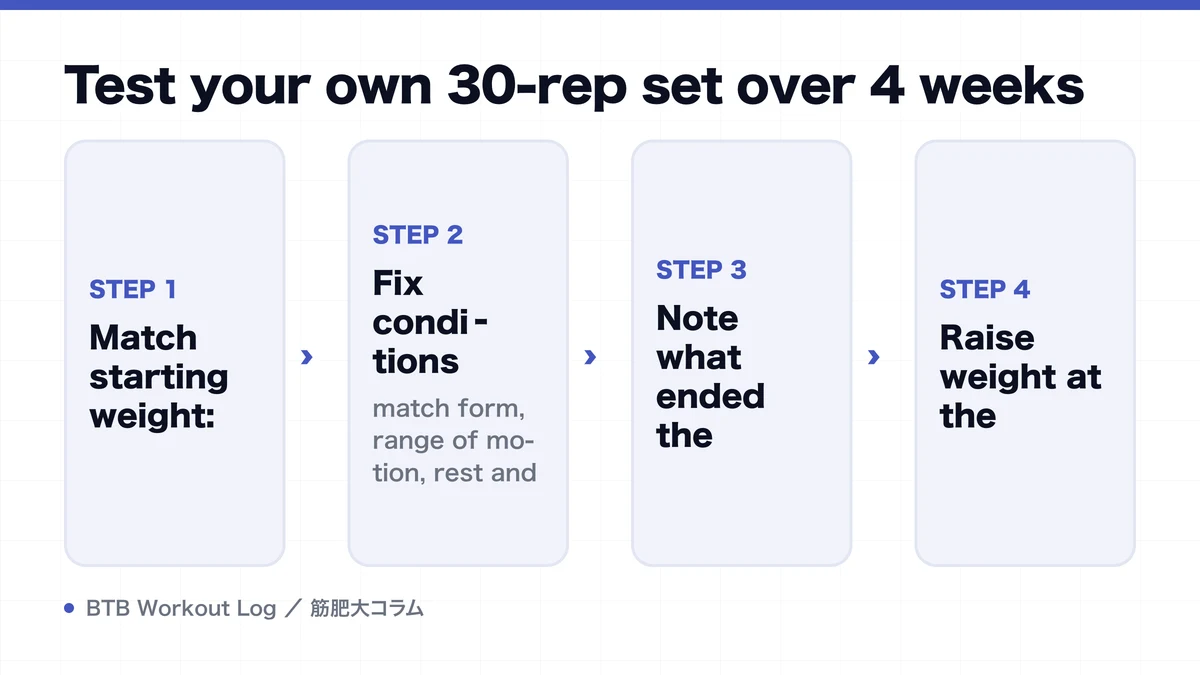
Test your own 30-rep set over 4 weeks
Whether to keep a 30-rep range isn't decided from one pump or bout of soreness — judge from the trend under matched conditions. First pick one exercise you can safely abort, and observe for roughly 4 weeks without substantially changing other exercises, weekly set count, or rest time. Changing several variables at once makes it impossible to isolate the effect of the 30-rep range.
- Match starting weight: find a weight where set one lands around 25-30 reps at RIR 1-3.
- Fix conditions: match form, range of motion, rest and set count, and log each set's reps and RIR.
- Note what ended the set: distinguish between the target muscle, cardiovascular strain, grip, pain, or form breakdown.
- Raise weight at the ceiling: once every set reaches your defined ceiling at comparable RIR, raise weight by the smallest available increment.
- Watch next-time results: if reps don't rise for several weeks, later exercises decline, or recovery isn't happening, adjust load band or set count.
Some people find RIR estimation drifts more at high reps. One method: on just the final set of a safe exercise, occasionally push to true failure and check the gap between your reported RIR and the reps you could actually add. That said, more failure sets don't automatically mean more benefit — how to treat reaching failure should be considered separately, using testing failure every set.
Use as your material not a single 30-rep record, but whether reps rise under matched conditions and whether you can rebuild into your target range after a weight increase.
Conditions for adopting a 30-rep range, and conditions for calling it off
A roughly-30-rep set is adoptable when the target muscle approaches its limit first, form and range of motion hold, later sets and next-time recovery aren't hurt, and reps or weight can progress. It's a practical option in situations like limited home equipment, coarse difficulty adjustment on bodyweight exercises, or discomfort at heavy load.
Conversely, if breathlessness or grip keeps giving out first, 30 reps takes too long to fit your planned sets, RIR isn't reproducible, or neither reps nor weight progress after several weeks, there's room on that exercise to raise load and lower reps. Being capable of hypertrophy and being efficiently sustainable within your own routine are different questions.
A weight light enough for 30 reps can be used for hypertrophy if conditions are met, but 30 reps itself doesn't guarantee the effect. Rather than treating rep count as pass/fail, only once you match what ended the set, RIR, movement, recovery, and progress over several weeks can you test whether that lightness actually works for you.
FAQ
- If I can do 30 reps, should I raise weight right away?
- If you land in RIR 1–3 at 30 reps, hold form and range of motion, and every planned set reaches your ceiling, a small increase is worth considering. If reserve is still large at 30 reps, load may be insufficient; if movement is breaking down, lower weight or reps first instead.
- Does a 30-rep set need to go to failure every time?
- Complete failure can't be treated as mandatory every set. At low load, getting sufficiently close to the limit matters, but it's workable at roughly RIR 1–3 too. Occasionally check the true limit on the final set of a safe exercise, and keep it within a range that doesn't hurt later sets or next-time results.
- Is a weight I can do more than 30 reps with unusable for hypertrophy?
- Not immediately unusable, but the more reps involved, the more likely cardiovascular strain, pain tolerance, or time become the limiter before the target muscle, and research certainty drops too. It's practical to first raise weight or movement difficulty back to a range where the target muscle's limit is easier to judge.
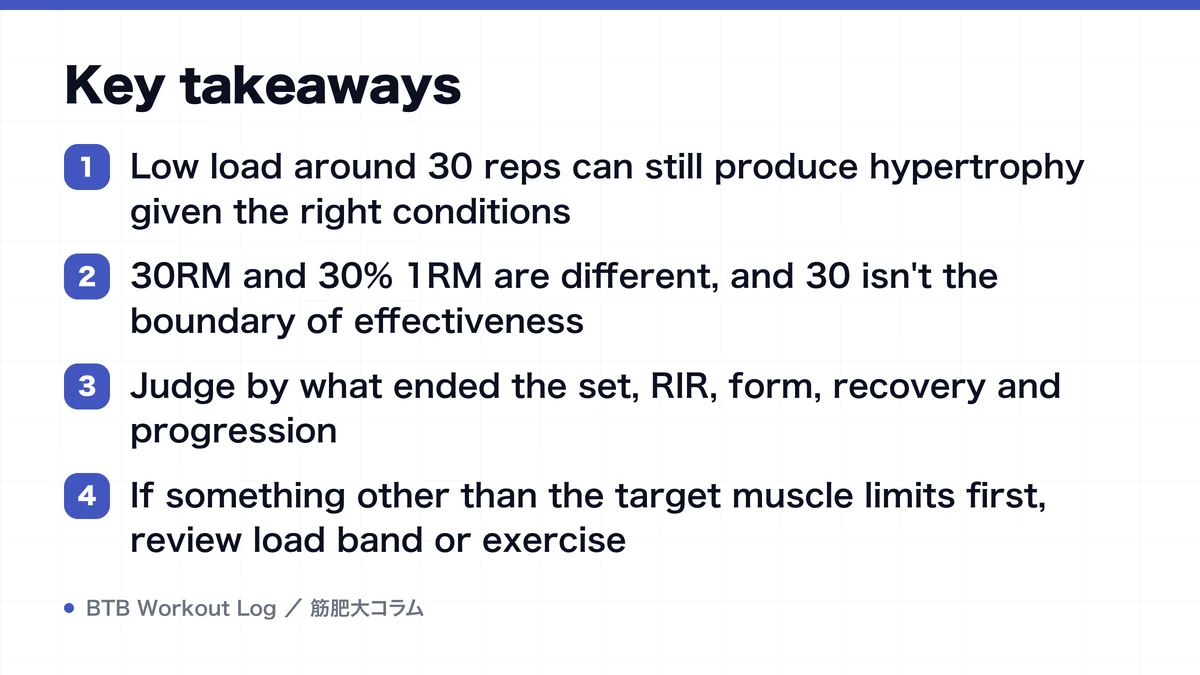
Key takeaways
- Low load around 30 reps can still produce hypertrophy given the right conditions
- 30RM and 30% 1RM are different, and 30 isn't the boundary of effectiveness
- Judge by what ended the set, RIR, form, recovery and progression
- If something other than the target muscle limits first, review load band or exercise