
Why Lifters Who Log Their Training Catch a Plateau Sooner | What Non-Loggers Miss
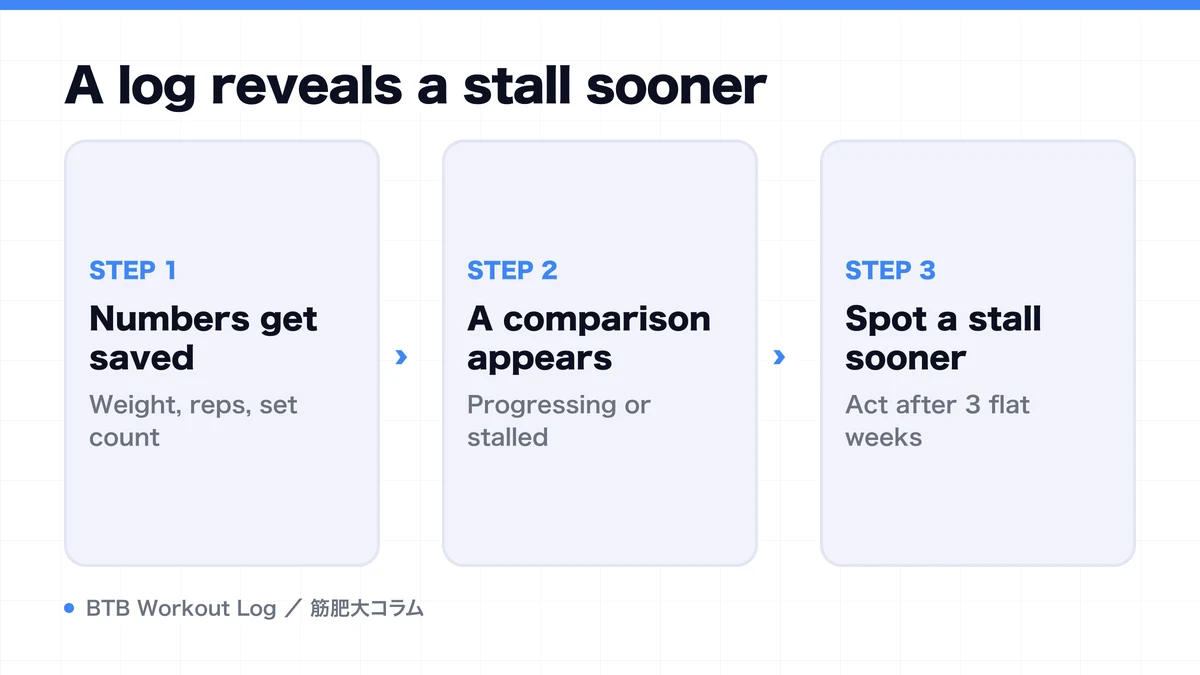
People who log their training notice a plateau sooner because they can confirm it not as "today felt off," but as a trend accumulated under matched conditions across weight, reps, set count and RIR.
The log itself doesn't add muscle. But it becomes an observation instrument for identifying where and when progress stopped, and deciding what to change next.
The weakness in the intuition "you can just feel a plateau"
A plateau doesn't begin the moment one day's set felt heavy. Even the same person's performance swings day to day with sleep, diet, exercise order, warm-up, rest between sets, and work fatigue. Changing your routine just because you did one rep fewer than last time risks mistaking normal variance for a plateau.
Conversely, relying purely on each session's impression can also miss a genuine plateau. Even with a feeling of "I pushed hard today" or "that pumped," the same weight, reps and effort level might have continued unchanged for weeks. Memory tends to get pulled toward a recent strong experience and can't accurately reproduce each set from several weeks ago.
In other words, sensation isn't unnecessary — the problem is that sensation alone makes it hard to distinguish a single off day from ongoing stagnation. A plateau is a pattern across time, not a single point, so the sooner you have a log you can line up across several sessions, the sooner you can confirm that pattern.
A log fixes "your past self" as a comparison baseline
A log's biggest role is keeping a baseline. The number "bench press 80kg for 8 reps" alone, for instance, doesn't tell you whether that's progress or a plateau. If the same 80kg was 6 reps in the past, reps have risen. If it's the same 8 reps but RIR (an estimate of how many more reps were possible) went from 0 to 2, you may have completed the same work with more reserve. But if you could previously do 10 reps, that's a decline.
Progressive overload isn't only raising weight. Reps rising under the same movement conditions, completing the same weight and reps with more reserve, or completing needed weekly sets at high quality — these are all material for gradually advancing load too. With a log, you can read "did I progress" not as a vague sense of satisfaction, but as a difference against your baseline from last time.
Only once that difference disappears across several sessions does the hypothesis of a plateau form. A log doesn't auto-diagnose a plateau, but it prevents losing the comparison point that diagnosis needs.
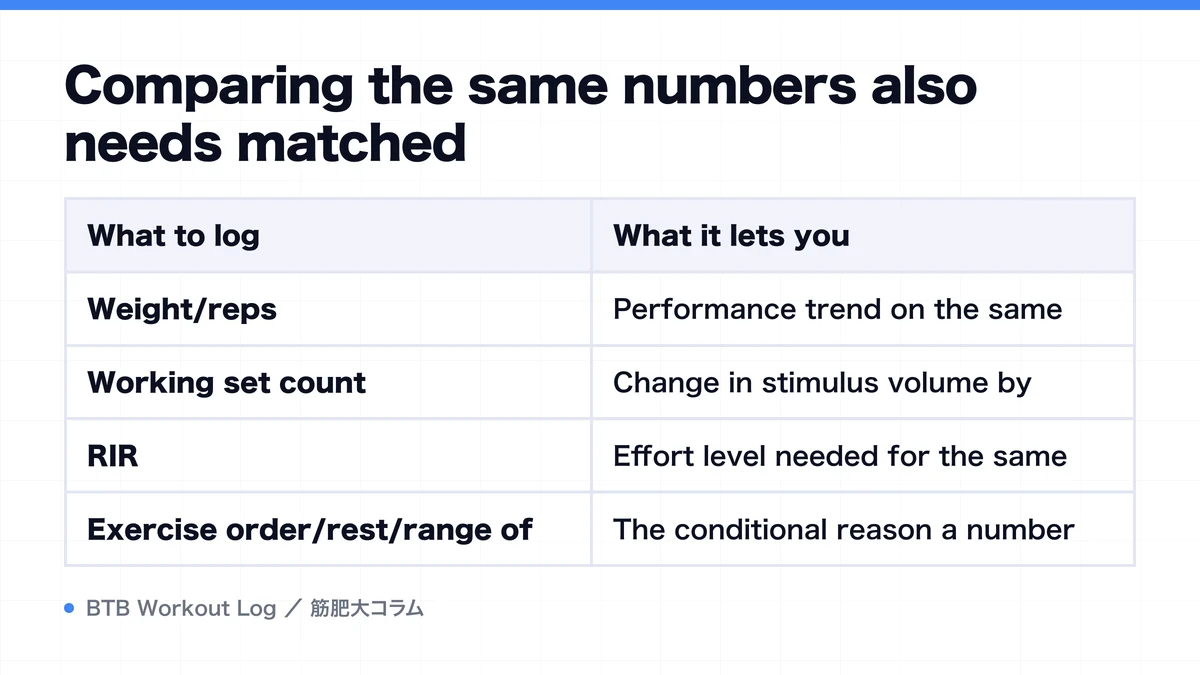
Comparing the same numbers also needs matched conditions and effort level
Even with a log, if comparison conditions vary, the trend blurs. Line up a day squats were your first exercise against a day they came after 3 other leg exercises, and it's no surprise the latter's reps are lower. Changes like going deeper, cutting rest, or tightening form also change what the number means.
| What to log | What it lets you distinguish |
|---|---|
| Weight/reps | Performance trend on the same exercise |
| Working set count | Change in stimulus volume by exercise/muscle group |
| RIR | Effort level needed for the same weight/reps |
| Exercise order/rest/range of motion | The conditional reason a number changed |
| Brief notes on sleep loss, pain, etc. | A clue explaining a temporary decline |
You don't need to log everything in fine detail. Make weight, reps and working set count mandatory first, and add per-set RIR. Leaving a brief note only on days you changed conditions preserves comparability while keeping logging effort low. Rather than adding so many fields that logging stops being sustainable, it's more useful to keep tracking a small number of decision-relevant metrics the same way every time.
Weight stalling doesn't necessarily mean a plateau yet
Judging hypertrophy-relevant progress from weight alone declares a plateau too hastily. Even at the same weight, if reps went from 8 to 10, if you could add a set at the same RIR without it shrinking, or if range of motion and form held, at least your training capability is still moving. Conversely, even if weight alone rose, if reps dropped substantially, range of motion narrowed, or compensatory movement increased, you can't fully call that progress on the same scale as before.
On a weekly basis, also check training volume. An average dose-response relationship is shown between hypertrophy and weekly set count, but that doesn't mean adding sets always produces more growth. The meaning and recovery cost of the same set count shift with RIR, exercise, frequency and recovery status. The log's advantage isn't hitting a fixed correct answer — it's letting you connect the volume you're currently completing with subsequent performance.
Volume load — weight times reps times sets — can also serve as a reference line within a range where you keep the same exercise and method. But you can't simply add up numbers across different exercises or ranges of motion as equivalent stimulus to the muscle. If only volume load rises while your main exercise's reps or RIR worsen, don't immediately conclude "more work toward growth" — suspect instead whether you can recover from the added amount. Use the log not as a race to inflate numbers, but as a way to read the combination of stimulus and response.
Watching whether several indicators have stalled under comparable conditions makes it easier to separate a false weight-only plateau from a genuine one worth intervening on. This doesn't directly measure hypertrophy itself — it's a method for monitoring whether day-to-day training is still progressing.
Five steps for judging a plateau from your log and moving to a change
- Decide a baseline exercise: per muscle group, choose the main exercise that's easiest to track consistently.
- Match your main metrics: log weight, reps, set count and RIR, and keep exercise order and range of motion as constant as possible.
- Watch several sessions, not one day: in practice, use the most recent 3-6 sessions of the same exercise as your window, checking direction rather than a single up or down. This isn't a physiologically defined plateau boundary - it's an operational rule to avoid changing too hastily.
- Isolate the scope: check whether just one exercise stalled, several exercises on the same muscle group did, or your whole body declined. Different scopes point to different hypotheses to test - technique, stimulus volume, local fatigue, whole-body recovery.
- Change one thing at a time: pick a fix for the plateau, don't change weight, rep range, set count, frequency and recovery all at once, and watch the response over your next comparison window.
3 weeks on an exercise done once a week gives you 3 observation points; 3 weeks on an exercise done 3 times a week gives you 9. So rather than fixing a rule like "X weeks with no progress = a plateau" uniformly, it fits reality better to count how many comparable sessions you've actually run. The more experienced you are, the smaller your progress increments - so it can be worth extending your judgment window and including reps and RIR too.
Rather than deciding the cause from a displayed number alone, it's better used by testing one hypothesis and comparing what moved before and after. Whether it's a plateau is decided by whether the same exercise's numbers haven't moved in 3 weeks. BTB Workout Log is a tool for keeping the history that judgment needs.
The procedure for finding a plateau in your log is fixed. Lay out the weight and reps of your main exercises in time order, then lay out weekly total sets, then overlay bodyweight. If all three have stopped at once, that's a target for intervention; if any one of them is moving, it's fine to wait and watch. Start from feel and you can't make this distinction.

FAQ
- How many weeks without progress before I can call it a plateau?
- There's no universal number of weeks. An exercise done once a week and one done 3 times a week give different observation counts, so use the most recent 3–6 comparable sessions as your practical comparison window. Consider a change once weight, reps and RIR have all stayed unchanged for that window.
- What's the minimum I should log to notice a plateau?
- Exercise name, weight, reps per set, working set count, and RIR are the basics. Leave a brief note on days you changed exercise order, rest or range of motion, to make comparison easier. Sleep or pain can be logged just as supporting notes explaining an off day.
- If weight isn't progressing, has hypertrophy stopped too?
- Not necessarily. It's still progress if reps rose at the same weight, you completed the same reps with more reserve, or form and range of motion improved. Since a training log isn't a direct measurement of hypertrophy, check body weight, measurements, or photos on a separate timescale.
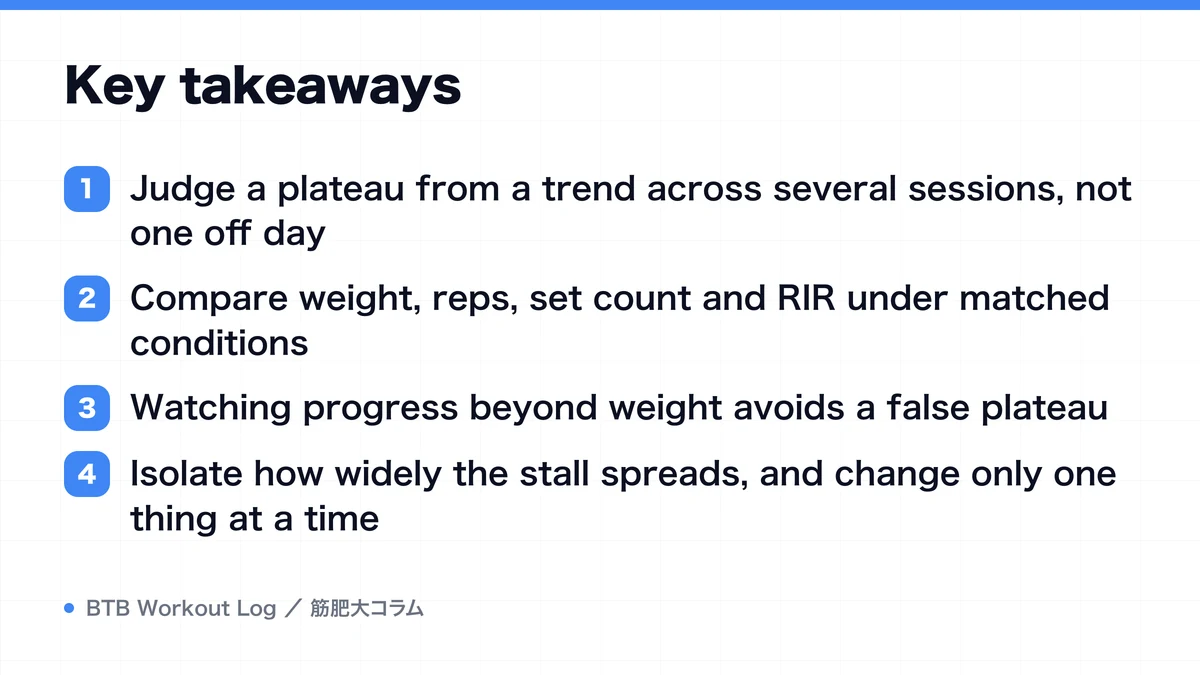
Key takeaways
- Judge a plateau from a trend across several sessions, not one off day
- Compare weight, reps, set count and RIR under matched conditions
- Watching progress beyond weight avoids a false plateau
- Isolate how widely the stall spreads, and change only one thing at a time