
Muscle Growth Without Training to Failure | No Need to Burn Out
Growing muscle needs enough reps with real tension, repeated within what you can recover from — not failing the last rep of every set. That condition can be met a little short of the limit.
Going to failure makes the intensity of a set easy to confirm, but there's no special mechanism that switches hypertrophy on only at the boundary between success and failure. What matters isn't whether you failed — it's how close you got, and what that cost you in the next set and the next session.
The failed rep isn't the switch that turns on growth
Failure — reaching the point where you can't lift a given load with correct technique — draws a clean line on paper between a set you finished and one you stopped mid-rep. What's happening in the muscle doesn't flip from zero to maximum at that line.
As a set progresses, the force you can produce shrinks, bar speed drops, and the effort needed to keep moving rises. By the time you're just short of failure, the muscle has already been asked for high force repeatedly. Stopping with one rep left doesn't retroactively erase the tension built through everything before it. Conversely, grinding to failure by changing your form doesn't earn much credit if load came off the target muscle to get there.
Training to failure is one way to get stimulus, but making failure itself the goal loses sight of movement quality and the next set. For hypertrophy, what you accumulated on the way toward the limit is more useful to look at than the single failed rep outside your successful count.
The fibres you need get recruited before failure too
Muscle doesn't use every fibre equally from the first rep — motor units are recruited in proportion to the force demanded. A relatively heavy load needs high force from the start. A light load recruits more units as the reps already working fatigue and the same force has to be maintained. So a sufficiently effortful set can build stimulus regardless of which load you used.
"You don't have to go to failure" doesn't mean "stop wherever's comfortable", though. RIR (Reps in Reserve) is your estimate at the end of a set of how many reps you had left. Too much RIR — especially on a light load — can mean you stopped before reaching the recruitment you needed. But treating it as a strict binary — no stimulus unless RIR hits zero — isn't accurate either. What managing RIR is really about is how reliably you land in your intended range, not whether it hit exactly zero.
The lighter the load, the more slack sits in the early reps, so generally the need to approach failure rises. On moderate-to-heavy compounds, leaving a little RIR still produces high force while keeping technique intact, so you can secure stimulus without grinding. That connects to choosing between heavy and light: rather than one RIR for every exercise, it's more sensible to set it by load and exercise characteristics.
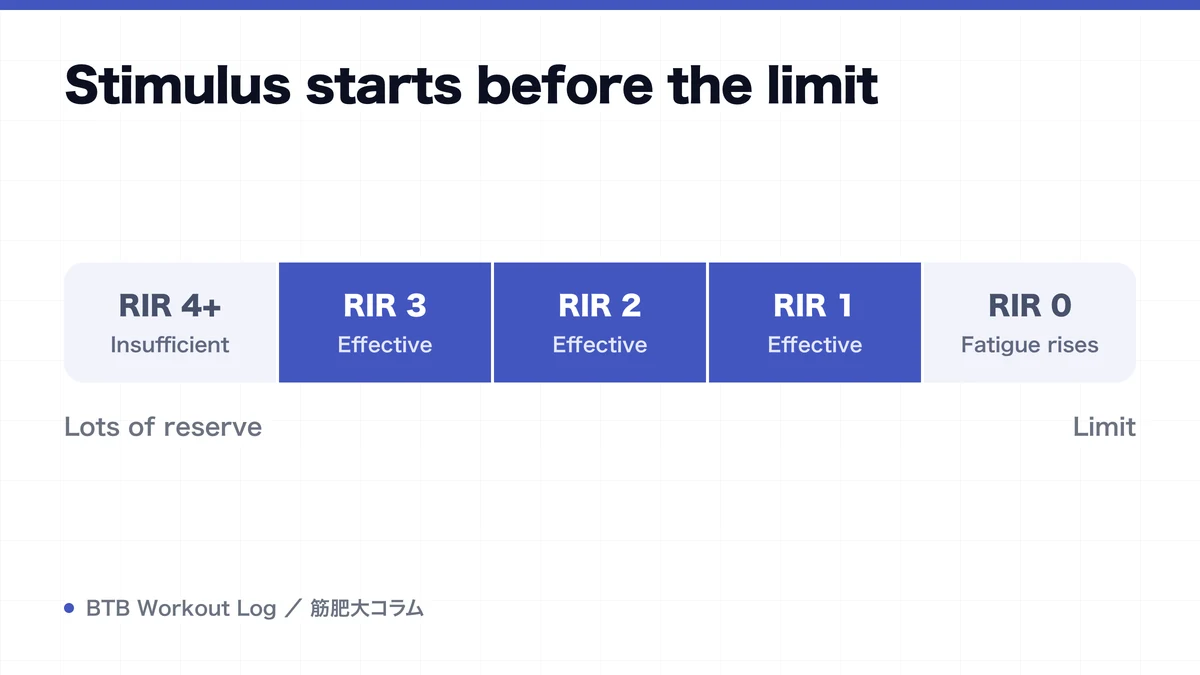
Closer to failure, fatigue can outpace stimulus
The final reps approaching failure aren't easy. They demand high effort, which pushes stimulus up. But that last rep from near-failure to actual failure doesn't raise stimulus alone while fatigue stays flat. Local fatigue, breathlessness, mental drain and slower bar speed all climb together.
Looking only at that one set undersells the cost. Take set 1 to failure and reps on set 2 onward can fall sharply, shrinking the quality reps you can bank across the week at the same form. If fatigue lingers into the next session and load or reps don't return, frequency and progression suffer too. Hypertrophy comes from repeating a recoverable stimulus over weeks and months, not from how brutal any single set was — so maximum effort every time doesn't guarantee the maximum long-term result.
It helps not to assume stimulus and fatigue rise in a straight line together. Pushing a set that's far from failure a bit harder can be worth a lot; pushing one that's already close all the way to failure may add little stimulus while adding a lot of fatigue. Set count works the same way — adding more isn't always a win, as covered in why too many sets backfire. Effort per set has a similar ceiling on what it pays back.
How far the research supports skipping failure
Systematic reviews and meta-analyses comparing training to failure with stopping short generally find no clear hypertrophy difference, and conclude that failure isn't a necessary condition. A separate review on proximity to failure found no evidence that training to momentary failure outperforms non-failure training. So results don't rise in a straight line the closer you get to the limit.
That doesn't mean "any RIR is equivalent", though. Studies differ in how they define failure, and in whether load, sets, participant experience and volume were matched. Most work centres on young adults, which limits conclusions specific to advanced lifters or the ideal RIR per exercise. One analysis found a small advantage for failure in a trained-lifter subgroup — worth noting, but not something to generalise broadly.
What carries over into practice: failure can be dropped as a requirement, but that doesn't license sets that stay far from the limit either. Rather than treating the gap between RIR 1 and RIR 3 as a precise universal boundary, getting genuinely close and then watching recovery and progress fits the current evidence better.
Decide by exercise and by what it costs the next set
A workable default: leave more in reserve on earlier sets, and get closer to the limit as you go. Technical, whole-body exercises like squat and bench press hold set quality afterward better if you stop at RIR 1–3 with form intact. Exercises with lower risk at failure and easier target isolation — leg extensions, cable curls — can afford taking a final set to RIR 0 to check the sensation.
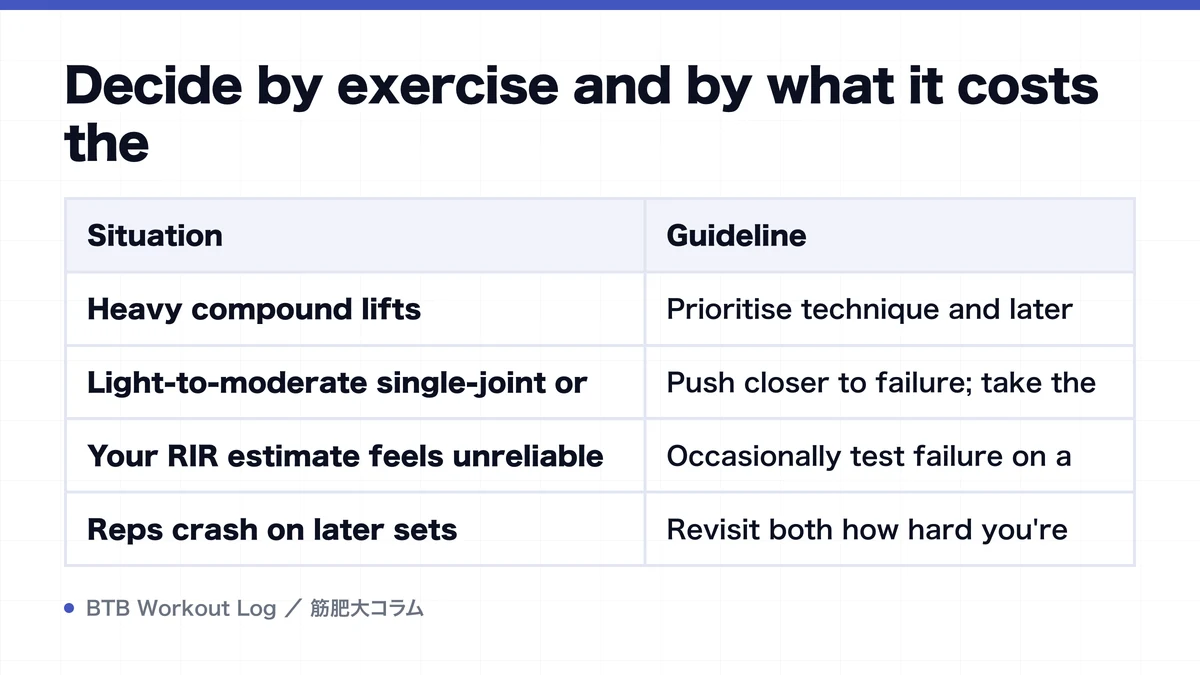
| Situation | Guideline |
|---|---|
| Heavy compound lifts | Prioritise technique and later sets — mostly RIR 1–3 |
| Light-to-moderate single-joint or machine work | Push closer to failure; take the last set to RIR 0 if useful |
| Your RIR estimate feels unreliable | Occasionally test failure on a safe exercise to recalibrate |
| Reps crash on later sets | Revisit both how hard you're pushing and your rest periods |
Judge from RIR per set, load, reps, form consistency, rep drop-off under matched conditions, and recovery by next time. RIR isn't a fully objective measurement, so occasionally taking a safe exercise to failure lets you check your "two left" estimate against reality. If load or reps then keep climbing on the same exercise at your intended RIR, you're progressing without failing every time.
Layer your RIR sense on top of the load and rep trend per set, and check whether easing off effort still lets weekly reps and next-session performance hold — that's how you tune how close to the limit you personally need to go.
FAQ
- If I'm not going to failure, how much should I leave in reserve?
- RIR 1–3 is a reasonable starting point for most sets. Lighter loads generally need to get closer to the limit, while heavy compounds may warrant prioritising technique instead. Judge from whether load or reps rise at your intended RIR and whether you recover by next time.
- If I can't judge RIR accurately, should I go to failure every time?
- Not every time — occasionally taking a safe machine or single-joint exercise to RIR 0 to recalibrate your everyday estimate is enough. Comparing the RIR you called with the reps you actually managed afterward, repeated over time, teaches you where your own estimate tends to drift.
- Where should I place the sets I do take to failure?
- A good candidate is the final set of a machine or single-joint exercise late in the session, where failing is easy to make safe. That limits the knock-on effect compared with failing early on a heavy compound. If reps crash sharply or the next session's load falls repeatedly, cut back the frequency.
Key takeaways
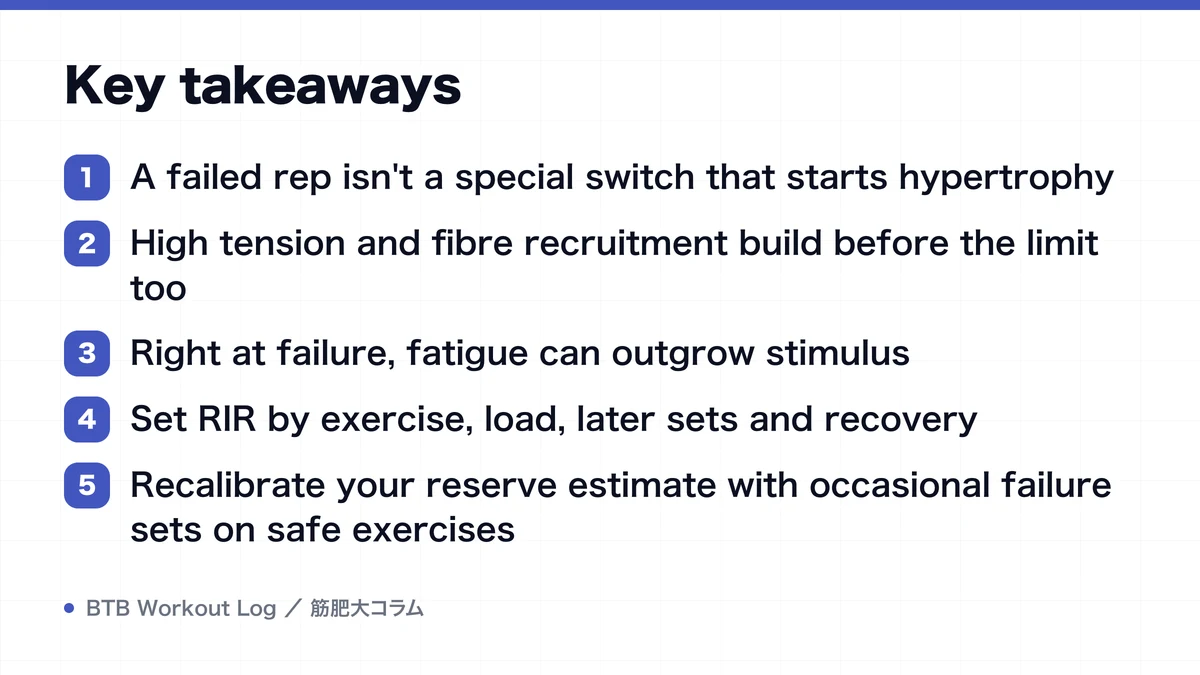
- A failed rep isn't a special switch that starts hypertrophy
- High tension and fibre recruitment build before the limit too
- Right at failure, fatigue can outgrow stimulus
- Set RIR by exercise, load, later sets and recovery
- Recalibrate your reserve estimate with occasional failure sets on safe exercises