7 Ways to Break a Training Plateau | Find the Real Cause Before You Give Up on Making Gains
Most plateaus are not a talent ceiling but one of four things: (1) not enough stimulus, (2) not enough recovery, (3) not enough nutrition, or (4) simply never beating last session's numbers. Once you sort out the cause, the fix decides itself.
Before you pile on more exercises, use your log to pinpoint where you are actually stuck. Get the order wrong and time passes without you ever learning which fix worked.
First: confirm the plateau is real by checking your log
When you suspect a plateau, the first thing to do is look at your records. "I feel like I'm not progressing" usually turns out to mean the weight or reps ticked up slightly, or that there is no log at all and you were never beating last session. Line up the weight, reps, and volume load from the last few weeks, and if the numbers genuinely have not moved at all for 3 or more weeks, that is the definition of a plateau.
Stalling for 1-2 weeks is within normal variation. Sleep, food, the previous day's fatigue, and differences in measurement conditions alone can move your reps at the same weight by about 1 rep. If you change your program over short-term ups and downs, the change itself becomes new noise.
Also, a stalled weight does not necessarily mean hypertrophy has stalled. A weight plateau and a hypertrophy plateau are different things, and changes such as a deeper range of motion, more reps in reserve, or the same weight feeling easier are all part of progress.
Only records taken under matched conditions count for this call. If the number of warm-up sets, the exercise order, and the rest times differ every session, reps will vary even at the same weight. What you compare is working sets performed in the same order with the same rest.
Separate the normal slowdown that comes with experience from a plateau
The longer you have been training, the smaller your gains get (the relationship between experience and gains). Numbers that moved month to month in the beginner phase moving only over several months is a normal course, not a plateau that needs a fix.
A rough guide for telling them apart is whether anything is moving when you take a longer window. If you line up 3 months of records and nothing has moved, it is worth intervening; if there is even a slight upward trend, it is fine to keep going as you are. The more experienced you are, the longer the evaluation window needs to be.
The same caution applies during a cut. While you are eating fewer calories, holding your weights steady is a good outcome, and not gaining is not in itself a plateau. If you respond in this period by adding stimulus, you can eat into recovery and make things worse.
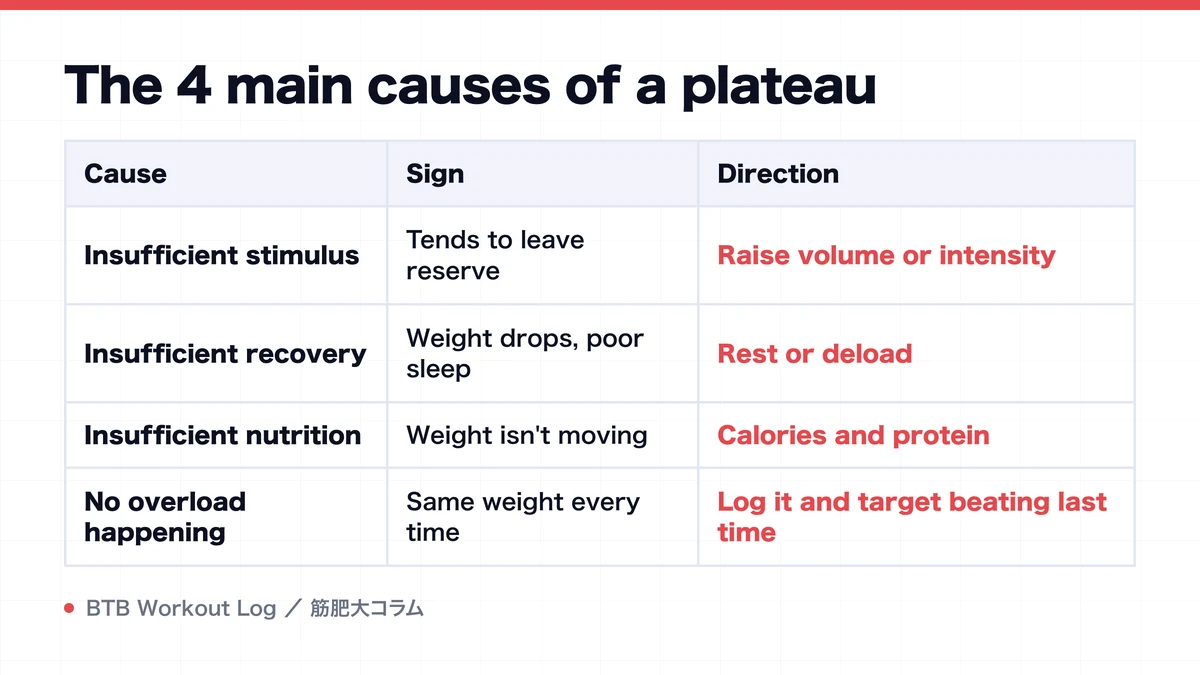
Sort through the 4 main causes of a plateau
| Cause | Signs | Direction |
|---|---|---|
| Too little stimulus | Leaving a lot in the tank; low set count | Raise volume or intensity |
| Too little recovery | Weights dropping; chronic tightness; poor sleep | Rest, deload |
| Too little nutrition | Body weight not rising; running out of energy | Review calories and protein |
| Overload never executed | Roughly the same weight every session | Log it and aim to beat last time |
Too little stimulus and too little recovery call for opposite fixes. Mistake one for the other and things get worse. Telling them apart is simple: if your weights are dropping it is too little recovery, and if you are holding your weights but leaving a lot of reps in reserve it is too little stimulus. When you cannot decide, trying a one-week deload first will sort it out.
Overload never executed is the most common of the 4 and the most overlooked. If you settle for roughly the same weight and the same reps every session, your body has no reason to change. Without records, you cannot even become aware of this cause. It is more efficient to rule this one out first, then suspect the other 3.
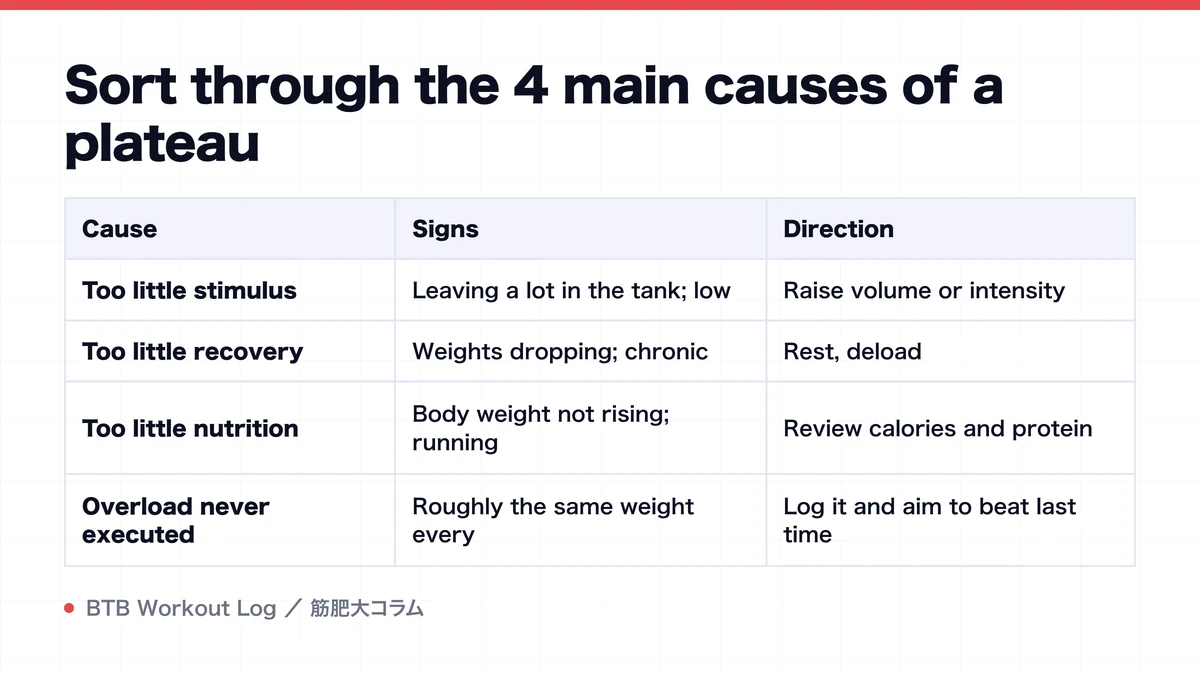
7 strategies to break through the plateau
- Flush fatigue with a deload: stalled progress alongside tightness means too little recovery. Insert a one-week deload.
- Add 1-2 sets of volume: if the stimulus is too low, raise your weekly sets slightly.
- Increase your push: if you're leaving too much in the tank, move your RIR toward 1-2.
- Shift rep ranges: if 8-12 is stalled, move to 5-8 or 12-20 to route around a plateau in the same weight range.
- Fix your nutrition: if your body weight isn't moving, check your calorie and protein intake.
- Prioritize sleep: recovery starts here. Target 7-9 hours.
- Improve form and range of motion: even at the same weight, a wider range of motion means more work done.
You do not need to do all 7 at once. Pick the one that matches the cause you identified in the previous section. If you run all of them without knowing the cause, nothing is left to learn from the next time the same situation comes around.
Keep the size of each fix gradual too. Up to 2 sets a week for set count, one step for RIR, 200-300kcal a day for calories. Swing something too far at once and the benefit and the side effects blur together, leaving you unable to judge. Changing something small and watching for 2-3 weeks gets you moving faster in the end.
Changing exercises is a low-priority fix
When you stall, the first thing you want to do is change exercises, but the priority is not high. Swapping an exercise resets the numbers, so you can no longer compare against last session. Even if you appear to be progressing on the new exercise, that is often just the early gain from learning the technique, and the cause of the plateau is still unsolved.
A swap is worth it when one specific exercise has not moved for a long time and either your joints feel off or your form breaks down so you cannot hold the range of motion (fixed routine vs rotating exercises). Otherwise, getting the conditions right on your current exercise solves it faster.
If you really want to introduce a change, there is a way to change the rep range or the order rather than the exercise itself. Move to 5-8 reps on the same exercise, or bring it to the start of the session. That way you can change the quality of the stimulus while keeping continuity in your session-to-session comparison.
Change one variable at a time
The classic mistake when you hit a plateau is overhauling exercises, set counts, and nutrition all at once. That leaves you unable to tell what worked, so you cannot use it next time. Form one hypothesis, change one thing, and observe for 2-3 weeks.
Decide in advance which metrics you will watch. Weight and reps on your main exercises, weekly sets, body weight, and hours of sleep - those four cover most decisions. Compare the 2 weeks before the change with the 2 weeks after on the same metrics and the numbers will tell you whether it worked.
A fix that did not work is information too. Once you know that adding volume did nothing for you, you can move on to recovery or nutrition next. Ruling them out one at a time gets you out in less time overall.
The test window fails if it is either too short or too long. Under 2 weeks it gets buried in day-to-day variation, and beyond 6 weeks other factors get mixed in. Treat 2-3 weeks as one cycle, and decide at the end of the cycle whether to continue or move on.
Even if you see no result partway through a cycle, do not add another fix mid-window. Adding one mid-cycle leaves you unable to tell which of them worked, and wastes the cycle itself. Waiting until the next cycle to add it leaves you with more information.
Separate a whole-program plateau from a single-exercise plateau
If every exercise has stalled at once, the cause is on the systemic side. Look at recovery, nutrition, sleep, and life stress first. If only one specific exercise has stalled, on the other hand, it is more likely a problem with that exercise's technique, a weak point, or its position in the session.
For example, only your bench press failing to progress and your weights failing to progress across the board call for completely different moves. Check the scope of the stall before you pick a fix.
Sometimes the stall is at the body-part level. In a case where your upper body progresses but only your legs are stuck, look first at that body part's weekly sets, frequency, and exercise order. If systemic recovery or nutrition were the cause, it would be less likely for only one body part to stall.
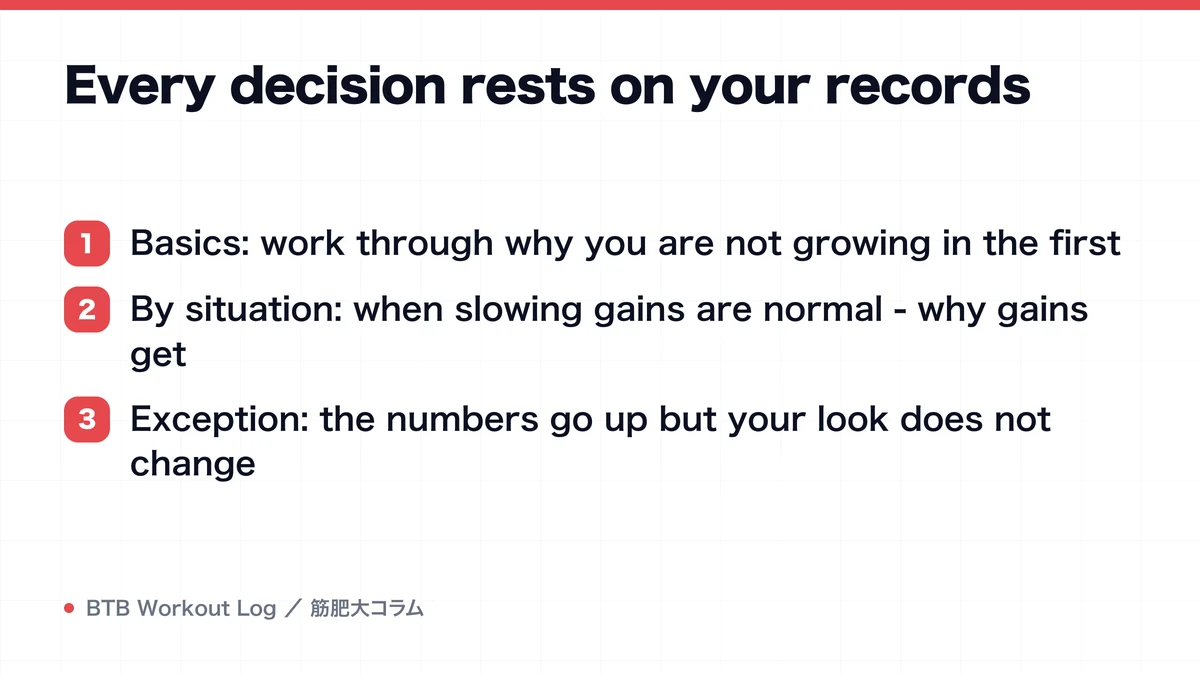
Every decision rests on your records
Everything above only takes its first step once you have records. What weight in kg and how many reps was your last bench, how many chest sets did you do this week, how many reps in reserve did you leave on each set. Only when you can answer those does sorting out the cause begin (finding a plateau from your log).
Conversely, with records in hand you can self-diagnose most plateaus. Are the numbers really flat, or are they moving and you just cannot feel it. Is the volume too low, or is recovery not keeping up. An app like BTB Workout Log lets you view per-exercise trends alongside weekly total sets, so you can run this diagnosis the same way every time.
A plateau is not a failure but a checkpoint that comes back again and again once the rapid beginner gains are over. Once you build the habit of identifying the cause and addressing it one at a time, you will get through the next plateau faster than the last.
Your records do not need to be fine-grained. Four fields - exercise, weight, reps, and rough reps in reserve - are enough to run every diagnosis above. The more fields you add the harder logging is to sustain, so narrowing it to the minimum you can keep up is more practical.
What to read next on plateaus
- Basics: work through why you are not growing in the first place - 7 reasons you are not gaining muscle
- By situation: when slowing gains are normal - why gains get harder as you gain experience
- Exception: the numbers go up but your look does not change - when you are getting stronger but not bigger
FAQ
- How long does a plateau have to last before I should intervene?
- If the same exercise shows no improvement in weight or reps for 3 or more consecutive weeks, start acting on it. Stalling for 1-2 weeks is within normal variation, so there is no need to panic and change things. If you are experienced, take a slightly longer evaluation window.
- Should I swap exercises when I hit a plateau?
- Changing exercises is a low-priority fix. Swapping an exercise means you can no longer compare against last session, which delays identifying the cause. Check recovery, intensity, nutrition, and your log first, and consider a swap only if one specific exercise is still stuck after that.
- Does everyone hit plateaus eventually?
- Yes. The rapid gains of the beginner phase always slow down, and from there progress comes as a repeating cycle of plateaus and breakthroughs. A plateau itself isn't a failure - the realistic view is to treat it as a checkpoint where you identify the cause and address it.
- How do I tell too little stimulus from too little recovery?
- If your weights are dropping it is more likely too little recovery, and if you are holding your weights but leaving a lot of reps in reserve it is more likely too little stimulus. When you cannot decide, inserting a one-week deload will tell you whether fatigue was the cause.
Key takeaways
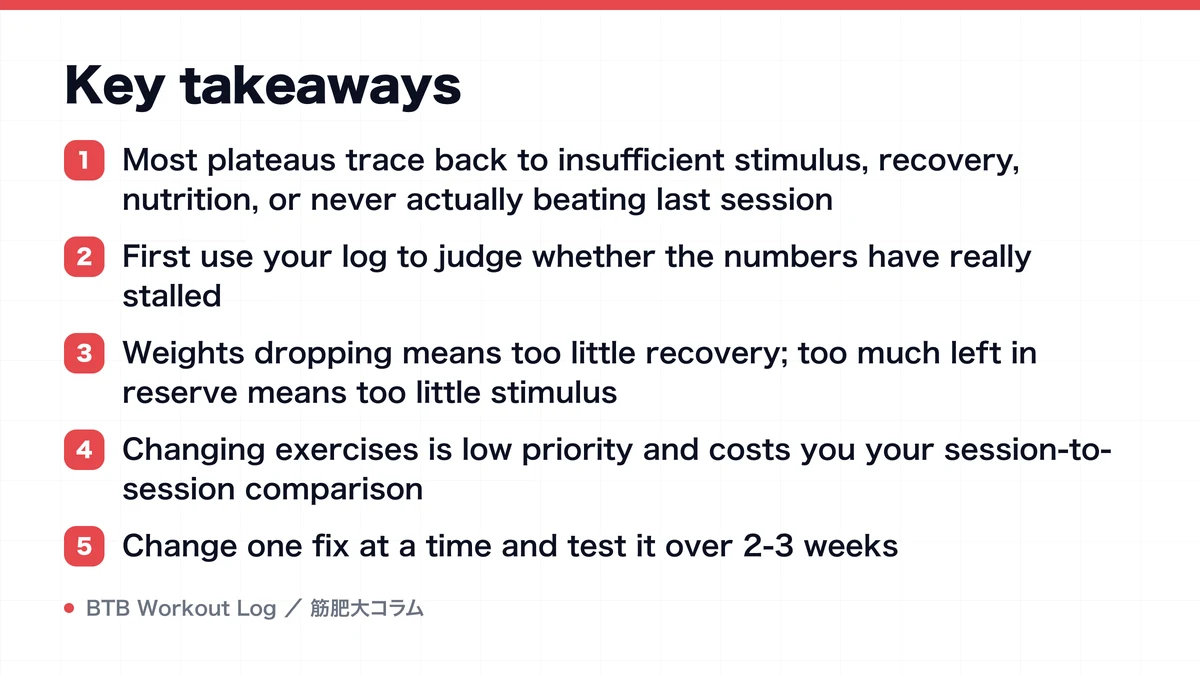
- Most plateaus trace back to insufficient stimulus, recovery, nutrition, or never actually beating last session
- First use your log to judge whether the numbers have really stalled
- Weights dropping means too little recovery; too much left in reserve means too little stimulus
- Changing exercises is low priority and costs you your session-to-session comparison
- Change one fix at a time and test it over 2-3 weeks
References
- Dose-response Relationship Between Weekly Resistance Training Volume and Muscle Mass
- Training to Repetition Failure or Non-failure: Systematic Review and Meta-analysis
- Nutrition Recommendations for Bodybuilders in the Off-Season
- Inadequate Sleep and Muscle Strength: Implications for Resistance Training
- ACSM Position Stand: Progression Models in Resistance Training for Healthy Adults
- Periodization, Strength and Muscle Hypertrophy: Systematic Review and Meta-analysis