Hypertrophy: Aim for 10–20 Sets per Week | How to Tell If You're Doing Too Few or Too Many
For hypertrophy, take 10-20 hard sets per muscle per week as a starting point, then adjust while watching progress in load and reps and your recovery. 10-20 isn't a fixed prescription - it's a rough guide for finding your own effective range.
Matching the number alone doesn't equalise the stimulus if contribution to the target muscle, RIR, range of motion, rest and frequency differ. First decide what counts as one set, then distribute those sets across the week, and finally judge from your log whether to add or cut.
10-20 weekly sets is a starting point, not the right answer
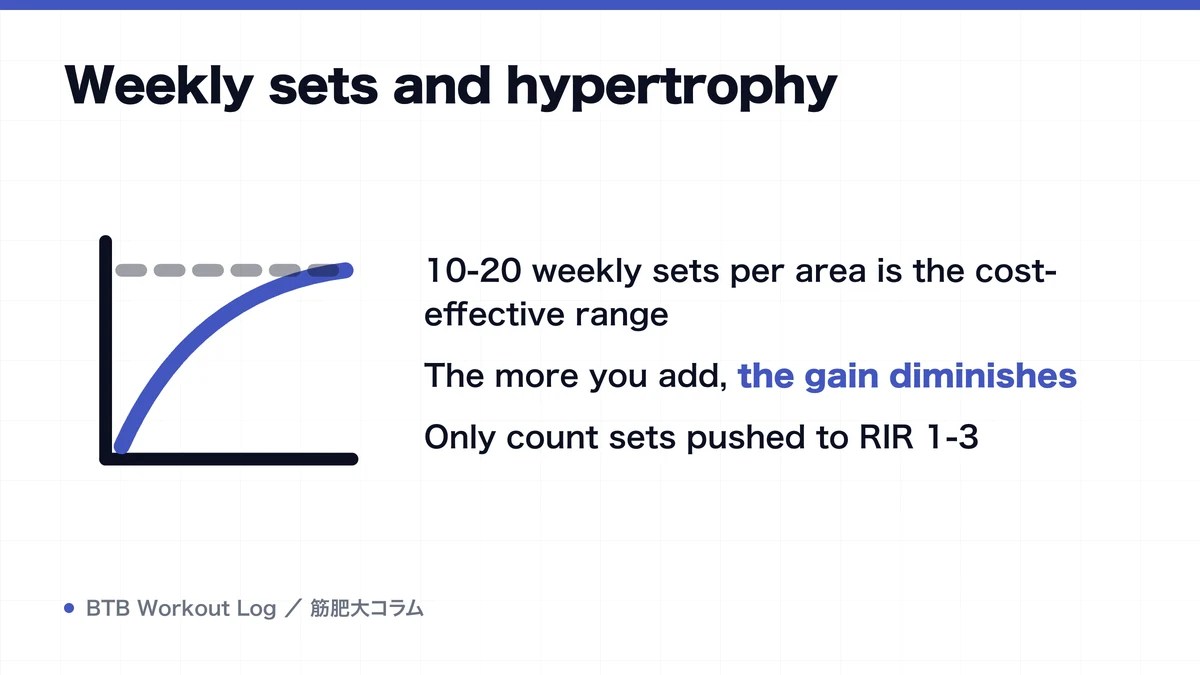
Multiple studies show a dose-response trend: the more total weekly sets, the greater the average hypertrophy. Adding sets gives the muscle more opportunities to receive sufficient tension. The gain from each additional set isn't constant, though. As volume rises the benefit gets smaller, while fatigue and time cost tend to grow. The path from stimulus to growth is laid out in how set count affects hypertrophy.
The frequently cited 2017 meta-analysis is also a study showing that higher weekly volume was favourable on average, not one that established that nobody grows below 10 weekly sets. For how to read that research, see Schoenfeld's volume research. The 10-20 band is a practical range for experienced lifters weighing up volume, not a boundary that fixes a floor or a ceiling for everyone.
So if you are progressing well on 8 sets, there's no need to go to 10 just to match a number. On the other hand, if you have been stuck around 10 sets for several weeks, with no major problems in sleep, nutrition or form, and you are recovering by the next session, there is room to consider adding.
Count the hard sets that reached the target muscle
For managing weekly sets, you count the working sets in which the target muscle group does substantial work, not the warm-ups. The rough guide is RIR 1-3, an effort level where you finish the set 1-3 reps short of failure. RIR is your own estimate, so it isn't an exact measurement, but recording it against the same standard makes it easier to separate preparation sets with a lot left in reserve from your main sets.
- Count: sets where you brought the target muscle group close to being the limiting factor and finished within your chosen range of motion and form.
- Don't count: warm-ups, technique rehearsals, and light sets where you deliberately left a lot in reserve.
- Log separately: methods such as drop sets and rest-pause, whose fatigue profile differs from a normal set.
Adding everything up as volume load alone - weight x reps x sets - has its limits too. Volume load works as a supporting metric when you follow the same exercise under similar conditions, but it doesn't include RIR, range of motion, or the load reaching the target muscle. Separating weekly volume from progress within an exercise leads into managing training volume, and the limits of the number into why volume load alone can't explain it.
Don't double-count direct and indirect sets
The bench press is a direct set for the chest, but it also puts stimulus into the triceps and front delts. In a row the back is the prime mover, yet the biceps assist. If you mechanically add one set to every muscle group involved in one compound set, you tend to overestimate volume for the small muscles.
In practice, log one set against the prime mover and track the assisting muscles separately as "received indirect work". Where the assisting muscle approaches its limit first, or local fatigue is high, don't ignore that contribution - feed it into your decision about adding direct arm and shoulder exercises. Rather than deciding strictly between 0 and 1, it is more useful to keep the same rule for several weeks and tie it to your results.
Why the same 10 weekly sets produce different results covers RIR, movement quality and between-set recovery on top of this contribution to the target muscle. Even when the set count looks the same, the work that reached the intended muscle is not necessarily the same.
Weekly set guides by muscle group and experience level
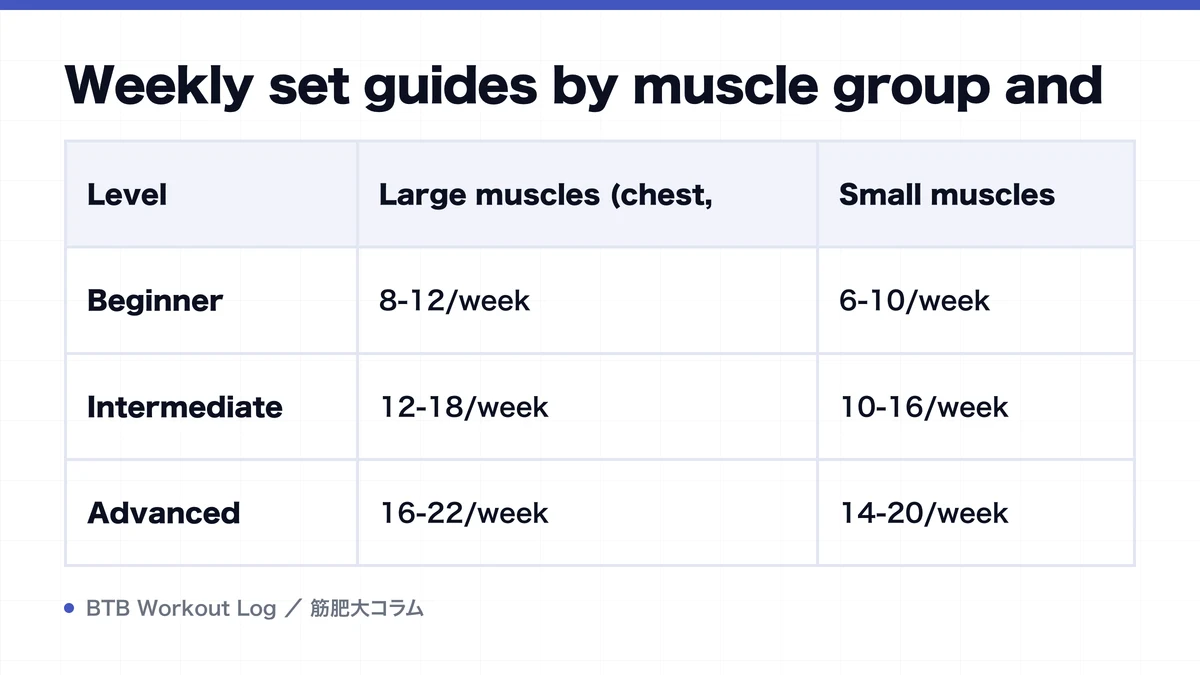
| Level | Large muscles (chest, back, legs) | Small muscles (shoulders, arms) |
|---|---|---|
| Beginner | 8-12/week | 6-10/week |
| Intermediate | 12-18/week | 10-16/week |
| Advanced | 16-22/week | 14-20/week |
This table is a rough guide for choosing your starting volume. Small muscles also get stimulus indirectly from presses and pulls, so fewer direct sets than the large muscles can be enough. Conversely, lumping the legs together as "one area" hides how the work is split between quads, hamstrings and glutes. When you actually adjust your programme, count by muscle group rather than by movement.
The relationship isn't as simple as "the longer you have trained, the more you need". Someone who can put load on the target muscle with high output may get more stimulus and more fatigue out of each set. And even a small amount of work can create a stimulus in the direction of growth. For the low end when time is tight, see the conditions under which one set builds muscle, and build up from the smallest volume that keeps progress coming.
Spread weekly sets across frequency instead of cramming them into one session
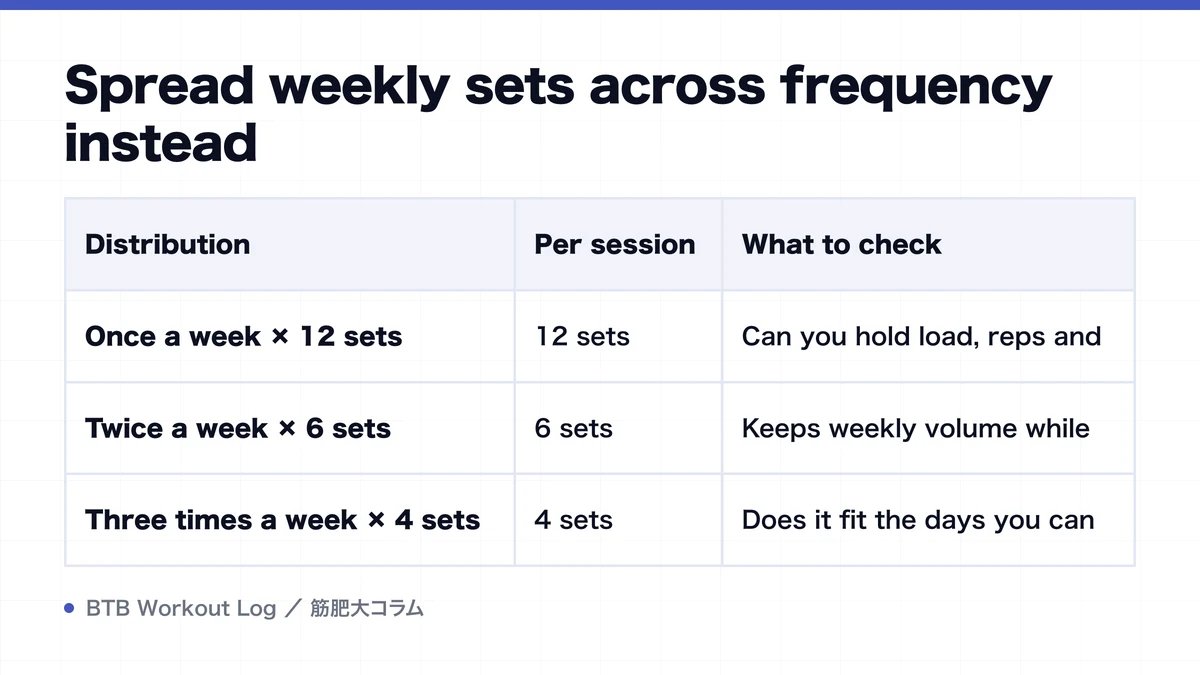
Frequency is a separate variable from weekly sets. Doing 12 weekly sets in one session and splitting them into 6 sets twice a week give the same weekly volume, but per-session fatigue and the quality of the later sets change. If instead you keep 6 sets per session and go from once to twice a week, you raise not just frequency but weekly volume too, from 6 to 12 sets.
| Distribution | Per session | What to check |
|---|---|---|
| Once a week × 12 sets | 12 sets | Can you hold load, reps and technique to the end? |
| Twice a week × 6 sets | 6 sets | Keeps weekly volume while spreading quality more easily |
| Three times a week × 4 sets | 4 sets | Does it fit the days you can train and local recovery? |
If you want to evaluate frequency, fix your weekly total first and change only the arrangement. For a fuller breakdown, see how frequency changes your weekly sets. For where frequency sits within the overall dose-response literature, the volume and frequency meta-regression also helps.
When to go from 10 to 20 weekly sets
20 weekly sets isn't a prescription for twice the growth of 10 weekly sets. Higher weekly volume may add something on average, but that benefit tends to diminish, and you have to weigh the extra time and fatigue too. If load or reps are climbing at 10 sets, there is good enough reason to hold there.
The conditions for considering more volume are that progress on the target muscle has stalled several times, that form, RIR, rest, sleep and nutrition haven't broken down badly, and that you have recovery to spare before the next session. Even then, don't double it at once - add 1-2 sets a week and watch the response. The axis of comparison is set out in choosing between 10 and 20 weekly sets, and the check including study conditions in when 20 sets beats 10.
A "more is better" mindset leads you to keep adding volume even while you are still progressing. The balance between extra benefit and recovery cost is the heart of the mistake of endlessly adding sets. Choose the volume of quality work you can repeat, not the maximum.
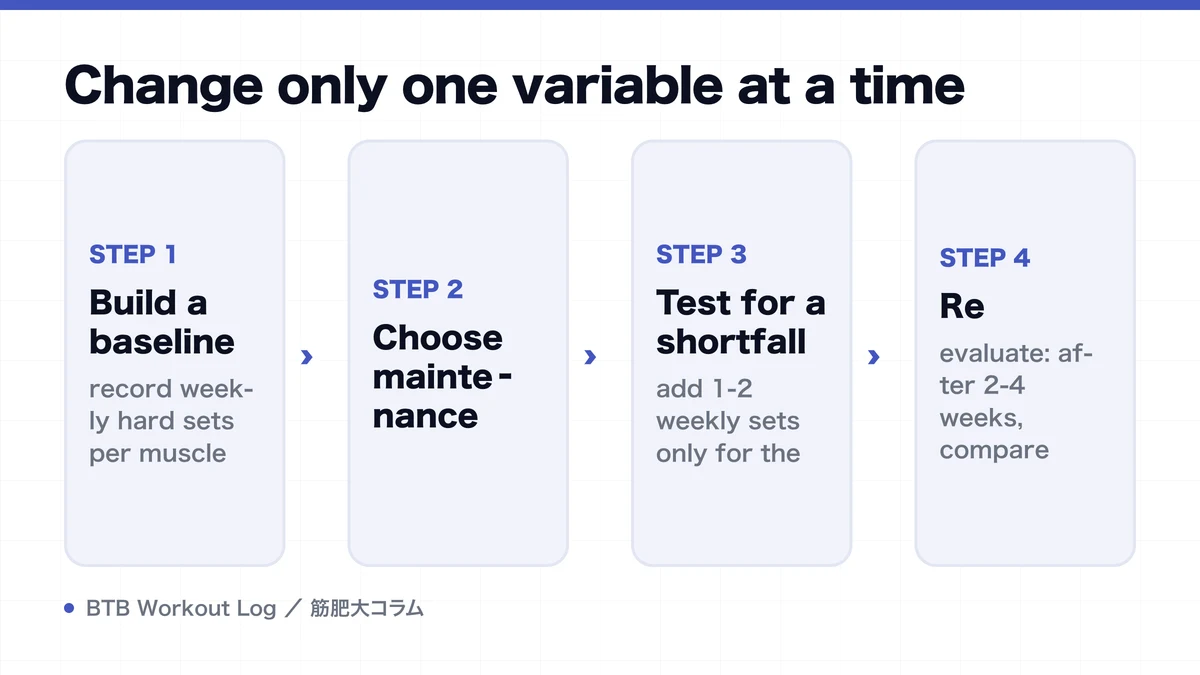
Change only one variable at a time
- Build a baseline: record weekly hard sets per muscle group, plus load, reps and RIR on your main exercises, consistently for 2-4 weeks.
- Choose maintenance first: if load or reps are trending up and there is no pain and no drop in output next session, stay at your current volume.
- Test for a shortfall: add 1-2 weekly sets only for the muscle groups that have stalled and still have recovery to spare.
- Re-evaluate: after 2-4 weeks, compare progress on the main sets, quality in the later sets, and recovery before the next session.
If you change exercises, frequency, RIR and rest in the same week that you add sets, you can no longer tell what caused the result. Move volume alone, and move it a little. Looking at the muscle groups you left alone as well makes it easier to separate out whole-body swings in condition. If reps in the later sets suddenly fall after the addition, the assisting muscles fatigue before the target muscle, or your main exercise drops next session, suspect the pattern where adding too much backfires.
Judge "too much" by next session's progress, not by soreness
The sign that volume is too high isn't just one bout of bad soreness. You look for trends: your target load or reps dropping several times under conditions close to the same exercise, range of motion, rest and RIR, discomfort in joints and tendons that persists, or local fatigue that lingers until the next session. Disrupted sleep and appetite are evidence too, but separate them from the effects of work and life stress.
If the decline has continued since you added volume, roll the addition back first. If whole-body fatigue and drops across several exercises pile up together, don't add sets - consider a deload if needed. Conversely, if your current volume is delivering both progress and recovery, there is no hurry to change it even if the number looks low.
BTB Workout Log shows weekly hard sets per muscle group alongside the trend in load and reps per exercise over the same period. Use it not to push the number up, but as evidence for whether the sets you added turned into actual progress.
FAQ
- How many sets per muscle can I do in a single session?
- Take around 6-10 sets per muscle per session as a rough guide, and adjust by whether you can hold load, reps and range of motion to the end. If your weekly target is high, spreading it over 2-3 sessions rather than cramming it into one day tends to make quality easier to hold.
- Do warm-up sets count toward the weekly total?
- Normally, no. What you count are hard sets that make the target muscle work sufficiently and finish at an RIR of roughly 1-3 reps short of failure. Log light prep sets and technique rehearsals separately, and don't add them to your weekly sets.
- Does more sets always mean more muscle growth?
- Raising a volume that is too low can be expected to add something on average, but the benefit gradually shrinks. If you are progressing at your current volume, hold it, and add small amounts only for the muscle groups where a plateau and spare recovery line up.
- Does a bench press count as three sets - chest, shoulders and triceps?
- The practical approach is to count it as a direct set for the chest and track shoulders and triceps separately as indirect work. Don't mechanically add one to every muscle group; adjust volume by watching fatigue in the assisting muscles and progress on your direct exercises.
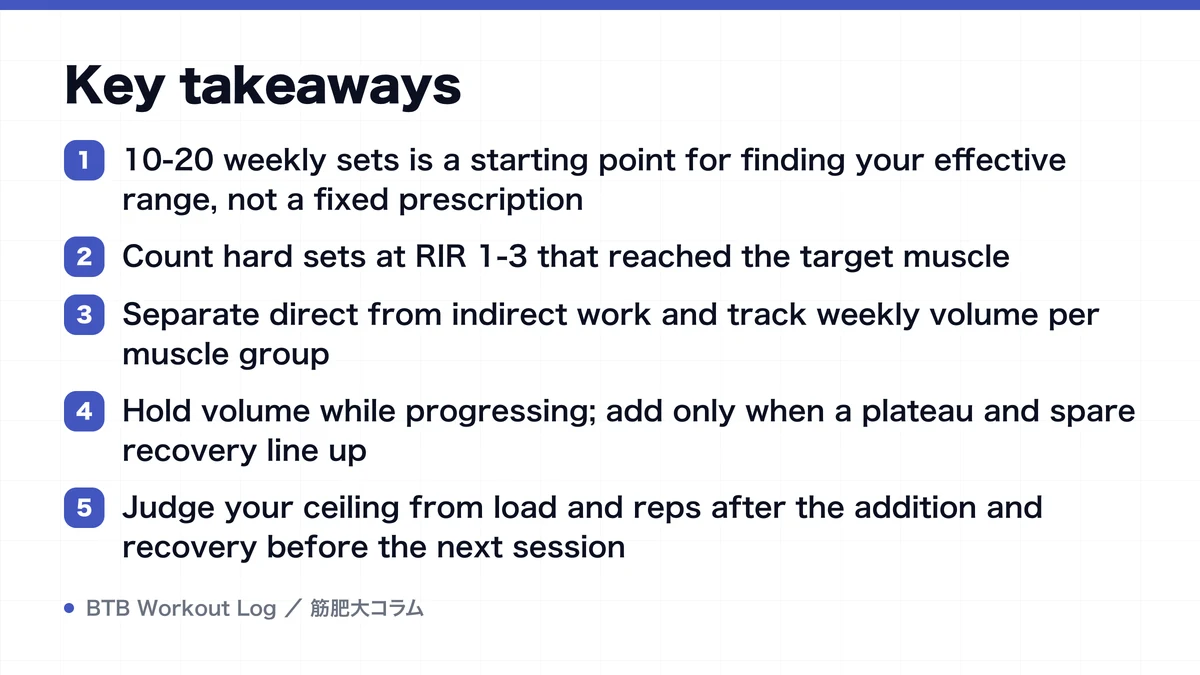
Key takeaways
- 10-20 weekly sets is a starting point for finding your effective range, not a fixed prescription
- Count hard sets at RIR 1-3 that reached the target muscle
- Separate direct from indirect work and track weekly volume per muscle group
- Hold volume while progressing; add only when a plateau and spare recovery line up
- Judge your ceiling from load and reps after the addition and recovery before the next session
References
- Dose-response Relationship Between Weekly Resistance Training Volume and Muscle Mass
- Resistance Training Volume Enhances Muscle Hypertrophy in Trained Men
- ACSM Position Stand: Progression Models in Resistance Training for Healthy Adults
- A Systematic Review of the Effects of Different Resistance Training Volumes on Muscle Hypertrophy