Does Squatting Alone Build Your Whole Leg? | Which Muscles Usually Get Left Behind
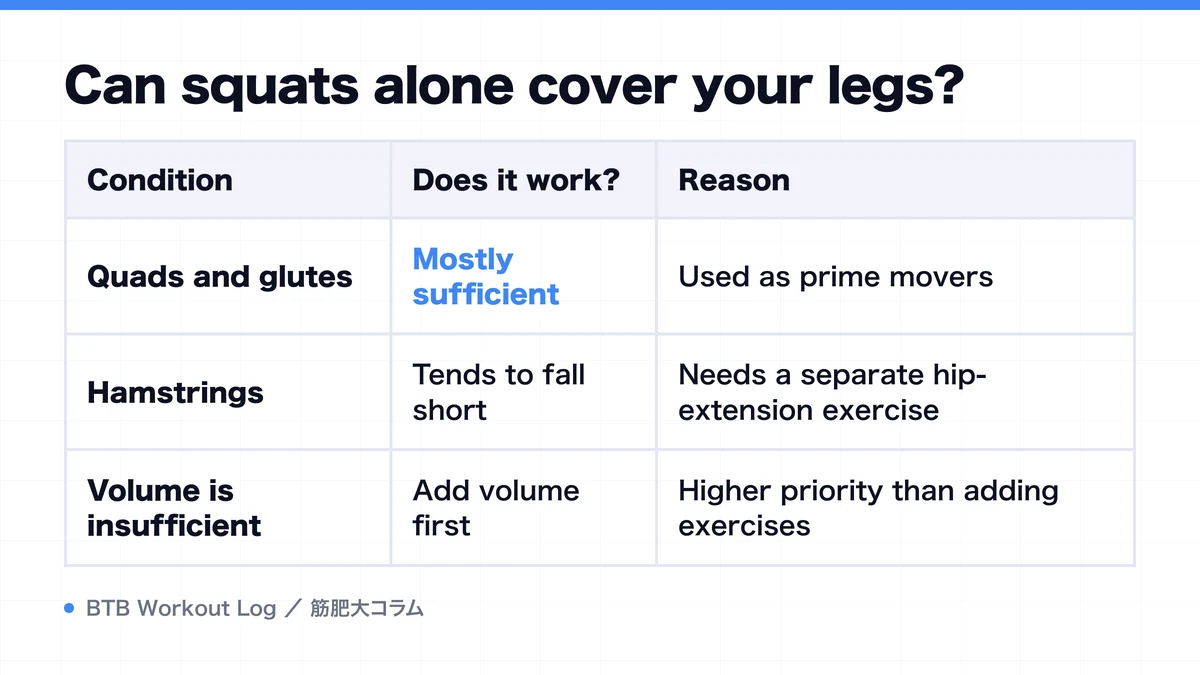
Squats alone can develop the quads and glutes, but the test result is that it tends to fall short for evenly growing your "entire lower body" including hamstrings and calves.
Whether one exercise suffices shifts with which muscle squats make the limiting factor, whether you can hold sufficient range of motion and effort, and how far "entire lower body" extends.
First, define which muscles count as "entire lower body"
Before judging whether squats alone suffice, split the target. "Entire lower body" here means the quadriceps, glutes, adductors, hamstrings, and calves (triceps surae). If you mean only the front thigh and glutes, the answer leans fairly positive; include the back thigh and lower leg, and the answer changes.
Squats are a multi-joint exercise extending the knee and hip simultaneously, letting you load large muscle groups with few exercises. But many muscles participating in a movement is different from all of them receiving the same degree of hypertrophy stimulus. Results also shift with whether it's the quads, glutes, spinal erectors, or breathing and core that actually end the set. This is the question of "are compound lifts alone enough" tested specifically for legs.
So what to test isn't "did squats work the legs" — it's whether you can secure valid, long-term-updatable sets for each individual muscle group.
Where squats excel, and where they tend to fall short
On a standard back squat, the knee-extending quads and hip-extending glutes/adductors carry the largest work. Distribution shifts with depth, torso angle, stance and build, but these two areas commonly tend to be the stars. If you can reach a deep position while reproducing form, and the quads or glutes approach their limit first, squats become a strong main lift for those muscles. See comparing squat and leg press for an alternative when prioritizing quads.
The hamstrings, though, are a two-joint muscle extending the hip and also flexing the knee. Since hip and knee joints move together on a squat, the hamstrings participate, but not in the same form as a knee-flexion exercise loads them. "They felt tight from holding posture" or "I was sore the next day" alone is premature evidence of sufficient hypertrophy stimulus.
Calves also stabilize the ankle joint, but squats don't involve a large repeated plantarflexion movement. And within the quads, the rectus femoris also crosses the hip, so it doesn't necessarily receive matched stimulus alongside the vastus lateralis or medialis. This is why squat weight rising doesn't guarantee every leg muscle group is developing at the same rate.
Five conditions where squats alone tend to work
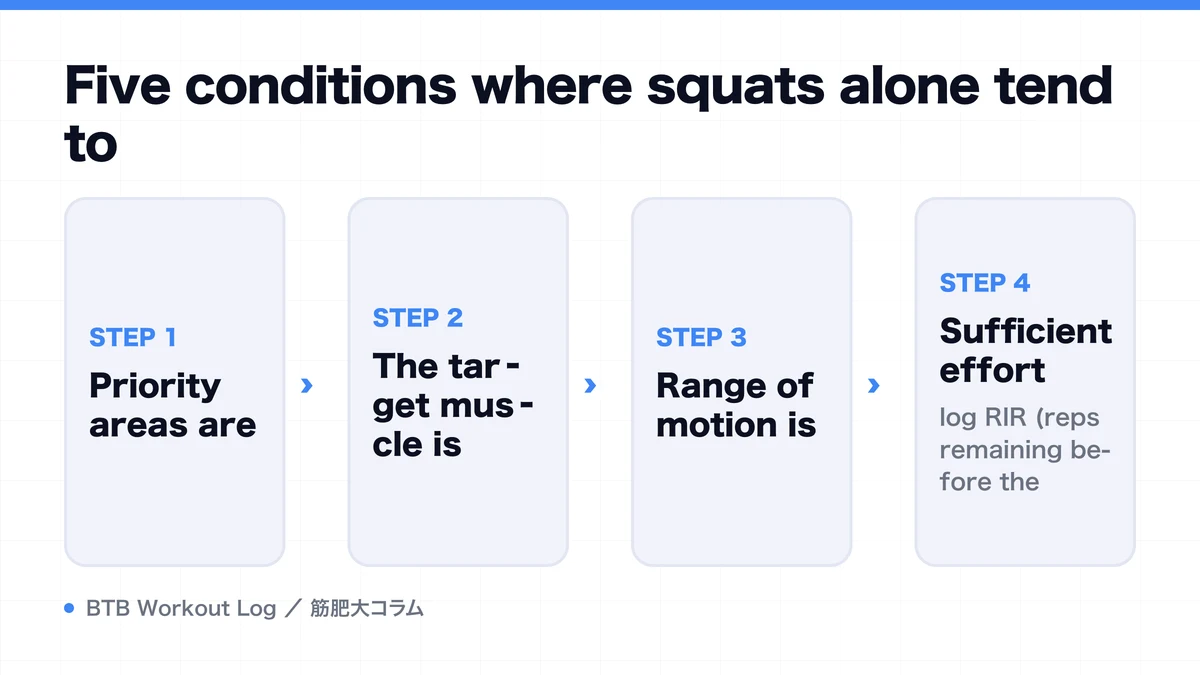
"Squats alone" isn't automatically unreasonable. If the following conditions are met, it can work as leg training for a defined period.
- Priority areas are quads and glutes: you're not seeking hamstring or calf maximization at the same priority.
- The target muscle is the limiter: the target leg muscle approaches its limit before lower back, breathlessness, or bar discomfort do.
- Range of motion is reproducible: depth doesn't shallow out as weight rises, letting you compare under the same form.
- Sufficient effort: log RIR (reps remaining before the limit) and end most working sets around RIR 1–3. See how to use RIR for detail.
- Quality holds across the week: rather than cramming into one day and breaking back-half form, split across twice a week if needed to protect target-muscle set quality.
For beginners or during a time-constrained period, narrowing to one exercise makes technique-building and progress-judging simpler. But mechanically meeting typical weekly set count guidelines from squats alone isn't advisable — axial load and whole-body fatigue tend to rise first, and added sets may not deliver valid stimulus to the target muscle. Needed volume isn't fixed — it shifts with each set's effort level, frequency, recovery, and training history.
What research shows isn't "one exercise covers everything"
Summarizing resistance-training research, hypertrophy is shaped by several variables — load, frequency, total volume, effort level, movement style. There's also a trend where more weekly training volume favors larger muscle gain, but that doesn't mean "add more squat sets and every leg muscle group grows the same." Volume needs to be thought of as sets that actually reached that specific muscle.
Also, given matched effort level, hypertrophy can occur across a wide load range. So accessory work doesn't need to sit in the same heavy-load band as squats. Leg curls or calf raises at moderate-to-high reps are viable options too, as long as you're not too far from the limit and reps or load are progressing long-term.
Keep the uncertainty here in mind too. Studies differ in exercise, participants, measurement site, and duration — none gives a complete answer like "have everyone do only squats and measure every leg muscle group with equal precision." So rather than declaring a shortfall from theory alone, judge from progressive overload combined with your own per-area response.
Add an exercise with a different role only where a shortfall is observed
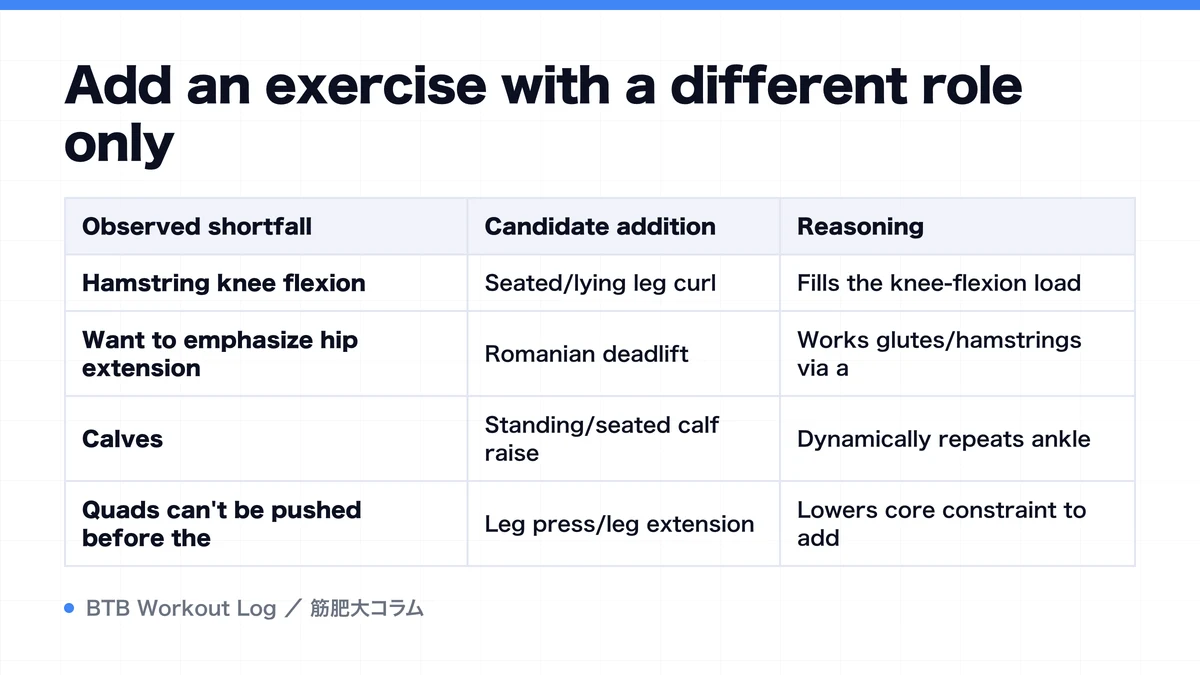
Choose exercises to complement squats based on the joint actions your training is missing, not the number of exercises in your plan. You don't need a long list of leg exercises from the start.
| Gap identified | Exercise options | Why choose them |
|---|---|---|
| Hamstring work through knee flexion | Seated / lying leg curl | Adds loaded knee flexion, which squats provide little of |
| More posterior-chain work through hip extension | Romanian deadlift | Trains the glutes and hamstrings in a different position from squats |
| Calves | Standing / seated calf raise | Trains ankle plantar flexion through repeated movement |
| Your torso limits the set before your quads are fully challenged | Leg press / leg extension | Adds knee-extension sets with less demand on your torso |
For a minimal setup, simply adding leg curls and calf raises to squats can cover much of what's missing. Use Romanian deadlifts during phases when you prioritize the posterior chain. If your quads need more work, shift some sets to leg presses or leg extensions. Add just 1 exercise at a time, then monitor your squat recovery and progress over several weeks to check that the extra work isn't interfering.
Don't judge "is it enough" from squat weight alone
Fix form for roughly 8–12 weeks and track squat weight, reps, RIR and depth. At the same time, watch response for front thigh, glutes, back thigh, and calves — via measurements, matched-condition photos, and baseline performance on accessory exercises. If squats are progressing, priority areas are changing too, and there's no pain or worsening recovery, continue. Conversely, if squats progress but the back side and lower leg don't change, lower back or breathing consistently limits you, or depth breaks down as you add sets, there's no reason to keep restricting yourself to one exercise.
Use the log not to prove "squats alone are enough" but as material for making minimal changes to whatever area is falling short.
FAQ
- Does high-bar squat train the entire lower body?
- High bar makes it easier to stay upright and emphasize the quads, but it doesn't sufficiently cover hamstring knee flexion or calf plantarflexion. Even changing bar position, the problem of covering the whole lower body with one exercise remains.
- If adding just one exercise to squats, what should it be?
- Leg curl is a candidate if the back thigh is lacking; Romanian deadlift if you want to emphasize glutes and hip extension. If calves are also a priority, you'll need a separate calf raise slot. Choose based on your priority order for the area you're adding.
- Is it fine for beginners to start with squats alone?
- Reasonable for a short period prioritizing technique-building. First learn a reproducible depth and RIR, and build weight or reps. But if whole-lower-body hypertrophy is the goal, once movement stabilizes, it's practical to add leg curl and calf raise to fill the stimulus gap.
Key takeaways
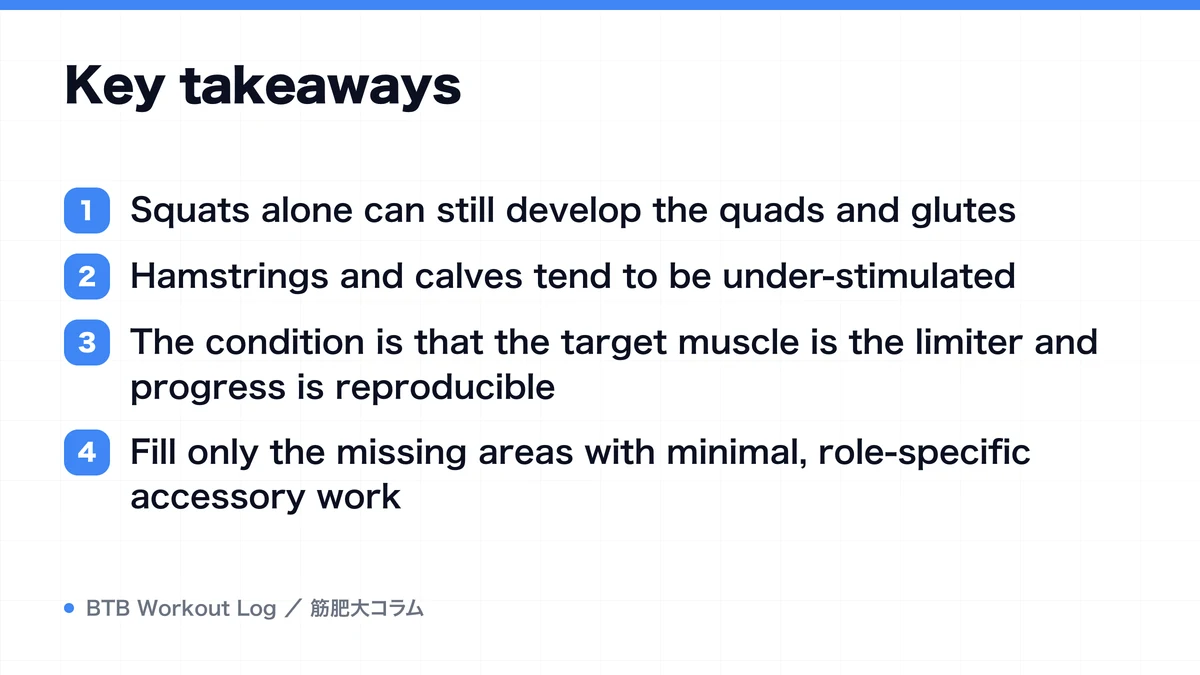
- Squats alone can still develop the quads and glutes
- Hamstrings and calves tend to be under-stimulated
- The condition is that the target muscle is the limiter and progress is reproducible
- Fill only the missing areas with minimal, role-specific accessory work
References
- The Influence of Frequency, Intensity, Volume and Mode of Strength Training on Whole Muscle Cross-sectional Area in Humans
- Dose-response Relationship Between Weekly Resistance Training Volume and Muscle Mass
- Muscle Hypertrophy Is Independent of Load Across Upper and Lower Limbs When Effort Is Matched
- Low- vs High-load Resistance Training for Strength and Hypertrophy: Meta-analysis