Why Do Your Triceps Fatigue Before Your Chest on Chest Day? | For Lifters Who Can't Push Their Chest to the Limit
Triceps fatiguing first on chest day happens because a pressing exercise is a compound movement that requires elbow extension from the triceps, not just the pecs. When form, exercise choice and prior fatigue make the triceps the "part that stops first" in the overall movement, the set ends even while the chest still has reserve.
That said, you can't conclude "the chest isn't working" from arm tightness or burn alone. You need to separately confirm whether the triceps are genuinely ending the reps, and whether your chest exercises are progressing long-term.
A triceps pump and "getting crushed by the triceps" are different things
The triceps feeling intensely tight during a press isn't abnormal on its own. On bench press, dumbbell press, or chest press, the weight can't move without the elbow extending, so the triceps do work too. Local heat or a pump there is a clue the muscle is active, but it isn't proof that stimulus to the pecs is insufficient.
What's worth treating as a problem is a state where triceps fatigue repeatedly decides when the set ends, preventing the chest from receiving the reps or load it needs. Clues include: the weight clears your chest on the last rep but you stall every time during elbow extension; your arms crash sharply set to set; and single-joint chest exercises still leave a lot of reserve. You can't pin down the limiting muscle from where you stall alone, but if it happens under the same conditions every time, it's worth investigating.
Here, log overall set reserve as RIR (how many more reps were possible). Watching whether triceps-driven interruption persists even when your RIR standard is the same makes this easier to compare than the feeling "my arms were tired today."
A press is teamwork between chest, shoulders and triceps, so the weak link stops first
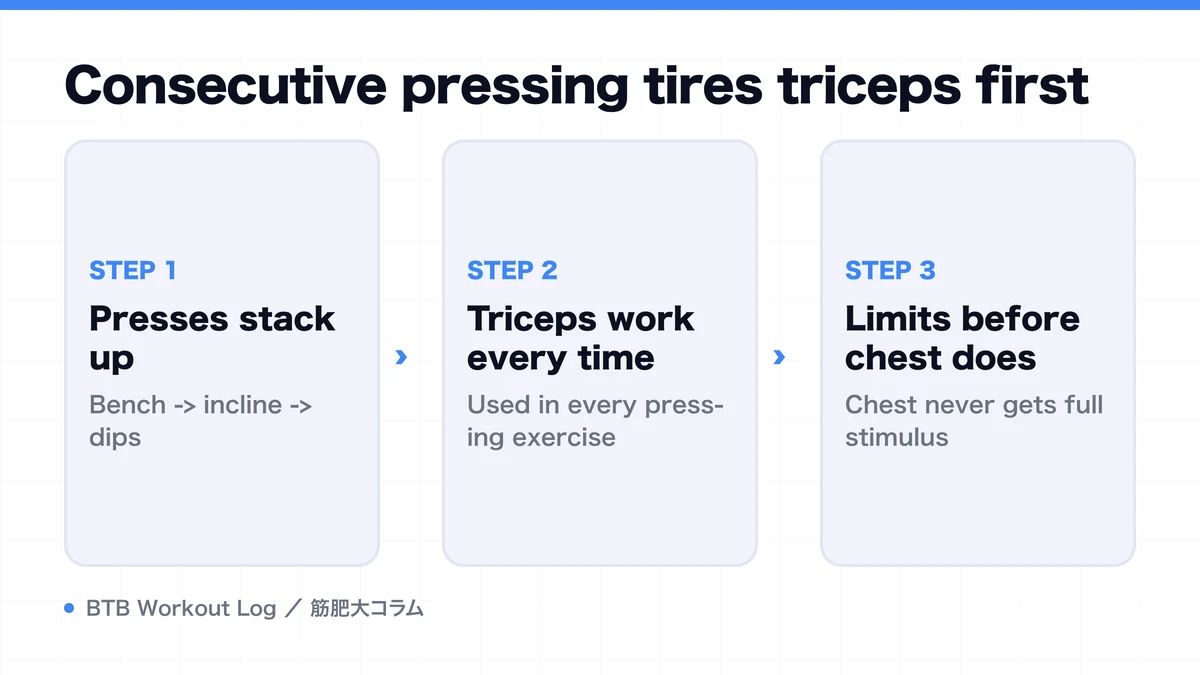
In a pressing movement, the pecs move the upper arm forward and inward, the anterior deltoid assists the shoulder joint's movement, and the triceps extend the elbow. These three roles aren't separate — they transmit force to the weight simultaneously. So even with room left in the pecs, if elbow-extension force runs out, the rep can't be completed. "The limit" on a compound exercise doesn't mean every participating muscle hit its limit at the same time.
Which part becomes the weak link isn't fixed. A narrow grip, a path that tucks the elbows tightly to the sides, or an exercise weighted heavily toward the lockout, tend to raise the relative demand on elbow extension. Conversely, a path that controls the descent to a position where the chest is sufficiently stretched, without the forearm-to-weight relationship breaking down, makes it easier to use the segment where the pecs can produce force. On bench press, grip width and bench angle can shift lifted weight and some muscle activity, but activity measurements alone can't determine long-term hypertrophy amount.
Prioritizing heavy weight can also shorten range of motion, or lead to pressing through with the arms while avoiding the position where the chest actually receives load. This is a case of the intuition "heavier means more chest" reshaping form. If chest development is your goal, match reproducible range of motion and path before chasing the number on the plate. Cross-check basic form and exercise roles with a chest hypertrophy routine too.
Yesterday's routine, exercise order, and short rest can all stop the triceps first too
Even with no major form issue, the triceps will limit a chest press first if they haven't recovered. If you did shoulder presses or direct triceps work the day before, placed dips or a narrow press earlier the same day, or stacked pressing exercises at high frequency, chest day starts with both muscles' reserve mismatched.
Short rest between sets can also mean triceps output hasn't fully returned even once breathing has settled. If you're cutting rest to chase a chest pump and later-set reps drop from arm fatigue, the primary goal and the method have flipped. Rest until you can reproduce the same path and intended RIR on the next set, and revisit how to think about rest intervals if needed.
Another easy thing to overlook is treating indirect load from pressing and direct triceps sets as fully separate accounts. A pressing set can't be counted as identical to a direct triceps set, but it doesn't leave zero fatigue either. If you press a lot across chest, shoulder and arm days, check total weekly pressing volume and placement, not just direct triceps exercises. Weekly set count is a metric to adjust while watching output and recovery, rather than a fixed correct answer to hit (see how to think about weekly set count).
A practical procedure to isolate the cause over 3 chest sessions
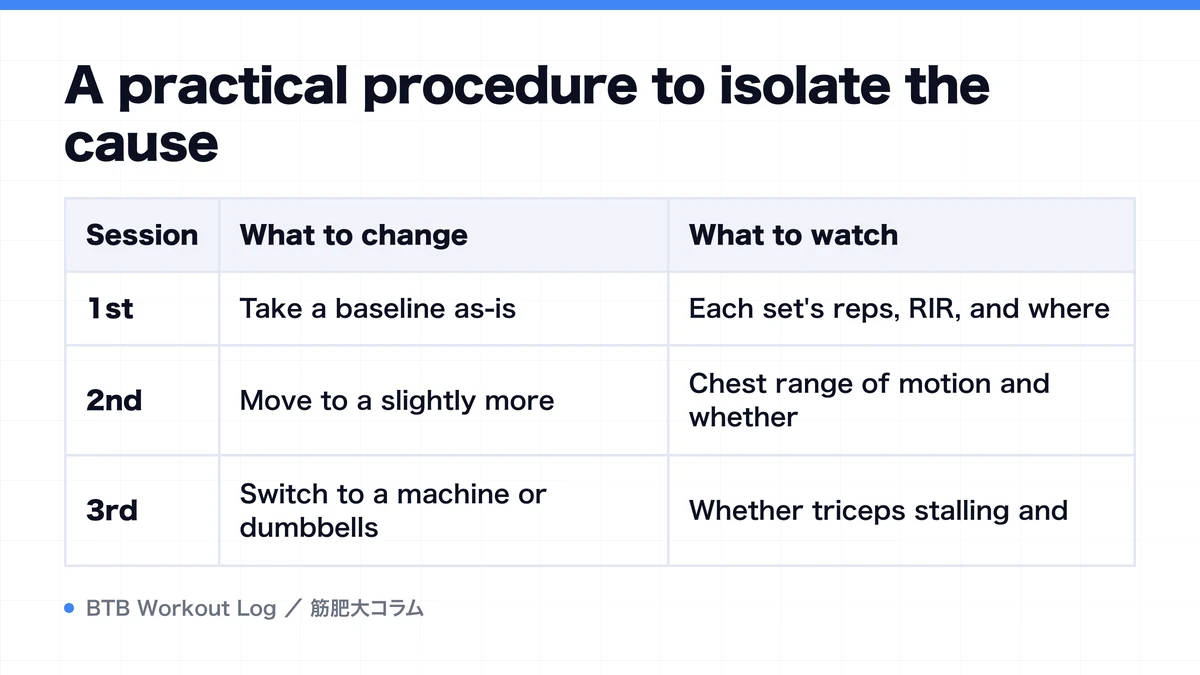
Changing grip, exercise, weight and set count all at once makes it impossible to tell what worked. For the next 3 sessions, first fix your main press's exercise order, and match weight, range of motion, rest and set count. Then introduce just one change.
| Session | What to change | What to watch |
|---|---|---|
| 1st | Take a baseline as-is | Each set's reps, RIR, and where you stalled |
| 2nd | Move to a slightly more manageable weight or path | Chest range of motion and whether later-set reps hold |
| 3rd | Switch to a machine or dumbbells | Whether triceps stalling and chest-exercise progress change |
Judge from more than just "it feels like it's working my chest." Check whether reps on your main press rise at the same form, whether chest accessory work also holds quality, and whether triceps heaviness carries over to next time. Pushing every set to failure can actually reinforce the phenomenon of the triceps stopping first. Since failure reps aren't always required for hypertrophy, first hold your main press around RIR 1–3 to make the cause easier to observe.
If bench press specifically stalls at one particular phase, separate a hypertrophy problem from a lifting-technique problem. The task of raising your max weight overlaps with a bench press plateau, but if chest hypertrophy is the goal, you don't need to stick to the competition lift — choosing equipment that reliably delivers load to the chest is fine.
Fix order: form, exercise placement, weekly volume, then triceps strengthening
Fix the range of motion and path that let the chest produce force first. You don't need to widen your grip to the point of shoulder discomfort or force your elbows out unnaturally. Even dropping weight a notch, if you can press through the same path from a position where the chest is stretched, that becomes a comparable set. Then, place your main press first and move direct triceps work later.
Next, adjust exercise choice. If a barbell keeps leaving your arms as the limiter, try a chest press machine, which is easier to stabilize the path on, or a dumbbell press, where each side moves independently. Flye-type movements need almost no elbow extension, making them a way to add stimulus to the chest without being limited by the triceps. Pre-exhausting the chest with flyes first makes it easier to feel the chest working, but it also lowers subsequent press weight and reps. It's usable as a short-term test for identifying the cause, but not a method to prioritize routinely.
If triceps recovery still can't keep up, change the spacing between chest, shoulder and arm days, or temporarily reduce direct triceps sets. Conversely, if recovery is sufficient but you keep stalling at lockout every time and chest exercises overall aren't progressing, there's room to add a small amount of separate triceps strengthening on another day. After adding it, check whether chest press weight and reps rise over several weeks — revert if they don't.
A logging app's job isn't automatically determining the cause — it's letting you compare before and after a change under matched conditions. If chest progress returns, you can conclude that adjustment fit you.
FAQ
- Is a press pointless for the chest if the triceps fatigue first?
- Not pointless. Load still lands on the pecs even while the triceps are working. The problem is when the triceps' limit consistently ends the set early and chest weight/reps aren't progressing long-term. Judge from rep stalling and multi-week progress, not the pump.
- Does widening my grip reduce the load on my triceps?
- It can shift somewhat, but wider isn't always better. Try it gradually, within a range that doesn't cause shoulder discomfort or path breakdown, and compare range of motion, reps, and where the stall happens. Avoid an extreme elbows-flared correction.
- Should I start with flyes to pre-fatigue the chest?
- It's usable for short-term cause identification, but routine use lowers subsequent press weight and reps. It's more reasonable to first fix form, rest, exercise order, and weekly triceps load, and try this only as an option if the chest still remains hard to engage.
Key takeaways
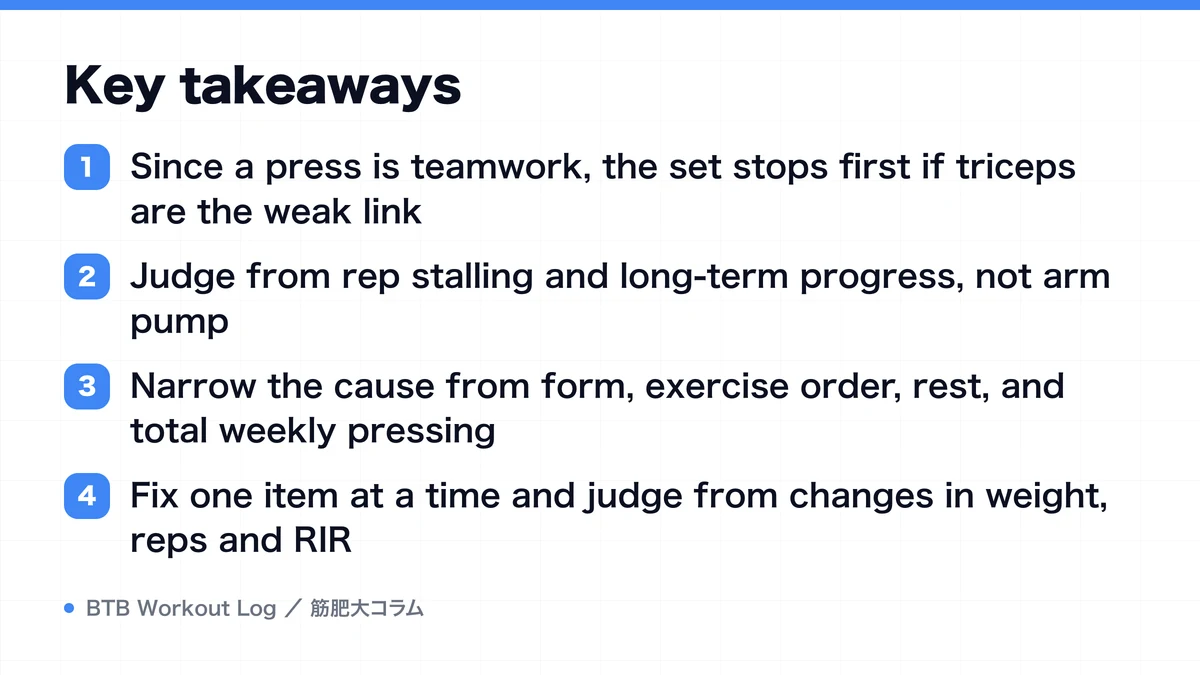
- Since a press is teamwork, the set stops first if triceps are the weak link
- Judge from rep stalling and long-term progress, not arm pump
- Narrow the cause from form, exercise order, rest, and total weekly pressing
- Fix one item at a time and judge from changes in weight, reps and RIR
References
- The Effects of Bench Press Variations in Competitive Athletes on Muscle Activity and Performance
- The Sticking Point in the Bench Press, Squat, and Deadlift
- Training to Repetition Failure or Non-failure: Systematic Review and Meta-analysis
- Proximity-to-Failure and Muscle Hypertrophy: Systematic Review with Meta-analysis
- Dose-response Relationship Between Weekly Resistance Training Volume and Muscle Mass