5 Reasons Your Lifts Aren't Increasing | The Programming Strategy to Rethink When the Numbers Won't Move
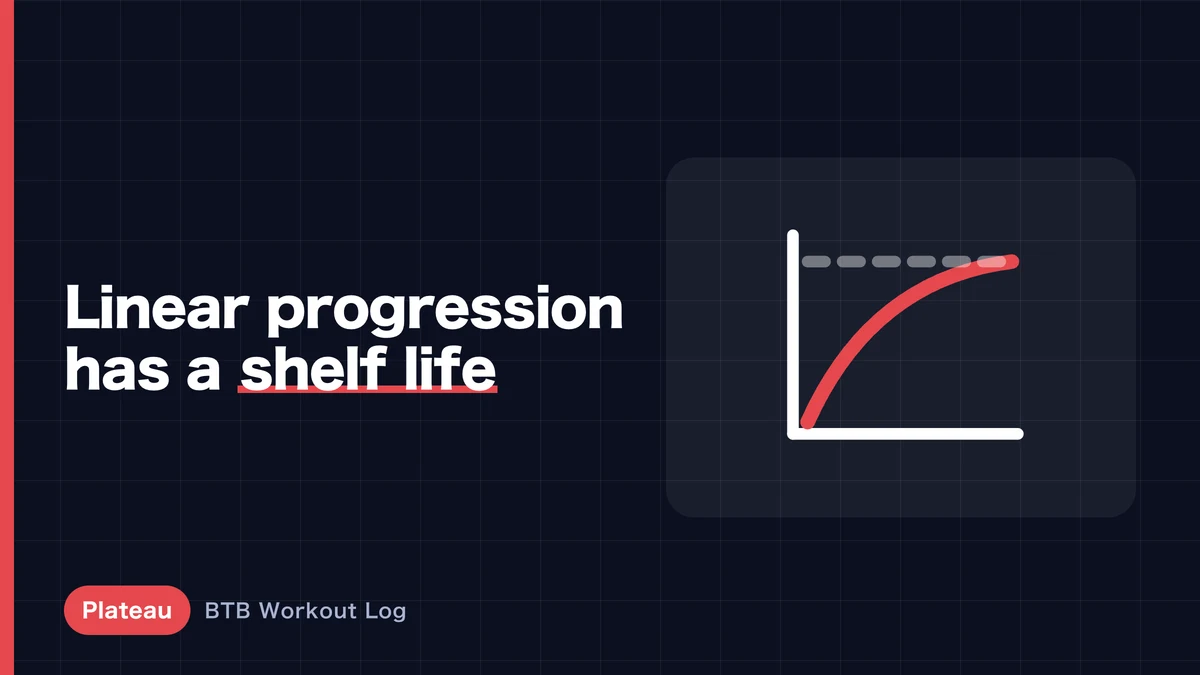
The most common reason weights stop going up: linear progression - adding weight every session - has run its natural course. Once you're past the beginner phase, you need to change how you progress, not just push harder.
Stop grinding for a new plate every single session. Use reps and programming cycles to make progress the long way around - it goes further.
Why you can't keep adding weight every session
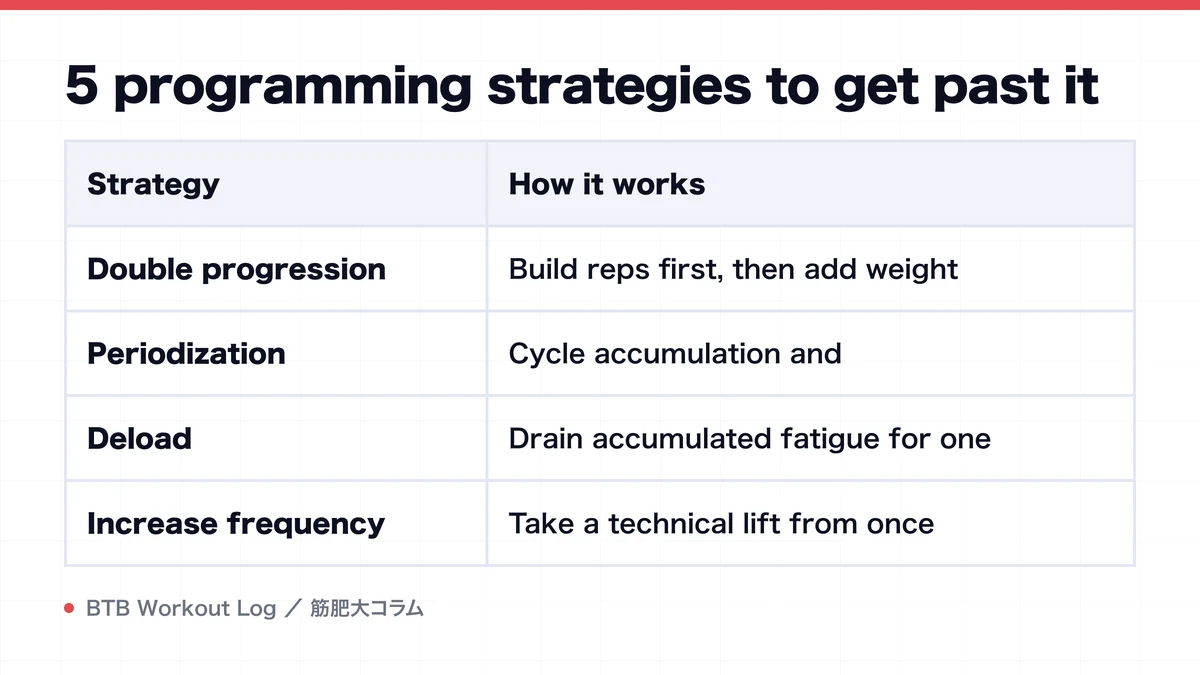
Early in training, you can add weight almost every session - that's linear progression. But this honeymoon phase lasts only a few months. As you become more advanced, the room for improvement each session shrinks, and trying to add weight every time will inevitably break down. This isn't failure - it's a normal developmental stage. Forcing weight increases anyway leads to form breakdown and accumulated fatigue. Recognize it as a signal to change your approach, not to train harder in the same way.
5 reasons your weights aren't going up
- Linear progression has run out: your progression method no longer matches your training stage (most common).
- Too little recovery: accumulated fatigue means you can't put out 100% every session.
- Volume too low or too high: either not enough total work, or so much you can't recover from it.
- Technique ceiling: movement inefficiencies are acting as a hard cap on how much you can lift.
- Nutrition and body weight stalled: without adding muscle mass, the strength base doesn't rise.
5 programming strategies to get past it
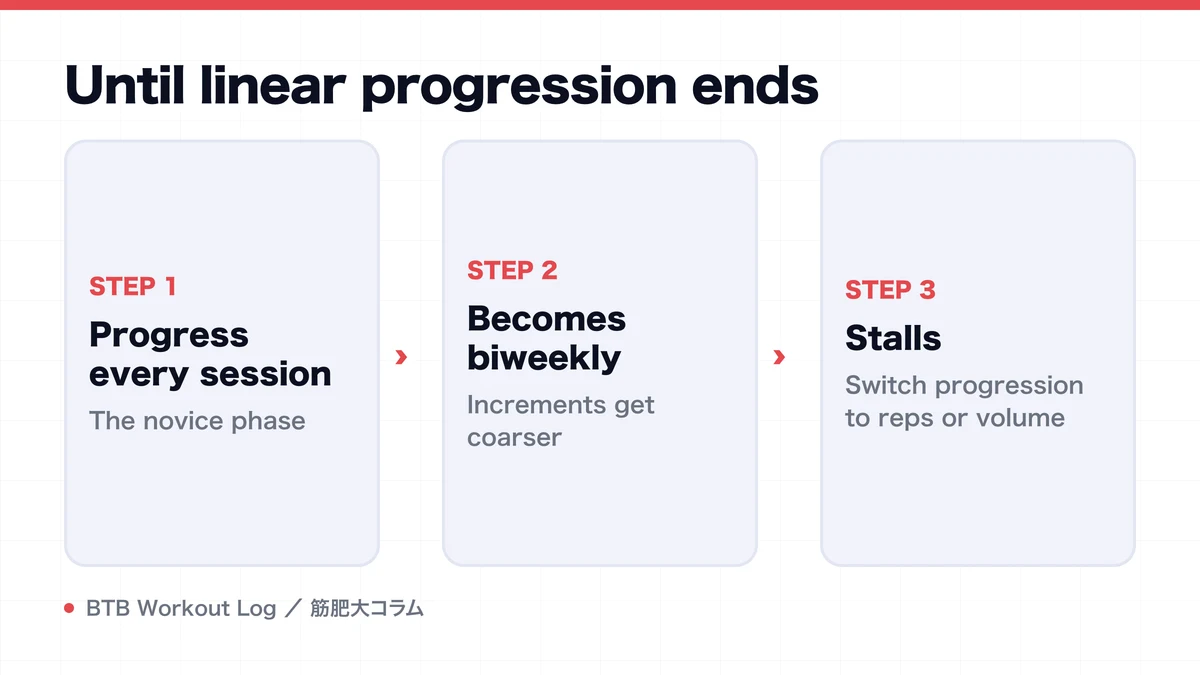
| Strategy | How it works |
|---|---|
| Double progression | Build reps first, then add weight (details) |
| Periodization | Cycle accumulation and intensification phases (details) |
| Deload | Drain accumulated fatigue for one week (details) |
| Increase frequency | Take a technical lift from once to twice a week |
| Lean bulk | Add body weight to raise the strength ceiling |
Make invisible progress visible with your log
For intermediate and advanced lifters, progress often shows up in reps and total tonnage before it shows up in weight on the bar. Going from 80 kg × 5 reps to 80 kg × 7 reps is real progress - but if you only watch the weight on the bar, you'll feel stuck. Track reps and tonnage trends in your log and you'll see the groundwork being laid before the weight actually moves. That visibility is what keeps motivation intact and tells you whether your strategy is working.
FAQ
- When my weight stops going up, should I just force it anyway?
- No - forced weight increases with deteriorating form is a path to injury. Switch to double progression: build reps first, then add weight when you've earned it. In most cases, the problem is the progression method, not your ceiling.
- Is it possible for muscle growth to keep going even when my strength stalls?
- Yes, especially with higher-rep training. You can gain muscle mass without a corresponding jump in maximal strength. If strength is also a goal, build in heavier sets in the 5-8 rep range periodically.
- Won't my strength drop during a deload?
- It may dip temporarily, but once fatigue clears you typically come back above your pre-deload numbers. Grinding forward while fatigued keeps a ceiling over your head; planned recovery removes it.
Key takeaways
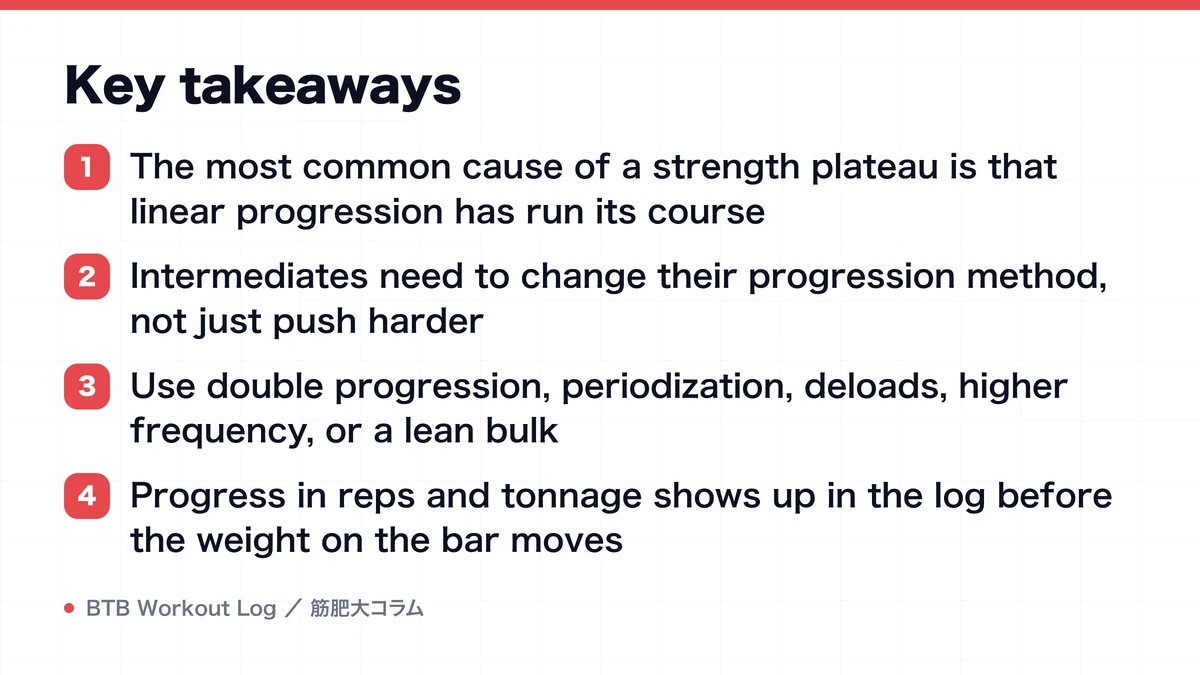
- The most common cause of a strength plateau is that linear progression has run its course
- Intermediates need to change their progression method, not just push harder
- Use double progression, periodization, deloads, higher frequency, or a lean bulk
- Progress in reps and tonnage shows up in the log before the weight on the bar moves
References
- ACSM Position Stand: Progression Models in Resistance Training for Healthy Adults
- Periodization, Strength and Muscle Hypertrophy: Systematic Review and Meta-analysis
- Dose-response Relationship Between Weekly Resistance Training Volume and Muscle Mass
- Low- vs High-load Resistance Training for Strength and Hypertrophy: Meta-analysis