How Hypertrophy Actually Happens | Training Without Knowing This Is a Waste: From Stimulus to Growth
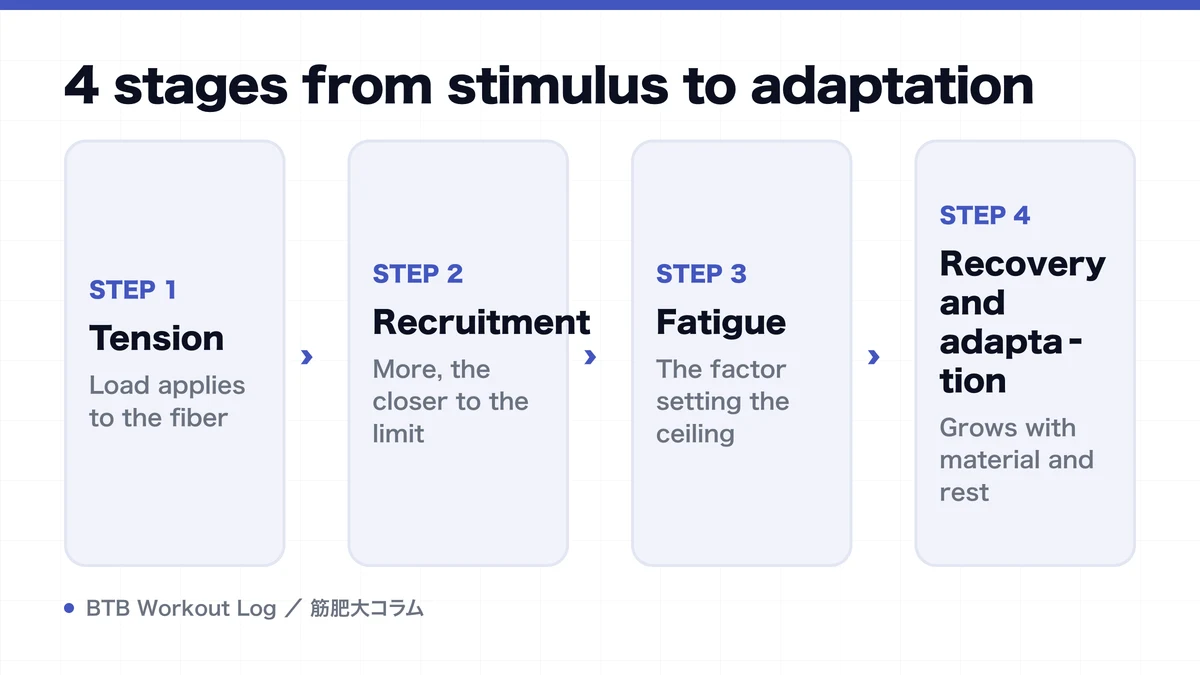
Hypertrophy isn't a simple reaction — "you pushed hard, so it grew." Load applies tension to the muscle fiber, a set close to the limit recruits many motor units, and only once the resulting changes accumulate during recovery do they become size.
Knowing which link in this chain is weak lets you choose — by reasoning, not guesswork — whether to add sets, rest more, or raise load. Here we summarize the key point of each stage and link to the articles that cover them in detail.
What actually counts as "hypertrophy stimulus"
Three mechanisms have repeatedly been examined for hypertrophy: mechanical tension, muscle damage, and metabolic factors. The prevailing view in recent years is that mechanical tension plays the central role, with muscle damage no longer considered necessary and metabolic factors thought unlikely to work independently of tension.
What matters practically is that tension isn't decided by weight alone. Even at the same weight, how many fibers get recruited shifts with how close you get to the limit. Understanding the path from training to muscle growth and how stimulus changes as RIR drops makes every decision after this easier.
What changes when you move weight, reps, or set count
The variables you can directly adjust in a program are weight, reps, set count, rest, and frequency. Each acts on a different part of the stimulus.
| Variable | What it directly changes | Detail |
|---|---|---|
| Weight | Tension and recruitment per rep | Mechanism |
| Reps | Proximity to the limit and total work | Mechanism |
| Set count | Total valid stimulus | Mechanism |
| Rest | Reps available on the next set | Mechanism |
| Frequency | How weekly volume is arranged | Mechanism |
Range of motion is also an easily overlooked variable. How stimulus changes as you widen range of motion, and especially what happens when you load a muscle in a stretched position, are useful for raising stimulus without raising weight.
Fatigue is what sets every ceiling
If more stimulus always meant more growth, this would be simple, but fatigue creates a real ceiling. Within a set, reps drop the later it goes; within a session, whatever you do first has the advantage; and across weeks, fatigue accumulates.
Clearing that buildup is what a deload does — performance returning once you deload isn't "you got stronger from resting," it's hidden capability surfacing. Conversely, leaving stimulus off entirely leads to detraining.
What matters practically here is that fatigue and a genuine performance decline look identical. When weight drops, you can't tell from that day's feeling alone whether it's accumulated fatigue, just an off day, or a program that isn't working. Only lining up the trend across several weeks reveals whether it's a temporary dip or a real downward trend.
Only recovery plus material together turns stimulus into size
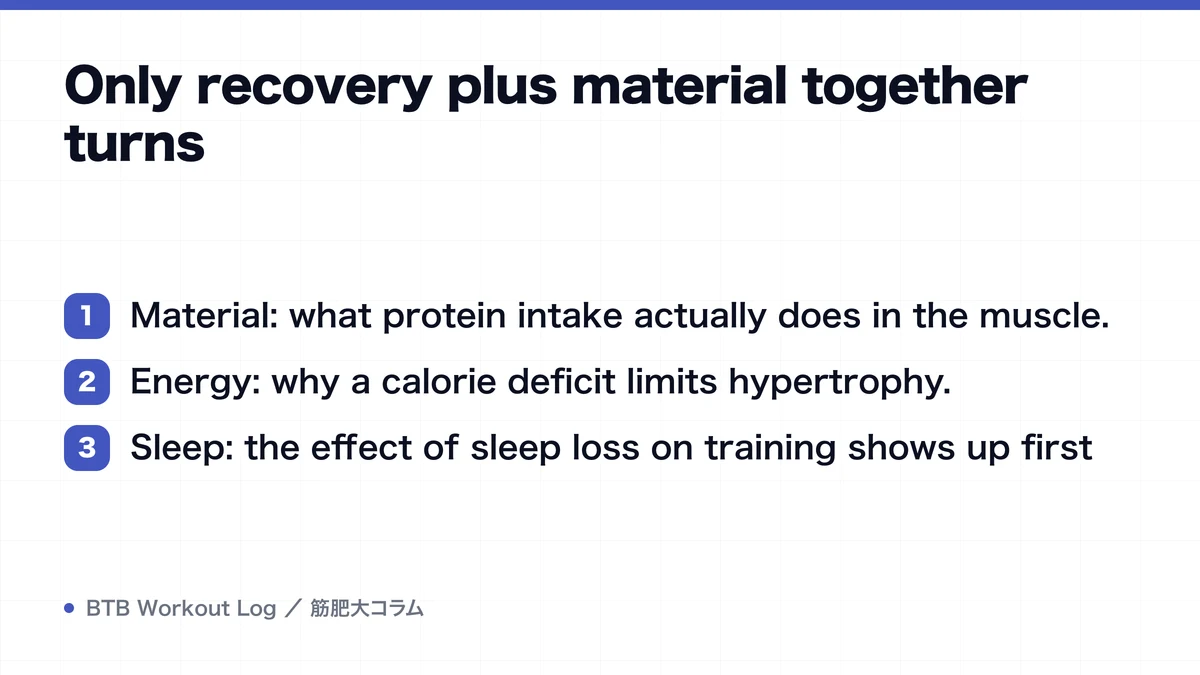
Stimulus is only the trigger — muscle actually growing happens during the recovery phase. There are mainly three constraints here.
- Material: what protein intake actually does in the muscle. A single synthesis response and a long-term change in muscle mass are different things.
- Energy: why a calorie deficit limits hypertrophy.
- Sleep: the effect of sleep loss on training shows up first as that day's performance decline.
If one of them is badly lacking, progress can be hard to come by no matter how much stimulus you add. When progress stalls, the instinct is to add sets first, but in terms of order, this comes first. Adding sets raises the recovery burden too — pile on volume while the recovery side stays thin and things can actually get worse.
The way to tell them apart is fairly simple: if body weight hasn't moved at all for several weeks, suspect energy; if sleep is chronically under 6 hours, suspect recovery; if neither is a problem but the numbers still aren't moving, suspect stimulus — check them in that order.
What's happening on a longer timescale
Over a period of months, a different dynamic takes over. Rising strength lets you handle more weight, raising total load even at the same reps, while progress slows the longer your training history gets. This slowdown isn't failure — it's the normal end of the rapid novice-phase growth.
The process where progress stops entirely is a plateau. A plateau doesn't arrive suddenly — it appears as the result of stimulus, fatigue, recovery or nutrition drifting slightly out of place, one at a time. That's exactly why reading the signs from your log matters — keeping a trend of your numbers lets you later pinpoint at which stage things drifted.
FAQ
- Is soreness a good indicator of hypertrophy?
- No. Muscle damage isn't considered a required condition for hypertrophy, and soreness intensity is also affected by familiarity, exercise choice, and range of motion. If you want an indicator, watch whether load and reps are progressing over several weeks.
- What actually changes once you understand the mechanism?
- It decides the order of moves to try when progress stalls. Whether stimulus is insufficient, fatigue hasn't cleared, or material is lacking calls for opposite fixes, so it cuts down on random changes made by guesswork.
- Is a pump a sign hypertrophy is happening?
- A pump is a temporary blood-flow and metabolic response — it doesn't represent that session's total stimulus. Even with a weak pump, stimulus is still landing if you completed sufficient volume of sets close to the limit.
Key takeaways
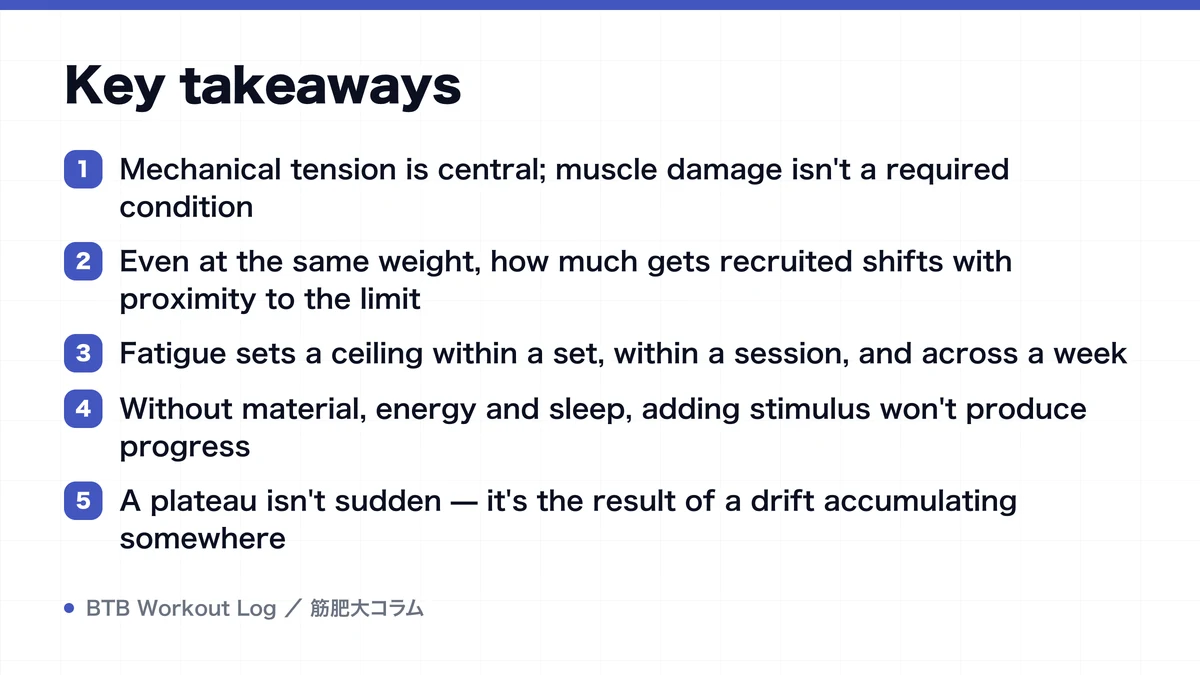
- Mechanical tension is central; muscle damage isn't a required condition
- Even at the same weight, how much gets recruited shifts with proximity to the limit
- Fatigue sets a ceiling within a set, within a session, and across a week
- Without material, energy and sleep, adding stimulus won't produce progress
- A plateau isn't sudden — it's the result of a drift accumulating somewhere
References
- The Mechanisms of Muscle Hypertrophy and Their Application to Resistance Training
- Mechanisms of Muscle Hypertrophy: Current Understanding and Future Directions
- Mixed Muscle Protein Synthesis and Breakdown After Resistance Exercise in Humans
- Muscle Protein Synthetic Response to Resistance Exercise: Systematic Review and Meta-analysis