Do the 3 Mechanisms of Hypertrophy Still Hold Up? | Revisiting the Classic Schoenfeld 2010 Paper With Current Research
Conclusion: It does not fit with current understanding to consider the three elements to be equivalent "muscle hypertrophy switches." The core concept that remained was mechanical tension, and the rationale for targeting muscle damage or increasing the pump itself was weakened.
Schoenfeld 2010 remains relevant. However, the value does not lie in simply adhering to the hypotheses as of 2010, but in following what has been updated in subsequent research.
Paper details
| Original title | The Mechanisms of Muscle Hypertrophy and Their Application to Resistance Training |
|---|---|
| Authors | Brad J. Schoenfeld |
| Journal | Journal of Strength and Conditioning Research, 24(10), 2857-2872 |
| Year | 2010 |
| Study design | Narrative review |
| Participants / scale | Current literature including human, animal, and cell research |
| Comparison / methods | Organizing the mechanisms of action and training applications related to muscle hypertrophy |
| Main outcomes | Relationship between mechanical tension, muscle damage, metabolic stress, and anabolic signals |
| DOI | 10.1519/JSC.0b013e3181e840f3 |
What did Schoenfeld 2010 propose?
This paper answersThis review is organized into three categories: mechanical tension, muscle damage, and metabolic stress. Different frequency bands, stretching contractions, short rests, and pumps were discussed as stimuli that can lead to intracellular signals.
It is important to note that this is not a comparative study in which participants were randomly divided into three conditions. This paper proposed a mechanism by integrating research at the time, and did not measure the contribution rate of the three elements or the optimal number of sets.
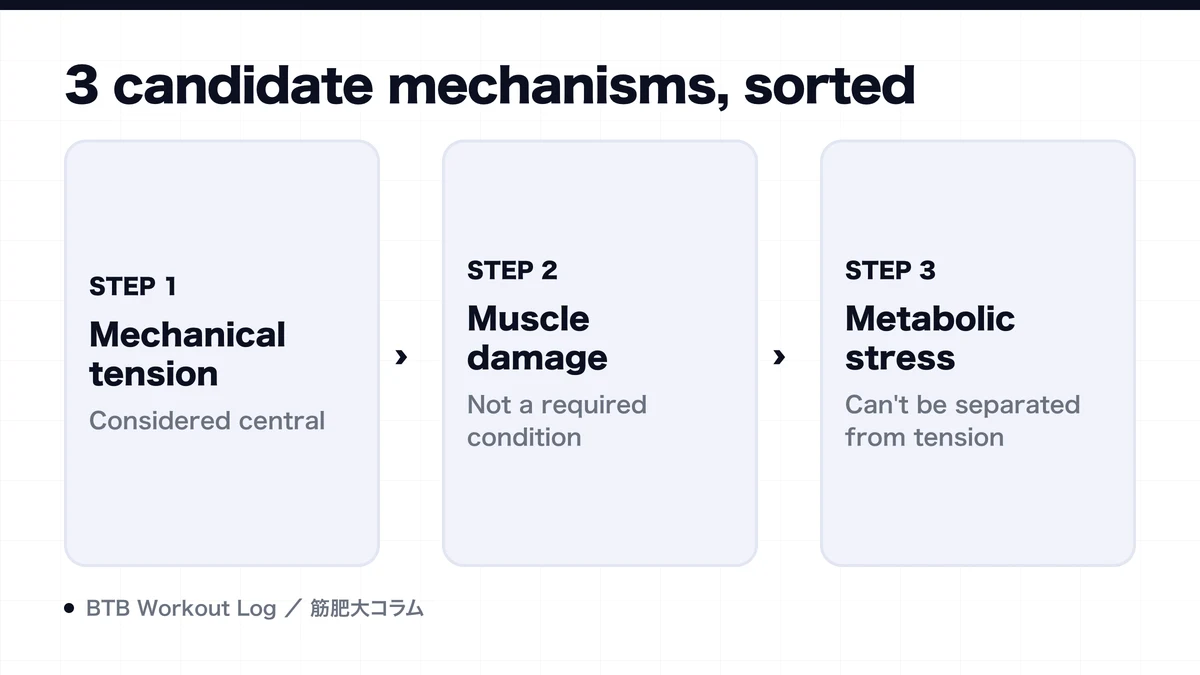
The difference between mechanical tension, muscle damage, and metabolic stress
Mechanical tensionis the tension that muscle fibers experience while exerting force. It involves good effort, stable form, range of motion, and long-term load progression.
Muscle damageincreases with unfamiliar exercise and large tensile loads, but damage repair and new muscle protein accumulation are not the same. Severe muscle soreness is not proof of stimulation and may reduce the next time's output.
Metabolic stressis a phenomenon similar to the so-called pump, which is the accumulation of metabolites associated with high reps and short rest periods. This is consistent with the fact that you can gain muscle mass with enough effort even with light weights, but it cannot be concluded that pumping itself is the cause.
What's updated in the 2025 review
The 2025 mechanistic review positionedmechanical tension as the primary stimulus for muscle hypertrophy. On the other hand, there is a lack of support for the claim that acute anabolic hormone increases, metabolic stress, and cell expansion independently increase long-term muscle hypertrophy.
This is not a story about ``high reps and short rests being meaningless''. These methods also provide enough tension to the target muscles to build up the hard sets needed. The key is not to confuse method and mechanism of action.
What this paper doesn't tell us
This review alone cannot determine the optimal number of reps, weekly sets, frequency, or rest time. Additionally, intervention studies or meta-analyses published after 2010 were not included.
Specific prescription:Comparison of low load and high load,Dose response of number of weekly sets,frequency studiesshould be combined to make a judgment.
What should be recorded in practice
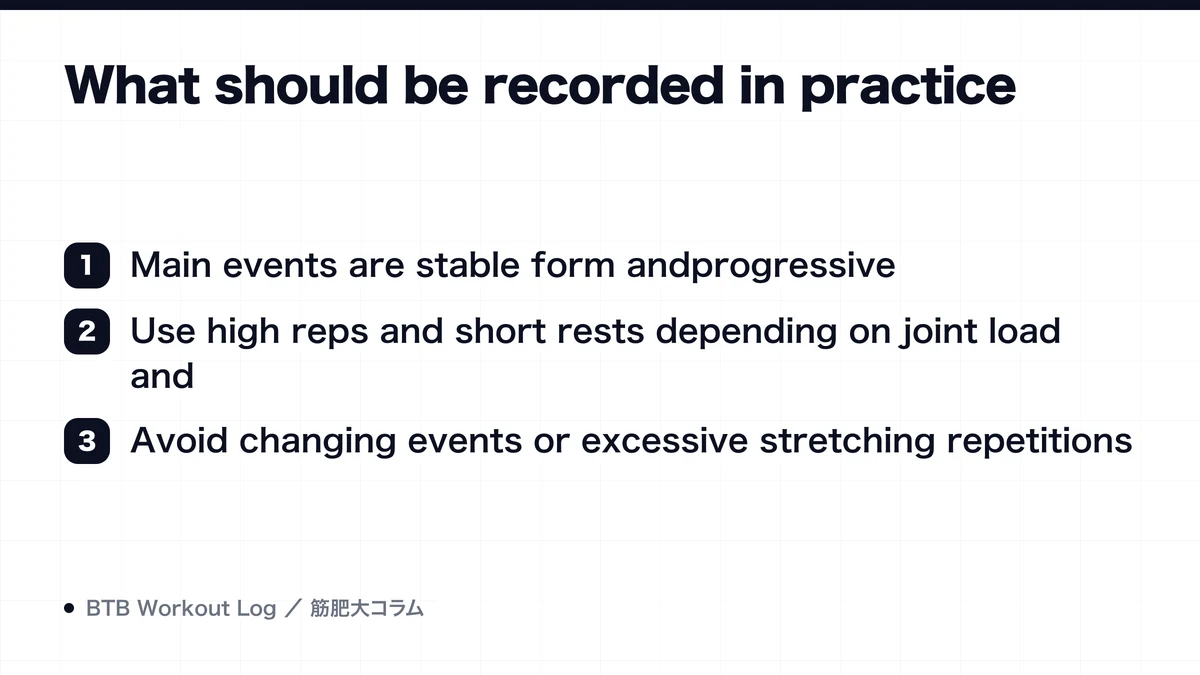
Rather than muscle soreness or pump strength, record the hard sets, weight, reps, RIR, and number of weekly sets that maintained tension in the target muscles. If you can increase reps or weight and recover with the same form, then the stimulation is working.
- Main events are stable form andprogressive overload.Prioritize
- Use high reps and short rests depending on joint load and time efficiency
- Avoid changing events or excessive stretching repetitions that increase muscle soreness
FAQ
- Wouldn't your muscles grow if you don't have muscle pain?
- Muscle pain is not necessary. Prioritize and judge whether the target muscles are being trained appropriately by increasing the weight, repetitions, and number of weekly sets.
- Are pumping high rep sets meaningless?
- It's not meaningless. Even high repetitions can stimulate muscle hypertrophy if the effort is sufficient, but pump strength itself is not a measure of growth.
- Should I maximize all 3 elements?
- No need. Practical designs focus on mechanical tension and sustainable weekly volume to avoid excessive muscle damage and fatigue.
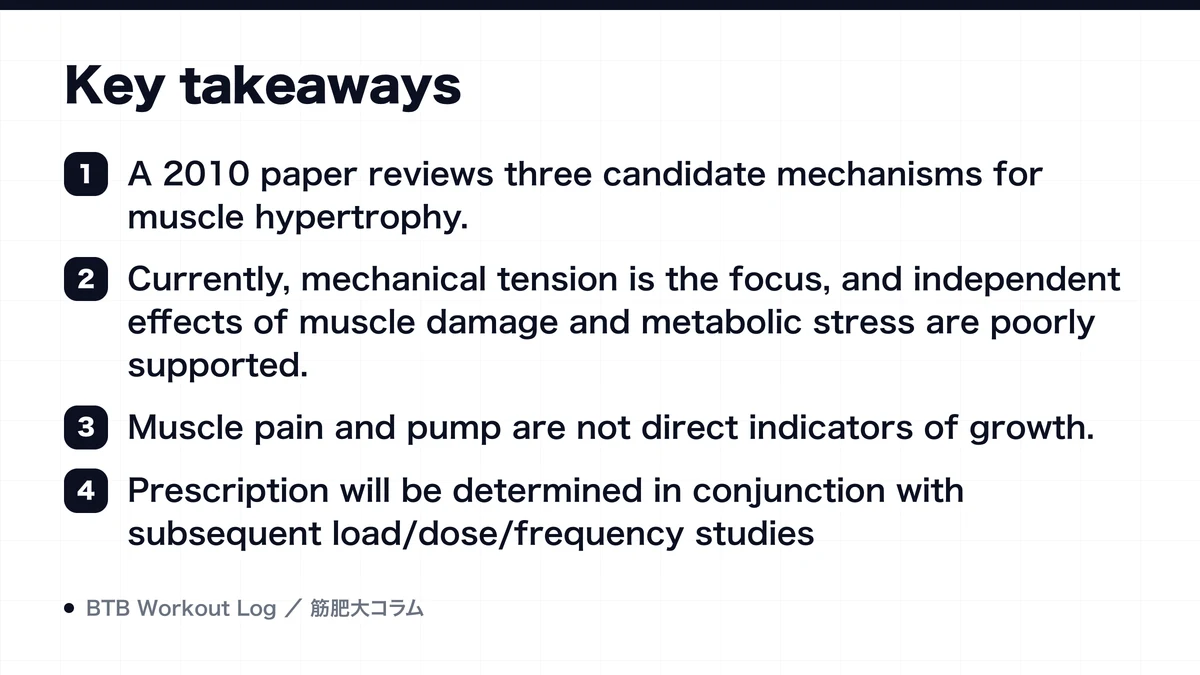
Key takeaways
- A 2010 paper reviews three candidate mechanisms for muscle hypertrophy.
- Currently, mechanical tension is the focus, and independent effects of muscle damage and metabolic stress are poorly supported.
- Muscle pain and pump are not direct indicators of growth.
- Prescription will be determined in conjunction with subsequent load/dose/frequency studies