Rep Progression: Build Muscle Without Adding Weight
Even at the same weight, if reps rise with form, range of motion, rest and RIR matched, you can conclude repeated-effort capacity has risen and you completed slightly more work than last time. Stacking these small gains and switching to a weight increase at the top of your rep range is what makes progression work for hypertrophy.
But a rep squeezed out purely by approaching the limit, and a rep banked by shortening the movement, aren't the same kind of progress. Let's break down, step by step, what an added rep actually changes.
What changes in a set when reps rise at the same weight
The first thing that changes with one added rep is the number of reps completed in that set. At the same weight, same range of motion, and comparable movement speed, the target muscle gets one more opportunity to produce force under tension. Volume load — weight times reps — rises too, but volume load itself isn't a score for hypertrophy stimulus. Padding the rep count through a shallow range of motion or momentum doesn't necessarily raise stimulus to the target muscle by the same proportion.
The other important point is that an added rep becomes an observation of raised capability. If last time was 80kg for 8 reps at RIR 2, and this time it's the same conditions for 9 reps at RIR 2, you completed one more rep while holding the same reserve before the limit. RIR measures how many more reps were possible. This comparison reads as a likely improvement in repeated-effort capacity at that weight — not just gritting it out.
Adding reps isn't a magic operation that directly grows muscle. It's a way of capturing adaptation from training and recovery as a number, while incrementally raising the work you handle in your next session. The bigger picture, including variables beyond weight, connects to how progressive overload is organized.
How an added rep leads to updated growth stimulus
Connecting "reps rose by one" directly to "muscle grew" in a single step misreads the causal chain. It's clearer thought through in this order.
- The target muscle produces force at a fixed load: repeating with stable form and range of motion applies mechanical tension to the fiber.
- Stimulus and recovery repeat: continuing the same exercise with sufficient nutrition and recovery in between, the body adapts to that demand.
- Repeated-effort capacity rises at the same effort level: you can lift the same weight more times than before while holding RIR steady.
- Completed work rises slightly: the added rep raises how many times the target muscle works under tension, even at the same set count.
- Weight gets updated at the ceiling: once you reach the top of your set rep range, you make a minimal increase, then start building reps at the new load again.
In this cycle, a rep increase is both "a result of adaptation" and "an operation that slightly raises the next stimulus." For intermediate lifters who can't add a plate every session, the practical strength here is being able to advance demand in finer increments than weight allows. Which to move first — weight or reps — is a separate decision axis, covered in comparing weight-first vs. rep-first progression.
Generally, hypertrophy can occur across a wide range of loads from light to heavy, which is compatible with adjusting load by extending reps. That said, the lighter the load, the more reps it tends to take to reach effective stimulus, and breathlessness or local burn can become the limiter first. Rather than extending reps without limit, advance within whatever range fits the exercise.
Calling a rep increase progress requires matching RIR and movement conditions
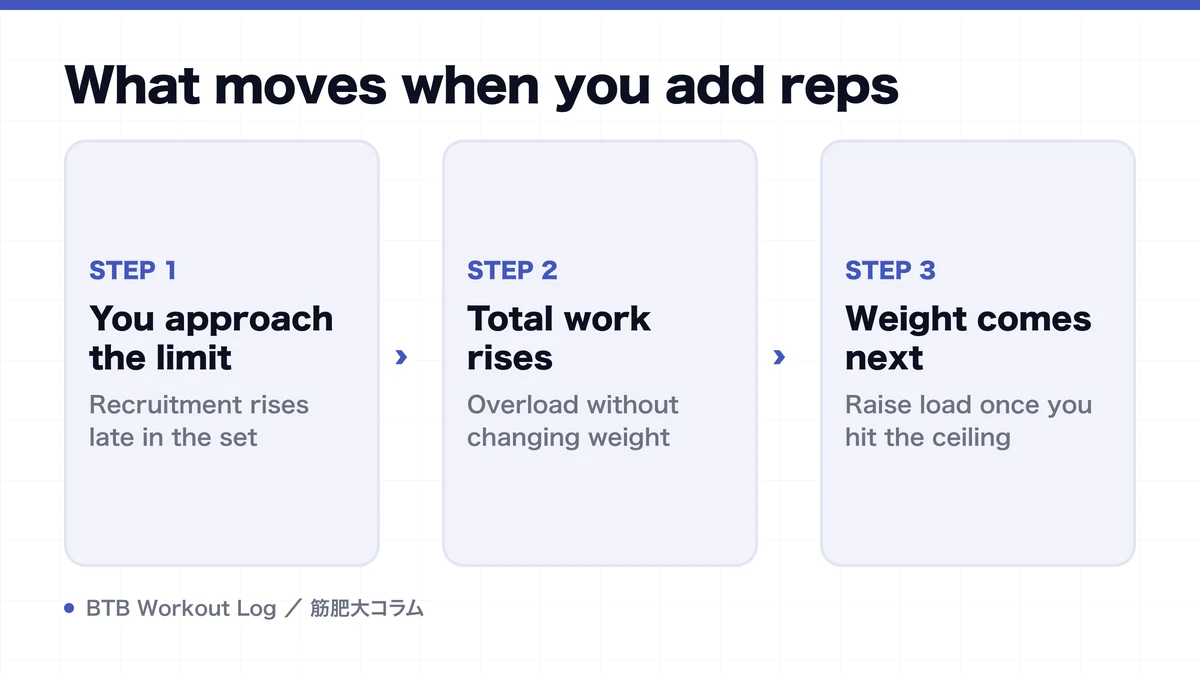
What most easily muddies a rep comparison is effort level. If last time's 80kg × 8 reps was RIR 3, and this time's 80kg × 9 reps is RIR 0, you can't separate whether capability rose or you simply pushed closer to the limit. Conversely, if both are RIR 2, the comparison reads as "one more rep at the same reserve." See the RIR guide for how to use RIR.
| Record change | How to read it | Next decision |
|---|---|---|
| 8 reps RIR 2 → 9 reps RIR 2 | Possible progress in repeated-effort capacity | Continue under the same conditions |
| 8 reps RIR 3 → 9 reps RIR 0 | Mixed in with raised effort level | Match RIR next time |
| 8 reps full range → 9 reps shallow | The rep condition has changed | Revert to your baseline range of motion |
| 2-min rest → 4-min rest, +1 rep | A recovery-condition change is a factor | Re-compare at the same rest |
Condition, sleep, exercise order, and equipment differences can also shift reps by 1–2 on their own. So don't conclude hypertrophy is progressing from a single personal best — watch the trend across several sessions under matched conditions. A forced rep right before form breaks down is less useful data for next time's comparison than a reproducible rep banked cleanly.
Converting reps into a weight update via double progression
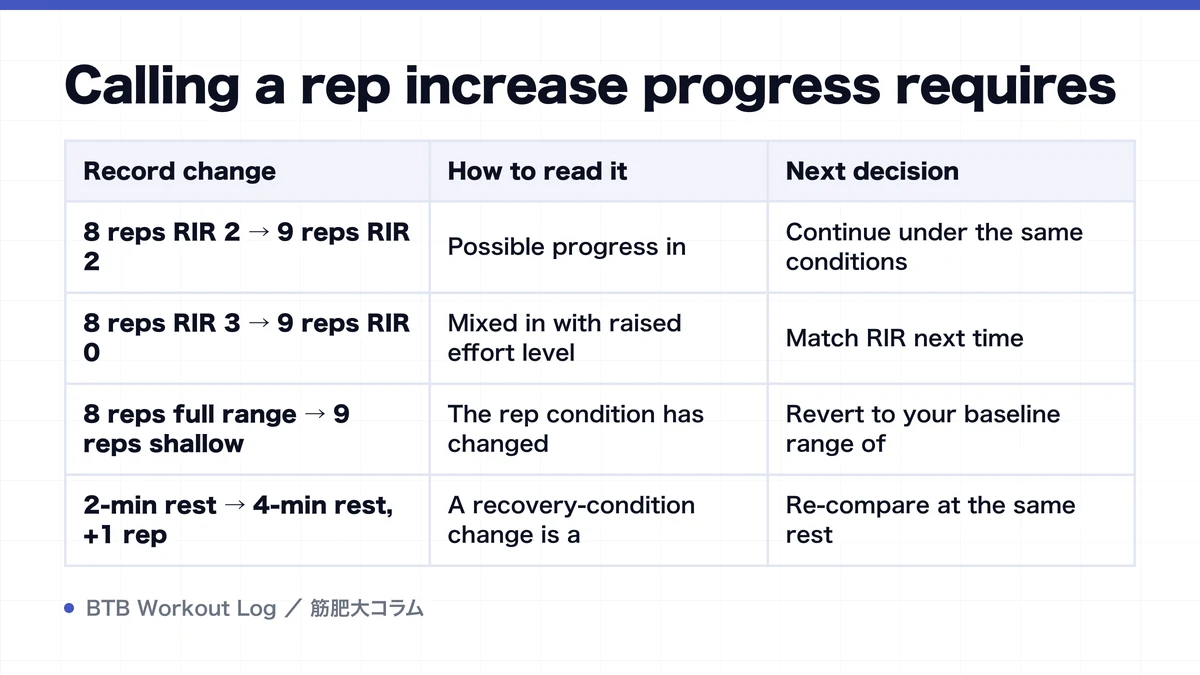
Double progression is the method that most easily turns a rep increase into a long-term load update. Set a rep range first, hold weight fixed while building reps within it, and raise weight once you meet the standard. See deciding load from rep count too, for the relationship between load setup and rep range.
Example: progressing at 8–12 reps, 3 sets
| Stage | Example record | Decision |
|---|---|---|
| Start | 70kg for 10, 9, 8 reps | Hold weight, build total reps |
| In progress | 70kg for 11, 10, 9 reps | Continue as progress if RIR matches |
| Reached ceiling | 70kg for 12, 12, 12 reps | Candidate for a weight increase if target RIR held |
| After increase | 72.5kg for 9, 8, 8 reps | Within range — build reps again |
Raising weight only once every set hits the ceiling is a conservative approach, and works well for dumbbell exercises with large weight increments. Alternatively, you could raise weight once just the first set hits the ceiling, or use the combined 3-set total as your standard. Whichever you choose, what matters is not switching the standard mid-stream — keeping the same rule for comparison.
Also, if the first set gains one rep but later sets lose a combined 3, it's hard to say total work for the session actually rose. Lining up per-set reps, total reps, and RIR lets you distinguish whether you just gritted out the early set or genuinely raised overall repeated-effort capacity. The limits of weight × reps × sets are covered in training volume.
Situations where fixing conditions matters more than adding reps
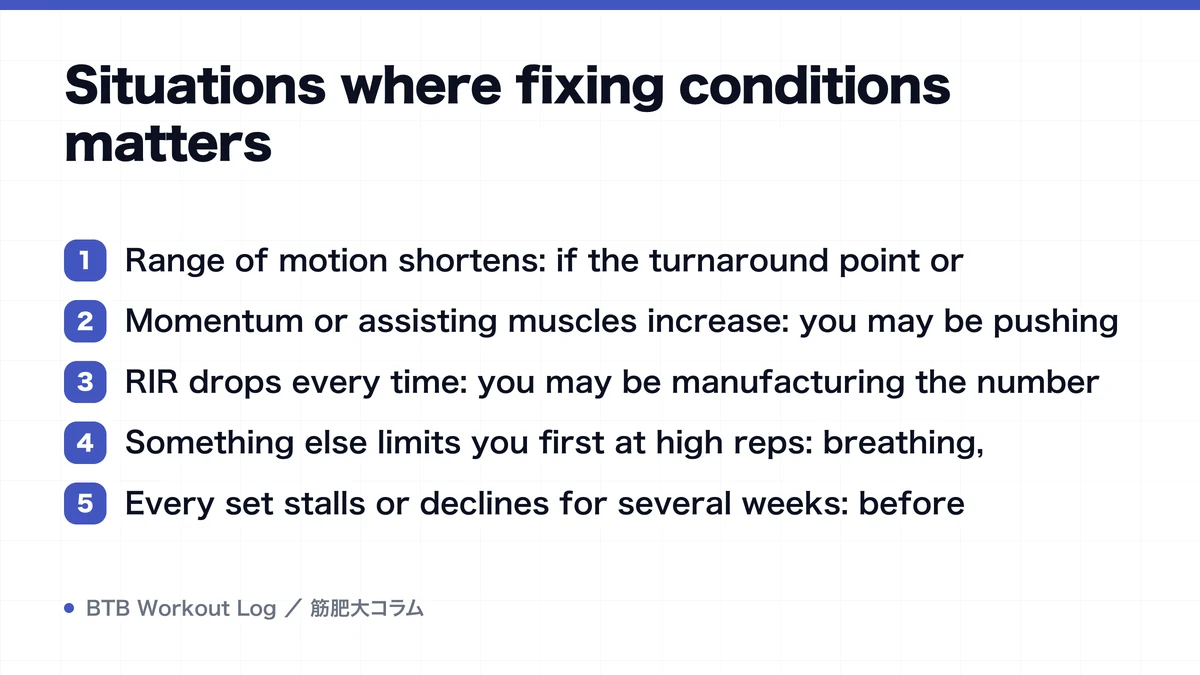
Forcing "one more than last time" every session eventually breaks the comparison conditions themselves. The following changes need fixing before you chase more reps.
- Range of motion shortens: if the turnaround point or endpoint changes, it's hard to compare as the same rep.
- Momentum or assisting muscles increase: you may be pushing the count through movement tricks rather than the target muscle.
- RIR drops every time: you may be manufacturing the number through added fatigue rather than genuine capability gain.
- Something else limits you first at high reps: breathing, grip, or holding posture ends the set before the target muscle does.
- Every set stalls or declines for several weeks: before forcing more reps, check sleep, nutrition, weekly set count and exercise placement.
Conversely, adding reps is especially useful on exercises where the smallest weight increment is too large. If bumping a dumbbell up a notch means a large jump in load for both hands, building room toward the top of your rep range at the current weight first makes it easier to stay within range even after the increase.
The decision is simple: hold weight while reps rise under matched conditions and comparable RIR; once you hit the ceiling, raise weight by the smallest available increment. If reps have stalled and RIR or later sets are also worsening at the same time, check recovery and your current volume before adding more sets.
Log weight, reps and RIR together to make the call
To use reps as your progression, log not just weight and reps but each set's RIR, rest time, and any change in range of motion or form, in the same record. What to check isn't just "did I gain a rep today" — it's whether total reps under matched conditions are trending up over several weeks, and whether you can hold your set range even after a weight increase at the ceiling.
The log itself isn't the stimulus that produces growth, but it's material for choosing your next move — build reps, raise weight, or review volume and recovery — based on comparison with last time. Progressing by reps can't work without knowing your last session's rep count. BTB Workout Log is built for exactly this — watching your last value while aiming for one more.
FAQ
- Does gaining one rep at the same weight prove hypertrophy happened?
- A single rep increase alone doesn't prove hypertrophy. Reps can shift with condition, rest, or RIR too. If reps keep rising across several sessions at the same form, range of motion, rest and RIR, you can treat it as progress suggesting raised repeated-effort capacity.
- How many reps should I build to before raising weight?
- Set a rep range per exercise ahead of time, and treat hitting the top of that range at your target RIR as the candidate point to raise weight. Whether your rule is every set reaching the ceiling, or a combined-total standard, don't switch it mid-stream, and choose an increment that won't drop you below the range's floor.
- Reps rose overall, but later sets dropped. Is that progress?
- If only the first set gained reps while later sets dropped substantially, it's not necessarily an overall capability gain. Compare per-set reps, total reps, and RIR against last time, and check whether you overdid the early set. If the total trends up consistently, it's easier to read as genuine progress.
Key takeaways
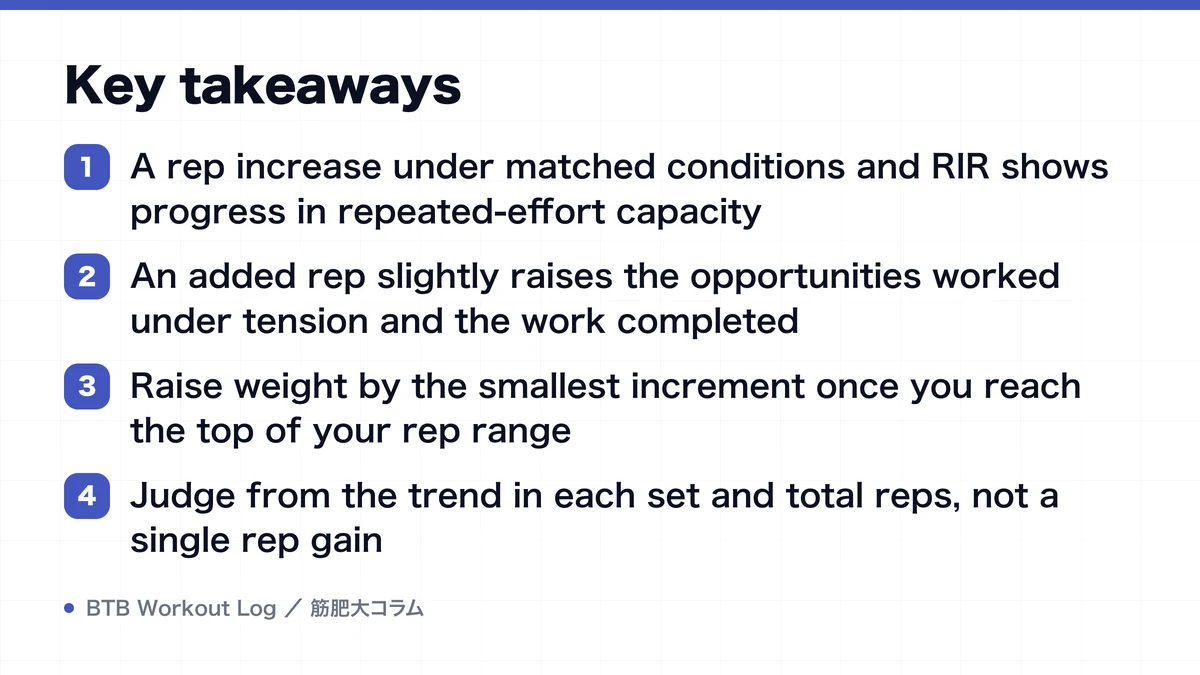
- A rep increase under matched conditions and RIR shows progress in repeated-effort capacity
- An added rep slightly raises the opportunities worked under tension and the work completed
- Raise weight by the smallest increment once you reach the top of your rep range
- Judge from the trend in each set and total reps, not a single rep gain
References
- ACSM Position Stand: Progression Models in Resistance Training for Healthy Adults
- Low- vs High-load Resistance Training for Strength and Hypertrophy: Meta-analysis
- Proximity-to-Failure and Muscle Hypertrophy: Systematic Review with Meta-analysis
- Mechanisms of Muscle Hypertrophy: Current Understanding and Future Directions