
Hypertrophy and Training Volume: When Do More Sets Stop Helping?
Adding sets increases the opportunities your muscle takes on high tension, and on average you can expect some added hypertrophy. But the effect of each added set isn't constant — the benefit shrinks as volume rises, and eventually fatigue outweighs it.
What decides growth isn't just "how many sets you did." What turns volume into hypertrophy is whether you keep the added sets' quality intact and can still repeat equal or greater work after recovering.
What actually rises when you add one set
What adding a set directly increases isn't muscle mass — it's the opportunity for the target muscle to receive training stimulus. Perform it with sufficient range of motion and stable form, without leaving too much RIR — how many more reps were possible before the limit — and the fiber gets exposed to high mechanical tension. Add a set of matched conditions to the week, and you've added one such opportunity.
But set count isn't a unit that fully represents stimulus. Count a warm-up, a preparatory set with a lot of RIR left, or a set where load leaked away from the target muscle as an equal set, and only the number goes up. Conversely, taking the first set to the limit and tanking later-set reps changes the content of each set even at the same set count. What to prioritize increasing isn't raw total sets — it's hard sets that place sufficient load on the target muscle. Why the same 10 weekly sets can produce different results comes down to this content of stimulus.
How added stimulus leads to hypertrophy
The path to hypertrophy isn't a single step — "you added a set, so muscle grew." In reality, this causal chain follows.
- You perform the added set: time under tension and repeated opportunities for the target muscle both increase.
- An intracellular response occurs: the mechanical stimulus converts into signals involved in remodeling, including muscle protein synthesis and breakdown.
- Remodeling proceeds during recovery: with sufficient energy, protein and sleep, repair and adaptation after the stimulus can proceed.
- This repeats over weeks to months: as recoverable stimulus accumulates, the change in fiber cross-sectional area becomes large enough to measure.
So a single burst of added sets producing intense fatigue isn't the same thing as long-term hypertrophy. Only once you maintain weight, reps and movement conditions after the addition, and can reproduce the stimulus the following week too, does the added opportunity accumulate into long-term adaptation. This layers a volume-manipulation question on top of the basic path from training stimulus to hypertrophy.
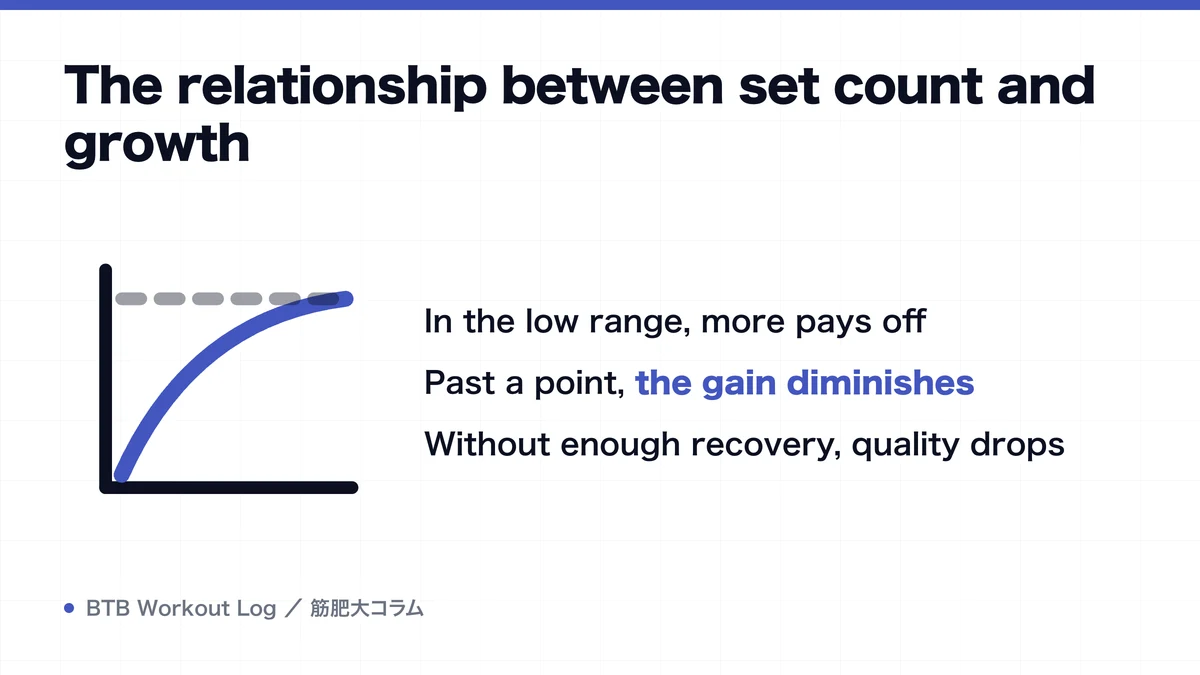
Why the added benefit shrinks the more sets you add
A dose-response relationship is seen, on average, between weekly volume and hypertrophy. For someone already doing too little, adding sets fills a stimulus-opportunity deficit and tends to translate into a growth difference. For someone already doing sufficient volume, the benefit from each addition shrinks progressively. This isn't a linear relationship where going from 10 to 20 sets doubles the effect.
Part of the reason is that earlier sets have already delivered high tension to many fibers. Stimulus remains in later sets too, but the more you repeat work on the same muscle group, the more local fatigue accumulates, making it easier for achievable reps or load to drop. Added sets aren't worthless — but the increment in stimulus you gain per unit of time and recovery resource spent shrinks.
Research showing "the high-volume group grew more on average" doesn't mean everyone needs the same additional volume. Starting set count, training history, exercise, RIR, diet and sleep all differ, and the slope of the dose-response relationship shifts with them. Comparing 10 vs. 20 weekly sets isn't about picking one fixed correct answer — it's about figuring out whether you're positioned to actually benefit from the addition.
When added sets turn into an amount that hinders growth
Adding sets raises fatigue along with stimulus. Within a session, depleted energy substrates and local fatigue lower reps and make compensation more likely. Between sessions, muscle and connective tissue recovery may not keep pace, lowering the load or reps you can produce next time on the same exercise.
What matters here isn't the intensity of fatigue itself — it's whether that fatigue reduced the stimulus you needed next. If adding two chest sets lowers not just the rest of that day but your pressing performance days later too, the high-quality reps you bank across the week could actually decrease. And if joint discomfort or disrupted sleep hurts consistency, the long-term loss can outweigh the short-term addition.
The recoverable ceiling isn't a fixed number. Even for the same person, it can drop during a cut, a poor-sleep week, or a high-stress work period, and rise during a stretch with stable diet and rest. Rather than drawing a line at "up to X weekly sets", it's better to track performance and recovery after each addition. See the mechanics of when set count backfires for how to identify overdoing it in more detail.
Even the same weekly set count can differ in stimulus quality by how it's placed
When raising weekly set count, you don't need to add it all to the same day. If output drops substantially in the back half of one session, splitting the addition across a separate day makes it easier to hold each set's load, reps and form. The main benefit of increasing frequency isn't automatically raising weekly volume itself — it's making it easier to place your needed volume in a high-quality state.
Say you do 10 chest sets on Monday and reps crash in the last 4. One option is splitting it to 6 sets Monday, 4 sets Thursday. Weekly total stays at 10, but you perform Thursday's 4 sets while recovered, making it easier to preserve tension to the target muscle. Conversely, if splitting into twice a week means pushing to the limit both times and doubling total weekly volume too, the frequency change and the volume increase get mixed together and you can't judge the effect of either.
If you want to raise volume, change only set count by a small amount and hold everything else — exercise, RIR, rest, frequency — as fixed as possible. If you want to improve placement only, spread it out while holding weekly sets constant. This separation is the practical basis for the relationship between frequency and weekly set count.
The decision procedure for turning added sets into growth
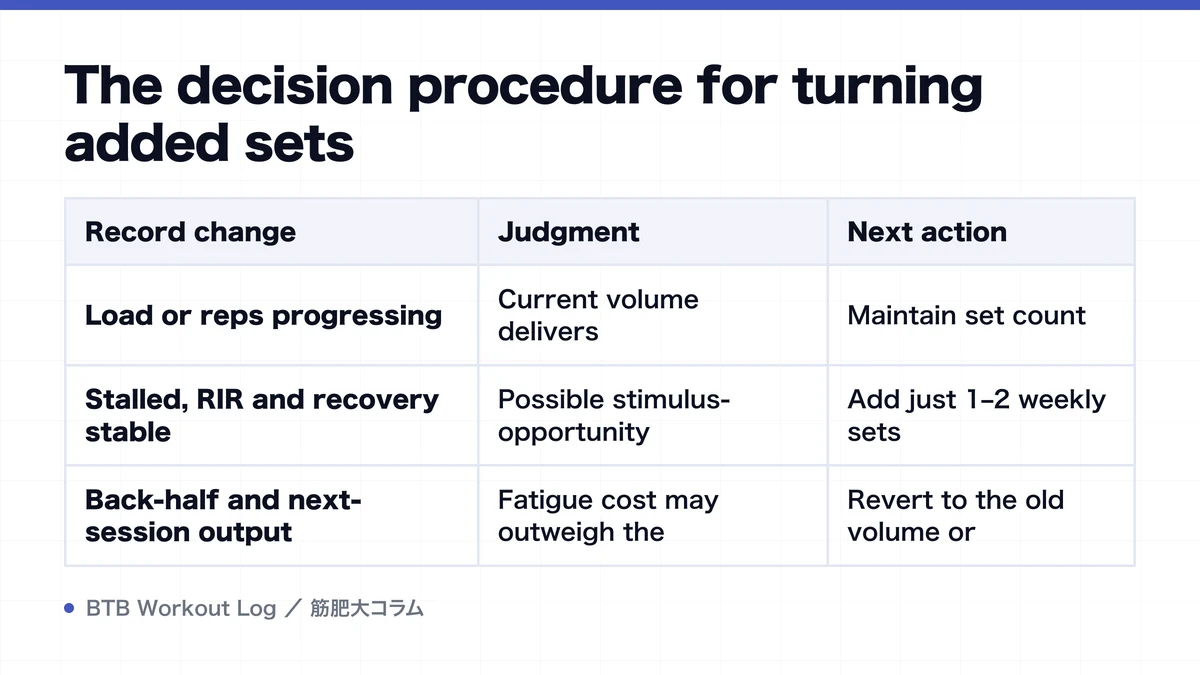
If load or reps are progressing at your current volume, there's little reason to rush and add sets. Once progress has stalled for several weeks, first check each set's RIR, range of motion, rest, form, diet and sleep. If those are stable and there's no joint issue or carried-over fatigue, there's room to add just 1–2 weekly sets to the target muscle.
| Record change | Judgment | Next action |
|---|---|---|
| Load or reps progressing | Current volume delivers sufficient stimulus | Maintain set count |
| Stalled, RIR and recovery stable | Possible stimulus-opportunity deficit | Add just 1–2 weekly sets |
| Back-half and next-session output decline after adding | Fatigue cost may outweigh the benefit | Revert to the old volume or spread it out |
After a change, watch the same exercise's load, reps and RIR alongside weekly sets per muscle group. Rather than deciding from a single good or bad session, comparing before and after over several weeks makes it easier to tell whether the added volume worked, or it was just day-to-day variance. Whether the added set worked is judged from how load and reps move afterward. BTB Workout Log lets you line up before and after a change.
FAQ
- Does hypertrophy speed up that same week if I add sets?
- What rises immediately after an addition is stimulus opportunity, not muscle mass proportional to that week. Only after you maintain each set's quality and recovery afterward, and repeat the stimulus over weeks to months, does a hypertrophy difference show up.
- At what set count should I start adding more?
- There's no starting value shared by everyone. Maintain your current volume if load or reps are progressing; if you've stalled but confirmed RIR, rest, diet and sleep aren't the problem, adding just 1–2 weekly sets to the target muscle is an easier decision to make.
- Does an added set still count if reps drop on it?
- A modest drop alone doesn't make it invalid, but if range of motion or form breaks down enough that load leaks away from the target, quality has dropped. If back-half crashes or decline persisting until next time continues, split the addition to a separate day or revert to your old volume.
Key takeaways
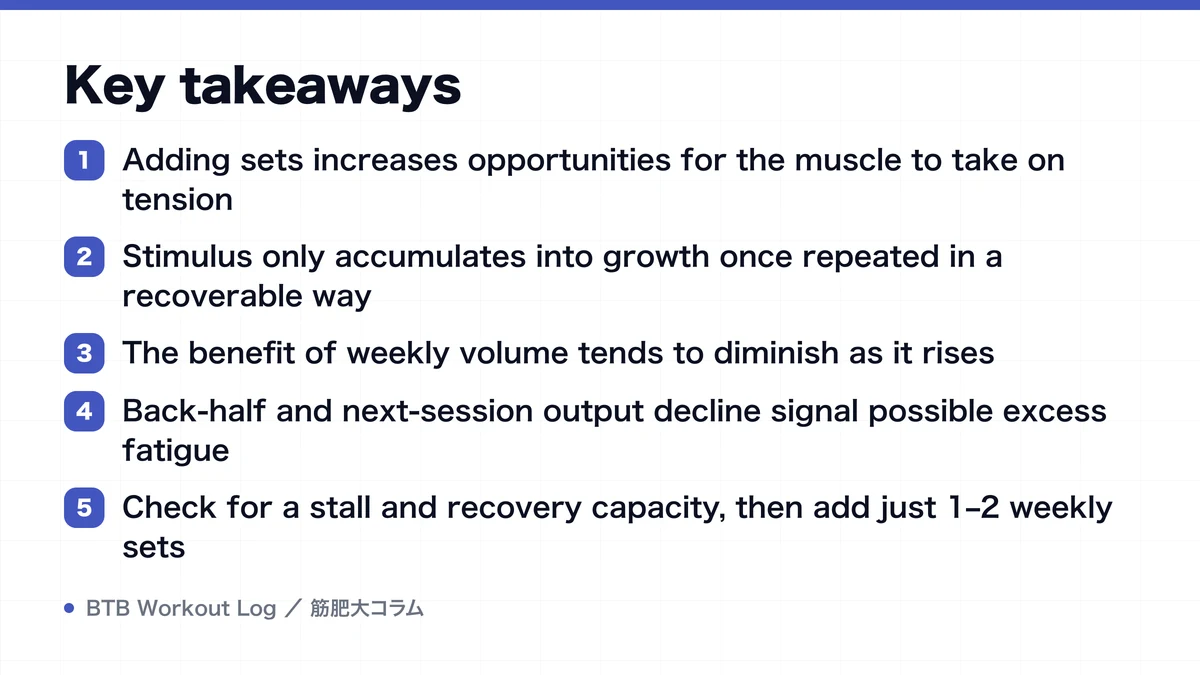
- Adding sets increases opportunities for the muscle to take on tension
- Stimulus only accumulates into growth once repeated in a recoverable way
- The benefit of weekly volume tends to diminish as it rises
- Back-half and next-session output decline signal possible excess fatigue
- Check for a stall and recovery capacity, then add just 1–2 weekly sets
References
- The Resistance Training Dose Response: Meta-Regressions Exploring the Effects of Weekly Volume and Frequency on Muscle Hypertrophy and Strength Gains
- Dose-response Relationship Between Weekly Resistance Training Volume and Muscle Mass
- Resistance Training Volume Enhances Muscle Hypertrophy in Trained Men
- Mechanisms of Muscle Hypertrophy: Current Understanding and Future Directions
- The Mechanisms of Muscle Hypertrophy and Their Application to Resistance Training